

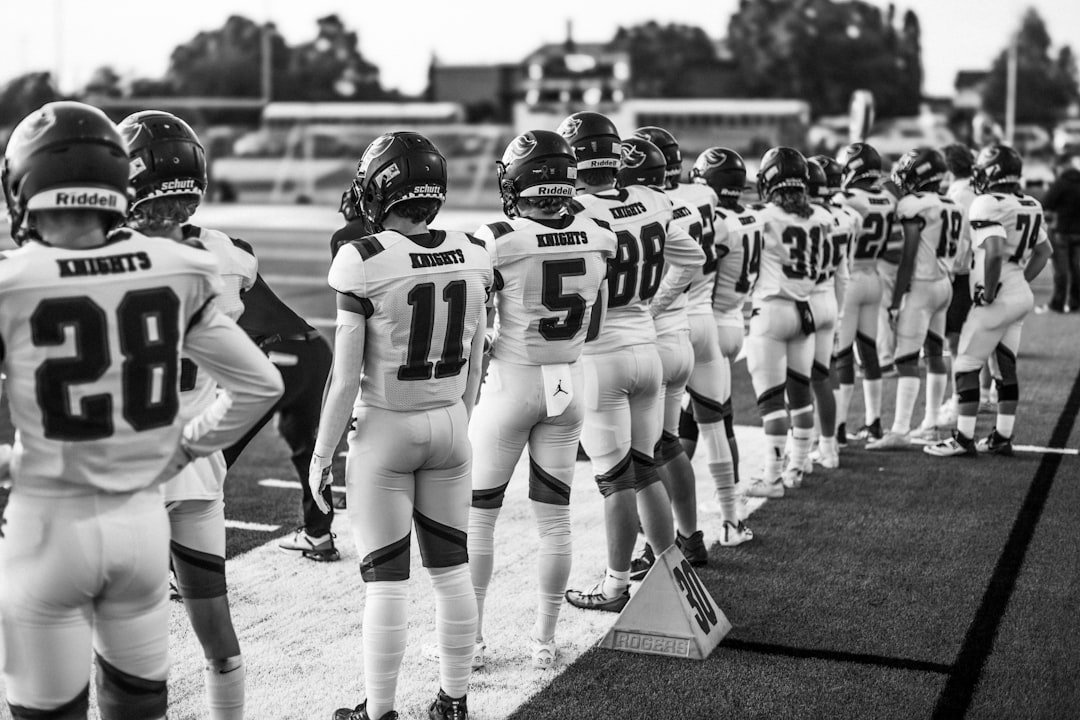


There's a specific kind of ache that shows up every fall.
It's not the weather — though people say that. It's not age, either, though people say that too. It's something older and more specific. It's the knee you taped before every game junior year. The shoulder you rotated wrong on a bad tackle and never quite rested long enough. The stress fracture in your foot that the trainer called a "bone bruise" and sent you back out on.
High school sports injuries that last aren't a mystery. They follow a predictable pattern: specific tissues damaged at specific developmental moments, never fully rehabilitated, quietly compounding across decades. And every fall, when the Friday night lights come back on and the homecoming banners go up, a lot of former athletes feel them again with unusual clarity. Each one is a marker on the map of aches and pains your old injuries left behind.
This isn't nostalgia. It's biomechanics.
Here's what the research actually shows, which injuries are most likely to follow you, and (more importantly) what you can do about them now.
The Developmental Window Nobody Talks About
High school athletes are not small adults. Between the ages of 14 and 18, the musculoskeletal system is in an active growth phase: bones are elongating, growth plates haven't fully closed, and connective tissue is still catching up to the rapid changes in muscle mass and body weight that puberty drives.
This matters for injuries in a specific way: tissue damaged during this developmental window heals differently than tissue damaged at 25 or 35. Growth plate injuries can alter bone structure permanently. Ligament tears in adolescents involve tissue that is still being laid down and organized. Cartilage damage at 16 creates a joint that enters adulthood already compromised.
The 2020 American Journal of Sports Medicine data on youth athlete injury outcomes is unambiguous on this point: athletes who sustain significant joint injuries before age 18 show measurably higher rates of early-onset osteoarthritis, chronic instability, and functional limitation in their 30s and 40s compared to non-injured peers.

That number deserves to sit for a moment. Not decades later. In their 30s and 40s.
The athletes who are feeling it now — the ones whose knees ache on cold mornings or whose shoulders catch on certain movements — aren't imagining things. They're experiencing the long tail of injuries that were undertreated during a window when the tissue was most vulnerable, and it's only one part of the physical changes that happen after your playing career ends — changes that many former athletes are left to figure out on their own.
The Injuries Most Likely to Follow You
Not every high school sports injury becomes a lifetime companion. Muscle strains that were properly rested and rehabilitated often resolve completely. Mild concussions, managed correctly, may leave no lasting structural damage. The injuries that tend to persist are the ones involving specific tissue types (cartilage, ligament, bone) or the ones that were played through rather than rested.
ACL Tears and the "Fixed" Knee That Isn't Fixed
ACL reconstruction has a 90-plus percent success rate for return to sport. What most athletes don't hear after surgery is the rest of the data: even successfully reconstructed ACLs leave the joint at meaningfully higher risk for early-onset osteoarthritis, and approximately 30 percent of athletes who undergo ACL reconstruction will re-tear (either the same knee or the opposite one) within two years of return to sport.
The 17-year-old who had reconstruction, did her physical therapy, and played her senior season isn't "fine." She's operating a joint that has been fundamentally altered — with a graft replacing native tissue, with subtle changes in proprioception (the knee's ability to sense its own position), and with a cartilage environment that was disturbed during injury and surgery both. By her mid-30s, that knee will often tell the story clearly.
What it looks like now: Stiffness after sitting for extended periods. Pain on stairs, especially descending. Swelling after higher-impact activities. A specific instability sensation on uneven terrain.
What actually helps: Strength training focused on the posterior chain — hamstrings, glutes, and hip stabilizers — reduces compressive load on the joint. This is one of the most evidence-supported interventions for chronic knee dysfunction. It doesn't reverse the injury, but it changes the load environment significantly.
Shoulder Impingement and Rotator Cuff Damage
Overhead athletes — swimmers, baseball pitchers, volleyball players, tennis players — develop shoulder injuries at high rates, and the rotator cuff is almost always involved. At the high school level, these often present as "impingement" (the tendon being pinched under the bony arch of the shoulder) rather than full tears, and they're frequently managed with rest and anti-inflammatories rather than structured rehabilitation.
The problem is that impingement, without proper scapular stabilization and rotator cuff strengthening, tends to become a progressive condition. The tendons that were inflamed at 16 are the tendons operating with reduced blood supply and altered mechanics at 40.
What it looks like now: A specific arc of pain, usually between 60 and 120 degrees of arm elevation, rather than constant discomfort. Difficulty sleeping on the affected shoulder. A catching sensation on certain movements.
What actually helps: Targeted rotator cuff strengthening (external rotation in particular is often undertrained) and scapular retraction work. Most adults with chronic shoulder pain from old impingement have been told to "strengthen their shoulders" without ever being shown the specific 20-degree angle of external rotation that actually changes the mechanics.
Growth Plate Injuries in the Knee and Wrist
Osgood-Schlatter disease, the tibial tubercle apophysitis that causes that distinctive bump just below the kneecap, is almost a rite of passage for adolescent athletes. Most coaches treat it as a nuisance condition that resolves when growth stops. For many athletes, it does.
For a meaningful subset, particularly those who continued training at high intensity through the acute phase, the apophysis doesn't heal cleanly. The tibial tubercle can become permanently enlarged, changing the angle of the patellar tendon and creating chronic patellar tendinopathy in adulthood. The same mechanism applies to Sever's disease in the heel.
Wrist growth plate injuries (common in gymnasts, cheerleaders, and any athlete who falls on an outstretched hand repeatedly) can create subtle malunions (bones that healed slightly misaligned) that alter wrist mechanics for life.
What it looks like now: Patellar tendon pain during or after running. A specific wrist position that produces pain on loading; push-ups and certain weightlifting movements are common triggers.
When the Injury Was the Whole Story
Marcus T., 34, played defensive back for his high school team and took pride in never missing a game. He had what the trainer called "a bad ankle sprain" during his junior season — rolled it badly on a cut, couldn't bear weight for two days, then played through the rest of the year with heavy taping.
What Marcus didn't know until an MRI at 32 was that the original injury had included a small osteochondral defect — a chip of cartilage off the talar dome — that never healed because it never stopped being loaded. He's now looking at a procedure to address chronic ankle instability and cartilage loss that has been slowly progressing for 16 years.
His story isn't unusual. The athletes most likely to carry injuries into adulthood are the ones who were celebrated for toughness, for playing through, for not coming out, for getting back on the field fastest. That culture is worth naming honestly, and so is the harder question underneath it: what pushing through real injuries taught you about your own limits when the scoreboard no longer sets the standard for what you tolerate.
Stress Fractures: The Injury That Gets Misnamed
Stress fractures in adolescent athletes are frequently undertreated because they're frequently misdiagnosed. A stress fracture in the tibia or metatarsal can look like shin splints on initial presentation: same location, similar pain pattern, often no obvious swelling. X-rays frequently miss early stress fractures entirely; MRI is needed for definitive diagnosis.
When a stress fracture is called "shin splints" or "bone bruise" and the athlete continues training, two things happen: the fracture may not heal in proper alignment, and the bone's response to load is altered in ways that increase fracture risk at the same site going forward.
Lumbar stress fractures (spondylolysis) are particularly common in athletes who perform repetitive hyperextension: gymnasts, offensive linemen, divers, cheerleaders. Spondylolysis that isn't properly identified and rested during adolescence has a high rate of progression to spondylolisthesis (vertebral slippage) in adulthood, with chronic low back pain as the predictable result.
What it looks like now: Low back pain that is worse with extension and rotation, better with rest and flexion. A specific spot — often around L4-L5 — that is tender to direct pressure.
What actually helps: Core stabilization work targeting the deep stabilizers (transverse abdominis, multifidus) rather than the superficial flexors. This is mechanically different from "doing crunches," which is what most people think of as "core work" and which does not address the stabilization deficit.
Concussions: The Injury Without a Scar
Concussion research has advanced significantly in the past decade, and the emerging picture is not reassuring for athletes who sustained multiple head impacts during their playing years, particularly those who played contact sports and either weren't diagnosed or returned to play before full symptom resolution.
The concern is cumulative exposure. A single properly managed concussion may resolve without lasting structural consequence. Multiple concussions, or concussions with premature return to contact, create an environment of cumulative neurological stress that can manifest decades later in cognitive and mood symptoms that are difficult to trace back to their origin.
This is among the most important high school sports injuries that last, precisely because there's no visible damage (no scar, no limp, no MRI finding in mild cases) and because the connection between high school football or soccer or hockey and mid-life neurological symptoms is not one most people make spontaneously.
The Pattern That Connects Them
Looking across these injury types, a pattern emerges:
- Tissue that was damaged during the developmental window (growth plates, adolescent cartilage) had less capacity to heal completely than adult tissue
- Injuries that were played through rather than properly rested were prevented from completing the healing response
- Rehabilitation that stopped at "return to sport" rather than continuing to full tissue and neuromuscular recovery left the joint or structure operating below its pre-injury baseline
This isn't an indictment of high school athletic medicine, which has improved substantially. It's a description of the incentive structure that existed, and often still exists, in competitive adolescent sports: the pressure to return, the culture of toughness, the finite window of the season.
Understanding the pattern is the first step toward doing something useful about it now. Part of that pattern is cultural: the habit of pushing your body the way you did at seventeen doesn't switch off when the season ends, and it keeps loading tissue that never finished healing.
What You Can Do About It Now
The injuries are old. The decisions that undertreated them were made 15 or 20 years ago. What's actionable now?
Get an accurate current picture. Many adults with chronic pain from old high school injuries have never had a proper imaging workup as adults. The MRI you didn't get at 17 is available now. Knowing exactly what the structural picture looks like — what cartilage is compromised, whether a stress fracture healed correctly, what the shoulder's current tendon status is — allows targeted rather than generic intervention.
Strength training is the primary intervention for most joint injuries. Not stretching. Not rest. Specifically, progressive resistance training that addresses the muscle groups responsible for protecting the compromised joint. This is not the same as general fitness; it's about moving differently as your body changes after 30, which requires knowing which specific muscles to prioritize based on which structure was injured.
Pain is information, not an obstacle. Adults with old sports injuries sometimes develop a relationship with their pain that treats it as background noise to be managed. Pain that changes — new patterns, new locations, increased intensity — is the joint communicating a change in its status. That communication deserves a clinical conversation, not an extra ibuprofen.
The anniversary effect is real. Fall is when many former athletes feel old injuries most acutely, and not entirely because of cold weather. The return of football season, homecoming, the first cool nights: they bring a specific kind of awareness. Use that awareness purposefully. Let it be the annual prompt to check in with your body honestly rather than dismissively.
And if the goal is to keep moving, finding a rec league that fits your body now is often what makes the rest of the work stick.
Your jersey is still out there waiting.
Design yours in minutes and see your name and number exactly the way you remember it.
Frequently Asked Questions
Can high school sports injuries that last be fully reversed in adulthood?
Some can be significantly improved, particularly those involving muscular dysfunction or poor movement patterns that developed around the original injury. Cartilage damage and structural changes to bone are generally not reversible, but their functional impact can be substantially reduced through targeted strength training, activity modification, and in some cases, orthopedic intervention. "Fully reversed" is rarely the right frame; "meaningfully improved" is the more accurate and achievable goal.
How do I know if my chronic pain is from an old sports injury or something else?
Location and pattern are the primary clues. Pain that occurs at or near a site where you previously sustained an injury, that follows predictable patterns (worse after specific activities, better with rest, aggravated by the same movements that originally hurt), and that has been present in some form since your playing days is most likely connected. A sports medicine physician or orthopedic specialist who takes a full injury history is the right person to make this assessment definitively.
Is it worth getting old high school injuries looked at now, even years later?
Yes — especially if the pain is affecting daily function or you're avoiding activities you'd otherwise enjoy. The clinical picture has likely changed since the original injury, and treatment options available now are meaningfully different from what existed 15 or 20 years ago. Knowing the current structural status of a chronically symptomatic joint is almost always useful information, regardless of what you ultimately decide to do with it.
Does the type of sport affect which injuries are most likely to persist?
Significantly. Contact sports (football, wrestling, hockey) produce higher rates of joint instability, concussions, and acute ligament injuries. Overhead sports (baseball, softball, swimming, volleyball) produce higher rates of shoulder pathology. Running and jumping sports (basketball, soccer, track) produce higher rates of stress fractures and knee injuries. Gymnastics and cheerleading carry elevated risk of lumbar stress fractures and wrist injuries specifically. Knowing your sport history helps focus attention on the structures most likely to be affected.
See also: athletic identity that collapses the moment the season ends | the grief that comes with losing the body you once had | the growing gap between your athletic memory and what your body can actually do | getting back into training after years of physical setbacks