

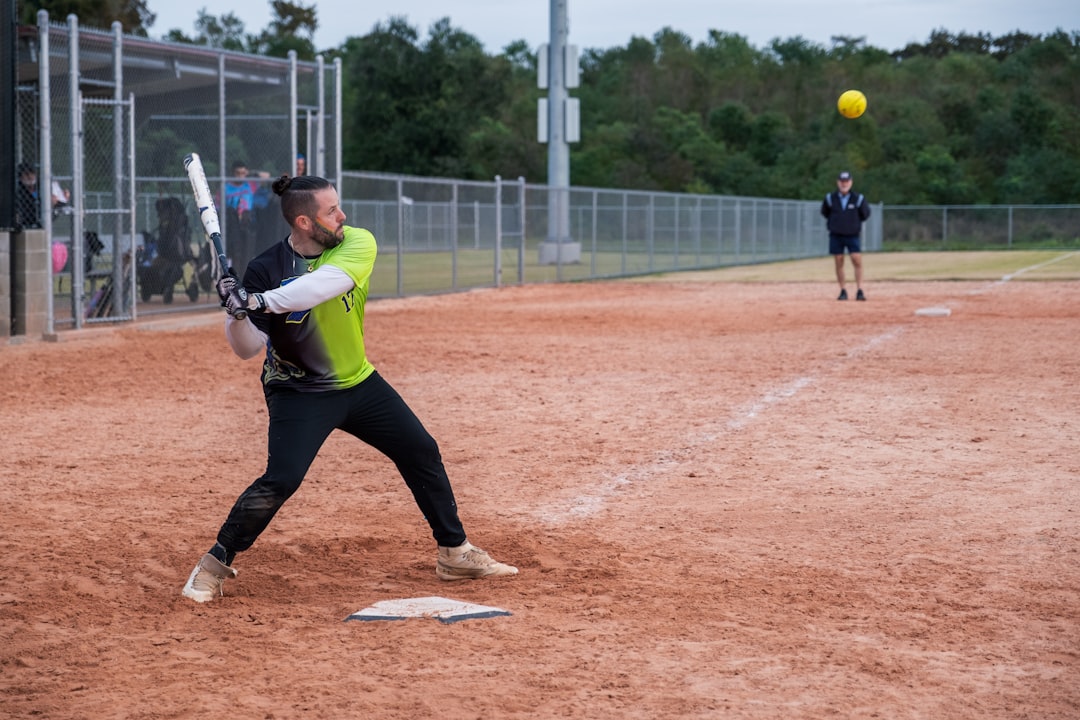




The ball comes off the bat with that familiar crack — slightly flatter than you remember, a little more thud than ping — and for exactly one second, your body does the thing it always did. Weight shifts. Eyes track. Legs move before your brain gives the order.
You're thirty-eight years old. Or forty-three. Maybe fifty-one. And none of that matters at all.
If you've ever played adult softball rec league baseball on a Thursday night under the lights at a municipal park — the kind with the chain-link dugouts and the handwritten lineup card and the cooler someone dragged from their truck — you already know what this article is about. You know the feeling of pulling on a jersey with your name on the back and realizing, with some surprise, that you still care about this. That you care about it more than you thought you would when you signed up for an adult rec league.
This is about what rec league softball actually is, underneath the funny team names and the questionable strike zone and the guy on the other team who is definitely taking this way too seriously. It's about why the sport, stripped of scholarships and scouts and coaching staffs and everything that used to surround it, turns out to be the most honest version of baseball you'll ever play. And why former competitors — people who bled for the sport at some real level — tend to find their way back to it eventually, and stay.
What Gets Removed When the Pressure Leaves
There is something clarifying about playing a sport when absolutely nothing is at stake in the conventional sense.
No coach is evaluating your mechanics. No scout is watching from behind the backstop with a radar gun. Your spot in the lineup is not conditional on your batting average. You could go 0-for-4 tonight, boot a grounder in the seventh, and still be back in that same spot next week — because your teammates need you there, and because you paid the registration fee.


Competitive sports at every level carry a particular weight. Not just the physical demands, though those are real. The weight is the constant awareness that performance is being measured, compared, and used to make decisions about you. That awareness shapes the way you play, the way you carry yourself in the dugout, the way failure registers in your body. A strikeout in a game that counts feels different from a strikeout in a game that doesn't. Every former player knows this. You absorb it into your posture during warmups.
Rec league removes all of that.
And here is the thing that surprises former competitors the most: without the pressure, the game doesn't shrink. It expands.
You start noticing things you were too focused to notice when the stakes were high. The specific quality of light on a June evening when the shadows are long across the outfield grass. The sound of infield chatter — that particular low murmur of people getting ready for the ball to be hit to them. The weight and smell of a batting glove. The way a runner's footsteps sound when they're bearing down on you from second and you're deciding whether to go home with the throw.
None of these things are new. They were always there. But competitive pressure narrows attention to the outcome, and rec league opens it back up to the experience. That is the first honest thing about adult softball rec league baseball: it gives you the sport back without the survival mechanism that made you stop seeing it clearly.
The Lineup Has Always Been a Cross-Section
Walk into any rec league dugout in America and you will find a demographic mix that no other regular social setting produces.
The guy who played D-I ball at a school with a real stadium is talking to the woman who didn't pick up a bat until she was twenty-seven. The former high school shortstop with the still-clean footwork is shading to his right based on twenty-year-old muscle memory while the guy next to him is playing his first season of anything athletic since seventh-grade gym class. Someone's company organized this team. Someone else found it on a parks-and-rec website at midnight and decided, for reasons they can't fully explain, to sign up alone.
This does not happen at the gym. It doesn't happen at cycling studios or 5K races or golf courses, where the social sorting is invisible but real. It happens in softball because the sport creates something rare: a setting where former athletes and first-timers share a field in a way that feels natural rather than uncomfortable.
The reason is the position structure. Nine positions on the field, and at the rec level, every one of those positions can be played adequately by someone whose athletic history is complicated or minimal. The game forgives physical limitation in ways that basketball or soccer don't — not because it's easy, but because competence at softball distributes across different bodies and different skill sets in ways that allow everyone to contribute in a specific inning on a specific night.
Every former athlete remembers the first time they saw a teammate who had no business making a particular play make that play. In rec league, it happens every week. The accountant who moonlights as the cleanup hitter. The woman who looks entirely unbothered at the plate until she isn't. The guy who hasn't played since high school who turns out to still have the footwork on a slow roller to his left. There is no explaining where it comes from. It was always in there, waiting for a Thursday night.
How You Actually Get On a Team
Signing up alone isn't the hard part. Most municipal parks-and-rec departments are built for it. They keep free-agent lists for exactly this reason: you register as an individual, and the league places you on a team that needs players. Some leagues distribute solo registrants through a preseason draft; others simply hand you to the captain who is one body short of his roster minimum. If you'd rather compare before you commit, it helps to know which rec leagues suit former high school athletes looking to get back in the game. The difference between a well-run league and a thinly disguised beer league is usually visible from the outside.
That minimum is the quiet reason free agents get placed at all. A slow-pitch team fields ten, and a league that requires a few extra names on the bench will always have a Thursday-night hole for you to fill.
The costs are smaller than the sport looks. Team fees commonly run from roughly $400 to $875 per team, and when you register alone, the individual fee usually lands around seventy dollars. For that you get a season of six to fourteen weeknight games, plus a postseason tournament if you make it. Split across a roster, it is one of the least expensive ways an adult can still feel like an athlete.
Then there's the question every former varsity player faces at registration: which bracket do I actually sign up for? Municipal leagues classify their levels rather than assume them. Rec C is the recreational floor — little or no organized experience, participation first. Rec B is for players with some background who want a real game without an arms race. Rec A is the experienced division, sometimes the home-run bracket, where the guys who still lift in the offseason tend to land. Some men's rec divisions are built explicitly for players carrying past competitive baseball or softball experience — often exactly the right home for someone whose last real season was twenty years ago. When in doubt, most league directors will tell you the same thing: sign up a level lower than your ego suggests. You can always move up next season, and a season spent as the best player in Rec B beats a season spent overmatched in Rec A.
The Specific Honesty of a Game Without a Future
Here is what competitive sports rarely let you feel: pure relationship with the game itself.
When you're playing with something on the line — a spot on the team, a scholarship, a regional berth, even a starting position on a competitive adult amateur club — your relationship with the sport is always triangulated. You love the game. But you also need the game to produce something. That need sits between you and the experience of playing, shaping every at-bat and every defensive rep by what it might mean for your status.
Rec league is the first time most former competitors have played since they were very young with absolutely no status attached to the outcome. The game doesn't need to produce anything. It just needs to be played.
This is what former players sometimes describe as the moment they understood what the sport actually was underneath everything they'd built around it. The mechanics are still there — the hip rotation in the swing, the decision on a ball in the gap, the release point on a throw from the hole — but they're no longer in service of a larger project. They're just the thing itself.
Marcus T., 44, played four years of varsity baseball in high school and spent a decade away from the sport entirely before his son started Little League. A friend talked him into joining a Thursday night softball league the same spring. He described his first real at-bat — the first one where he wasn't just trying to remember how to stand in the box — as the moment he realized he'd missed the game itself, not the results. He went back the next week. He's been back every week since.
That recognition — that the game you played so seriously was worth loving on its own terms, separate from everything competitive you wrapped around it — is what rec league produces for former athletes who give it a real chance. It's not a lesser version of what you used to do. It's a different and, in some ways, more honest version of it.
What the Body Remembers That the Mind Forgets
There is a neuroscience to this, though you don't need the science to feel it.
Motor memory is among the most durable forms of human memory. The movement patterns built through thousands of repetitions in practice and competition encode in a part of the brain that doesn't care how old you are or how long it's been. When you step into the batter's box for the first time in a decade, your hands know where they're supposed to go. Your back foot knows how to load. The question of whether the ball is going to break away from you is processed somewhere below conscious thought before you've finished processing it consciously. It's the reason the hands that still remember the grip after twenty years away can step back into the box and settle into a stance the mind had long since filed away.
This is why rec league softball is, for many former athletes, one of the few places they can still feel fully like the athletes they were.
In most areas of adult life, the things you learned over years of serious training are invisible. Your employer doesn't see your footwork. Your kids don't know about your release point. The specific physical intelligence you spent years building has almost nowhere to demonstrate itself in a world of office chairs and commutes and spreadsheets. Rec league gives that intelligence somewhere to go. It gives the body a conversation with its own history.
The player who lines a gap shot in the fifth inning on a 3-1 count is not just hitting a softball. They're accessing something that was built a long time ago, through a process that shaped them, and finding out it's still there. That matters. Not in a results-and-outcomes way. In an identity way. In a "this is still part of who I am" way.
In my experience as a former player, this is what keeps the adult softball rec league field from feeling like nostalgia. Nostalgia is looking back. This is looking inward and finding out something is still there — the softball diamond never forgot your swing.
The Rules Are Built Around the Fact That You Have a Life
Watch an adult rec league game closely and you'll notice the rulebook has been quietly rewritten around one admission: you are not a full-time athlete anymore. The courtesy runner is the clearest sign of it. In most adult leagues, a player who reaches base — often the pitcher, the catcher, or anyone nursing a knee, a hamstring, or a forty-five-year-old lower back — can be replaced on the bases by a teammate, no questions asked. The players have jobs in the morning, and a pulled muscle on a Thursday night is a real cost in a way it never was at nineteen.
Then come the time limits. Many leagues play seven innings, with no new inning starting after roughly fifty-five minutes, or a hard cap around seventy-five. Run limits keep a single bad inning from turning into a three-hour ordeal, and mercy rules end a lopsided game early so nobody spends a weeknight getting humiliated. Roster minimums work the other way: a team usually needs at least eight players on the field to start, which quietly keeps every body in the dugout valuable.
None of this softens the game. It is, in its own way, another form of the honesty this whole piece is about: the sport is built around the fact that you have a life now, and it still holds its shape anyway. The game doesn't ask you to pretend you're twenty-two — it asks you to show up and makes room for the rest of your life.
Why the Competition Still Shows Up Anyway
It would be dishonest to pretend that rec league is free of competitive seriousness, because it isn't.
There is always someone on the other team who has done the defensive positioning for this specific ump's strike zone. There is always a player who bats their dominant side exclusively and has clearly been working on their swing since spring. There will be a disputed call at the plate that generates more energy than any call in a game with nothing on the line has any right to generate.
This is not a failure of the rec league concept. This is the sport being true to itself.
Baseball and softball, at every level, create competition. That is what they are. The absence of external stakes — the scholarship, the contract, the roster spot — doesn't remove the competitor from the player. It just relocates the competition to its natural home: the game itself, in the moment, between these nine people and those nine people, on this particular evening.
What former athletes who've spent time in adult leagues will tell you is that this localized, unpretentious competitiveness is actually more pure than the version they experienced at higher levels, where the competition was always also about something else. Here, when you make a great defensive play, you made a great defensive play. When you strand three runners in the fifth and spend the walk back to the dugout replaying the at-bat, that frustration is clean. It belongs only to tonight.
The game holds its shape without any external structure holding it in place. That's what rec league reveals: that the shape was always the game's own.
What the Jersey Still Means
There is a reason former athletes who play rec league softball — regardless of what they played originally, regardless of what level — tend to take the uniform question more seriously than anyone would expect.
The jersey is not trivial. It never was.
At every level of the sport, from the first time you pulled on a uniform with your last name stitched above a number to whatever version came after, the jersey was the physical object that made the team real. It was the thing that said you were a part of something. That you belonged on this field with these people tonight. It's why the softball jersey you earned in high school still means something, and why the rec league version does too — the object changes, not the feeling.
In rec league, where none of the external structures of organized competition exist, the jersey carries that weight even more directly. It's one of the few material facts of the game. The handwritten lineup card is in pencil. The cooler is borrowed. The umpire is doing this on a Saturday morning certification. But the jersey with your name on it — that is yours. It means what it always meant.
And here is the practical fact hiding inside that feeling: most leagues require numbered uniforms, and almost none of them provide them. The league tells you the number has to be on the back, but getting the jersey is on the team — you and your teammates pick the colors, place the order, and show up wearing your own name and number. The league gives you the field; the players are the ones who make the team look like one.
That's why the right rec league jersey matters more than it might seem like it should. Name on the back. Number that means something. Colors the team actually chose together. It's not vanity. It's the adult version of the same thing you felt the first time you suited up for something real.
Your jersey is still out there waiting.
Design yours in minutes and see your name and number just the way you remember it.
Frequently Asked Questions
Is rec league softball actually competitive, or is it just casual?
Yes — adult softball rec leagues are genuinely competitive. Most leagues split play into recreational, intermediate, and competitive brackets so the level of intensity is yours to choose; "recreational" means participation-first rather than low-effort, and the brackets let former athletes and newcomers compete side by side at their own level. The recreational tier is designed for players who want to participate socially and athletically without the intensity of competitive amateur play — the emphasis is on participation and enjoyment rather than outcomes. Most leagues carry enough roster depth that former athletes and newcomers can play alongside each other without the gap creating problems on the field.
Do I need prior baseball or softball experience to join an adult rec league?
No prior experience is required in most recreational divisions. Leagues at this level are specifically structured to welcome players at different athletic backgrounds. That said, players who grew up with the sport — or who played any organized baseball at any level — will have a meaningful baseline. The sport has enough position flexibility and game pace to allow genuinely new players to contribute while building competence. Many leagues offer beginner or co-ed divisions with explicit no-experience requirements.
What's the difference between slow-pitch and fast-pitch in adult rec leagues?
The vast majority of adult recreational softball leagues use slow-pitch format — the ball is pitched in a high arc and batters are expected to put it in play, which distributes action across the field and reduces the physical barrier to participation. Fast-pitch leagues exist at the adult level, particularly in women's softball, and require specialized pitching mechanics and a higher skill ceiling for batters. If you're coming from a baseball background and haven't played softball specifically, slow-pitch will feel immediately familiar in the fielding and baserunning dimensions, with the primary adjustment being the timing and approach at the plate.
How do I find an adult softball rec league in my area?
Most municipal parks and recreation departments organize adult softball leagues seasonally — spring and summer being the most common windows, with some regions running fall leagues as well. USA Softball maintains a national league finder and also sanctions adult recreational leagues across the country, which is a reliable place to locate organized play in your area. Church leagues, corporate leagues, and independent local leagues round out the options in most metropolitan areas. Registration typically opens several weeks before the season start.
What equipment do I actually need to play?
At the recreational level, most leagues supply game balls and base equipment. You'll need a glove — most adult players who come from baseball backgrounds already own one that will work — and cleats appropriate for the field surface (metal cleats are prohibited in most rec leagues; rubber molded cleats or turf shoes are the standard). A bat is personal preference; leagues typically have bat certification requirements, so confirm your bat's certification before showing up. Helmets for batting are required and are generally available through the league if you don't have one.
See also: adult recreational leagues for former high school athletes | custom softball jerseys that carry your name and number | the athletic identity that never quite leaves you | how to start training again after years away from the game