

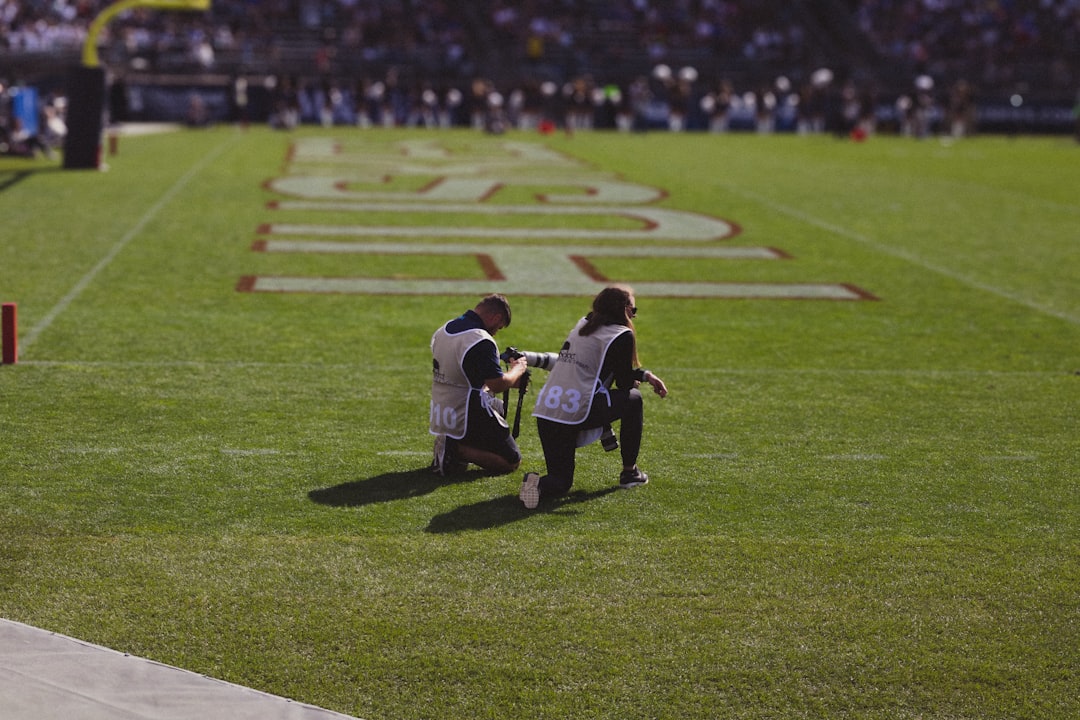




For every parent former athlete in youth sports, there is a moment on the sideline that nobody warns you about — the one where you stop watching your kid and start watching yourself.
It doesn't announce itself. The whistle blows, the ball goes up, and something in your chest does something it hasn't done in years. Not nostalgia exactly. Not pride exactly. Something older and less nameable than either of those words. If you gave serious years of your life to a sport, if you were once that kid in that uniform with those specific nerves firing before a big moment, you already know what that feeling is. You've lived it from this sideline now. You'll live it again.
Nobody prepares you for this when you become a parent. You show up thinking you're attending a game. You leave having revisited something foundational about who you are.
The Sideline Nobody Told You Would Feel Like This
Standing on a sideline as a parent is structurally different from standing on one as a player. As a player, the sideline was temporary — a place to catch your breath, watch the game, organize your mind before going back in. It had motion in it. Directionality.
As a parent, the sideline is your permanent address for the duration of that game. You are stationary. Your kid is moving. That inversion — that specific reversal of position — is where everything becomes complicated and beautiful and occasionally overwhelming in ways you didn't consciously anticipate.
Every former athlete remembers the precise quality of attention they gave their own parents in the stands. Whether you looked for them or deliberately didn't. Whether their presence steadied you or made the nerves spike. Whether you wanted them to see everything or nothing at all. That memory is not dormant. It is alive in you right now, informing the way you position your body, the expression you hold on your face, the things you allow yourself to call out and the things you keep behind your teeth.


You are not just watching a game. You are holding two timelines simultaneously, and the weight of both of them is real.
Research from the Positive Coaching Alliance consistently identifies former athletes as the parent demographic most likely to experience heightened emotional activation at youth sporting events — not because they are more anxious, but because they have a stored experiential library that non-athlete parents simply don't carry. The game is speaking to them in a language they learned in their bodies decades ago, and the body responds.
What Your Body Remembers That Your Brain Edited Out
The brain is a good editor. It softens the sharp edges of old defeats, smooths the rough patches, and lets the highlight moments run a few seconds longer than they actually did. The brain tells the version of the story you can live with comfortably.
The body keeps the full file.
When your kid lines up in the same pre-play stance you used to take — when they make that specific preparation gesture, the one that seems somehow universal to your sport across generations — your body knows before your conscious mind catches up. Your pulse changes. Your hands tighten on whatever you're holding. Your weight shifts slightly forward, as if you're about to go too.
This is somatic memory — the stored physical knowledge of having competed at a level that demanded full physical commitment. It doesn't care how many years separate you from your last real game. It doesn't care how many careers, relationships, moves, and life chapters have accumulated between that last season and this moment on this sideline. It lives in a part of you that doesn't respond to the passage of time the way the rest of you does. According to research on motor memory and athletic identity documented by the American Psychological Association, the embodied memory of sport-specific movement patterns can persist and reactivate across decades — particularly in response to contextual cues like familiar sounds, environments, or the sight of the sport being played.
Athletes who played seriously — not necessarily at an elite level, not necessarily with scholarships or records, but seriously, with real stakes and real commitment — carry that body knowledge for the rest of their lives. It waits. And on a youth sports sideline, watching your own kid move through the mechanics you once lived in, it wakes up.
The Scene You've Been Carrying Without Knowing It
Every former athlete has a scene. Not a highlight reel, not a best-of compilation — a specific scene. A particular moment, often not even the biggest game of their career, that has stayed more vivid and more available than almost everything else from that period of life.
Maybe it's the smell of a gymnasium before a meaningful game — that exact combination of floor wax and collective nervous energy and something that felt like potential. Maybe it's the weight of your helmet going on for the first time in a new season, that specific pressure across your temples that meant things were about to count. Maybe it's the sound of the ball coming off your foot or hand or bat in the way that told you — before you looked, before anyone else could confirm it — that everything in the mechanics was exactly right.
If you played, you can walk back into this scene right now. It is available to you the way most memories simply are not. It has a quality of presence that ordinary recollection doesn't carry.
Your kid is somewhere in the early chapters of building their own version of this scene. They don't know yet which moment will become that specific, permanent image. They are living through a period that will later crystallize into something they carry for decades. You know this because it happened to you. They cannot know it yet because it hasn't finished happening to them.
That asymmetry — understanding what they are in the middle of while having no way to convey it to them in any form they can fully receive — is one of the stranger and more tender privileges of being a parent who played.
When Their Hard Moment Echoes Your Hard Moment
Marcus T., 41, coaches his daughter's club soccer team on weekends and played Division II midfielder through college. He describes watching her face after a missed penalty kick in the same terms he uses to describe his own postgame processing: "She goes quiet in exactly the way I went quiet. I didn't teach her that. She just came with it." He had a custom jersey made with her name and number after that game — not as consolation, he's clear about that, but because he wanted her to see her name on something that treated her like the player she already was, independent of any single result.
This is where the parent-former-athlete experience becomes something more than echo and more than nostalgia. It becomes transmission.
You are transmitting something — not through lecture, not necessarily through explicit instruction, but through presence. Through the way you handle a bad call that goes against your kid's team. Through what you say in the car afterward and what you deliberately leave unsaid. Through whether the drive home becomes a debrief session or a silence spacious enough for their own processing.
Every former athlete carries lessons that took real time to earn. Lessons about how to lose without letting the loss define the week. About how to hold the gap between what you know you're capable of and what you actually produced on a specific day. About what it means to be genuinely accountable to teammates, not just technically present. These lessons don't transfer through advice. They transfer through the lived modeling of someone who has been through them and come out the other side with their relationship to the sport intact.
The Grief That Doesn't Get Named
Here is something true that parents almost never say explicitly: there is grief in this experience.
Not a consuming grief. Not a grief that requires intervention or signals something wrong with you as a parent. A real, quiet grief — for the version of you that is definitively located in the past. For the body that could do things at a level it can no longer do. For the identity that was so central for so many years and that had to find new shapes when the playing stopped.
Watching your kid play can open that grief the way pressing on an old bruise opens it. Not because you want their experience instead of your own life — of course you don't — but because their experience reminds you of something you genuinely loved and genuinely lost at the same time, and both of those things can be simultaneously true without either canceling the other.
If you played seriously, you know the particular texture of the last game you ever played — especially if you didn't recognize it as the last one at the time. The games you assumed were part of a series that would continue indefinitely. The final practice that felt like any other Tuesday. The last time you put on the jersey before the wearing-it phase of your life ended and the watching-it phase began.
Your kid is nowhere near that ending. They are at the pure beginning, where the last game is an unimaginable abstraction somewhere far in a future that doesn't feel real yet. You get to watch that. You get to be in proximity to the start of something that you know — from the far side of it — is precious in ways they won't be able to measure until much later.
The National Alliance for Youth Sports estimates that nearly 45 million children participate in organized youth sports in the United States each year. Behind most of them stands at least one parent who played, holding their own complicated relationship with the sport in one hand and their kid's emerging relationship with it in the other. You are not alone in this experience. You are, in fact, surrounded by people living the same quiet complexity.
The Inheritance That Doesn't Require a Speech
The most important things you transmit to your kid as a parent who played are almost never delivered as explicit instruction.
They watch how you carry a loss that isn't even yours to carry. They watch whether you ask genuine questions after a hard game or deliver verdicts. They watch your face when the coach makes a decision you privately disagree with — whether you model composure or let the frustration surface where they can see it. They are continuously learning what it looks like to be someone who played and who now exists in a healthy, generous relationship with sport rather than a consuming or resentful one.
This is the real inheritance:
- Your relationship with the sport itself — whether it still gives, or whether it has become something that takes
- Your model of how to process both outcomes, the ones that confirm your hopes and the ones that don't
- Your demonstrated belief that their athletic identity belongs to them, not to you
The former athletes who are most consistently cited as the positive presence at youth sporting events are the ones who show up fully and let the coach coach. Your specific knowledge of the sport is a genuine asset in many contexts. The sideline during competition is not one of them. What matters there is not what you know. It is what your kid sees in your face when things go wrong.
Permission is also an inheritance. Permission to love the sport without performing that love for your approval. Permission to be a categorically different kind of athlete than you were. Permission to discover what the sport means to them — which may look nothing like what it meant to you, and which is entirely their right.
Your jersey is still out there waiting.
Design yours in minutes and see your name and number exactly the way you remember it.
Frequently Asked Questions
Is it normal to feel emotional watching your kid play the sport you played?
Completely normal, and far more common than most parents say out loud. For a parent former athlete in youth sports, watching competition activates genuine somatic and emotional memory. Your body remembers the specific physical experience of competing, and watching someone you love in that same context brings those stored responses back online. The emotion isn't evidence of unresolved grief or excessive investment. It's evidence that the sport meant something real to you, and that meaning doesn't have an expiration date.
How do you separate your own athletic history from your kid's experience?
The practical answer is to ask more questions than you offer assessments, especially immediately after games. "How did that feel to you?" is almost always more useful than any analysis you can provide from the sideline. Your instincts are real and frequently accurate — but your kid's sense of ownership over their own athletic development matters more than your correctness in any given moment. The technical conversations have their place. That place is usually not the first twenty minutes after a hard loss.
What do you do when your kid doesn't seem to love the sport the way you did?
You let them not love it the way you did. Your relationship with your sport was constructed from your specific teammates, your specific coaches, your specific moment in time, your specific needs as a developing person. Your kid is building a completely different relationship with their sport on entirely their own terms. The goal isn't to duplicate your experience. The goal is that they have access to what organized sport can genuinely offer — discipline, belonging, the particular experience of committing to something difficult — regardless of whether the form it takes resembles yours.
How do you handle the urge to coach from the sideline during games?
Most youth programs have explicit policies about this, and those policies exist because the research behind them is clear. But the deeper answer is that sideline coaching — even technically accurate coaching — divides your kid's attention at precisely the moment they need full concentration, and it sends a signal that your approval tracks their performance. Former athletes who are consistently described as the positive sideline presence are the ones who cheer genuine effort, stay quiet about execution, and let the coach do the job. Your knowledge of the sport is a genuine asset. The sideline during competition is not where it belongs.
See also: athletic identity that doesn't disappear after the final whistle | why high school sports still carry so much emotional weight for adults | the grief that quietly follows the end of a playing career | why those memories from your own playing days are still so sharp