

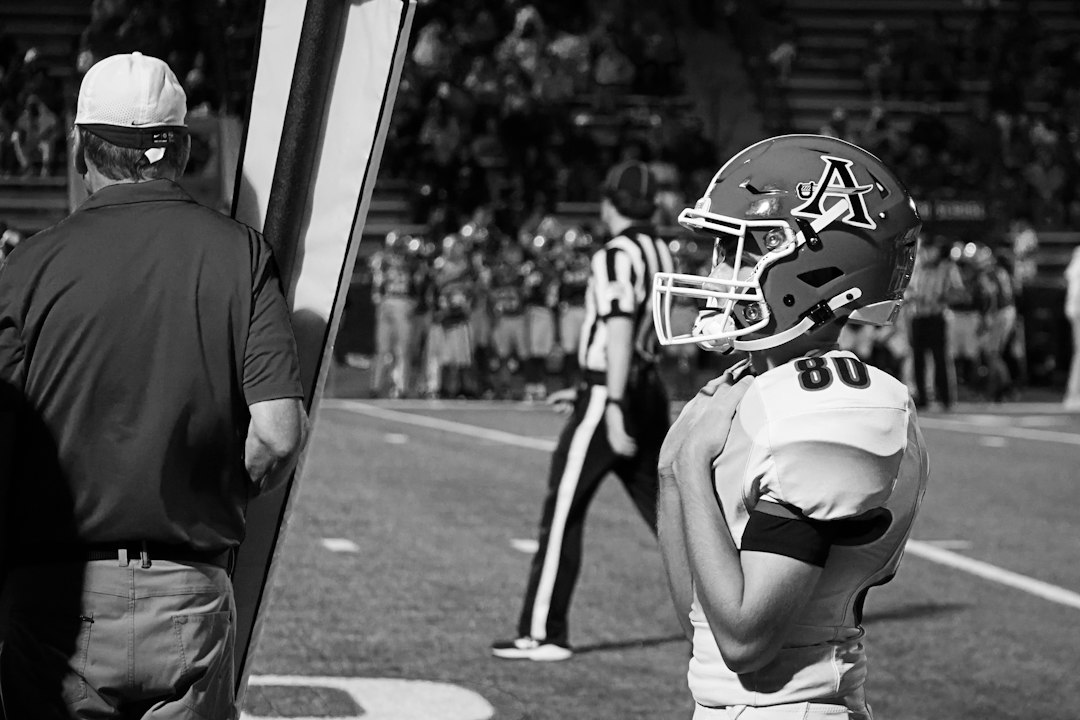




Remembering two-a-day football practices is one of the strangest acts of nostalgia an athlete can perform — because it is, by any honest accounting, the memory of voluntary suffering. And yet here you are. Thinking about it. Maybe smiling a little. Maybe not smiling at all, but feeling something large and difficult to name.
That feeling is what this article is about.
The alarm went off at 4:47 AM. Not 5:00. Not 4:45. 4:47 — because Coach wanted you moving before your brain had time to argue with your body about what you were about to do. You pulled on a practice jersey that still smelled like yesterday. You drove to school in the dark, in August, to a parking lot already half-full because some guys had been there since 4:30. And before the sun cleared the treeline, you were on a dew-soaked field, in full pads, beginning the first of two sessions that would gut you so completely you'd spend the three hours between them wondering how you were going to do it again.
What Two-A-Days Actually Were (For Those Who Need No Reminder)
For anyone arriving here from the outside looking in: two-a-days were exactly what they sound like. Two full practice sessions in a single day, typically run during the two weeks before the school year started — late July or early August, the worst heat of the year, in the most unforgiving conditions, in the heaviest equipment you'd wear all season.
The morning session ran from roughly 7 to 10 AM. The afternoon session picked back up around 3 and ran until 5 or 6. In between: ice baths if your program was well-funded, a hose in the parking lot if it wasn't, a trainer's table crowded with ankles and shoulders, and a cafeteria or gym floor where players slept on their pads because driving home and coming back felt like a cruelty too far.


This was high school football training camp at its most elemental. No shortcuts. No alternatives. No mercy from the calendar.
The National Federation of State High School Associations updated its heat acclimatization guidance after a string of heat-related deaths among high school athletes through the 2000s, and many states now restrict or ban two-a-days outright. Some programs still operate within modified frameworks — separated sessions, mandatory rest and hydration windows, temperature monitoring. But the version that generations of players remember — the full, unrestricted, two-contact-sessions-in-a-day grind of football practice — is largely gone. And its absence is, for a specific population of people, genuinely felt.
The Summer Football Camp Experience Nobody Talks About Honestly
Here is what the nostalgic posts get wrong: they sanitize it.
They make it sound like a movie montage — the whistle, the drill, the breakthrough moment where the team comes together. That version exists. It's real. But it isn't the whole story, and the sanitized version is not what stays with you decades later.
What stays with you is the specific ugliness of the second practice.
By 3 PM on day four, the novelty is completely gone. The soreness from the morning session has stiffened into something that feels structural. The heat index has climbed to something your body registers not as temperature but as pressure. The pads — which felt manageable in April, when you were fresh and optimistic — now feel like you are being asked to run sprints while wearing a small car.
This is the part nobody talks about honestly: the moment in the second session where you genuinely did not know if you could finish the next drill. Where "I might not be able to do this" was not dramatic but plain and practical. Where you looked at the guy next to you — the guy who, three weeks later, would be your closest friend on the team — and you could see that he was having the exact same thought.
And then the whistle blew, and you both did it anyway.
That gap — between "I don't know if I can" and "and I did it anyway" — is the entire emotional legacy of two-a-days. Everything else is logistics.
Remembering Two-A-Day Football Practices as a Shared Crucible
In our experience covering the rituals and memories of sport at the high school level, no single training experience generates the kind of cohesive team identity that two-a-days produced. Not the first game. Not the playoffs. Not senior night.
The reason is specific: two-a-days were the only part of the football experience that was not about performance. There was no scoreboard during two-a-days. There was no crowd, no opponent, no stat line. There was only the heat and the work and the person standing next to you.
Sociologists who study group bonding have a term for this: shared adversity. Research consistently shows that groups who undergo difficulty together — particularly difficulty that is voluntary and collective — form stronger bonds than groups who succeed together. The hardship is not incidental to the connection. The hardship is the mechanism of the connection.
Which is why, decades later, men who played high school football together can walk into a room, make eye contact across the years, and not need to say anything about two-a-days. They both know. They were both there. They survived the same thing — not metaphorically, but actually. The same heat. The same coach. The same second practice on day six that neither of them thought they'd finish.
Marcus T., 44, played linebacker at a mid-sized public high school in rural Georgia in the mid-90s. He still talks to three guys from his two-a-days — not from his team broadly, specifically from those two weeks. "There's something different about those guys," he said. "We went through that specific thing together. It stops being about football at that point. It's about knowing what someone's made of when they're completely empty."
The Grind of Football Practice and What It Built That the Scoreboard Never Showed
There is a motivational-speak version of this argument, and it is worth setting aside before making the real one.
The motivational-speak version goes: two-a-days built character, and character wins championships, and championships are what football is about. This is partially true and completely misses the point.
What the grind of football practice at this intensity actually built:
- A personal baseline. Every athlete who survived two-a-days carried that experience as a private reference point for the rest of their life. When something hard came later — a job loss, a failed relationship, a diagnosis — there was always the knowledge that there had been a thing they didn't think they could finish, and they finished it anyway. That knowledge does not expire. It does not transfer or become obsolete. It simply remains true.
- A team-specific language. Two-a-days created inside references, shared grievances, private jokes, and collective memories that belonged only to that team, that summer, that specific cohort. This is the actual infrastructure of team identity. The jersey is the symbol. Two-a-days were the substance.
- The experience of choosing discomfort. Two-a-days were not mandatory. At any point, in any session, any player could have walked off the field and not come back. The fact that they didn't — the act of choosing, every single day, to come back and do it again — was not incidental to the experience. It was the experience.
- A calibrated sense of what hard actually means. Athletes who went through two-a-days report, consistently, that they spent the rest of their lives with a recalibrated threshold for difficulty. What looks impossible from the outside looks different to someone who finished a second full-contact session in 98-degree heat on the fifth consecutive day of camp.
Why Two-A-Day Football Memories Live in the Body, Not Just the Mind
Ask anyone who went through two-a-days to describe the experience, and they will not start with the drills. They will start with the sensory details.
The smell of synthetic turf heated past the point of comfort. The specific sound of a helmet-to-shoulder pad collision in still morning air. The way cold water felt — not refreshing, not pleasant, but something that existed in an entirely separate category from normal experience. The feeling of grass wet with dew on bare calves during the first stretch of the morning session, before the sun had burned it off.
These details are not decorative. They are the architecture of the memory. The body encodes two-a-days differently than the mind does, and the body's version persists.
The intensity of this kind of training creates a specific sensory imprint — the kind that arrives uninvited, decades later, when the temperature hits a particular number on a late-July afternoon. When you smell cut grass in the morning. When you hear a coach's whistle from a practice field you're driving past at 55 miles an hour.
That involuntary memory is not trauma. It is the echo of something that was real, and hard, and finished, and entirely yours.
High School Football Training Camp Memories: What Got Lost When Two-A-Days Ended
There is a legitimate version of the argument against two-a-days. Heat illness in adolescent athletes is not a philosophical concept — it is a documented, preventable cause of death. The reforms that restricted two-a-days were protective, and they were warranted. Holding that truth at the same time as the nostalgic one is not contradiction. It is honesty.
What got lost was not the heat or the suffering. What got lost was the concentrated, contained, two-week crucible that produced a specific kind of team cohesion before a single regular-season play had been run.
Modern programs have found other ways to build culture. Some of them work extremely well. But the compressed intensity of two-a-days — the fact that it happened all at once, in the same heat, with nowhere to hide, with the same 40 or 50 guys all failing and recovering and failing again together — produced something that distributed, moderated training genuinely struggles to match.
The players who went through it knew something, together, that nobody outside that group could fully understand. That knowing — shared, specific, embodied — is what the nostalgia is actually about. Not the pain itself. The belonging that the pain produced.
And that belonging had a jersey attached to it. A number. A name on the back. Colors that meant your town, your team, your summer. The uniform you wore through both sessions, grass-stained and sweat-soaked by 5 PM, was the physical artifact of everything that happened inside those two weeks.
Your Jersey Is Still Out There Waiting
Design yours in minutes and see your name and number exactly the way you remember it — a tribute to the uniform, the number, the colors that belonged to that team and that summer and that version of you who showed up before sunrise and stayed until the whistle blew twice.
Frequently Asked Questions
Why do people remember two-a-days so fondly if they were so brutal?
The nostalgia attached to remembering two-a-day football practices comes from the same mechanism that makes any shared adversity bond people together: the experience was hard enough to matter, voluntary enough to feel like a genuine choice, and collective enough to produce real belonging. The pain itself is not what people are nostalgic for — it is the specific version of themselves that existed on the other side of it, and the people who were standing next to them when they got there.
When did most states stop allowing traditional two-a-days?
The timeline varies by state. Following a series of heat-related athlete deaths in the early-to-mid 2000s, the National Federation of State High School Associations developed formal heat acclimatization guidelines, which many states adopted between 2009 and 2015. As of the mid-2020s, the majority of states either ban traditional two-a-days outright or mandate significant modifications — separated sessions, mandatory rest windows, temperature and humidity cutoffs, and limits on contact. Some states never formally banned them but left the decision to individual school districts.
What made two-a-days different from regular-season practice in terms of team bonding?
Regular-season practice exists in the context of performance — there are upcoming opponents, standings, parental observation, and game-week urgency. Two-a-days existed in a different context entirely: the season hadn't started, there was no score to protect, and the only thing happening was the work itself, shared equally by every player on the roster regardless of position or status. That context — pure effort, no audience, no outcome but survival — is what produced the specific quality of bond that two-a-day veterans describe. It was the absence of external stakes, paradoxically, that made the internal stakes feel so permanent.
Is the memory of two-a-days different for players who went on to play college or pro ball?
In our experience, the intensity of the two-a-day memory is not proportional to how far a player's career went — it is proportional to how much the experience meant at the time. Players who peaked in high school often describe their two-a-day memories with the same specificity and emotional weight as players who went on to play at higher levels. The crucible experience is not about the destination. It is about the summer, the team, and the specific morning you weren't sure you were going to make it through the second session. That memory belongs to everyone who was there.
See also: why high school sports still matter to adults | the science behind why those summer memories are so vivid | the grief that comes when high school football ends | what it meant to your identity when football was over | what playing under the Friday night lights actually felt like