

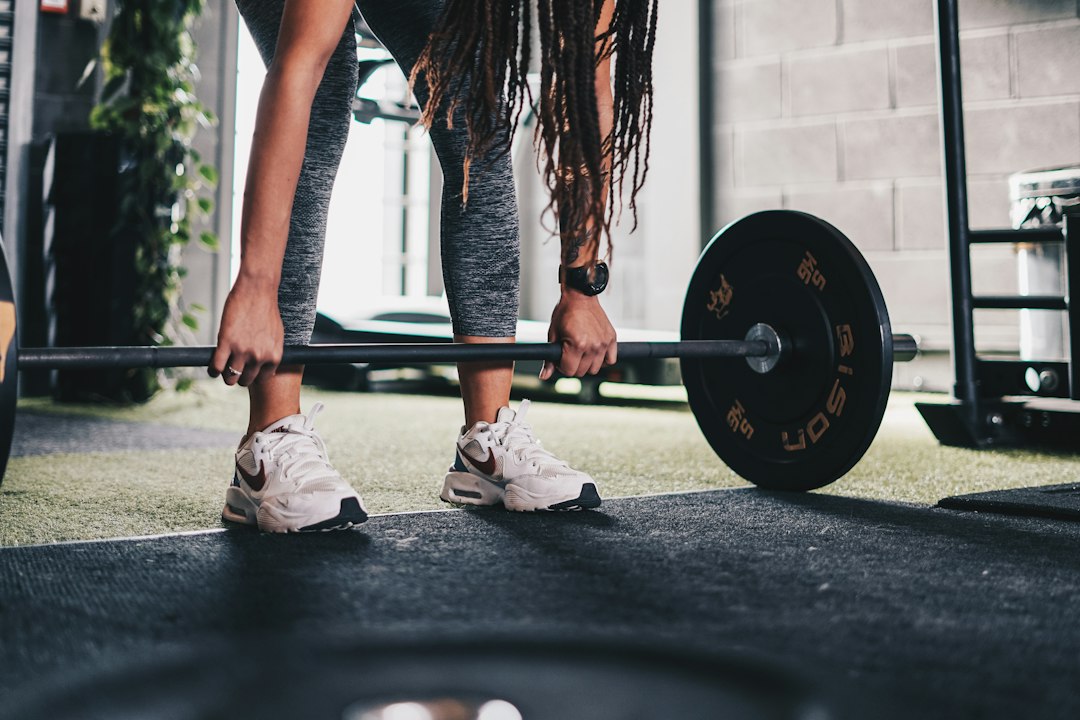




High school weight rooms have a smell that time doesn't touch. Rubber mats. Chalk dust. The faint metallic bite of iron that has been gripped by a thousand hands before yours. The first time you walked through that door — maybe at a coach's invitation, maybe on a dare, maybe because your team was required to be there — the room felt like it belonged to someone else entirely.
It didn't belong to you yet.
But the story of female athlete weight lifting confidence is exactly the story of how it became yours. Not through a montage. Not through a transformation arc that looks clean in retrospect. Through a series of specific, private, unremarkable-looking moments that permanently rewired what you understood yourself to be capable of. That's the kind of confidence nobody sells you in a fitness reel. It's the kind you earn in the gap between who you thought you were and what your body turned out to be.
When Female Athlete Weight Lifting Confidence Actually Begins
It doesn't begin when the weight moves. It begins the moment before — when you look at the bar and your first honest thought is: I don't think I can move that.
That moment of doubt is not the obstacle to confidence. It is the exact starting point of it.
The weight room is one of the most underwritten spaces in the story of girls' athletics. The broader conversation about women in sport tends to focus on access, on visibility, on equal funding and field time. All of that matters. But something more interior happens when a teenage girl stops performing her body for other people's evaluation and asks it a completely different question: What can you actually do?
The barbell doesn't have an opinion about how you look. It doesn't reward small or polished or pretty. It moves or it doesn't. And the first time it moves — the first time the plates leave the floor or the bar travels away from your chest on your own power — the information your nervous system logs is permanent.


You are stronger than you thought.
That is not a feeling. That is data. And data, unlike feelings, compounds.
The Moment Girls High School Weight Training Memories Are Actually Made Of
Ask any woman who lifted seriously in high school what she remembers, and she will not describe a trophy or a record board. She will describe one specific afternoon. The weight that felt wrong for her. The three attempts. The moment it moved.
Kayla M., 28, was a junior on her high school track team when her sprint coach put her on a twice-weekly strength program. She remembers standing over 95 pounds and being certain there had been a miscalculation. "That wasn't a weight for me," she says. "That was a weight for someone who had been doing this for years." On her third attempt, she pulled it. She went home and didn't tell anyone. "I didn't know how to explain what had changed. Something just had."
That experience — private, unremarkable from the outside, completely irreversible from the inside — is what girls high school weight training memories are actually constructed from. Not the logged PRs. Not the team photos. The Tuesday afternoon when nobody was watching and the weight moved anyway and you went home carrying something new.
The first time deadlifting is singular in memory because it strips away every variable except honesty. You can run on adrenaline. You can push through a swim set on sheer willpower and nerves. A deadlift either happens or it doesn't, and if it happens, the only explanation is you.
Strength Training, Body Image, and the Shift Nobody Warned You About
Here is what actually changes when a teenage girl starts strength training — and it is not what the magazines promised.
You stop looking at your body from the outside.
This sounds small. It is not small. Researchers at the University of Florida's Department of Applied Physiology and Kinesiology have framed this as a documented shift from "body as object" to "body as instrument" — and the strength training body image research in adolescent female populations consistently shows it happening faster and more durably than almost any other intervention.
The girl who walks into a weight room has usually spent years receiving her body as a visual object. The culture of female adolescence delivers that framing constantly: through fashion, through social media, through the particular arithmetic of comparison that thirteen-year-olds are fluent in. The mirror, in most contexts, is a judge.
The weight room mirror is something different. When you are under a squat bar with 115 pounds across your traps, you are not asking how do I look? You are asking do I have another inch of depth in me? When you are grinding through Romanian deadlifts and your hamstrings are burning and your coach is watching your hip hinge, the question is not am I thin enough? The question is is my back flat?
Attention moves from appearance to function. And when that shift happens — when how lifting weights helped my confidence stops being about the mirror and starts being about the load — something structural changes in how a girl understands herself.
The body becomes a tool she is learning to operate rather than a surface being evaluated. That is not a trivial reframe. It may be the most consequential body image shift available to an adolescent girl, and it arrives wrapped in chalk and iron rather than in a therapist's office.
What Strong Female Athlete Identity Actually Feels Like From the Inside
Strong female athlete identity is not a poster on a locker room wall. It is a private, ongoing ledger of proof.
It sounds like this: I did that. That was genuinely hard, and I did it.
It accumulates in deposits that look small individually. The week you added ten pounds to your bench. The morning your legs were wrecked from the day before and you still hit your squat numbers. The meet where you pulled a personal record with no crowd, no announcement, nothing but your teammates — and they came apart like it was a championship, because to them it was.
This is how lifting weights helped confidence in ways that outlasted the sport itself. Not a linear arc from low to high, but a reference library of specific proofs, each one saying the same thing in a different weight: You are more capable than your fear told you.
The weight room mirror works differently than other mirrors for exactly this reason. In most mirrors, a teenage girl is running an audition — checking whether she meets a standard that was written somewhere outside herself. In the weight room mirror, she is checking her form. Watching her knees track. Looking for depth she hasn't found yet. The mirror becomes a tool she uses rather than a judge she performs for.
That is the moment the mirror stops owning her.
What the Coaches Who Got It Right Actually Did
Not every girls' weight program produced this transformation. The difference between programs that built durable identity and programs that produced complicated relationships with effort and body came down to specific coaching decisions — decisions that looked ordinary from the outside and were not ordinary at all.
The coaches who got it right did four things consistently:
- They taught mechanics before they added load. A girl who understands why her hip hinge matters — that it's protecting her lumbar spine while loading her posterior chain — is not following instructions. She's operating a system she understands. Ownership of the mechanism is the foundation of athletic confidence.
- They named strength as the goal, without qualifying it. Not "strong for a girl." Not "toned." Strong. Removing the modifier changed the entire frame.
- They celebrated performance, never physique. "Your pull is incredible" is a different sentence — with different consequences — than any compliment about how a girl's body looks. The first builds athletic identity. The second reintroduces the evaluative frame the weight room was supposed to dissolve.
- They normalized missing a lift. The weight room where girls are allowed to fail in front of each other, set up again, and try without social performance around the failure — that is where identity gets built. Shame kills the experiment before it produces any data.
The coaches who skipped any one of these four things produced girls who were stronger but not necessarily freer. The coaches who held all four created something that lasted decades past the last set.
Your Jersey Is Still Out There Waiting.
Design yours in minutes and see your name and number exactly the way you remember it — from the weight room to the locker room to the field where you became who you are.
Frequently Asked Questions
Does strength training actually improve confidence in female athletes, or is that just gym culture mythology?
The research is consistent and has been for more than a decade: structured strength training produces measurable improvements in self-efficacy and body image in adolescent girls. The mechanism isn't mystical — it's the accumulation of performance-based evidence. A girl who demonstrates to herself that she can do hard, physical things under real load builds a reference library of capability that transfers to non-athletic contexts. The effect is well-documented in adolescent female athlete populations and shows up in both short-term self-report measures and longer-term identity studies.
I lifted seriously in high school and I've lost that feeling as an adult. Is it retrievable?
Yes — and faster than most women expect. The neural pathways built during high school training don't fully disappear; they go dormant. Most women who return to lifting after years away report that the identity-based confidence returns within weeks, not months, because the body recognizes the information immediately. The first time you pull something genuinely heavy and it moves, your nervous system files the same report it always did: still capable. The emotional response tends to come back before the strength fully does.
What if I was never in a formal weight training program? Can I still relate to this experience?
Absolutely. The shift this article describes — from body as object to body as instrument — happens in weight rooms, yes, but also in garage gyms, in college fitness centers at 22, in a CrossFit box at 35. The access point is less important than the moment of recognition: the first time your body proved something to you that your fear had been contradicting. If you've had that moment anywhere, the experience described here belongs to you too.
How do girls high school weight training memories shape how women relate to fitness as adults?
Profoundly, and in both directions. Women who had performance-focused strength training experiences in high school tend to return to strength-based activity more readily throughout their lives — and to define fitness success in terms of capability rather than appearance. Women whose early weight room experiences were aesthetically framed often carry complicated feelings about lifting that take real effort to untangle. The framing of the original experience matters long after the bar has been put down.
My daughter just started lifting at 15. What should I say — or not say — to support her?
Match your language to what the weight room is teaching her: comment on what her body did, not how it looks. "You pulled that?" lands completely differently than any appearance-based compliment. Ask what she's working on. Let her explain her lifts with the same seriousness you'd give a game recap. The weight room is teaching her that her body is an instrument — your job is to reinforce that frame, not accidentally reintroduce the evaluative one through the side door of a well-intentioned remark.
See also: athletic identity that doesn't disappear when the sport does | what high school sports actually teach you about yourself | closing the gap between who you remember being and how you feel now | finding your way back to training after years away from the sport