

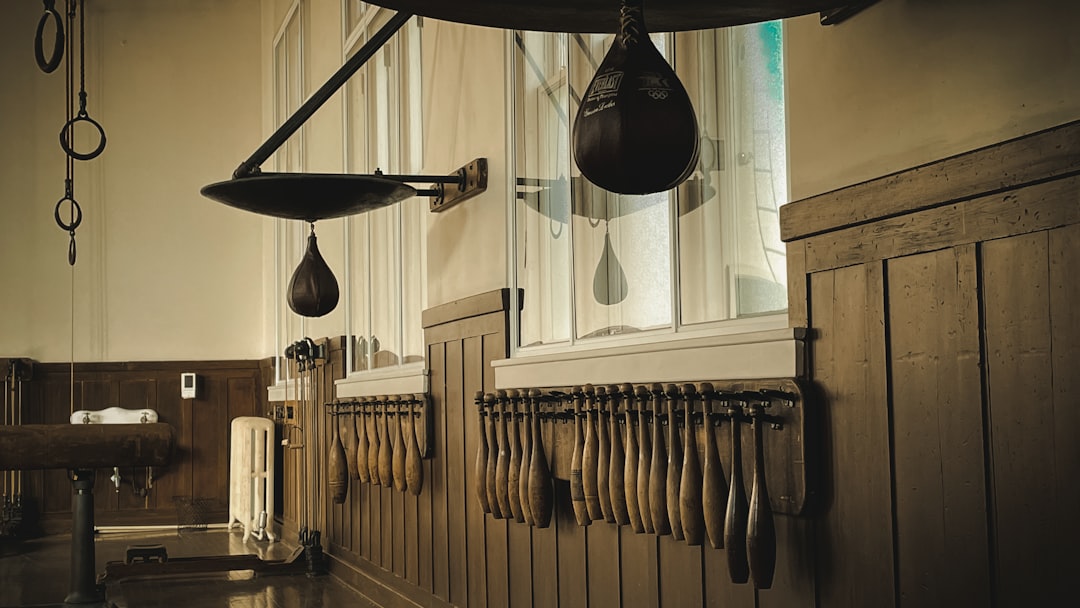




The bar was cold. That's the first thing you remember — not the weight, not the set, not even the burn. The cold of the bar in your hands at 5:50 in the morning, before the heat had worked its way into the room, before anyone else had arrived, before the school day had started or the hallways had filled or any of it meant anything. Just the bar, and you, and a room that hummed with the low mechanical sound of a fluorescent light that had been flickering for three years and would never be replaced.
Athlete early morning training memories live in a specific compartment. They don't fade the way other things fade. They stay tactile: the rubber mat smell, the weight of a winter jacket you hadn't taken off yet, the sound of a door closing behind you as you stepped inside a building that felt like it belonged to you alone for exactly this hour. Before the day divided itself into roles and requirements and noise, there was just the work. And you chose to be there for it.
This is for the ones who chose to be there.
The Hour That Nobody Counted — Except You
There is a specific kind of invisible labor in athletics that never makes it into the recap. The box score doesn't have a column for it. The highlight video doesn't start this early. The parents weren't in the bleachers. The coaches, more often than not, weren't even there yet.
Every former athlete who did this (who dragged themselves out of a warm bed while the rest of the house was still asleep, who navigated a dark parking lot, who pushed open a heavy door into a room that was barely warmer than outside) carries the memory of that solitude as something close to sacred. Not because it was romantic. It was inconvenient and monotonous and sometimes deeply unpleasant, and you did it anyway.


That's the part worth holding onto.
The discipline wasn't installed by the coach standing over you with a clipboard. You installed it in the moments when no one was watching and you still went through the full range of motion. When you counted the rep honestly instead of cutting it short. When you came back the next morning after a day when you were sore and tired and had homework you hadn't finished and came back anyway.
Nobody gave you credit for those mornings in the moment. That was the entire point.
What you learned, what you were actually building, wasn't purely physical. You were building the internal evidence that you could be trusted with hard things. You were building the only kind of confidence that doesn't collapse when someone isn't watching: the kind that comes from having already watched yourself.
What the Weight Room Taught That the Classroom Didn't
The weight room before school operates by rules that have nothing to do with curriculum.
There is no partial credit. The bar either moves or it doesn't. You either completed the set or you didn't. You either added ten pounds this week or you carried the same weight you were carrying three months ago. The feedback is immediate, physical, and non-negotiable.
Every former athlete who spent real time in that early-morning environment absorbed something that took years to name: the relationship between input and output is never random or subject to interpretation. It is relentless and honest and, once you've internalized it, it becomes the standard against which everything else gets measured.
If you played, you know the feeling of sitting in a meeting a decade after your last season and recognizing that the colleague across the table hasn't done the equivalent of your 6 AM lift. Not in fitness. In anything. You can feel the absence of the thing that gets built when you show up to do the work before anyone requires you to.
This isn't contempt. It's recognition. And it's a byproduct of having spent enough mornings in a cold gym to understand what that consistency actually produces.
It produces something that lives below the level of skill. Skill can be learned. What you build in the pre-dawn hours, over a season, over a career, is something more foundational: a baseline assumption that difficulty is something you move through, not something you stop at.
The Specific Memory Every Early-Morning Athlete Carries
There's a version of this morning that almost every athlete who trained before school can reconstruct in specific detail.
The alarm. The negotiation your brain tries to start — the very sophisticated, very convincing argument for why today is the exception, why this particular morning doesn't count, why the warmth of five more minutes is a reasonable trade for whatever you're giving up by not going. The athletes who built something real are the ones who heard that argument most mornings and got up anyway — not every time, not perfectly, but consistently enough to create the record.
Then the drive or the walk. If you drove, you remember the specific quiet of the roads at that hour: a different city than the one you'd navigate two hours later, slower and emptier and lit differently. If you walked, you remember the weather in your body before the gym replaced it.
The parking lot. The building. The door.
And then the smell. Every weight room has its own particular smell, a combination of rubber and sweat and metal and cleaning solution and something older underneath all of it — the accumulated residue of thousands of hours of the same kind of work. Your brain catalogued that smell as belonging to something important. It still does.
Marcus T., 34, played college basketball after four years of pre-dawn conditioning sessions at his high school in rural Ohio. He tells a story about the winter morning he arrived to find the heat broken and the gym at 38 degrees. "I almost drove home," he says. "Then I thought about the fact that I'd already driven there. I did the whole workout in my jacket. I still think about that morning more than any game I played."
What Marcus describes isn't nostalgia for discomfort. It's the recognition that the discomfort was the credential. The broken heater wasn't a hardship to survive — it was an audition you didn't know you were in, and you passed it.
That's what the early-morning sessions gave you that the afternoon practices didn't. Afternoon practice was required. It was monitored and structured and you would have been noticed by its absence. The early morning was optional in every practical sense. And option is the entire difference.
You showed up for the optional thing. You kept showing up — the same way athletes commit to training rituals like two-a-days, where the hardship becomes the bond. And then you stopped keeping count because keeping count wasn't the point.
The Discipline That Didn't Announce Itself
One of the stranger things about building this kind of discipline in your teens is that you don't recognize it as discipline while it's happening. It feels like routine. It feels like what you do. The word "discipline" implies a kind of effortful, conscious self-governance — and what actually happens in an athlete who has done this long enough is that the effort moves underground. The decision-making apparatus gets quieter. You stop debating the alarm because you stopped treating it as debatable.
That shift, from conscious effort to embedded habit, is the actual output of the early-morning weight room. Not strength, not conditioning, not whatever physical metric you were tracking. The output was the rewired assumption that the thing you have decided to do is the thing you are going to do.
Former athletes carry this into every domain that follows. Into the first job, where the work ethic looks outsize next to people who've never had to be anywhere at 5:45 AM without external compulsion. Into the relationships, where showing up consistently is the whole thing — and for athletes who trained this way, consistency doesn't read as exceptional; it reads as baseline. Into the hard chapters, where the internal record of difficult mornings survived becomes the evidence that difficult things are survivable.
You didn't build this on purpose. You built it because someone handed you a training schedule and you were the kind of person who took it seriously. But it built you back.
The Private Badge
There is a reason former athletes don't talk about this much. Not because it doesn't matter (it matters enormously) but because the entire structure of it was private. The value of the early-morning session was inseparable from its invisibility. This was a different kind of quiet than the quiet before the storm in the locker room before a game — that was shared tension; this was solitary choice. The moment you talk about it too much, it starts to look like something you're doing for credit. And the whole point was doing it without credit.
This creates a specific kind of quiet pride. Not the pride you feel after a win, which is shared and celebrated and exists in the presence of other people. Something closer to the pride you feel when you know something about yourself that you've earned the right to know — when the evidence isn't external but internal, and the internal evidence is airtight.
This is one of the most consistent threads across sports, genders, positions, and levels of competition: the morning sessions are remembered not for the physical results they produced, but for what they proved. They were a private contract, written and renewed in the dark, between the athlete you were trying to become and the habits that would either get you there or not.
You kept the contract.
That still counts. It counts in your work ethic, in your threshold for discomfort, in the way you respond to difficulty with movement instead of paralysis. It counts in how you define commitment — not as a declaration but as a practice, repeated in the absence of an audience until the practice becomes the person.
What You Carry Forward
The last set of your athletic career happened without announcement. The final early-morning session before the sport ended (whether through graduation, injury, age, or simply the natural conclusion of a chapter) was probably indistinguishable from any other. You didn't know it was the last one. You just did it.
That's a strange thing to sit with. All that accumulated early-morning work, and the ending was invisible too. No ceremony for the discipline. No marker placed at the moment the habit stopped being exercised by the sport and started being carried forward by the person.
But it was carried forward. Research on habit formation consistently shows that behavioral patterns built during formative years, particularly those tied to identity and high-stakes performance, create durable neural architecture that persists long after the original context is gone. The morning discipline you built in a weight room at 15 or 17 or 20 didn't disappear when the season ended — which helps explain why working out feels different when you're not training for a season; the body remembers the stakes that were once attached to every rep. It was integrated.
You carry the bar in your hands, even without the bar.
Every former athlete who built something in those pre-dawn hours carries a private asset that doesn't appear on any resume and doesn't translate directly into any credential. It's a knowledge of self under pressure, before the world was watching, before the outcome was decided, before anyone told you what the session was worth.
You decided what it was worth. You showed up. And the showing up accumulated into something that, decades later, still shapes how you move through difficulty.
That's not a small thing. That's the whole thing.
Your jersey is still out there waiting.
Design yours in minutes and see your name and number the way you remember them.
Or browse the gallery to see what other former athletes have created — every jersey tells a story.
Frequently Asked Questions
Why do athlete early morning training memories stay so vivid for so long?
Early-morning training sessions occur during a period of heightened neurological encoding — the combination of physical stress, repetition, and emotional stakes creates the conditions under which long-term memory consolidates most effectively. For athletes who trained before school, the isolation and voluntary nature of the sessions adds additional salience. The brain flags experiences that were chosen, not mandated, as carrying more personal significance. Decades later, the sensory details (the cold, the smell, the sound of the equipment) remain accessible because they were encoded under conditions that the brain treats as important.
Is the discipline built through early-morning athletic training transferable to other areas of life?
Yes, and this is one of the most consistent findings in research on athletic identity and post-sport life. The behavioral architecture built through repeated voluntary effort, particularly in the absence of external monitoring, transfers across domains because it operates at the level of identity, not skill. Former athletes who maintained early-morning training habits frequently report higher baseline consistency in professional environments, stronger responses to adversity, and a more practiced relationship with discomfort than peers who did not have this experience. The sport ends; the pattern persists.
How do former athletes typically reconnect with their athletic identity years after competing?
The most common reconnection points are physical — returning to the gym, running, playing recreational leagues — but identity reconnection doesn't require physical replication of the original experience. Many former athletes find that wearing gear associated with their sport, telling the stories of the specific moments that defined their athletic chapter, or being around current athletes triggers the same identity activation. The jersey, the number, the team colors are particularly potent because they are visual anchors to a period of identity that doesn't fully close when the playing stops.
What separates athletes who benefited most from early-morning training from those who simply did it?
The difference is almost entirely internal. Athletes who actively assigned meaning to the voluntary nature of the sessions — who understood at some level that they were building a record of self-trust — derived more durable benefit than athletes who treated the sessions as an obligation to complete. This has nothing to do with talent or physical results. It comes down to whether the athlete was developing a relationship with their own discipline or simply accumulating hours. Both types got the physical training. Only the first type built the deeper asset.
See also: what high school sports actually taught you that no classroom could | the psychology of why those athletic memories still hit so hard | the identity you built around being an athlete doesn't disappear when the season ends