

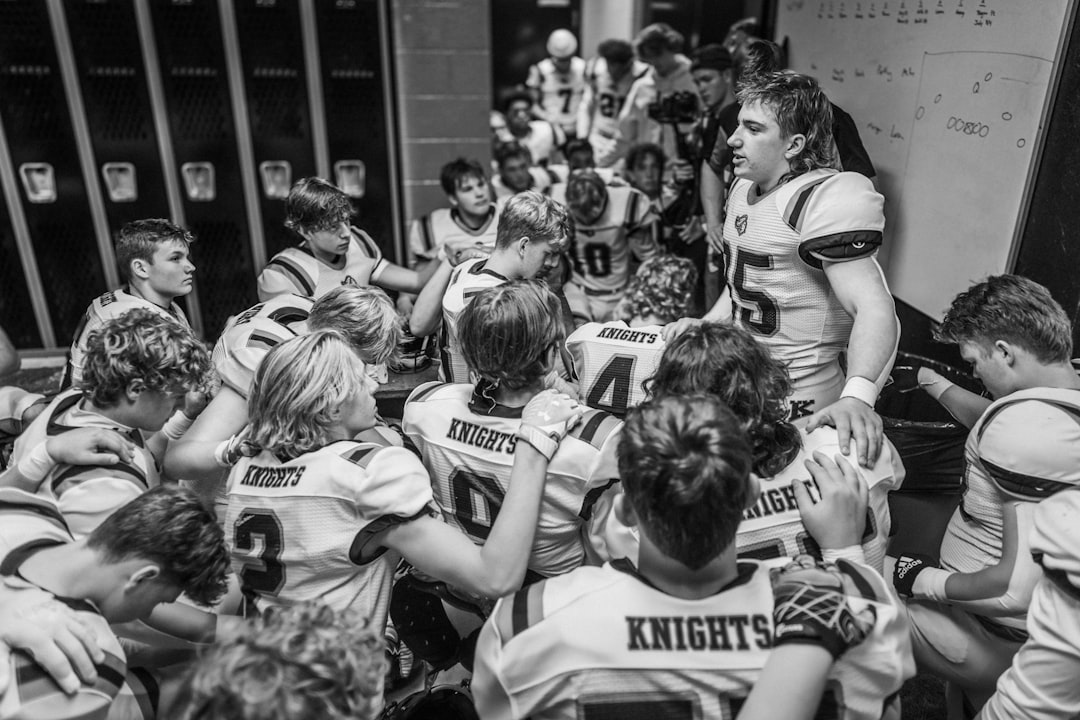




There is a specific smell you have never forgotten.
Athletic tape, that particular medicinal sweetness of it. Sweat already worked into the fabric of the walls. Someone's body spray applied with no sense of proportion. The sharp, almost industrial smell of a freshly mopped concrete floor that never quite dried all the way. And underneath all of it, something harder to name. Something that smelled like anticipation, if anticipation had a smell.
If you played (any sport, any level, any era), your body just remembered something. That's not nostalgia working on you. That's former athlete identity, and it doesn't fade. It lives in the nervous system the way a language you learned young lives in the mouth. You don't have to think about it. It's just there.
This is about that room. The one before the game. The one that adult life, in all its genuine richness and real accomplishment, has never quite managed to recreate.
What the Locker Room Actually Was
It was not a room for changing clothes.
Anyone who has only ever changed clothes in a locker room has missed the thing entirely. The function was secondary. The locker room before a game was a pressure vessel. A place where a group of people (some of whom barely spoke during the school day, some of whom had been playing together since they were nine) arrived as individuals and left as something else.
The before was the transformation. You walked in carrying everything that made you a regular person: the test you'd done poorly on, the argument with your parents that morning, the vague social anxiety of being seventeen and not entirely sure who you were. You walked in carrying all of it. And then, over the course of forty-five minutes that felt both eternal and instantaneous, the regular person got set aside. Not erased — set aside. Placed carefully on the bench with your street clothes, left there to wait.


What you put on instead was the version of you that knew exactly what to do.
That's what the uniform was for. Not identification. Not tradition, though it carried tradition. The uniform was permission to be the version of yourself that was most organized, most purposeful, most completely present. You knew your assignment. You knew your teammates. You knew the opponent. For the next two hours, the world had walls and a scoreboard and rules, and you had a specific, practiced role inside it.
Every former athlete knows: adult life offers almost none of this. Adult life is beautifully, maddeningly ambiguous. The scoreboard is invisible. The rules keep changing. Your role is negotiated continuously. What you're supposed to do at any given moment is almost never as clear as "get to your position before the snap."
The Ritual as Architecture
The rituals were not superstition. Or — they were superstition, but they were also engineering.
Every serious athlete built a pre-game sequence that was less about luck and more about neural priming. Lace the left shoe before the right, always. Sit in the same spot in the locker room for every home game. The same playlist, in the same order, through the same headphones. Tap the doorframe leaving the locker room. Touch the nameplate above the locker. Three deep breaths in the tunnel before you see the field.
None of this was irrational. The body learns to associate physical sequences with specific states of activation. Research in sports psychology has documented this extensively: pre-performance routines regulate arousal, reduce decision fatigue, and prime motor patterns. What athletes were building, without necessarily knowing the science, was a reliable pathway to their own best performance.
The rituals are often the most specific and durable memories. Not the games themselves — the rituals before them. The exact sequence. The feeling of the tape being applied. The way a particular coach knocked twice on the locker room door before entering. The exact song that came on third and meant it was almost time.
The rituals are so specific because they were repeated so many times that they carved grooves. Those grooves don't fill in. They stay.
And here is what adult life rarely provides: a reliable sequence that tells your nervous system now is the time to become your best self. Most adults improvise their preparation every single day. Former athletes, somewhere beneath the surface of a Tuesday morning meeting, are missing the ritual. They don't always know that's what they're missing. But it is.
The Specific Silence Before the Noise
There was a moment (if you played, you know the one) when the locker room went quiet.
Not because anyone called for quiet. No coach asked for it. It just happened, the way weather happens. Someone's music got turned down without discussion. The laughing settled. The tape guns stopped. And for thirty seconds, maybe a full minute, a room full of people who had been loud and loose and joking became absolutely still.
This was the collective acknowledgment that the thing was real. That in a few minutes, the preparation ended and the performance began. That everything you'd practiced either worked or it didn't, and you were about to find out.
That silence — that specific, voluntary, shared silence — is one of the most sophisticated emotional experiences most athletes ever have, and they have it for the first time at fifteen or sixteen with essentially no framework for understanding what it is. It is a group of people choosing, without being asked, to enter the same internal space at the same time. It is the closest thing to meditation that most competitive athletes touch before someone eventually introduces them to meditation twenty years later and they think: oh. This is what that was.
Adult life has meetings with agenda items and phone calls with talking points and no one goes quiet like that. Not voluntarily. Not all at once. Not because something that matters is about to happen and everyone in the room already knows it.
The Identity That Travels With You
There's a version of this story that plays out after nearly every playing career ends. A few seasons go by in jobs that look right on paper and feel wrong in the body, roles written for someone else and taken anyway. Something stays flat underneath, and it takes a while to name. What's missing isn't the game. It's the team. The way a locker room knows each other.
Sooner or later, that person is someone you know, and it may be you. They land somewhere that genuinely runs like a unit, and it feels instantly familiar: the most functional group they've been part of since they played. The instincts had traveled with them the whole time. So had something smaller and more stubborn. The old jersey, still within reach, on a wall or in a drawer. Just to have it there.
That's not unusual. That's former athlete identity doing exactly what it does.
The identity formed in athletic spaces doesn't stay in those spaces. It travels. It shapes how you lead and how you follow. It shapes your tolerance for discomfort and your appetite for preparation. It shapes what you think accountability looks like and what you think effort looks like and what you think loyalty looks like. Athletes who go on to build functional teams, run demanding organizations, or simply live with unusual consistency tend to trace the origin of those instincts to the same place: the room before the game.
This is not sentimentality. The instincts were real. They were trained. They transferred.
The problem isn't that the identity is outdated. The problem is that adult life doesn't always offer a clear arena for it. The identity is running in the background, looking for a field.
Why Nothing in Adult Life Quite Closes the Gap
Let's be honest about this, because honesty is more useful than reassurance.
The reason the locker room before the game doesn't have an adult equivalent isn't because adult life is lesser. Adult life contains things that sport cannot hold: depth of relationship, the weight of real consequences, the satisfaction of work that compounds over decades. None of that is small.
But sport, at its functional peak, offers four things that adult life distributes unevenly at best:
- Complete clarity of purpose. For two hours, your purpose is unambiguous. It is stated, agreed-upon, and shared. There is a ball. There is a goal. There is a team. There is an opponent. This is the entire world.
- Immediate feedback. You know within seconds whether what you just did worked. Adult feedback loops are long, delayed, and frequently unclear.
- Earned trust under pressure. You know your teammates because you have watched them perform when it was hard. Adult trust is mostly theoretical until tested.
- The moment of full embodiment. Sport demands your complete physical and mental presence in a way that most adult activities simply do not. You cannot be distracted during a pick-and-roll. You cannot be partially present during a third-and-long.
The locker room before the game was the anteroom to all four of those things. It was where the transition happened: from partial to complete, from distracted to present, from individual to unit. Of course nothing recreates it. It was built by and for a very specific set of conditions that most adult structures don't come close to.
Knowing that doesn't take the ache away. But it clarifies what you're actually missing, which is more useful than a vague, unplaceable longing.
What You Carry Out of That Room
Here's what the locker room gave you that it never took back.
You learned to be ready. Not confident in the way that means comfortable, but ready in the way that means I have done the preparation, I am in my body, I know what I am here to do. That quality — readiness — is rarer than talent and more durable than motivation. Athletes who developed it at seventeen still have it at forty-five. It shows in the way they approach hard things. They get quiet. They get specific. They move.
You learned what a real team feels like. Not a group of people with aligned incentives, but a group of people who have seen each other scared and tired and failing and who showed up anyway. That knowledge is a compass. Once you know what a real team is, you can recognize the absence of one, and you spend your adult life (sometimes consciously, sometimes not) trying to find or build another one.
You learned that the feeling before the hard thing is part of the hard thing. The nerves in the locker room weren't a problem to be solved before you performed. They were the performance beginning. Every former athlete who has gone on to do difficult things in difficult rooms has some version of this coded in: the fear and the preparation coexist, and the fear doesn't mean stop.
And you learned, in that specific shared silence before the noise, that some things are worth going completely quiet for.
That's not a small education. That's the education. Everything that came after (the degrees, the titles, the accumulated competence of adult life) built on top of it.
Giving the Trained Identity a Field Again
The identity is still there, running in the background, waiting for somewhere to go. It doesn't need a program or a set of exercises. It needs what it always needed: an arena. Former athletes who carry it well tend to do a few ordinary, concrete things to give it one.
The first is to name the instincts out loud. Readiness. Preparation. Showing up when you would rather not. Building a unit out of individuals. You were trained in these so thoroughly that they now register as personality rather than skill — which means you may not be pointing them anywhere on purpose. The athlete who spent seasons learning to make the next right play can carry that same deliberate calm into a hard negotiation, a tight deadline, or a room gone quiet with stakes. The instinct transfers; it just has to be placed deliberately instead of left to drift.
The second is to find or build a real team. Not a contact list. A team: the kind where people have seen each other under pressure and chosen to stay. It might be a rec league, a volunteer crew, a group training for the same hard thing, or a handful of people who hold each other accountable the way a locker room did. The identity doesn't need the same sport back. It needs people who know each other the way teammates do.
The third is to use the ritual. That pre-game sequence (the same order, the same quiet, the deep breath before the hard thing) was never only for game days. Borrow it before the high-stakes adult moments: the presentation, the difficult conversation, the day you have been building toward. The nervous system still answers to it.
And if you want a physical anchor for all of it, that is what the jersey is for. Something on the wall that says: I was that version of myself, and I still am.
Your jersey is still out there waiting.
Design yours in minutes and see your name and number exactly the way you remember it.
Frequently Asked Questions
Why do former athletes feel a strong sense of loss when they stop playing?
The transition out of competitive sport involves more than missing a physical activity. It involves the disruption of a core identity structure. For many athletes, the playing environment provided clarity of purpose, team belonging, consistent feedback, and a predictable path to self-worth through preparation and performance. When that environment disappears, former athlete identity doesn't dissolve; it continues operating without a clear arena. The psychological literature on athletic identity describes this as "foreclosure" or identity disruption — the internal self-concept trained through years of sport suddenly lacks a matching external structure. The sense of loss is real precisely because the identity formation was real.
Is the locker room experience the same across different sports?
The physical details vary: the smell of a swimming pool locker room is categorically different from a football locker room, and a gymnastics preparation space operates on different energy than a hockey dressing room. But the structural experience is remarkably consistent: a contained space, a defined group, a shared purpose, a period of transition from regular self to performing self, and the specific compressed time before the performance begins. Athletes across sports, when they compare notes, almost always land on the same emotional core. The rituals differ. The transformation is the same.
How do former athletes reconnect with that sense of identity in everyday life?
The most effective approaches tend to involve recreating the structural conditions rather than the specific activities. Teams built around real shared purpose — not just shared tasks — activate the same belonging instincts. Pre-performance rituals applied to high-stakes adult moments (important presentations, difficult conversations, creative work) engage the same neural priming mechanisms. Physical training that involves progressive preparation and measurable performance, even done alone, maintains the connection between effort and feedback that sport provided. And deliberately placing yourself in spaces where people have seen each other perform under pressure — and chosen to stay anyway — rebuilds the earned trust that the locker room produced over seasons.
Does the intensity of former-athlete nostalgia differ based on the level at which someone played?
The level mattered less than the commitment. Athletes who played at modest competitive levels but who were fully invested — who prepared seriously, who belonged to a real team, who experienced the pre-game ritual genuinely — report the same depth of attachment as athletes who played at elite levels. What appears to determine the depth of the nostalgia is the degree to which athletic identity was central to the person's self-concept during their playing years, not the external significance of the competition itself. A fully committed high school volleyball player and a college athlete may carry identical emotional weight into their post-playing lives.
See also: the weight of athletic identity after high school | the grief that comes with losing that chapter of your life | why those memories stay so sharp decades later | what high school sports actually gave you that nothing since has matched