

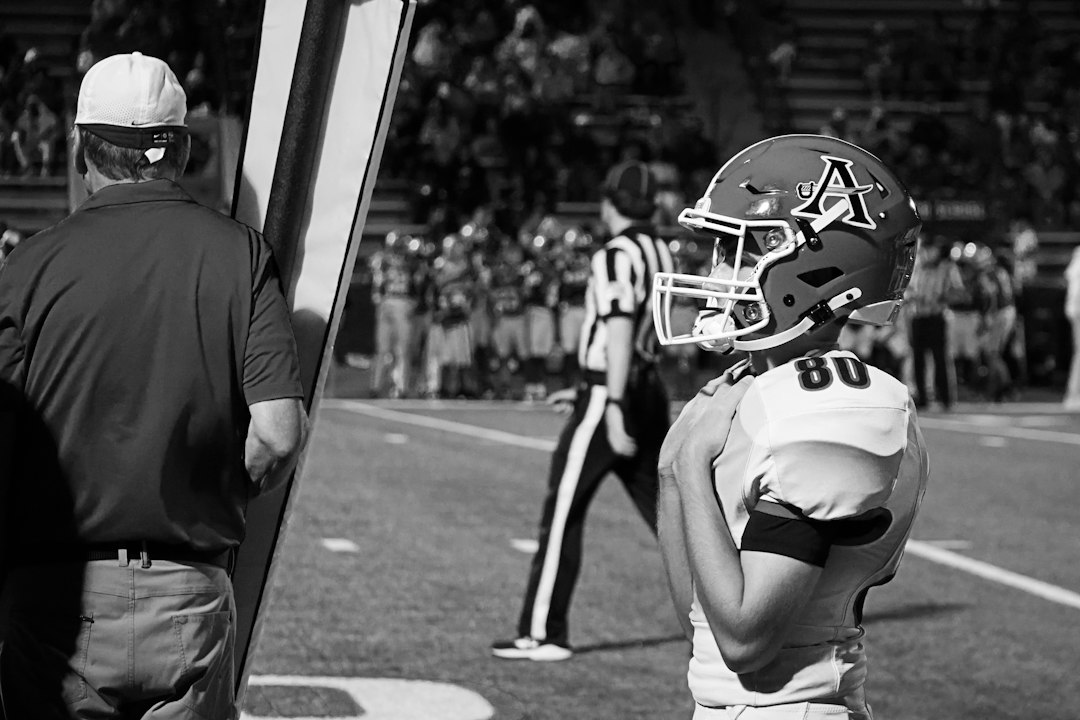




There is a play you still see clearly. Not the touchdown you scored. Not the state championship banner in the gym. The one you almost had.
Almost touchdowns, high school football memories of missed opportunities, the dropped interception that would have sealed the game — these are the moments that live the longest in a player's body. You can feel the grass under your cleats. You can feel the ball hit your hands. And then you can feel it leave them.
If you played football — at any level, for any amount of time — you know exactly what this article is about before you've read another sentence.
What nobody talks about is why those almost-moments won't let you go. And what it actually means that they don't.
The Highlight Reel Isn't the Real Story
Walk into any high school gymnasium during football season and you'll find the same wall. Framed photos of championship teams. Names on a banner. Numbers retired from service. The official record of what happened.
But ask anyone who played — really played, through mud and doubt and the weight of a Friday night — and the first story they tell you is never from that wall.
It's the fumble at the two-yard line. The tackle they didn't make. The block they missed on the play their teammate got hurt. The interception they dropped with six seconds left in a rivalry game.
Sports psychology has spent decades studying elite performance, and one persistent finding is that athletes recall failures with significantly greater emotional detail than equivalent successes. The reason isn't pathological. It's instructional. The human brain assigns narrative weight to unresolved outcomes precisely because they contain information it hasn't finished processing.
The almost-moment never fully closes. And that's not a wound. That's a story still being written.
What the Almost Actually Teaches You
Here's what nobody says at the end-of-year banquet: the plays that didn't go right are doing more developmental work than the plays that did.


When you execute correctly and the result follows — touchdown, interception, the quarterback sack that sends the crowd into noise — the feedback loop is clean. It worked. Move on. The brain files it and clears the memory buffer.
When it almost works, the brain does something completely different. It runs the scenario again. And again. It isolates the variables. It rehearses the corrected version compulsively. What your coach called "living in your head" was actually high-intensity mental simulation — the same cognitive process that sports scientists now call mental rehearsal, and it's one of the most effective performance development tools in athletics.
You were doing elite-level cognitive training at 16. You just didn't know it.
The dropped interception ran you through every micro-decision in that play: your route to the ball, your hand position, where your eyes were, what you would have done in the half-second after the catch. You rehearsed a corrected version of that play hundreds of times in the two weeks after it happened. No coach assigned that work. You couldn't stop doing it.
That is what football almost-moments actually produce:
- Involuntary, intensive skill rehearsal
- Heightened attention to the specific mechanics of failure
- An emotional investment in the gap between current performance and possible performance
The almost-moment doesn't haunt you because you failed. It haunts you because you almost succeeded — and your brain knows the difference between the two is small enough to close.
The Specific Weight of an Almost
There is a taxonomy to these memories. Not all almost-moments are the same kind of almost.
The One That Was Yours and Left Your Hands
The dropped pass. The fumble at the goal line. The missed field goal that would have forced overtime. These carry a particular weight because they were entirely within your body's jurisdiction in that moment. No opponent took it from you. Physics handed it to you and you gave it back.
Former players describe these with almost clinical precision decades later: the angle of the ball, the point of contact, the sensation of having it and not having it in the same fraction of a second. The fumble memory is specific in a way that successful plays rarely are. That specificity is the brain's way of marking the moment as unresolved business.
The One Where You Were One Step Late
You were in position. You read the play correctly. You got there almost in time. The tackle that missed by a hand width. The blitz that arrived one beat after the quarterback released the ball. The pursuit angle that was right but the speed that wasn't quite enough.
These carry a different weight — less about execution failure and more about the physics of almost. If you had run the same route a tenth of a second faster. If you had broken on the ball a beat earlier. The margin is so thin that the almost becomes permanent precisely because it was so close.
The Team Play That Came Down to One Block
This one is different from the other two. This almost belongs to everyone on the field, but you feel it alone at 2am thirty years later because you know which block wasn't made. You know whose block it was.
The collective almost carries individual guilt in a way that's deeply specific to team sports. You share the loss publicly, in the team meeting, in the film room. You carry your part of it privately, in a way that your teammates may not even know. This is one of the defining psychological experiences of high school football: the moment you understood that a team's shared outcome and an individual's internal reckoning are two completely different things, happening simultaneously, in the same locker room.
"It Was Right There": Marcus T., 44
Marcus T., 44, played defensive back at a small public high school in rural Ohio. In the state quarterfinals his senior year, with two minutes left and his team down by three, the opposing quarterback telegraphed a crossing route so obviously that Marcus read it before the receiver moved.
He stepped in front of the route. The ball hit his chest. He had it.
For approximately one second.
The ball bounced off his hands and was caught by the receiver — who went on to score. His team lost by ten.
Marcus has coached youth football for sixteen years. He tells his players about that play every single season. Not as a cautionary tale. As proof.
"I tell them: that's the play that made me a coach," he said. "Because I went home that night and I didn't sleep. I ran that play in my head until I figured out every single thing I did wrong. I became a better defensive back in one night than I had been in four years. I just didn't have another season to use it."
The almost-moment gave him something a successful interception never could: a complete dismantling and reconstruction of his technique, driven entirely from the inside.
Playing Through Disappointment: The Part Nobody Coaches
There is a moment on the sideline after an almost — after the dropped pass or the fumble or the missed block — when the game is still happening around you and you are still in it, but part of you has gone somewhere else.
Every player who has been there knows this moment. The noise of the stadium becomes oddly distant. Your helmet feels heavier. The next series is coming and your body is present but your attention is still on the field three plays ago, running the corrections.
This is the psychological crucible that high school football creates in a way very few other experiences do in adolescence. You have to come back. You have to snap to the next play. You have to function at game speed while carrying something unresolved at full weight.
Playing through disappointment isn't a character trait some players have and others don't. It's a skill. It's trainable. And almost-moments are the training ground.
The players who go on to perform at higher levels aren't the ones who feel these moments less. Research on elite athlete resilience consistently shows the opposite — high performers often feel failure more acutely than their peers. What they develop is a faster return pathway. The drop hurts as much. The gap between the drop and "next play" gets shorter.
That gap is what gets built in high school. In the almost-moments. In the fourth quarter of a game you're losing, on a field lit by lights that go off at ten, in front of three hundred people who drove forty minutes to watch you figure out who you are under pressure.
Football What-Ifs: The Healthy Kind and the Other Kind
There's a distinction worth drawing here, because not all football what-ifs land the same way.
The healthy football what-if sounds like this: I wonder if I had stayed for weight training that summer. I wonder if I had played a different position. I wonder what that season looks like if I make that play. These are exploratory. They're the brain honoring the narrative weight of the experience without demanding a different outcome.
The other kind sounds like this: I ruined that game. I let my team down. I should have been better. That was my fault and it cost everyone. This one has teeth, and it doesn't let go the same way.
The difference between the two isn't the almost-moment itself. It's whether the memory has been processed through the full arc — through the pain of the miss, through the technical lesson extracted from it, and through the larger truth that athletic identity isn't built from a single play.
No one who played high school football remembers you only for the dropped pass. The people in that stadium — the teammates, the coaches, the parents — remember a player across a body of work. The almost-moment that defines you in your own memory is usually invisible to everyone else, or remembered entirely differently by them.
That gap is worth sitting with. What you remember as the defining miss of your career, your offensive lineman from that same team probably remembers as the game where you played the whole second half with a rolled ankle.
The story you've told yourself about that play — it's worth asking who assigned you that version.
The Almost Is Part of the Archive
Here's what the almost-moment is, stripped of the anxiety around it: it's part of your complete athletic record. Not the missing chapter. Not the asterisk. The play that happened, was real, and belongs in the full account of what that season was.
The highlight reel version of any athlete's career is a selection. The real career includes the almost-touchdowns, the missed opportunities, the fumble at the goal line. These aren't the failures that balance the victories. They are equal parts of the same story.
The players who carry their almost-moments the lightest aren't the ones who had fewer of them. They're the ones who let them belong to the full story instead of standing apart from it as evidence of something that wasn't good enough.
Your almost belongs to the archive. The whole point of the archive is that it's complete.
Your jersey is still out there waiting.
Design yours in minutes and see your name and number exactly the way you remember it.
Frequently Asked Questions
Why do football players remember their mistakes more vividly than their successes?
The brain assigns more emotional and cognitive weight to unresolved outcomes than to completed ones — a well-documented phenomenon in memory research. When a play succeeds cleanly, the feedback loop closes and the brain moves on. When an almost-moment occurs, the brain continues processing because the gap between what happened and what could have happened contains information it hasn't finished using. The result is a more detailed, more emotionally textured memory that persists far longer. This isn't a flaw in how athletes process experience — it's an adaptive mechanism that drives performance improvement through involuntary mental rehearsal.
Is it normal to still think about a missed play from high school decades later?
Completely normal, and extremely common among former athletes at every level. The specific emotional texture of a high-stakes almost-moment — particularly one that occurred during a defining developmental period like high school — tends to remain accessible in memory in ways that routine daily experiences from the same era do not. The vividness of the memory is a function of the emotional significance assigned to the event at the time, not evidence of unresolved psychological damage. For most former players, these memories are part of a larger narrative about identity, effort, and what they were capable of under pressure — not wounds, but landmarks.
How do you talk to younger players about almost-moments without minimizing what they feel?
The key is to validate the specific feeling before introducing any reframe. "That was a hard play and it makes sense that it's sitting with you" lands differently than "don't worry about it" or even "you'll learn from this." Young athletes need to feel that the weight of the moment is real before they can be curious about what it contains. Once that's acknowledged, the most effective coaching move is to focus on the technical specific: not "what does this mean about you as a player" but "here is the exact mechanical thing that happened, and here is what we adjust." Keep the analysis about the play. Keep the identity assessment out of it entirely.
Does the intensity of these memories fade over time?
The emotional charge typically softens while the narrative significance often deepens. Former players who are decades removed from their high school careers frequently describe their almost-moments with less acute pain and more appreciation for what those moments produced in them. The play that felt catastrophic at 17 often gets reframed, over time, as a turning point — the moment they understood something about effort, or pressure, or the gap between wanting something and having it. What doesn't necessarily fade is the vividness of the sensory memory itself. The feel of the ball, the specific field conditions, the score on the board — these details often remain remarkably precise even forty years later.
See also: why high school sports still matter to adults decades later | the grief nobody talks about when your playing days end | why your senior season memories stay so sharp years later | why you still dream about high school games | what it really felt like to play under the Friday night lights