



There is a specific sound you never forget.
Not the crowd. Not the band. Not the announcer reading your name over a crackling PA system on a Friday night. Those sounds belong to everyone who was there — the parents in the bleachers, the students rushing the fence, the opposing team's fans rattling their side of the stadium with noise that meant nothing to you personally.
The sound you can't shake is the one that happened two feet from your face mask.
The sounds of a high school football game — the real ones, the ones that actually live inside a former player's memory — have almost nothing to do with what spectators describe when they talk about "the atmosphere." The atmosphere is a spectator's word. Players don't experience atmosphere. They experience something closer to a full-body sensory immersion, and the auditory component of that immersion is specific, jarring, and absolutely nothing like what you hear on a broadcast.
This piece is about those sounds. The ones that are still there when you close your eyes.
What the Crowd Never Hears: The Sounds Inside the Pile
Stand outside a high school football game on a Friday night and the dominant sound is crowd noise — a warm, oscillating roar that builds during big plays and drops to a murmur between snaps. It is the ambient sound of collective anticipation, and it is genuinely beautiful if you're experiencing it from the stands.
From inside the helmet, that crowd noise becomes something completely different: a muffled, pressurized backdrop that your brain rapidly files under "irrelevant" within the first two minutes of warmups. The crowd doesn't disappear — you know it's there — but it recedes to the edge of perception, like the sound of a highway from inside a house. Present. Peripheral. Unimportant.
What moves to the front is everything the crowd cannot hear at all.

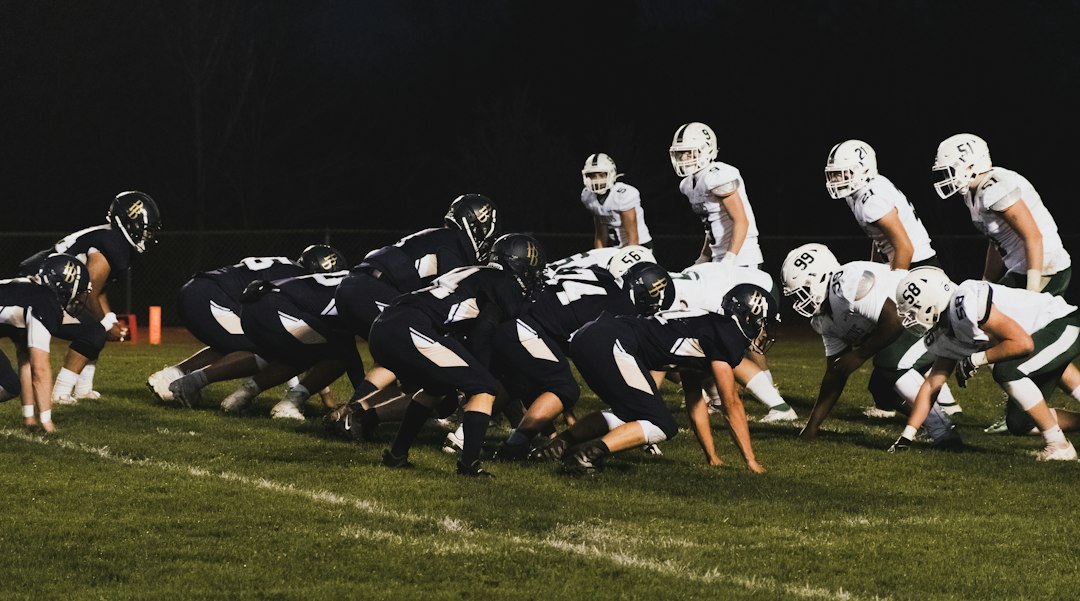
The pop of shoulder pads on initial contact. This is the most underrated sound in football, and it's also the most disorienting to describe to someone who hasn't been in it. It's not a crash. It's not a thud. It's a short, sharp percussion — hollow and synthetic — that happens the exact moment two players engage. It has almost no sustain. It's over before you've consciously registered it, which means your body has already reacted by the time your brain processes that a sound occurred at all. From the stands, this gets swallowed by the crowd. From the line, it is the primary rhythmic event of every single snap.
The creak and compression of pads under sustained pressure. When a play goes to the ground and bodies pile on, there is a secondary sound that has no good analogue in everyday life. It's the sound of hard plastic and foam and fabric under concentrated weight — a grinding, settling compression that you feel through your whole body while you're also hearing it through your helmet. Players who spent time on the offensive line will recognize this immediately. It's the sound of a real football game being played by people who have mass and momentum and nowhere easy to go.
Breathing. Your own, first — ragged and controlled, depending on which quarter you're in. But also the breathing of whoever is lined up against you. It is close. Sometimes it is uncomfortable. By the fourth quarter of a hard game, it is one of the most human sounds in sports.
The Language That Lived Only Between the Lines
Every sport has its own internal language. Football's is particularly dense, and most of it is delivered by sound.
The quarterback's cadence is the most obvious example, and also the most technically interesting one when you think about what it actually does to a trained player's nervous system. By the third week of practice, the cadence stops being something you hear and starts being something you respond to. The rhythm of it — the specific syllable stress, the particular pause before the live count — becomes a physical trigger. Your body loads for movement before conscious thought is involved.
Standing on the field during a road game, listening to an opposing QB run his cadence for the first time, was one of the stranger sensory experiences high school football offered. Your body was trained to respond to a specific sound pattern. This was a different pattern. Your nervous system had to hold itself still while running the evaluation in real time: not yet, not yet, different rhythm, not yet — there.
The offensive line's pre-snap communication had its own acoustic texture. Short, clipped. Almost coded. A center making a blocking call sounds nothing like a coach making a blocking call — the register is lower, faster, and delivered with the specific urgency of someone who has about three seconds to communicate before the situation changes entirely. Defensive players who could identify and process those sounds faster than their opponents had a real, functional advantage that had nothing to do with physical gifts.
The referee's whistle deserves its own paragraph.
There is a version of the referee's whistle that you hear as a spectator — clean, clear, declaratory. Play is over. And then there is the version you hear when you're in the middle of a pile or in the process of completing a block or tracking a receiver across the middle of the field. That version is urgent in a way that is almost physically uncomfortable. It cuts through the contact noise, through the crowd noise, through your own breathing, and it carries a specific instruction that your body has been conditioned to obey: stop what you are doing, right now, completely.
Players who came up in programs with good officiating developed a finely calibrated sensitivity to that whistle. Players who came up in programs with inconsistent officiating — where the whistle sometimes came late, or not at all — developed a different kind of wariness. The sound of a referee's whistle is, for a former player, never entirely neutral.
The Hit Sound: What No Broadcast Microphone Has Ever Captured
Marcus T., 34, played linebacker at a mid-size high school in central Ohio for three seasons. He describes the sound of helmet-to-helmet contact the same way every former player does when pressed: "It's not loud. That's the thing people always get wrong. It's not a boom. It's more like someone snapped a thick rubber band right next to your ear, except you also felt it in your molars." He still hears it when he watches games on television. The broadcast audio, he says, doesn't come close.
He's right, and the reason is partly mechanical and partly physiological.
The sound of a helmet hitting a helmet — the actual contact sound football — travels through two mediums simultaneously: air and bone conduction. The air-conducted component is what a microphone would theoretically capture: a sharp, mid-frequency impact with a very short decay. The bone-conducted component travels directly through the skull and into the cochlea, bypassing the outer ear entirely. You don't just hear the hit. You hear it and feel it through the same sensory pathway at the same time, which is why the subjective experience of helmet contact sounds nothing like it looks from outside.
Broadcast microphones are positioned at distances that capture the air-conducted component in a crowd-noise context. They miss the bone-conducted component entirely. They miss the proximity. They miss the specific quality of that sound arriving at 0.2 seconds and being processed by a brain that is simultaneously managing balance, positional awareness, and the immediate tactical question of what just happened and what happens next.
The result is that the most iconic physical sound in football — the sound that is most deeply embedded in the football auditory memory of every player who has played the game — is also the most poorly documented sound in football media. It lives almost entirely in the memory of the people who were inside it.
Third Quarter, Fourth-and-One: The Soundscape Shifts
There is a specific acoustic quality to a late-game, short-yardage situation that former players recognize before they can fully explain why.
The crowd gets louder, but it also gets more focused. The diffuse roar of spectators watching a flowing game compresses into something more targeted — a building pressure rather than an ambient wash. Players on the field feel this shift, even when they're trying not to.
In the huddle, the quarterback's voice drops. This is nearly universal across programs and levels — something about the compression of a critical moment makes people speak more quietly, not more loudly. In a quiet huddle on a noisy field, you lean in slightly. You read lips as much as you listen. The play call lands with a different weight than it does in the second quarter.
The crowd noise player perspective is one of the most misunderstood dimensions of the game. Commentators often describe crowd noise as a tactical disadvantage for the offense — it disrupts communication, forces audibles, creates chaos. All of that is true. What gets less attention is the way crowd noise functions as information for the defense. A road crowd that suddenly gets quiet in a critical situation is telling you something. A home crowd that surges in volume when a runner hits the line is confirming something your body already knew.
Experienced players develop what amounts to a passive crowd noise processing system — not consciously listening, but using the crowd's acoustic behavior as a secondary data stream that confirms or complicates what they're seeing with their eyes.
The Sounds That Stayed: On Football Auditory Memory
The science of auditory memory is interesting precisely because it works differently from visual memory. Research on episodic memory suggests that sounds — particularly sounds with strong emotional or physiological associations — tend to be encoded with unusual durability. The combination of high physical arousal, emotional significance, and repetition that characterizes competitive football creates near-ideal conditions for the formation of lasting auditory memories.
Former players report hearing specific game sounds for decades after their last game. The pop of pads during warmups on a fall afternoon. The specific acoustic texture of a stadium crowd at kickoff, as distinct from the crowd sound mid-game. The sound of cleats on a painted concrete locker room floor before a game, and the different sound of the same floor after one.
The sensory memories of playing football are overwhelmingly auditory, which is interesting given how visual the sport appears from the outside. Ask a former player what they remember most vividly about their playing days and they will often start with something they heard, not something they saw.
The thing about those sounds is that they arrive carrying everything that was happening at the same time. The pop of a pad in a late-October Friday night game doesn't arrive alone — it arrives with the temperature, with the specific anxiety of the week's preparation, with the weight of the people watching and the people across the line and the people in the huddle beside you. Auditory memory in football is never just about the sound. It's about everything the sound was soaked in at the moment it was recorded.
Your jersey is still out there waiting.
Design yours in minutes and see your name and number exactly the way you remember it.
Frequently Asked Questions
Why do football players remember sounds more vividly than visuals from their playing days?
High physical arousal, repetition, and emotional significance create near-ideal conditions for auditory memory formation. The sounds of a high school football game — pad contact, cadence, whistles — are encoded during moments of peak physiological activation, which research consistently associates with stronger and more durable memory traces. Visual memories from competitive football are often fragmented because attention is so narrowly focused during play; auditory processing happens more peripherally, capturing a broader snapshot of the moment.
What does helmet-to-helmet contact actually sound like from inside the helmet?
Former players almost universally describe it as sharper and shorter than broadcasts suggest — a compact, percussive snap rather than the heavy crash that sideline audio implies. The reason is bone conduction: the sound travels through the skull directly to the inner ear, bypassing the outer ear, which means the subjective experience includes both an air-conducted and a bone-conducted component simultaneously. The result is a sound that is felt as much as heard, which no microphone currently captures accurately from the outside.
How did players use crowd noise as tactical information?
Experienced players develop a passive sensitivity to crowd acoustic behavior that functions as a secondary information source. A road crowd that goes quiet during a critical defensive series often signals that the home offense has communicated something the crowd recognized as significant. A sudden surge in crowd volume at the line of scrimmage can confirm — or complicate — what a defender's eyes are telling them about a blocking scheme. This is distinct from consciously listening to the crowd; it's closer to using crowd noise as ambient context that either aligns with or contradicts other available information.
Are the sounds of a high school football game different from college or professional football?
In important ways, yes. The acoustic environment is smaller — high school stadiums are more intimate, which paradoxically makes some sounds more present rather than less. The crowd noise is closer. The communication between players has to work harder against that proximity. The contact sounds are produced by players who are still developing in size and mass, which changes the specific quality of pad and helmet contact. Former high school players who went on to play at higher levels often describe the jump in contact sound as one of the more physically jarring aspects of the transition — the pads are bigger, the mass behind them is greater, and the acoustic result is noticeably different.
What practice sounds do former players remember most?
Beyond game sounds, former players consistently cite three practice sounds: the specific rhythm of a blocking sled being driven into the ground repeatedly on a summer afternoon, the sound of a coach's voice carrying across an open practice field (which has a different acoustic quality than a voice inside a stadium), and the particular sound of a football being snapped cleanly versus snapped poorly. The clean snap has a specific, satisfying acoustic quality that players develop sensitivity to very quickly — and the sound of a fumbled exchange in practice registers as distinctly as a wrong note in a familiar song.
See also: why high school sports still matter so deeply to adults | why your senior season memories are encoded so vividly | what playing under the Friday night lights actually felt like | the bus ride home after a loss that no one needed to narrate