

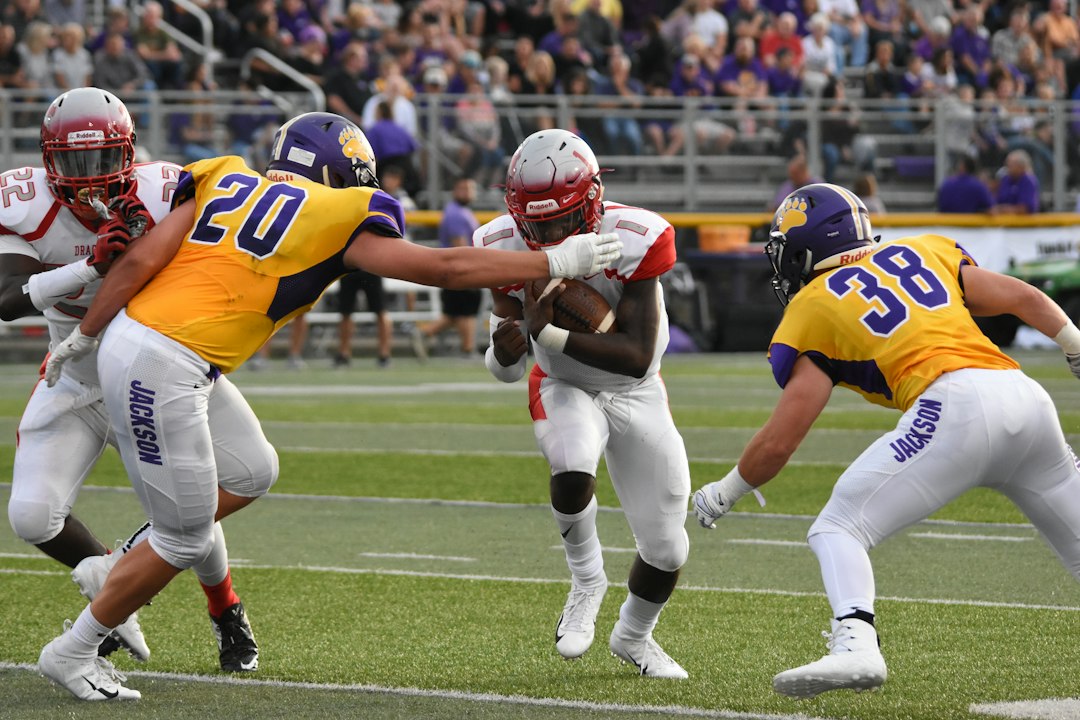




There's a number you haven't thought about in years. Maybe decades. But if someone asked you right now — no hesitation, no pause — you'd say it.
Thirty-two. Eleven. Eighty-four. Forty-four.
It came out of your mouth the way your childhood address comes out. Without effort. Without searching. Because it's stored in a different part of your memory than facts you learned — it's stored with the things that happened to you.
That's the thing about high school football jersey number meaning. It doesn't work the way people expect. It's not a label you wore for a season. It's closer to a name you answered to.
This piece is about why that happens — and why the culture, hierarchy, and psychology of sports jersey numbers in football specifically make the number on your back one of the more quietly permanent things about the game.
The NFL Rulebook Lives in High School Too
Before we get to identity, let's talk about the system underneath it — because the rules that governed your number weren't arbitrary, and understanding them reframes what it meant to be assigned one.
In football, jersey numbers aren't decorative. They're functional. The NFL's official numbering system, which filters down through college and into most high school programs, assigns number ranges by position:
- 1–19: Quarterbacks, kickers, punters, wide receivers, defensive backs
- 20–49: Running backs, fullbacks, linebackers, tight ends, safeties
- 50–79: Centers, offensive linemen, defensive linemen, linebackers
- 80–89: Wide receivers and tight ends
- 90–99: Defensive linemen and linebackers
This isn't just tradition. It's eligibility. Under NCAA and most state high school federation rules, an offense must declare which players are eligible to catch passes — and the number on the back is part of that declaration. An offensive lineman who lines up at a skill position in an unusual formation has to report to the referee. His number announces his ineligibility before he runs a single route.
Your number was a legal document.
That's the first reason it carries weight most people don't consciously acknowledge. When you wore 72, you weren't just wearing a jersey — you were wearing a declaration of role, governed by a rulebook. The referee scanned the field and read you by your number before the snap. The opposing linebacker read you. The safety read you. Everyone on that field knew something about you before you moved.


In our experience covering football culture and the jerseys that carry it forward, that specific detail — that the number was functional before it was symbolic — is what separates football number identity from jersey numbers in other sports. A basketball player's number is largely aesthetic. A football player's number is an assignment with legal implications.
The Hierarchy Nobody Wrote Down (But Everyone Knew)
Here's what the rulebook doesn't capture: the unwritten hierarchy that every high school locker room enforces with absolute precision.
The quarterback's number was different. Not numerically — a QB could wear anything from 1 to 19. But the number a quarterback wore carried a specific gravity. In most programs, it was the same number for years. Players inherited it. And when you pulled on that number, you inherited the weight of everyone who had worn it before you.
The same was true of a few specific numbers that developed local mythology.
Number 44 carries something everywhere it goes. Jim Brown wore it. Ernie Davis wore it. Floyd Little wore it. By the time it arrived in your high school's equipment room, it had decades of freight attached. Coaches who had studied the game knew it. Players who had been raised on football lore felt it. Being handed 44 wasn't an equipment transaction — it was a statement about expectation.
Number 12 became, in many programs, the quarterback number. It's not universal, but it recurs. Tom Brady wore it long enough that an entire generation of high school QBs requested it. Before Brady, Roger Staubach wore it. The number accumulated associations until requesting it was itself a signal — a signal about how a young quarterback understood his own potential.
Numbers in the 20s and 30s — particularly anything worn by a running back — developed program-specific mythology. In schools where a 1,000-yard rusher had carried 32 for three straight seasons, the next sophomore running back who inherited that number felt it. Sometimes that pressure accelerated development. Sometimes it crushed confidence before the first snap.
The hierarchy nobody wrote down was real, legible, and enforced — not by coaches, but by the culture of the locker room itself.
Why Your Number Followed You Off the Field
Mia K., 34, still puts her old soccer number — 7 — in the security answer to half her online accounts. She played goalkeeper all four years of high school and switched to 7 her sophomore year when the starting keeper graduated. "It became mine," she says. "I still think of it as my number. Not hers anymore. Mine."
The psychology here isn't unique to football, but football intensifies it. The number was visible. It was announced. It was read by officials with legal authority. It was printed in the game program your parents kept. It was embroidered on the back of the jersey your mom folded into a box that's sitting somewhere in a closet right now.
The high school football jersey number meaning doesn't fade because the number was never just a number. It was a repeated self-identification across hundreds of contexts — practices, games, school hallways, photographs, local newspaper coverage — over three or four years during the period of life when identity is most actively being formed.
Adolescent psychologists note that identity formation peaks between ages 14 and 18. That's exactly the window during which most players wear their number. The number wasn't just worn during that window — it was associated with every significant experience of that window. The first real win. The first crushing loss. The game where you found out what you were made of.
Neuroscience has a framework for this: memories encoded during high emotional arousal are stored more durably and accessed more easily. Every Friday night under the lights was high emotional arousal. The number on your back was there for all of it.
No wonder you can still say it without thinking.
The Superstitions That Went With the Number
Number superstitions in football are as old as the game and as specific as the player.
Some players refused to change their number at any cost. When a team's numbering system forced a position change, there were genuine negotiations — equipment managers fielding requests, coaches weighing in on whether the exception was worth making. A player who had worn 81 since his freshman year and was now being asked to switch to 86 as a junior might feel a genuine disruption to his preparation routine.
That's not irrational. It's ritual, which is a different category.
Sports psychologists distinguish between superstitions (magical thinking about causation) and pre-performance rituals (behavioral routines that reliably produce a consistent mental state). The line between them is blurry, but the effect of either one is real. If wearing 81 had been part of your mental preparation for forty games, the jersey was part of the system. Changing the number disrupted the system.
The most common number superstitions in high school football culture:
- Odd numbers as "skill position numbers" — a belief, in many locker rooms, that odd numbers belonged to players who made things happen. No particular logic. Persistent anyway.
- Numbers ending in 0 as "big man numbers" — again, not universal. But the association between 70, 60, 50 and interior linemen runs deep enough that skill players sometimes avoided requesting them.
- Inherited greatness — the belief that wearing a number previously worn by a successful player in the program carried forward something of that player's ability. This one is so widespread it barely qualifies as superstition. It's closer to tradition.
- Number changes as bad omens — particularly mid-season number changes, usually forced by roster additions. Players who had to switch numbers mid-season often played worse afterward. Whether that was the number or the disruption to routine is an open question.
The number on the back of your jersey was never neutral. The locker room made sure of it.
Choosing a Football Number: What It Signals Now
For former players designing a custom jersey — whether to frame it, wear it, or give it to someone who understands what it means — the question of which number to put on the back is not trivial.
Some choose the number they wore. That's the most common choice, and the most personal. The number on the back of a custom jersey for a former player is often the number they wore their senior year, or the first year they were a starter. It's the number that's stored in that part of the memory.
Others choose the number they wanted — the one that went to someone else, or the one the position rules made unavailable. A center who always wanted 52 but wore 61 for four years might design his custom jersey with 52 on the back and feel something correct about it. There's no game to play. No eligibility rules apply. The number is now purely symbolic, and purely his.
A third group chooses a number associated with a player they admired — a mentor, an older sibling, a college or NFL player who shaped how they understood the position. That number on the back of a custom jersey is a tribute, and the person who made it knows exactly what it means even if no one else does.
Choosing a football number for a custom jersey is, in every case, a small act of self-definition. It answers the question: when I think about who I was on a football field, what number was I?
The Number That Stays
The number placement on the back of a jersey is, visually, one of the most specific things about a football uniform. Not the front. The back. The number you can't see when you're wearing it — the one everyone else sees.
That's worth sitting with.
You identified with a number you couldn't read while you wore it. You knew it was there. You'd seen it on film. You knew how it looked on your back because you'd watched yourself play. But in the moment — in the game — the number on your back was something you carried for other people to see.
It became yours anyway.
That's the full arc of high school football jersey number meaning. The number was assigned by position rules. It was interpreted by locker room culture. It was associated with identity during the most formative years of your life. It was worn for other people to see while you were too busy playing to look at it. And then it stayed.
That's why former players still know it. That's why it shows up in passwords and anniversary dates and the number they pick when they need to pick a number. That's why the question of which number to put on a custom jersey — decades later — still requires actual thought.
The number on the back isn't where you kept your name. It's where the game kept it for you.
Your jersey is still out there waiting.
Design yours in minutes and see your name and number exactly the way you remember it.
Frequently Asked Questions
Do jersey numbers mean anything in football?
Yes — specifically and structurally. In football, jersey numbers determine position eligibility under NCAA and most state high school federation rules. Certain number ranges are assigned to certain positions, and those numbers signal eligibility to catch passes, which affects how defenses align and how referees enforce the rules. Beyond the rulebook, numbers carry cultural and historical weight within programs: specific numbers are associated with successful former players, specific positions carry status within the locker room hierarchy, and the number becomes part of a player's identity through years of repeated association during high school.
What do jersey numbers mean in high school football specifically?
High school football programs generally follow the same number range conventions as the NFL and NCAA — quarterbacks and receivers in the 1–19 range, running backs and linebackers in the 20–49 range, linemen in the 50–79 range, and so on. Beyond the positional rules, the meaning of a specific number in a specific program is shaped by that program's history. A number worn by a memorable former player carries weight in the locker room. The quarterback's number, in many programs, is treated as an inheritance passed between signal-callers. The specific meaning of any given number is always a combination of the universal positional system and the local mythology of the school.
Why do former players still identify so strongly with their jersey number?
The number was worn during adolescence — the peak window for identity formation — across hundreds of high-arousal experiences: practices, games, wins, losses, recruiting conversations, and local recognition. Memories formed during high emotional arousal are stored durably and retrieved easily. The number was also publicly visible and repeatedly announced across multiple contexts over three or four years. All of that repetition during a critical developmental period creates an association between the number and the player's sense of self that doesn't simply dissolve when the season ends. It's why former players use their old number in passwords, pick it when asked to choose a number at random, and still say it without hesitation decades later.
Does it matter which number you put on a custom football jersey?
For a former player ordering a custom jersey, the number choice is a genuine act of self-definition. The most common choice is the number the player actually wore — the one stored in memory from their playing days. Some former players choose the number they always wanted but couldn't have due to position rules or roster dynamics. Others choose a number associated with a player who meant something to them. Because a custom jersey has no game-day eligibility requirements, the number is purely symbolic — which means it carries exactly as much weight as the person wearing it assigns to it.
What football numbers are considered prestigious or high-status?
This varies by program, but certain numbers carry recognized weight across football culture broadly. Number 44 has a documented lineage through some of the most celebrated running backs in professional football history. Number 12 is associated with quarterback success at the professional level to a degree that influenced high school quarterback number requests for years. Numbers in the low single digits — 1, 2, 3 — carry a kind of minimalist prestige in many programs, often reserved for the most skilled skill position players. Within any given high school program, the numbers worn by former standouts develop their own local prestige that may not map to any national convention. The most meaningful number in any specific locker room is often the one with the most specific local history.
See also: why high school sports still matter to adults long after graduation | the athletic identity that stays with you long after your last game | preserving those memories in a custom sports shadow box | why your senior season memories feel more vivid than almost anything else