

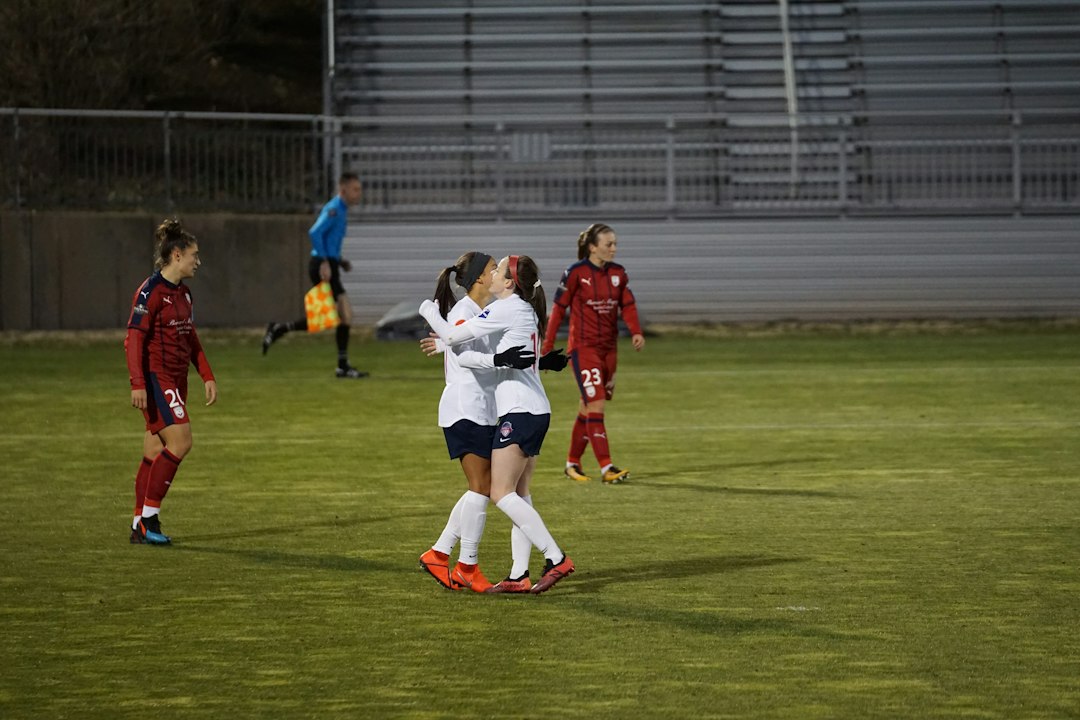




Last game high school team memories don't live in the scoreboard, the highlight reel, or the picture your mom took from the bleachers. They live in the minute after — the circle, the arms, the specific silence that settled over your team when the whistle blew and everyone understood at the same time that this was it. That huddle is the memory nobody has written about yet. Not the coaches' guides. Not the senior night retrospectives. Not the athletic department newsletters with their careful, cheerful language about growth and opportunity.
The last huddle. That is the one that stays.
The Final Whistle Memory Nobody Talks About
The final whistle sounds exactly like every other final whistle. That is the first thing that gets you.
You have heard it in preseason scrimmages that meant nothing. You have heard it at the end of blowout wins when you were already laughing. You have heard it at the end of losses that stung for a day and then dissolved. The sound itself is unremarkable. And then it blows on the last day and the sound lands differently — not because anything about it changed, but because something in your chest already knows before your brain confirms it.
For one suspended second, nobody moves. Your lungs are still working. Your knees still have the game in them. The girl to your left has gone very still in that specific way where the jaw is set hard and the eyes are bright and wide, and you recognize it because you are probably doing the same thing. The whole season is sitting on your sternum like a stone.
And then the circle happens. Not because the coach called it. Not because that was the protocol or the tradition or the plan. Because your bodies understood what to do when your minds couldn't process it yet. Someone opened her arms — maybe your captain, maybe the keeper, maybe the girl who had been your locker neighbor since freshman year — and the team came together the way it had all season: without being asked.


The huddle after the last game is not a celebration and it is not a defeat. It is a third thing. It is the athletic equivalent of a threshold — the last moment you are completely, undeniably, irreversibly yourselves as a team before you become something else. Former players. Alumni. Girls who used to.
That threshold is what this is about.
What Was Actually Said (And What Wasn't)
The specific strangeness of the last huddle is the communication that happens entirely without language.
You were inside a group of people you had sweated with, screamed at, driven four hours in a bus with, eaten cold gas station food with at 10pm on a Tuesday in October. You had watched each other fail and recover. You had been present for each other's worst performances and best ones. You had a shared vocabulary — shorthand, inside jokes, the particular way your team said let's go that no other team said exactly the same way.
And at the end, in the circle, almost none of that vocabulary was available.
What got said instead was: eyes meeting eyes. The way a hand grips a shoulder blade harder than necessary. The specific quality of a hug between two people who do not usually hug, both of them pretending not to know what it means. The girl who buried her face and didn't come up for a long time. The one who kept repeating I know, I know without anyone having said anything she was responding to.
What got said was: you were real to me. What got said was: this was real. What got said was: I don't know how to be done yet.
None of that required words. The circle said all of it.
Marisa T., 28, played varsity volleyball in central Illinois through her senior season. She describes the final huddle after the regional semifinal loss like this: they lost by two points in the fifth set, and when the whistle blew, her libero — a girl she had played with since seventh grade — walked straight across the court and put her forehead on Marisa's shoulder. No words. They stood there while the other team celebrated around them. "I still think about that more than the actual match," Marisa says. "More than anything else from that whole year. She didn't say anything. She didn't have to."
Senior Night Memories Get a Banner — The Last Game Gets Nothing
There is an official ceremony for senior night. Someone prints your name on a poster. Your parents walk you out in pregame. You get flowers. The PA system says something nice. It is choreographed and photographed and preserved in a folder somewhere in your parents' house.
The last game gets none of that.
The last game gets a bus ride home in the dark, some of you still in uniform, court dust still on your knees. It gets the fluorescent light of a locker room at 10:30pm when the season is over. It gets the sound of sneakers being pulled off for the last time in that context, dropped on the tile floor with a finality that hits harder than you expected.
It gets the quiet in the car when your parents drive you home and they know enough not to say the wrong thing, so they say almost nothing, and you sit in the passenger seat watching the highway and feeling the shape of something enormous that you don't have a word for yet.
What senior night gives you is a ceremony for something you haven't lost yet. What the last game gives you is the real thing — the actual goodbye, unscripted, undecorated, entirely yours.
The flowers from senior night are in a photo somewhere. The feeling from the last huddle is still in your body. That is the difference.
The Team Hug After a Loss Hits Differently Than Any Other
There is something specific about the last team hug when you lost.
A team hug after a win has joy in it, relief, the metabolization of four quarters of effort into a result. It is loud. Someone picks someone else up. There is screaming and there is motion.
The team hug after the loss that ended everything is quieter than any hug you have ever been in. It contains more people and makes less noise. It is the hug version of a held breath — everyone inside it trying to be strong for everyone else, and because everyone is trying, no one quite is, and that is somehow exactly right.
What made this one different from every other hug:
- You knew it was the last time the team would be in a circle like this, and your body registered that knowledge before your mind confirmed it
- The hug was not a celebration of something shared — it was the sharing of something that could not be celebrated
- Everyone in it was grieving something slightly different: their own ending, the team's ending, the specific friendship that only existed inside this sport, inside this season, inside this particular configuration of people
And then the fourth thing, the one that stays longest: nobody wanted to be the first to let go.
Letting go made it real in a way the whistle hadn't quite finished making real. The circle was the last protected space where the season still existed as present tense. While everyone was still in it, it was still, technically, happening. The first person to step back would end it. Nobody wanted that. Not because anyone was refusing to face what was coming, but because the body resists being the instrument of its own ending. That is not weakness. That is one of the most human things any of you did all year.
The Eulogy for Your Athletic Self
The last huddle is the funeral for the athlete you were.
This is not dramatic. It is structurally accurate. Everything that follows — the locker cleanout, the end-of-season banquet, the moment in October when practices would have started and don't — is the extended aftermath. But the actual moment of ending is the circle. That is where the athlete you built yourself into, the one who existed inside this team inside this sport inside these four years, finishes.
She does not transfer cleanly to college sports or club leagues or recreational play. She exists specifically in the context of this team. She is gone when the team disperses.
You may play again. You may play for years. But the you who wore this number with these people on this court — that version of you ends there. The huddle is the goodbye to her.
This is what makes the crying after the final game so specific and so hard to explain to people who weren't in it. You are not crying because you lost, necessarily. You are not crying simply because you will miss your friends, though you will. You are crying because you are watching yourself end in real time and there is nothing to do about it except stand in the circle and let it happen.
The research on athletic identity and retirement from sport consistently shows that the transition out of competition is experienced as a form of grief — not metaphorically, but neurologically and emotionally. What athletes report is not simply missing the game. They report missing the self they were inside the game: the decisive, physical, team-embedded self who knew exactly what she was doing and who she was doing it with. That self has an ending. For high school athletes, it ends in a circle, in the last minute of the last game, before the bus home.
You did not know you were grieving a version of yourself. You just knew the hug was hard to let go of.
What You Carry Out of the Circle
Here is what does not end in the huddle.
The number. The name on the back. The specific identity of being a player on this team — that does not dissolve when the circle breaks. It becomes a different kind of thing. It becomes who you were, which is a permanent form of who you are.
The girl who wore 14 for three seasons does not stop being the girl who wore 14 when she takes the jersey off. She carries the number differently, that is all. She carries it as memory instead of present tense. She carries it in the way she still instinctively watches the game correctly, in the way she understands exactly what that midfielder is feeling right now because she was that midfielder, in the way she says we used to and means it with her whole chest.
The last huddle is an ending. It is also a consolidation. Everything that happened — four years of practice, travel, competition, early mornings, late buses, injured ankles taped and re-taped, the season where everything went wrong and the season where everything finally came together — all of it compresses into permanent form inside that circle. It stops being something you are doing and becomes something you are.
That is the other thing nobody tells you. The last game high school team memory is not only loss. It is also the moment the experience becomes yours permanently. No one can take it. The team disbands; the number stays. The season ends; the athlete you were is preserved exactly as she was — in the huddle, in the dark, holding on one more second before letting go.
She is worth remembering. She is worth wearing again.
Your jersey is still out there waiting.
Design yours in minutes and see your name and number exactly the way you remember it.
Frequently Asked Questions
Why do last game high school team memories from the final huddle stay so vivid for years?
Because the last huddle is a threshold event — the precise moment your athletic identity shifted from present tense to permanent past. The brain encodes threshold moments with unusual clarity and emotional weight, particularly when the experience involves physical sensation, group identity, and irreversible change happening simultaneously. You were not just experiencing an ending; you were watching a version of yourself close in real time, surrounded by the people who had shared that version of you. That combination of factors — identity, embodiment, community, and finality — is exactly the kind of encoding that does not fade the way ordinary memories do. The huddle stays because what ended there mattered at the level of self, not just season.
Is it normal to cry more after the final game than after other losses during the season?
Completely normal, and the reason is that the emotions are categorically different. Crying after a mid-season loss is about the game — the missed opportunity, the execution that didn't hold, the season still in front of you to redeem it. Crying after the last game is about the ending of the context itself. You are not grieving a result; you are grieving the self who existed inside that context. Many athletes describe being surprised by the intensity of it — they expected to feel sad and instead felt something closer to devastation. That response is accurate. It corresponds to what was actually happening: a permanent ending to a specific version of who you were.
How do you explain what the last team huddle felt like to someone who was never in one?
The closest analogy: imagine the last conversation with someone before a permanent separation, except instead of one person it was fifteen, and instead of words it was mostly silence and physical contact, and instead of knowing when you would see each other again, everyone in the circle knew without saying it that this specific configuration — this team, this season, this shared self — was ending right now and would not exist again. The team hug after a loss at the end of a season is a mass goodbye to something that only existed inside this particular group of people, assembled in this particular way. The circle held as long as it did because everyone inside it understood what breaking it meant. That understanding is what made it the memory it became.
What does it mean to feel proud of a season that ended in a loss?
It means you understood, even then, that the season was not reducible to its final score. Pride in a team that lost its last game is one of the most honest emotions in sport — it is the recognition that what you built together, what you became over those months, was real and worth something regardless of what the scoreboard said at the end. The girl who stood in that last huddle, who held on one more second before letting go — she earned the right to be proud of herself. The loss was the last game's outcome. The season was something much larger. Those are two separate things, and your body knew the difference even when you couldn't articulate it.
See also: the grief that comes with the end of your athletic career | why your senior season memories stay so sharp decades later | senior night and the ceremony that still gets you emotional | the athletic identity you carried long after the final whistle | reconnecting with the teammates you said goodbye to without saying anything at all