

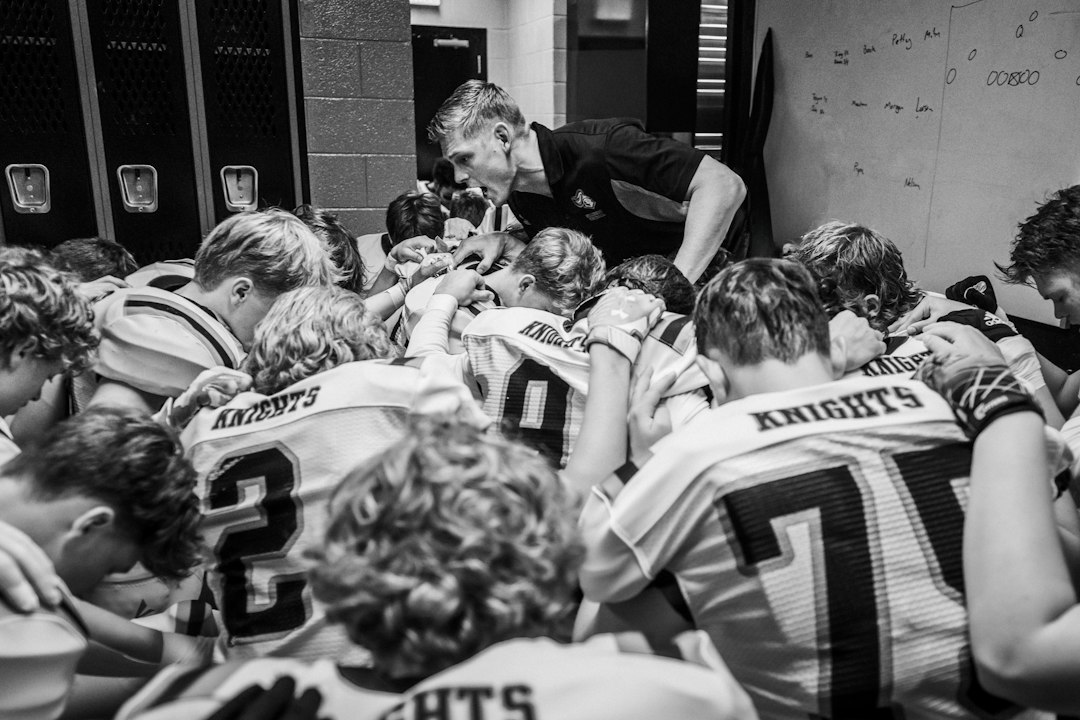




There's a speech you can still hear.
Maybe it came at halftime, down by two touchdowns, the locker room so quiet you could hear the ventilation system. Maybe it arrived before a championship game no one outside your town thought you'd reach. Or maybe it wasn't a big game at all — a Wednesday practice in November, legs heavy, season slipping, and your coach said something that shifted the floor beneath you.
Memorable half-time speeches carry a strange, durable weight. They don't soften with time the way other memories do. They stay somewhere in the chest — available on a difficult morning at work, before a hard conversation, in the middle of any season that isn't going the way you imagined it would.
This isn't a list of coaches quotes that stuck. That article already exists on this site. What follows is a genuine structural analysis: why those speeches worked, what rhetorical moves produced the effect, what emotional timing allowed the words to land so hard that you're still carrying them years later.
That understanding isn't nostalgia. It's transferable.
The Anatomy of a Speech That Sticks
Most halftime talks evaporate before the second half ends. A coach speaks, players absorb something, the game resumes. Nobody quotes it twenty years later.
Then there are the ones that become permanent fixtures in someone's inner life.
Our team has spent considerable time studying what athletes and coaches across different sports remember — and more importantly, why they remember it. The speeches that last share a recognizable structure. Not a formal one, not a scripted one. A set of moves that skilled communicators make instinctively under pressure, and that less experienced coaches miss even when their intentions are identical.
Rhetorical scholars would name this kairos — the Greek concept of the opportune moment, when words carry maximum force because the audience is maximally open to receiving them. A halftime locker room is one of the most reliable kairos environments in human experience. The team is physically depleted, emotionally unguarded, and compressed inside a time constraint that makes everything feel urgent and consequential. The coach has, at most, fifteen minutes.


What the great ones do with those fifteen minutes follows a pattern.
Move 1: Name the Exact Reality
The speeches that endure almost never begin with inspiration. They begin with acknowledgment.
Jimmy Valvano didn't open his 1993 ESPY speech with an uplifting claim about the human spirit. He said, plainly, "I've got tumors all over my body, and I'm trying to smile." He named the undeniable thing in the room first. That precision — unflinching, unperformed — is what arrested the audience before a single motivational word was offered. It communicated: this person is not going to pretend.
In a halftime locker room, the same move sounds different. It might be as simple as: "I know exactly what the score is. I know exactly what your legs feel like right now." Not denial. Not "forget the first half." The coach placing themselves inside the same reality as the team.
This is the first structural requirement of a speech that travels through decades: the speaker must demonstrate they are not insulated from the truth before anyone will follow them toward a different interpretation of it.
Move 2: Reframe the Meaning Without Denying the Facts
Once reality has been named without flinching, the great coaches do something that looks counterintuitive from the outside.
They don't argue against the situation. They change what it means.
"Down by ten at halftime" is a fact. "They couldn't close us out in forty minutes" is a reading of that same fact — and it is a categorically different psychological launching point for the second half. Vince Lombardi built an entire coaching philosophy around this move. His halftime addresses rarely contested the difficulty his teams were in. They repositioned difficulty as confirmation of identity. The harder the moment, the more precisely it revealed who you were.
The reframe works because it hands the athlete something to defend rather than something to overcome. Overcoming is abstract and effortful. Defending your own identity is immediate and personal — and significantly more motivating under physical exhaustion.
Move 3: Collapse the Emotional Distance
This is the move that separates the speeches people describe for the rest of their lives from the ones that were technically fine and completely forgettable.
The great halftime talks collapse the distance between the person speaking and the people listening.
Not the professional distance of authority — not "I've been coaching for thirty years and I know what this team is capable of." Something more exposed than that. The coach makes themselves briefly vulnerable before asking the team to be brave. Al Pacino's locker room speech in Any Given Sunday — fictional, but built from real coaching archetypes — turns entirely on this move. He catalogs his own failures before he asks anything of the team. Real coaches who execute this don't usually confess failure. They confess feeling. "I believe in what this team is capable of more than I've believed in anything I've been part of." That isn't a tactical directive. That's a person telling the truth.
When the emotional distance collapses, the athlete stops processing the speech as external instruction. They start receiving it as shared experience. That shift is the difference between a talk that informs and a talk that transforms.
What the Timing Did That the Words Alone Could Not
Rhetorical structure explains a significant portion of why certain impactful coach speeches endure. But the timing explains the rest.
Halftime is a psychologically specific state. Athletes are inside something — not anticipating it, not reflecting on it. The research on performance psychology suggests that the middle of a challenge is the moment when identity claims are most neurologically available. You've already begun. You cannot reverse course. Everything ahead remains open.
This is fundamentally different from a pregame speech, which asks athletes to imagine something they haven't yet entered. It's different from a postgame speech, which asks them to process something finished and unchangeable. The halftime speech arrives at the precise moment when the athlete is most primed to make a real-time decision about who they're going to be — not in the abstract, but in the next twenty minutes.
Great coaches — often without formal knowledge of the underlying psychology — sense this. Their speeches don't tell the team what to do. They tell the team who to be. And they deliver that message at the only moment in a competitive event when that kind of identity choice is both urgent and genuinely available.
Three Structural Patterns Worth Studying Closely
Not all memorable motivational sports speeches follow a single arc. Three structural patterns appear with meaningful frequency in the talks athletes cite decades after the fact.
Pattern 1: The Hard Truth + The Harder Belief
This structure leads with accountability and closes with conviction. The hard truth is stated plainly — the team hasn't played to their standard, the first half was not acceptable. Then, without apology or softening, the speech pivots to a belief statement so specific to this team that it functions as a direct challenge: I know precisely what you're capable of, and this is the moment to show it.
The critical detail: the belief statement must be particular. "You can do this" is not a speech — it's a greeting card. "I watched you execute that exact sequence in practice for five weeks, and I've seen what happens when you run it the way you're actually capable of running it" — that's a speech. Specificity is what makes the belief credible.
Pattern 2: The Single Image
Some of the most enduring halftime talks are organized around one image, one story, or one metaphor that the athlete carries physically out of the locker room.
Herb Brooks, before the 1980 US Olympic hockey team faced the Soviet Union, built his speech around a single idea rather than a strategic briefing: You were born to be here. This moment belongs to you. No tactical adjustments. No statistical comparisons. One image of belonging placed directly in front of twenty young men about to do something no one thought they could do.
Athletes remember images. They do not remember arguments. A speech that builds toward one crystalline image gives the athlete something to see when the moment becomes its hardest.
Pattern 3: The Quiet Room
This is the rarest pattern and frequently the most powerful. The coach says almost nothing. The silence carries the weight.
This pattern is only available to coaches who have built deep trust over a full season — where the team knows exactly what the coach's composure under pressure means, where three sentences communicate more than thirty would. Sometimes it's a single word on a whiteboard. Sometimes it's a look held long enough to mean something specific.
The quiet room cannot be manufactured or borrowed. It is the product of months of relationship. But when it lands, athletes consistently report it as the speech they remember longest — precisely because the restraint said more than any amount of words could have.
The Youth Athlete and the Speech They're Still Growing Into
Here's what gets underestimated in almost every conversation about coaches quotes that stuck: the young athlete receiving the speech often doesn't know yet what they've been given.
Maya T., 34, played club volleyball competitively from age twelve through her senior year of high school. She remembers a halftime speech her coach gave during a regional qualifier — her team down two sets, the season effectively ending in real time. "She didn't raise her voice once. She just looked at us and said, 'I need you to decide right now whether you're going to look back on today as the day you stopped or the day you didn't.' That was the whole speech." Maya's team lost the match. "But I've thought about that sentence probably a thousand times since then. I used it the week I almost quit my graduate program. I use it now when my own team is struggling."
The speech didn't produce a comeback. It produced a decision-making framework that has operated in Maya's life for more than twenty years after she stopped playing competitive volleyball.
This is what parents and youth coaches underestimate most consistently. The great halftime speech isn't primarily about the second half of the game it accompanies. It's about installing a way of thinking about difficult moments that a young person will carry into every second half they ever face — in competition, in work, in relationships, in the private moments when no coach is present and they have to give themselves the talk.
When a coach finds the right words at the right moment for a thirteen-year-old, they are doing something that will matter at thirty-four.
How to Use the Structure Now — In Whatever Second Half You're Currently In
The reason people search for old motivational sports speeches and the coaches quotes that changed something in them isn't pure nostalgia. It's because they're in a second half right now.
A project running behind schedule. A team that has stopped believing. A personal goal that looked different at halftime than it did when the season started.
The structural moves that made your coach's speech land — the ones described above — apply with equal force to the words you offer someone else in difficulty, and to the internal dialogue you're running when no one else is in the room.
Here is the structure made practical:
-
Name the exact reality first, without softening it. Don't perform optimism before acknowledging what is actually true. Say the thing plainly. The score, the situation, the way it actually feels. Anyone listening — including the listening part of your own mind — will extend trust to what comes next because you didn't flinch from what came first.
-
Change what the situation means — specifically. Not "this is manageable" and not "we'll get through this together." Something more precise: what does this difficulty confirm about your capacity to handle difficulty? What does still being in the fight rule out that you might otherwise have feared about yourself? Reframe toward identity, not toward outcome.
-
Close the distance. Whether you're addressing someone else or yourself, drop the authoritative frame. Say what you actually believe about this moment and the people in it. That honesty is what gives the next thing you say its weight.
Three moves. Fifteen minutes — or fifteen seconds, if that's what the moment allows.
Your jersey is still out there waiting.
Design yours in minutes and see your name and number exactly the way you remember it.
Frequently Asked Questions
What makes a halftime speech memorable rather than instantly forgettable?
The speeches that endure share three structural qualities: they acknowledge the current reality without deflecting from it, they shift what that reality means in a way specific to this team at this moment, and they close the emotional distance between the coach and the players. Generic motivation — the kind that could apply to any team in any locker room on any day — is forgotten because it carries no specific weight. The speech that lasts is the one that could only have been said to these people, by this person, on this exact occasion.
Can a coach learn to give great halftime speeches, or is it an innate ability?
The structural moves are learnable — naming reality, reframing meaning, collapsing emotional distance are practices, not gifts. What develops more slowly is the instinct for reading a room and knowing what it needs in a specific moment. That instinct grows from relationship built over a full season, not from oratorical talent. The speeches athletes remember for decades are memorable partly because of what was said and largely because of who said it and the trust that person had earned. The words are almost secondary to the credibility already in the room.
How do I apply what I remember from an old coach's speech to a challenge I'm facing now?
Start by identifying which structural move that speech made on you. Was it the reframe — the shift in what your situation meant? Was it the single image your coach handed you? Was it the quiet conviction that communicated more than a longer talk would have? Once you identify the specific move, you can apply it deliberately to your current situation. The most useful thing about great coaches quotes that stuck isn't the specific words — it's the underlying move the words were making. Learn the move and you can make it yourself.
Are recorded or written versions of classic speeches as powerful as the original live delivery?
Rarely, and for a specific reason: timing. The force of an impactful coach speech comes substantially from when it arrives — dropped into a moment of maximum psychological openness, when the athlete is mid-effort and the outcome is still genuinely undecided. Recordings and transcripts can be moving and instructive, but they operate outside the kairos conditions that gave the original speech its particular weight. What they offer instead is the structural lesson — the moves the coach made — which can be studied and applied in live moments when conditions are right.
See also: why high school sports still matter so deeply to adults | the science of why those moments from your senior season are burned into your memory | the emotional weight of the bus ride home after a loss | what it means to carry your athletic identity long after the final whistle | the lessons high school sports taught you that nothing else could