

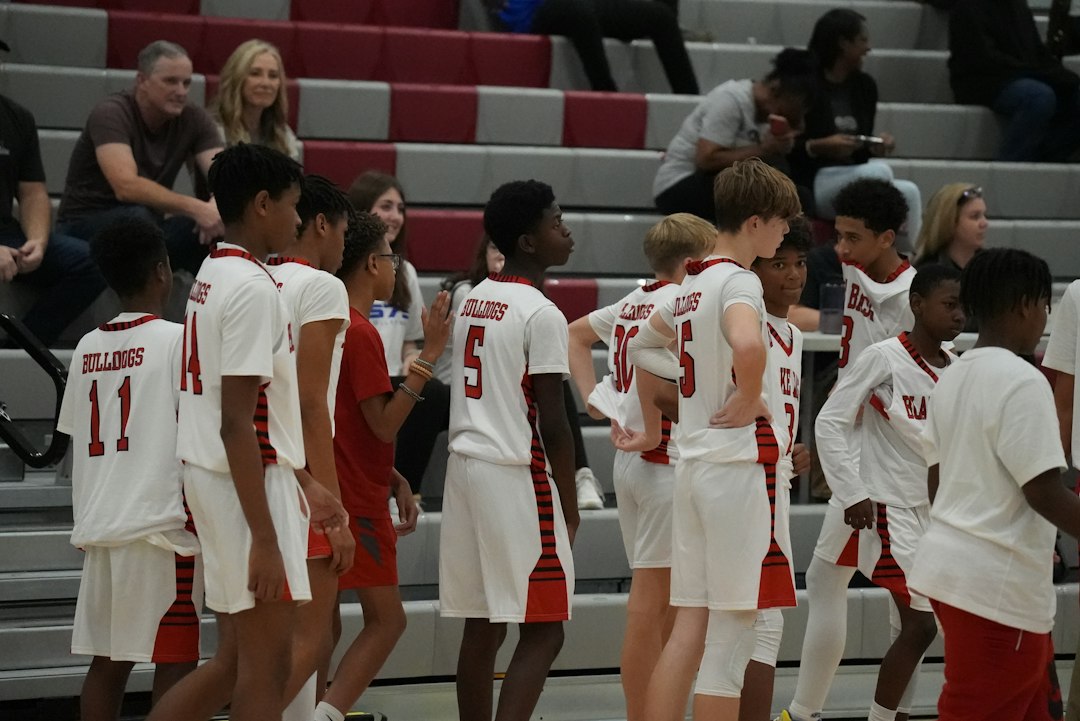




There are speeches you forget before the second half starts. And then there is the one you are thinking about right now.
You didn't go looking for it. Something happened — a hard week, a moment with your own kid, a practice you watched from the bleachers — and suddenly you were back in that locker room. The smell of it. The specific sound of the floor drain. The way everyone went quiet when he walked in. If you played high school basketball, you know exactly the kind of basketball coach halftime speech this article is about. Not the clipboard-and-diagram kind. The other kind. The one that rearranged something in your chest.
This is not a list of motivational basketball coach quotes pulled from the internet. This is about the experience of being in that room, hearing those specific words, and understanding — years later — why they still haven't left you.
The Locker Room Has Its Own Physics
Walk into any high school gym during a close game and the building hums with a particular kind of energy. The crowd, the buzzers, the sneaker squeaks — all of it carries its own momentum. But the moment that door swings shut behind the last player, everything changes.
The locker room is a pressure chamber. Outside, there are hundreds of people. In here, there are twelve. Outside, the game is abstract — a score on a board. In here, the game is personal. It is a grade on something that cannot be retaken.
The coach walks in, and the air shifts.
That shift — that specific atmospheric change — is the reason certain speeches reach places that ordinary conversation never does. The halftime locker room is one of the few environments in adolescent life where the conditions for genuine transformation are all present at once: exhaustion, stakes, group identity, and the compressed time pressure of knowing you have to go back out there in ten minutes.


What happens in that room is not performance. It is not motivation in the LinkedIn-post sense of the word. At its best, a coach's locker room speech is an act of naming — putting precise language on something the players already feel but cannot say out loud themselves.
The great ones knew this. They didn't manufacture fire. They handed a name to the fire that was already burning.
Two Kinds of Speeches, One Locker Room
Not every halftime speech is the kind you carry. In our experience talking to players who played decades ago, the speeches that survived fall into two distinct categories — and they produce opposite effects, though both can mark you permanently.
The speech that lit the fire.
This is the one people describe with the same words, over and over, regardless of what state they played in or what year they graduated: I didn't even know I could do that. The coach saw something specific in you — not the team in the abstract, but you, specifically — and named it out loud in front of everyone. Or they told the truth about the moment in a way that removed the fear from it. Or they said the one sentence that made losing this particular game feel like the worst possible outcome, more than you had allowed yourself to feel it before they said it.
Marcus T., 38, a former point guard from Rockford, Illinois, still keeps the specific phrase his coach used in a timeout during the regional semifinals on a note in his phone. Not because he looks at it regularly, but because he never wanted to forget the exact wording. "He didn't say we needed to play better," Marcus said. "He said we were already playing the right way and the other team was about to feel it. I didn't know what that meant. But I believed him. And then I went out and believed it into being true."
That is the first kind.
The speech that broke something.
This one is harder to talk about, and for good reason. Not every coach had the precision to match the moment. Some coaches walked into a locker room carrying their own frustration — with the game, with the season, with something that had nothing to do with the twelve teenagers in front of them — and they said things that did not build. They dismantled.
The players who experienced the second kind often describe a specific, lasting effect: a voice in the back of their head during future high-pressure moments that sounds exactly like that coach, telling them they are not enough. The speech changed them too. Just not in the direction the coach intended.
Both types are worth understanding. Because the locker room, like the game itself, is not neutral. What happens in it matters long after the final buzzer.
What Made the Great Ones Land
Sports psychology researchers have spent decades studying the conditions under which verbal instruction and emotional communication produce lasting behavioral change in athletes. The research consistently points to one finding that coaches in the greatest locker room speeches seemed to understand intuitively: specificity is not just more credible than vague encouragement — it is a fundamentally different kind of communication.
"You need to play harder" is information. "You have beaten their best defender three times in a row on the left side, and they still haven't adjusted — go get it" is revelation. The first tells a player what to do. The second tells a player what is already true. That distinction is the difference between a speech you forget by the third quarter and one that plays in your head twenty years later when you are trying to close a deal, finish a project, or convince yourself to get back up.
The speeches that lasted shared four qualities, in our observation:
- Specificity over generality. The coach named a specific play, a specific player, a specific moment in the first half that proved something the team needed to believe.
- Truth over inflation. The great coaches did not tell players the game was easier than it was. They told them the game was exactly as hard as they had felt it, and that they were capable of hard things.
- Brevity with weight. Not one of the lasting speeches was long. The ones that stuck were usually under three minutes. The room needed oxygen, not oration.
- A single image or phrase that crystallized everything. One coachable moment — one sentence the brain could hold onto going back out the tunnel.
Coach yelling at halftime is a cliché for a reason. Plenty of coaches did exactly that. But the ones who changed players did something harder than yelling. They spoke with precision under pressure to a room full of exhausted teenagers who were desperately hoping someone would tell them what was true.
The Speech That Changed You — What It Was Really About
Here is what most people don't realize until they are old enough to look back at it: the speech that changed you was not really about basketball.
It was about you.
The game was the container. The locker room was the pressure. But what that speech actually delivered — when it was the right one, the kind that stuck — was a specific piece of information about who you were. Not who you were supposed to be. Not who the coach needed you to be for the next two quarters. Who you already were, seen clearly by someone whose seeing you trusted.
That is a rare gift at any age. At sixteen, in a locker room, with a game on the line, it is almost incomprehensibly powerful.
Deja R., 31, played guard for a small-school program in rural Georgia that made the state quarterfinals her junior year against a team they had no statistical business beating. She remembers almost nothing about the game itself. She remembers exactly what her coach said at halftime, standing in front of a whiteboard she hadn't written a single thing on: "You have already surprised every person in this building except the people in this room. Now go surprise yourselves."
Deja went back out there and played the best half of basketball of her life. Her team lost by four. She says she still uses a version of that sentence — adjusted for context — whenever she is about to do something difficult. "It's mine now," she said. "She gave it to me and I kept it."
That is what the great basketball coach halftime speeches actually produced. Not a win. A voice. A portable piece of conviction that traveled with the player for the rest of their life.
Why You Are Still Thinking About It
Memory research tells us that emotionally charged experiences — particularly those that occur during periods of high physiological arousal — are encoded differently than ordinary memories. The amygdala tags them as significant. The body remembers the room, the smell, the sound. The brain holds the words with unusual clarity.
This is why you can't remember your locker room before the first game of your sophomore year, but you remember every word from the halftime of the game that mattered most.
It is also why the bad speeches — the ones delivered in anger, the ones that named something in you that you didn't want named in front of everyone — can be equally durable. The amygdala does not evaluate the quality of the experience before tagging it as significant. High arousal is high arousal. High stakes are high stakes.
The coach yelling at halftime in frustration hits the same recording mechanism as the coach speaking quietly about what he believed you could do. Both get stored. Both get replayed.
What you do with those recordings — which voice you choose to run in the moments that need a voice — that is the work that happens after the final buzzer. After the season. After high school. That is the work that takes a lifetime.
Carrying the Speech Forward
The players who seem to carry these locker room moments most productively are not the ones who idolize the speech or the coach. They are the ones who have done something specific with what they were given.
They extracted the principle from the moment. They asked: what was actually true about what that coach said? Not what felt good to hear, but what was specifically, verifiably accurate about the belief the coach named in them? And then they applied that specific truth — not the nostalgia of it, but the operational content of it — to the next difficult situation.
The speech that changed you was always about more than basketball. The only question is whether you have figured out exactly what it was about, specifically enough to use it on purpose.
Your jersey is still out there waiting.
Design yours in minutes and see your name and number exactly the way you remember it.
Frequently Asked Questions
Why do certain coach speeches stay with players for decades when others are forgotten immediately?
The speeches that last share one consistent quality: specificity. When a coach names something precise — a specific play, a specific belief about a specific player, a specific truth about the game as it is actually unfolding — the brain holds it differently than a vague motivational appeal. High-stakes environments like a tied game at halftime also trigger stronger memory encoding, which is why players can recall word-for-word a speech from thirty years ago but can't remember what they had for breakfast.
Is there a difference between a speech that motivates in the moment and one that changes a player long-term?
Yes, and it is significant. In-the-moment motivation typically relies on arousal and urgency — getting the team's energy level up for the next twenty minutes. Speeches that produce long-term change almost always deliver a specific piece of information about the player's identity or capability that the player did not fully believe before hearing it out loud from someone they trusted. The lasting ones are not pep talks. They are acts of naming.
What made certain coaches so effective at delivering halftime speeches?
The coaches players describe as most effective almost never delivered prepared remarks. They walked in and read the room — the specific emotional state of the specific players in front of them — and responded to what they actually found there. The best ones understood that their players didn't need a performance; they needed to hear something true spoken clearly. Brevity, eye contact, and the ability to identify and name one specific thing the team needed to believe were more consistent factors than volume, passion, or speech-writing ability.
Can a harsh or critical halftime speech have lasting negative effects?
It can, and the effect follows the same mechanism as the positive version: high arousal + trusted authority + specific language = durable memory. When a coach uses that combination to diminish rather than build — naming a failure publicly, questioning a player's character, or delivering criticism that feels personal rather than tactical — the encoding is just as permanent. Many adult athletes describe ongoing self-critical internal voices that trace directly back to specific things specific coaches said in specific locker rooms. The room amplifies everything. That is why what gets said in it matters so much.
How do you know if the speech you remember actually happened the way you remember it?
You probably don't, with complete accuracy — and that is worth acknowledging. Memory is reconstructive, particularly emotional memory. The feeling of the speech, the words that mattered most, the effect it had — those are likely accurate. The exact sequence, the precise phrasing, the specific context — those may have been refined by thirty years of retelling. What matters is the operational truth that the speech gave you. Whether the quote is verbatim is less important than whether the belief it installed still serves you.
See also: why high school sports still matter to adults decades later | the grief that comes with the end of your athletic career | what high school sports taught you that nothing else could | why your senior season memories are so unusually vivid | the athletic identity you carried long after the final whistle