

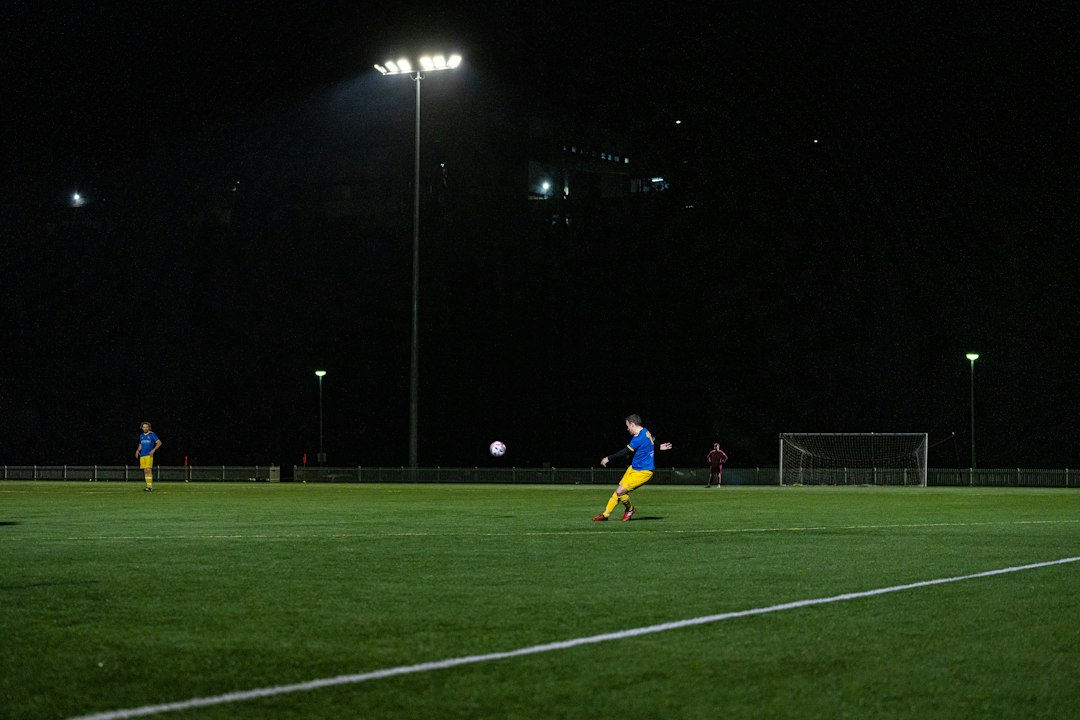




You remember the walk before you remember the score. That's the strange thing about senior night. Ask any former player what happened in the game and you'll get a shrug and a half-answer. Ask about the walk across the 50, who held your arm, what the announcer said, how the turf felt under cleats you suddenly realized you'd never lace up for a home crowd again, and the room goes quiet.
If you're searching for senior night football ideas, chances are you're one of three people. You're a former player trying to remember (or honor) that night. You're a coach building one for your own seniors. Or you're a parent who's already seen the checklists and wants something with more weight than a poster board. This guide is written for all three, but from one specific seat: the player's.
Most of what ranks for this topic is logistics: order the banners, line up the parents, assign someone to the PA system. That stuff matters, and we cover it below. But logistics isn't why anyone still thinks about the night thirty years later. Here's what is.
What Senior Night Actually Felt Like From the Field
The honest version starts with a confession we hear from nearly every former player: you were more nervous about the walk than the game.
Think about the physical reality of it. You've spent three or four years in a helmet. Your face is anonymous, your number is your name, and the crowd has only ever cheered for the idea of you. Then, for about forty seconds, the helmet is in your hand, the public address announcer reads your name, and your mom or dad or grandfather or whoever stood in the stands in the rain for four seasons walks out to meet you. For one moment you're not #54. You're a person with a family, and everyone in the stadium knows it.
The Three Things Players Remember
When we ask former players what stuck, the answers cluster tightly around three things.


The announcer's words. Not the banner, not the gift, not the photo. The thirty seconds of text read over the loudspeaker: your name, your position, a line about what you did, maybe a plan for after graduation. Players remember the line that was specific. "Number 54, offensive guard, who never missed a Tuesday film session in four years" lands harder than "a true leader and a great teammate." One of those could be about anyone. The other could only be about you.
Who walked with you. Players remember the physical presence: a father's hand on the shoulder pad, a mother who couldn't stop adjusting a collar that was already straight, a stepdad who showed up when he didn't have to. For players whose family situation was complicated, the person who walked with them is often the whole story.
The sound change. This one surprises people. Right as your name is called, the crowd noise shifts. It drops, then swells. Former players describe it as hearing the stadium breathe. You don't plan for it and you can't stage it, but a good ceremony protects the space for it by not talking over the moment.
What Didn't Matter
Here's the part the checklists skip. The things that took the most planning mattered least to the players.
Elaborate decorations. Nobody over thirty remembers the balloon arch. The giant framed collage that took a booster mom three weeks to assemble? It probably ended up in a garage. Nobody thought less of the effort; it just wasn't what lodged in memory.
The slideshow. If you've ever sat through a senior night video, you know the pattern: a baby photo, a pee-wee photo, a freshman photo, a sad acoustic song. Players are usually standing awkwardly on the field in full pads watching it on a stadium screen with eight hundred people looking at them. It's well-intended. It's rarely the memory.
The gifts, mostly. A handful of players kept a specific gift for decades, but they almost always kept it because of who gave it and what it said, not what it was.
The Senior Night Ceremony: What Actually Works
If you're building the evening, here's how to put your energy where players will actually feel it. Think of the senior night ceremony as three beats: the introduction, the walk, and the moment after.
Beat One: The Introduction
Write the announcer script like you're writing a toast, not a program. Each player gets two or three sentences, and at least one detail must be impossible to confuse with anyone else on the roster.
A simple way to gather those details: ask the position coaches for one story per senior, and ask each senior's parent one question: "What's something about your son that you hope someone says out loud tonight?" The answers are usually unexpected and usually perfect.
Keep the pace brisk but not rushed. Roughly twenty to thirty seconds per player is the sweet spot. Longer and the crowd drifts; shorter and it feels like reading a roster.
Beat Two: The Walk
Walking out with parents is the emotional core, and the details matter more than people expect.
- Decide who walks with whom ahead of time. Not every family fits the standard mom-and-dad picture. Let each player choose, privately and early, so nobody is figuring it out on the field with the whole town watching.
- Give them somewhere to look. A line of teammates, a banner, a specific yard line. A player with nowhere to look tends to stare at his shoes.
- Build in the pause. After the name is read, hold two beats of silence before the next name. That's where the crowd noise breathes.
Beat Three: The Moment After
This is the most neglected beat and the one players mention most often in hindsight. After the walk, the senior has to go play a football game. Give him thirty seconds with his family in a spot out of the way, with no cameras pointed at him, before the team huddles. Players who got that moment say it let them put the emotion down and pick up the game. Players who didn't often say they played the first quarter in a fog.
Ideas for Senior Football Night That Hold Up
Now the practical part. These ideas for senior football night go beyond the standard poster-and-balloons package, organized by how much they ask of you.
Low Effort, High Impact
- The handwritten letter from a coach. One page, handed over privately in the locker room before the game. Of everything on this list, this is the thing former players mention most. Coaches who write them tend to keep writing them.
- Teammate quotes read aloud. Ask each senior's underclassmen teammates for one sentence about him. Read two or three during the introduction.
- A game ball from a specific moment. Not a generic ball. One from a specific play or game that mattered to that player, labeled so he knows you remember it.
Moderate Effort
- A framed lineup photo from the player's freshman year next to this year's. The contrast does the work; no caption needed.
- A film clip. Not a highlight reel of the whole season. One clip: his best block, the tackle nobody noticed, the moment that showed who he was. Play it during the walk.
- A reserved seat, afterward. Assign each senior a seat at a postgame meal with his family, with the coaching staff circulating. It sounds small and it matters a lot.
Bigger Gestures
- A custom jersey that outlasts the season. More on this below.
- An alumni walk. Invite a former player from each decade to stand along the walk. Seniors shake hands with men who wore the same colors in 1989 and 2004. It reframes the night from "you're finishing" to "you're joining something."
Football Senior Night Gift Ideas Players Actually Keep
Gift ideas are where the checklists get most generic: frames, blankets, engraved water bottles. Some of those are fine. But if you want the gift to survive the closet purge that happens at 25, the formula is simple: it has to be specific to him, and it has to be something he'd want to look at again at 45.
What Tends to Last
Anything with his name, his number, and the year. Specificity is the entire game. A generic "Class of 2026" blanket gets donated. A framed piece with his actual number and a real moment from his season gets hung in a den.
Something wearable he'd actually put on. Think a jacket, a quality hat, a jersey built for wearing and not just displaying. There's a reason vintage and throwback apparel has had such a long run: brands like Mitchell & Ness built an entire business on the idea that people want to wear the memory of a team and an era, not just the logo. The same instinct drives a senior night gift. A shirt he wears at his own kid's game someday does something a trophy on a shelf can't.
A letter or recorded message he can't get anywhere else. Hard to overstate this one. Someone he respects saying exactly what they saw in him. No store sells it.
What Usually Doesn't
Generic engraved items, bulk-ordered with a name stamped on, tend to end up in boxes. So do gifts that are clearly the same for every senior regardless of who they are. The player can tell, even at seventeen.
A Story Worth Telling
Dale M., 52, played right guard for a small-town team in Ohio. His father, a night-shift mechanic, made it to exactly one home game his senior year, and it was the senior night game. Dale remembers the announcer botching the pronunciation of his last name and his dad, standing next to him in work boots with grease still under his fingernails, quietly correcting it into the microphone-adjacent air. "Nobody heard him but me," Dale says. Twenty-eight years later, Dale doesn't remember the score, the opponent, or what the banner said. He remembers his father fixing his name. When Dale's daughter made varsity volleyball, he had a custom number jersey made from his old football number, framed beside a photo of that walk. "It's the only thing in the house that I'd run back in for," he says.
That's the pattern. The thing that lasts is almost never the production value. It's the small, specific human moment, preserved somewhere it can be looked at again.
Marking It Now: If You're a Former Player
Maybe you're not planning anything for a current senior. Maybe you're the guy reading this at 38 or 55 with a quiet pull you can't quite name, because you remember that walk and nobody ever helped you mark what it meant.
You don't need a ceremony. You need a few small acts of attention.
Three Ways to Mark It Now
- Write down the walk. Open a blank page and describe it: who walked with you, what the announcer said (or what you wish he'd said), what the turf smelled like. Do this once, in full sentences. You'll be startled by what you still remember.
- Contact the person who walked with you. If they're still alive, tell them what that walk meant. If they've passed, write it anyway and keep it somewhere you'll find it. Players regularly say this is the single most meaningful thing they ever did about their football years.
- Put your number somewhere you'll see it. Not a trophy case. Somewhere in daily life: a framed jersey in the hall, a number on a shirt you actually wear. Your old high school number is one of the few things from age 17 that still says something about who you were. It's worth seeing it again.
If you've lost or never owned your jersey, that's a gap you can close. A custom jersey in your school's colors, with your name and your number, rebuilds the thing you'd have kept if life hadn't gotten in the way. It's not a costume. It's a tribute to your own playing days that makes the memory physical again.
Marking It Now: If You Coach
If you're the coach building senior night, you're in the unusual position of shaping a memory you won't be part of in thirty years, but one your players will carry the whole time. A few principles from the sideline side of the fence:
- Spend your time on the introduction script, not the decorations. Ten hours writing real, specific lines for each player is worth more than ten hours building a backdrop.
- Protect the quiet. The best senior nights have moments with no music, no announcer, and no cameras. Build them in on purpose.
- Include the kid nobody notices. The third-string long snapper who never missed a practice deserves the same specificity as the quarterback. How you treat the end of your bench tells the whole team what you actually value.
- Do something for the seniors who aren't starting. They walk out the same way. They feel the same thing. Make sure the script treats them that way.
Many coaches who've run senior nights for years describe the same shift: early on, they ran the ceremony as an event. Later, they ran it as a handoff, from the program to the player, with the whole community as witness. That framing is backed up by the research on why it matters: the National Federation of State High School Associations has long argued that high school athletics exist to build character and belonging, not just win games, and a well-run senior night is one of the clearest places that mission becomes visible to a whole community. The handoff version is the one players remember.
What to Skip
A few things we'd cut from almost any senior night plan:
- Generic praise. "Hardworking, dedicated, a great teammate" fits every player ever and tells nobody anything.
- Long speeches from adults. Nobody on that field wants a seven-minute monologue about the importance of perseverance.
- Anything that makes a player feel on display in a way he didn't choose. Surprise reveals are risky. Some players love them. Plenty hate them, and you often can't tell in advance. When in doubt, ask.
- Over-scheduling the families. Parents are already carrying a lot that night. Keep their instructions to two or three lines.
Frequently Asked Questions
What are good senior night football ideas that don't cost much?
The highest-impact options are nearly free: a handwritten letter from a coach, two or three teammate quotes read aloud, and a specific, detail-rich introduction for each player. Players consistently remember what was said about them far more than what was handed to them, so time and attention beat budget.
What should a football senior night ceremony include?
A strong ceremony has three parts: a specific, personal introduction read by the announcer, the walk with family across the field, and a short private moment afterward before the game begins. Everything else, such as banners, gifts, and videos, is optional. Protecting a few seconds of quiet during the walk matters more than any decoration.
What are good football senior night gift ideas?
The gifts players keep are the ones that are specific to them: something with their name, number, and year; a letter from a coach; a game ball tied to a real moment; or a wearable item they'd actually use. Generic bulk-ordered items tend to get donated years later. Specificity is what separates a keepsake from clutter.
Who walks out with the player on senior night?
Traditionally parents, but it doesn't have to be. Many players walk with a grandparent, stepparent, guardian, older sibling, or mentor. The best practice is to let each player decide privately and early so no one is working it out in front of the crowd.
How can a former player mark senior night years later?
Write down the walk in detail, reach out to the person who walked with you, and put your number somewhere you'll see it regularly. If you no longer have your jersey, a custom one with your name and number rebuilds the physical piece of the memory.
How long should the senior night introduction be for each player?
Roughly twenty to thirty seconds. Long enough for two or three genuinely specific sentences, short enough that the crowd stays with you through a full roster. Leave two beats of silence after each name so the moment can land before the next one starts.
Your jersey is still out there waiting.
Design yours in minutes and see your name and number exactly the way you remember it.
This article contains affiliate links. If you purchase through these links, we earn a commission at no cost to you.
See also: why your last home game ceremony still gets you emotional | how to create a custom sports shadow box | what playing under the lights actually felt like | the grief of ending your athletic career | what to do with your old varsity letter jacket