

The Inland Northwest Sports Hall of Fame welcomes Jeff Brown and a pair of legendary coaches, among others in its 30th induction class — and for anyone who ever played in this region, that sentence lands differently than a standard sports announcement. The ceremony is set for October 21 at 4 p.m. at Numerica Veterans Arena, sponsored by Spokane Sports, with tickets through TicketsWest. It honors Jeff Brown, coaches Ken Pelo and Pat Tyson, distance running great Rick Riley, and NCAA champion wrestler Jared Lawrence. Five names. Five careers. And two more, Bill Stanley and Bob Tobiason, honored in the Scroll of Honor. One region that made all of them possible.
This is not a recap of the press release. The news is already out. This is for the people who feel something when they read those names: the former players, the former runners, the former wrestlers who recognize a coach's name on a hall of fame list and are briefly, completely transported back to the gym floor.
The Class That Got Called: Who They Are and What They Built
Every one of these names deserves to be said out loud and held there for a moment.
Ken Pelo spent 37 years as a history teacher and wrestling coach at Rogers High School, and the numbers read like a dynasty. He led the Pirates to 13 Greater Spokane League championships with a 250-118-4 dual-meet record, with teams that finished top-four at state eight times and produced 10 individual state champions. Yet Pelo's name carries weight in this region the way certain gym floors carry weight: you walk in and you immediately understand that something serious happened here, that decades of practices and game-day decisions accumulated into the kind of coaching legacy a hall of fame exists to recognize.
Pat Tyson built one of the region's most dominant cross-country programs at Mead from 1986 to 2004, winning 12 state titles, 79 consecutive dual meets, and nine individual champions on the way to a 160-8 dual record. Those numbers make him synonymous with distance running excellence across the Northwest. But the kind of coaching that earns a hall of fame induction isn't measured in wins and losses alone. It's measured in the runners who kept running long after the last race, who still feel his training philosophy in their lungs and their legs thirty years later. He later coached at Gonzaga, leading the Bulldogs to four NCAA championship meets and the school's first WCC men's title in 2023.

Jeff Brown was a Mead High School standout before Gonzaga, and he represents exactly the kind of player this region produces and quietly takes pride in. He set the Greater Spokane League career scoring record and became Spokane's first Washington Player of the Year after scoring a state-tournament-record 127 points in 1989. At Gonzaga he was a three-time All-West Coast Conference selection, the 1994 WCC Player of the Year, and he led the Bulldogs to their first WCC title and the school's first postseason appearance. Brown's path from Mead's hardwood to Gonzaga's court is the kind of athletic biography that makes every Inland Northwest kid who ever shot around in a driveway believe the floor they practice on is connected to something larger than themselves.
Rick Riley set a national record in the two-mile at Ferris High School in 1966, a mark that stood as a state record for 58 years. At Washington State he became the first Cougar and the first Spokane native to break four minutes in the mile. The runners who came out of this region and competed at the highest national levels did so within a culture that valued consistency and mental toughness over flash, and Riley's career fits that tradition precisely.
Jared Lawrence went 133-0 at Sandpoint High School with four state championships, then won an NCAA championship at 149 pounds for Minnesota in 2002 and finished runner-up at the U.S. Olympic Trials. An NCAA title in wrestling is one of the hardest individual achievements in college athletics, and Lawrence belongs in any hall of fame that takes individual competitive accomplishment seriously.
Five inductees. Five entirely different athletic journeys. Two more names in the Scroll of Honor. One region that produced all of them.
This class was voted on by an 11-member committee chaired by longtime Spokane broadcaster Dennis Patchin. Inductions happen every two years, and this class lifts the hall's membership to 174, with 56 more names in the Scroll of Honor.
What It Means If You Played for One of Them
Here is what the official announcement cannot capture and what the October 21 ceremony will only partially capture: what it actually feels like to have been coached by someone whose name just appeared on a hall of fame list.
Former players know this in their bodies before they know it in their minds. You see the news and something in your competitive memory fires before you've finished the sentence. You are briefly, completely back in the gym. You can smell the floor wax. You can feel the specific weight of the practice jersey across your shoulders. You can hear the exact cadence of your coach's voice calling a correction from half-court.
Pat Tyson's runners have spent years describing what his coaching felt like — the specific way he calibrated intensity for each athlete, the way he seemed to know precisely where a runner's limit was and then found a way to push ten meters past it without breaking them. If you ran for Tyson, you are not reading about an inductee right now. You are reading about someone who is woven into the actual muscle memory of your athletic life. The breathing pattern you developed under his coaching. The mental arithmetic you ran in the final two hundred meters of a race.
Ken Pelo's players carry something similar. The coaches who end up in halls of fame are consistently the ones who taught something beyond the sport itself. Something about preparation, about accountability, about showing up on the days when showing up is the hardest possible thing to do. Those lessons do not expire when the final buzzer sounds. They tend to compound, which is why the coach who changed your life never really leaves the room.
Maria T., 38, played varsity basketball in the Spokane area and still walks into any gymnasium and hears her old coach's voice in her head. "It doesn't matter how many years go by," she said. "That voice is part of how I think about competition — about anything, really. You don't forget the people who showed you what it actually means to work for something." When she heard about this hall of fame class, she texted her old point guard before she finished reading the announcement.
That is what these inductions do. They reconnect people across years and miles, through the shared geography of a sports life built in the same region. And if a name on this list makes you want to reach back out, there is a real difference between actually thanking your high school coach and leaving a Facebook comment.
Remember When the Gym Was the Whole World?
Every former player who grew up in the Inland Northwest has a version of this specific memory stored somewhere they don't access often enough.
The gym is full — or full enough that the noise bounces off the old wooden backboards and comes back at you from a different angle. The drive to an away game through mountain passes meant you earned every road contest you played. The early bus departure, the hotels when the budget allowed and the same-night drive home when it didn't, the specific rivalry texture of playing a team whose coach had known your coach for fifteen years.
Jeff Brown coming out of Mead High School and going on to play at Gonzaga is a story that every basketball kid in this region felt in a personal way. His 1989 season is part of why playing in the '80s mattered so much to a generation of athletes who came through it. When a local player makes it to a program that went from regional presence to consistent national contender, it doesn't just validate that individual athlete. It validates the entire local ecosystem that produced them — every coach who ran a youth league, every gym teacher who noticed the footwork first, every program that gave the next generation a place to develop the game.
Rick Riley's distance running career and Pat Tyson's coaching legacy exist within the same regional logic. The terrain of the Inland Northwest doesn't accommodate shortcuts. The runners who came out of this region and competed nationally did so without the climate advantages and flat-course training environments that other programs enjoy. They built their fitness the hard way, on the kind of ground that makes you earn every second of improvement.
Halls of fame are where regions look at themselves and say: this is what we built. This is what came from here. And the people who came from here — who played and ran and wrestled here — get to look at that October 21 ceremony and say: I was part of that. My effort was part of that. The sweat I left on that floor was part of that conversation.
Distance Running, Wrestling, and the Sports That Build the Complete Athlete
Rick Riley and Jared Lawrence represent something important and specific about this induction class: the breadth of athletic excellence it honors without forcing all of it into a single competitive tradition.
Distance running in the Pacific Northwest carries its own culture. The terrain demands a particular kind of athlete — one who finds something in the discomfort of long training miles that other people simply cannot locate in themselves. Pat Tyson's coaching legacy and Rick Riley's competitive career both exist within that specific environmental and psychological context. The hills, the weather, the distances — none of it is glamorous at the training level, and all of it produces athletes who know something about perseverance that shorter, more explosive sports don't always teach in the same way.
Wrestling at the NCAA championship level is a reminder that individual sport excellence is among the most demanding athletic environments in American collegiate competition. There is nowhere to hide, no teammate to defer to, no game flow to blame for a bad performance. Jared Lawrence winning an NCAA title is a singular achievement. In a class that includes coaches who built multi-decade programs and a basketball player who carried regional pride to a nationally recognized program, Lawrence's individual excellence stands as its own complete chapter.
What connects all five inductees across their different sports is the geography and the culture it produced. The Inland Northwest generates competitive athletes not through infrastructure alone but through a specific seriousness of purpose that coaches like Pelo and Tyson built across careers that spanned decades. That culture is what this hall of fame is honoring on October 21 — not just the individual accomplishments, but the competitive environment that made those accomplishments possible.
The October 21 Ceremony: What Being in That Room Actually Feels Like
If you have never attended a regional sports hall of fame induction, the emotional temperature of the room is difficult to describe to someone who hasn't experienced it.
It is not a gala. It is not a corporate awards evening. It is a room full of people who care about sports at the level where sports actually live — not at the national broadcast level, but at the gymnasium-on-a-Tuesday-night level. The level where the coach drives the van. The level where the away trip goes on a volunteer's credit card and nobody makes a fuss about it. The level where the stakes feel completely real to the forty people in attendance even though nobody is watching on television.
The inductees walk in and the former players stand up first. That's the tell. The standing ovation from former athletes carries a specific weight that no other audience response can replicate, because those people are not applauding a career in the abstract. They are applauding something that happened to them personally — something that changed the specific trajectory of their athletic development and, in many cases, something beyond that.
Jeff Brown's induction will send people back to the Mead gymnasium in their memory. Pat Tyson's induction will send people back to the starting line of every cross-country race they ran with their lungs burning and his voice somewhere behind them in the cold morning air. Ken Pelo's induction will send people back to the practice gym, to the early mornings and the specific vocabulary of accountability that only certain coaches ever find a way to teach.
This is what halls of fame are actually for. Not the trophy display. The reconnection — the moment when scattered former players, now in their thirties and forties and fifties, realize simultaneously that what they built together in those years was worth remembering at this level.
Your Jersey Is Still Out There Waiting
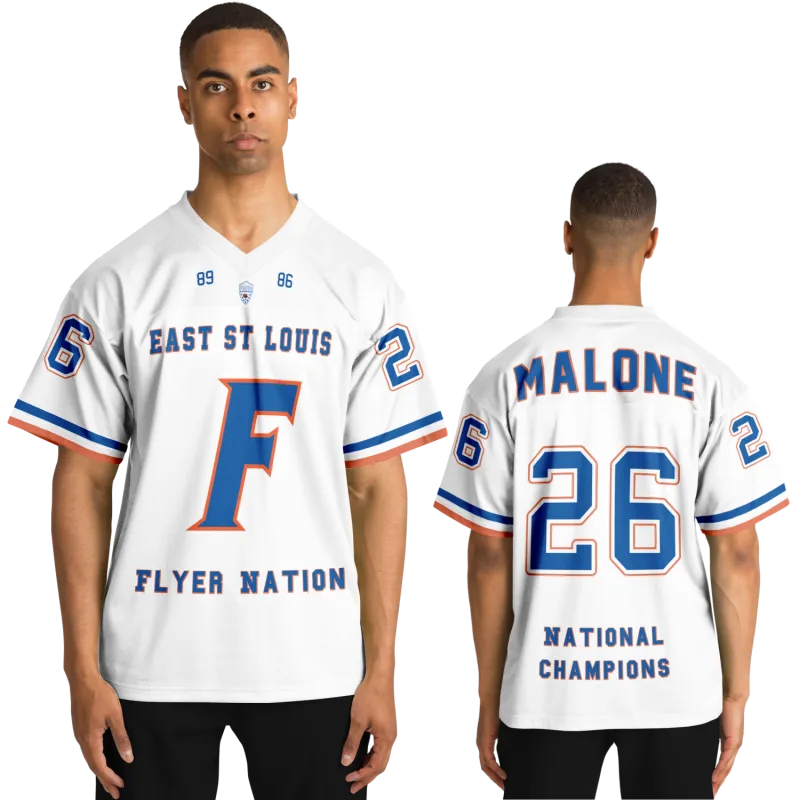
Design yours in minutes and see your name and number exactly the way you remember it: the team that shaped you, the season that defined you, the coach whose name you'd recognize anywhere.
Frequently Asked Questions
When and where is the Inland Northwest Sports Hall of Fame induction ceremony for this class?
The induction ceremony is scheduled for October 21 at 4 p.m. at Numerica Veterans Arena, sponsored by Spokane Sports, with tickets available through TicketsWest. The event will honor Jeff Brown, Ken Pelo, Pat Tyson, Rick Riley, and Jared Lawrence, along with Scroll of Honor honorees Bill Stanley and Bob Tobiason, in a formal recognition of their contributions to Inland Northwest sports.
Who is Jeff Brown and why does his induction matter to Inland Northwest basketball?
Jeff Brown was a Mead High School standout who set the Greater Spokane League career scoring record and became Spokane's first Washington Player of the Year. He went on to Gonzaga, where he was a three-time All-West Coast Conference selection and the 1994 WCC Player of the Year. His path represents the local-to-regional athletic pipeline the Inland Northwest has developed across decades of competitive basketball. For anyone who played Inland Northwest high school basketball, Brown's career is a recognizable story.
What sports are represented in this Inland Northwest Sports Hall of Fame class?
This class spans basketball, distance running, and wrestling. That reflects the genuine breadth of the region's competitive sports culture. Pat Tyson's coaching legacy and Rick Riley's career honor the distance running tradition specifically, while Jared Lawrence's NCAA wrestling championship represents elite individual sport achievement. Jeff Brown's basketball career and the coaching contributions of Ken Pelo and Pat Tyson together reflect the program-building culture that defines Inland Northwest athletics at its best.
What does a regional sports hall of fame induction actually mean for former players of the inductees?
For former players, a coach's or teammate's hall of fame induction functions as public confirmation of something they already knew privately. The coaches and athletes who earn regional hall of fame recognition are typically the ones who had the deepest impact on the people around them. Not just in outcomes, but in the way they taught athletes to compete, prepare, and show up. Former players of Ken Pelo and Pat Tyson consistently describe their coaching influence as something that extended well beyond the sport itself and well beyond the playing years.
See also: what high school sports teach you that nothing else could | why high school sports still matter to adults | athletic identity that stays with you long after the final whistle