

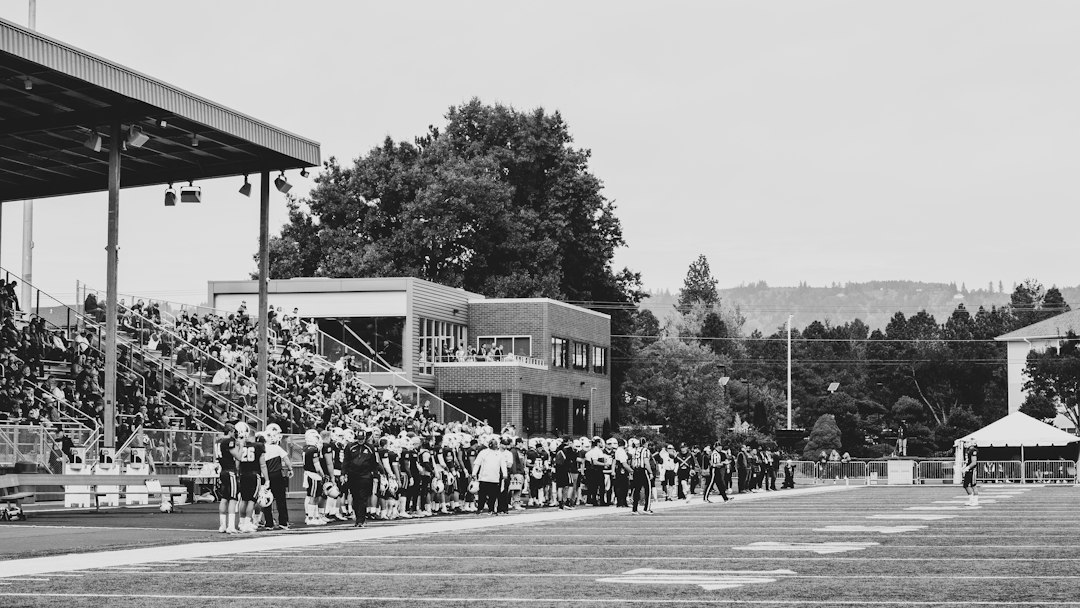




There's a specific moment most former athletes share — you're driving somewhere unremarkable, maybe a grocery run, maybe the school pickup line, and a song comes on, or you pass a gym that smells like that gym, and suddenly you're seventeen again and someone is telling you something you weren't ready to hear.
You think about your coach.
Not in an abstract "I'm grateful for my coaches" way. You think about that specific person. The way they called your name across a noisy gym. The season where everything fell apart and they didn't let you quit. The thing they said that you've probably repeated to your own kids without realizing you were quoting someone else.
And then the moment passes and you go back to your groceries, and another year goes by.
If you're here because you want to thank my high school coach — want to actually reach them, not fire off a "hey coach, thinking of you!" comment into the void — this is the framework that does it. Not a canned message. Not a template you swap your name into. A real structure for a real letter, built from what former coaches actually say moved them.
The Problem With Every "Thank You Coach" Message Online
Search "what to say to a former coach" and you'll find the same dozen quotes recycled across a hundred blog posts. You'll find lines like "You believed in me when I didn't believe in myself" and "Your impact will never be forgotten." They're not wrong, exactly. They're just not you.
Here's what those messages have in common: they could have been written by anyone, about anyone, to anyone.
Your coach spent years watching hundreds of kids. They remember the specific ones — the one who cried after the regional loss and then came back the next morning before anyone else. The one who argued about the starting lineup and then ran the hardest sprint of the season. The one who wasn't the best player but somehow made the team better just by being there.


They don't remember the generic gratitude. They remember the specific truth.
The other problem with reaching out to former coaches is the one nobody talks about: what to do when you don't remember specific moments. Maybe the season blurs together. Maybe you were young and not paying close attention to the things that were shaping you. Maybe you're reaching out fifteen years later and the details have softened into impressions.
That's fine. There's a way to write a coach appreciation letter from impressions that lands harder than forced specificity.
The 4-Part Structure Former Coaches Actually Remember
In our experience talking to coaches — through the stories athletes share with us, through the letters that end up framed rather than filed — there's a pattern to what stays with them. Four parts. Not five. Not ten bullet points. Four.
Part 1: The "Before" — Who You Were When You Walked In
Start not with gratitude but with honest description. Who were you at the start? Not a flattering version — the real one.
"I walked into your program thinking I was more ready than I was. I had the fundamentals and none of the discipline."
"I was angry that season. I don't know if you knew that. I was angry at home and I brought it onto the court and I didn't understand why you kept playing me anyway."
This is the part most people skip because it feels risky to be honest about who you were. It's also the part that coaches remember most, because it shows that you actually understand what they saw when they looked at you — and chose you anyway.
You don't need a specific memory for this. You need honesty about a state of being.
Part 2: The Thing They Did That You Only Understood Later
This is the pivot. It's the moment you name something your coach did — a decision, a habit, a way of running practice, something they said regularly — and connect it to something in your adult life.
The key phrase is "I didn't understand it then."
"You made us run after every loss. I thought it was punishment. I now run after every hard day at work and I didn't make that connection until I was writing this."
"You benched me during the semifinals. I was furious. You were right."
If you don't have a specific memory, use the pattern anyway — describe their general approach and the specific way you see it in yourself now.
"You had a way of acting like failure was just information. I didn't absorb that consciously. But I watch myself with my kids and I hear you in the way I talk about mistakes."
That's not a memory. That's the truth. It's better.
Part 3: The Specific Way You're Different Because of Them
Name something concrete about who you are now that traces back to that gym, that field, that season.
Not a general virtue. A specific behavior or belief.
- "I still warm up before things that don't require warming up. Interviews, difficult conversations. I still prepare the way you made us prepare."
- "I don't quit when I'm ahead. I finish. Every time. That's yours."
- "I apologize when I'm wrong and I mean it. That took me years to learn but I think it started with watching you own a bad call in front of the whole team."
Two of these is enough. Three if they're short. The specificity is what does the work — not volume.
Part 4: The One Thing You Need Them to Know
End simply. Not with a flourish. With the actual thing.
"I needed you to know that it worked."
"I don't think I ever said thank you and I've been meaning to for eleven years."
"You showed up for a lot of us who didn't have someone showing up for them. I was one of those kids. I don't think you knew that."
One sentence or two. No summary. No re-statement of the whole letter. Just the thing you actually needed to say.
When You Had a Hard Coach (And You're Grateful Anyway)
This is the nuanced territory that generic "thank you coach" content completely ignores.
Some coaches were hard in ways that were uncomfortable, sometimes unfair, occasionally wrong — and still shaped something valuable in you. Reaching out in those situations feels complicated because it doesn't fit the simple gratitude script.
Here's what to know: former coaches who pushed hard, who were demanding, who weren't always warm — they often wonder. They wonder whether it was right, whether it helped, whether you resent it.
You're allowed to acknowledge both things.
"You were hard on me. Harder than I thought was fair at the time. I want you to know I understand it differently now — not that it was all perfect, but that the standard you held mattered. I needed someone to hold it."
That's not revisionism. That's an adult perspective on a formative relationship. Coaches who receive letters like that often say it's the one they read more than once.
Kelsey R., 29, ran cross-country in a program that was known for its brutal training blocks. Her coach cut no corners and gave no sympathy for sore legs. Years later, she sent a card — not gushing, just honest. She told her coach: "You made it harder than it needed to be and I'm not sure I'd change it." Her coach emailed back within an hour. It was the first message she'd sent in twelve years.
What to Do If You've Lost Touch (Or Aren't Sure They're Still Around)
Reaching out to a former coach after years can feel like cold-calling someone who may not remember you at all. A few practical notes:
Start with LinkedIn or the school. Most coaches who coached long enough to matter to you were institution-adjacent — they worked at the school, or they went on to coach elsewhere. LinkedIn is surprisingly effective. High school athletic departments often have contact forwarding for longtime coaches.
If they've retired, their former colleagues know them. A quick email to the school's athletic director — "I'm looking to send a note to Coach [Name], who coached [sport] in [approximate years]" — is almost always answered.
Send the physical letter. This is the one piece of advice that separates coach appreciation years later that lands from coach appreciation that gets scrolled past. Email is fine. A letter is different. Coaches who receive physical letters mention them. They put them somewhere. The medium signals that you slowed down.
Don't wait for the perfect moment. Graduation season, team reunions, and the anniversary of a big season are natural triggers — but they also mean every former athlete had the same impulse at the same time. The off-season letter, the one that arrives in February with no occasion, is the one they don't expect.
Real Letter Tone (Not Text) — What Works and What Reads Hollow
The letters that former coaches describe as meaningful share a tonal quality that's hard to name but easy to recognize: they sound like the person who wrote them.
Not like a greeting card. Not like a LinkedIn recommendation. Like someone who sat down with a pen and was a little nervous about what to say and said it anyway.
Here's what that sounds like versus what it doesn't:
Hollow: "Your dedication and commitment to excellence shaped me into the person I am today. I am forever grateful for your mentorship and guidance during those formative years."
Real: "I still tie my shoes the same way you made us tie them — tight enough that they don't slip, loose enough to still feel the ground. I never thought I'd care about something like that. I've cared about it for fifteen years."
The difference is specificity and ownership. The hollow version could have been written by anyone. The real version could only have been written by someone who was actually there.
You don't need to be a writer to write the real version. You just need to stop trying to sound like gratitude and start sounding like yourself.
Your jersey is still out there waiting.
Design yours in minutes and see your name and number exactly the way you remember it.
Frequently Asked Questions
What if I don't remember specific moments from my time playing for this coach?
You don't need specific memories to write something meaningful. What coaches respond to isn't the recreation of a scene — it's the evidence that something transferred. Describe who you were when you arrived, what their general approach felt like, and the specific way you see that approach in yourself now. "I don't remember the exact practice but I remember the standard" is an honest and moving thing to say.
Is it too late to reach out to a coach from years ago?
No — and in many cases, the longer it's been, the more meaningful the contact. Coaches who hear from former athletes ten or twenty years later often say that's when the message hits hardest, because the athlete has enough life behind them to actually see what the coaching produced. The only version of "too late" is if the coach has passed, in which case reaching out to a family member with a story about what they meant is its own gift.
Should I send a letter, an email, or a message on social media?
Physical letter if you can manage it — it signals intentionality in a way that digital contact doesn't. Email is a strong second choice, especially if you have their direct address. Social media (including a Facebook comment or Instagram DM) is the lowest-signal option, not because the words matter less, but because the format suggests a passing thought rather than a deliberate choice. If a letter or email is possible, choose that.
What if my coach and I ended on difficult terms?
Write it honestly. You don't have to pretend a hard relationship was simple. Some of the most powerful coach appreciation letters are the ones that acknowledge complexity — "we didn't always understand each other and I've spent a long time thinking about why" — before arriving at gratitude. Coaches are adults who know that not every relationship was easy. Honesty is more honoring than a sanitized version of history.
See also: why personalized gestures hit differently than generic ones | the lasting psychological weight of high school sports relationships | what high school sports actually taught you that nothing else could | a custom sports shadow box as a tangible thank-you gift