





You can still feel the weight of it. The full kit spread across the locker room bench before a playoff game — jersey, pants, belt threaded through in school colors, stirrups lined up along the edge. That wasn't just clothing. That was the signal that something real was about to happen.
When former players go looking for custom softball uniforms today, they're usually after one of two things: either they're helping outfit a current team, or they're trying to recover something specific. A particular shade of gold. A script font on the chest that existed for exactly four seasons before the school rebranded. A number that meant something to exactly one person.
The challenge is that nearly every page on this topic is written for coaches placing bulk orders — jersey, pants, belt, socks, fifteen players, done. That's not what this article is. This one is for the former player who wants to understand what the full uniform actually consisted of, piece by piece, and make a clear-eyed decision about what's worth bringing back versus what belongs to memory.
What "The Uniform" Actually Meant in Softball
Here's a distinction almost no retailer takes the time to make: a jersey is one piece of fabric. A softball uniform is a system.
When your team took the field, you weren't just wearing a jersey. You were wearing an assembled kit where every element had a function, a name, and — in most programs — a specific rule about how it was worn. The jersey was the most visible component. It was not the whole thing.
Understanding what is included in a softball uniform, piece by piece, matters when you're thinking about what to recreate and how to talk to a builder about it.
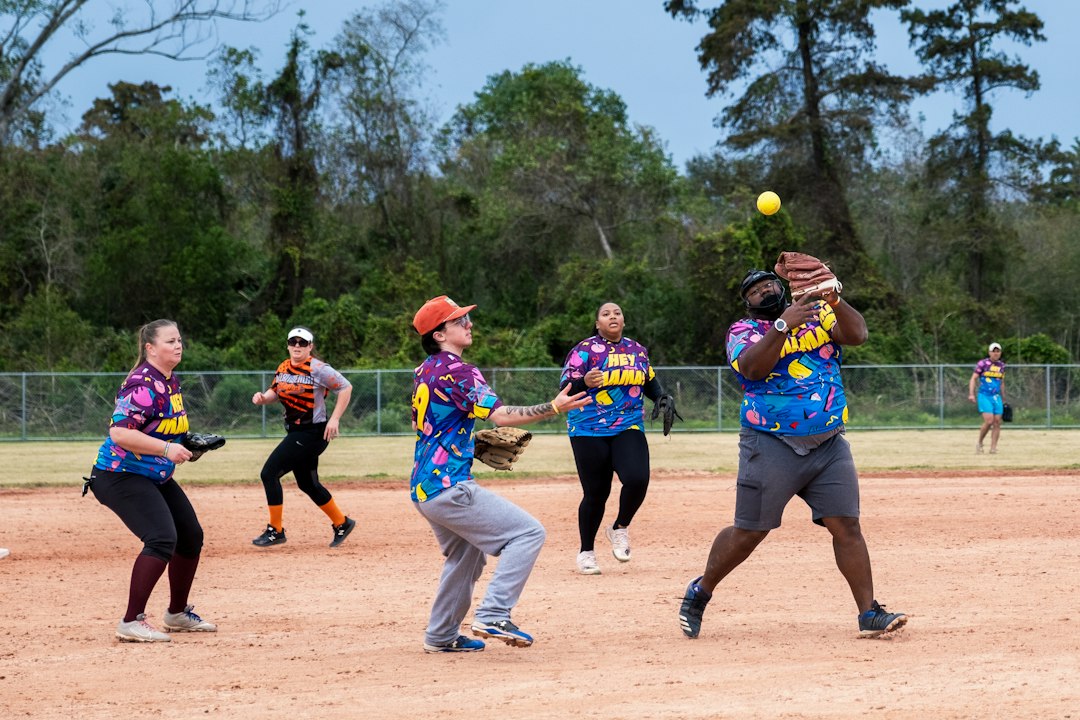
The jersey. Typically a pullover or button-front design, most commonly in a polyester-mesh or dri-fit construction. Numbered on the back, often on the front as well at the high school level and above. Team name across the chest. Sleeveless or short-sleeved depending on program and era.


The pants. Softball pants are cut differently from baseball pants — slightly longer in the thigh, with a different rise to accommodate sliding mechanics. Two common configurations existed: the knicker (cut below the knee, designed to pair with stirrups) and the full-length pant (sitting at the ankle). Knickers dominated through the 1990s and into the early 2000s. Full-length pants have been standard since the mid-2000s, particularly at the travel and collegiate level.
The belt. Elastic or leather, matched to team color. At many programs, belt color was written into the uniform policy — you didn't just grab whatever was in your bag. In photographs, the belt is one of the details that places a uniform in a specific era more precisely than almost anything else.
The stirrups and socks. The stirrup system — a colored stirrup worn over a white or solid-color sanitary sock — is one of the most misunderstood pieces of softball uniform history. For players born after 1995, stirrups were largely a thing of the past by the time they reached high school, replaced by solid-color or low-cut ankle socks. For players who competed through the 1980s and into the early 2000s, the stirrup was a required element, and how high you wore it was equal parts team policy and personal statement.
The cap or visor. Fastpitch programs typically wore structured caps. Recreational slowpitch leagues leaned heavily on visors through the 1990s. The specific cap profile — fitted versus adjustable, high-crown versus low-profile — was program-specific and is often the detail that triggers the sharpest visual memory of a particular team.
Sliding shorts. Not visible in team photos, not always required — but for any player who spent time in the dirt, padded compression sliding shorts were a real part of the uniform experience. They don't show up in the picture. They absolutely show up in the memory.
Knowing the full system matters because when you're approaching a custom softball uniform recreation, you're making a real decision: which elements are actually reproducible, and which ones you're honoring in spirit rather than literal form.
The Jersey vs. the Full Kit: Where the Recreation Decision Lives
For most former players thinking about a custom piece — a keepsake, a reunion gift, something to hang up or actually wear — the jersey does roughly 90 percent of the emotional work.
The name on the back. The number. The colors rendered in the right font with the right layout. Those are the elements that produce the recognition moment when you hold it up or pull it over your head. The pants add context. The belt completes it. But the jersey is the anchor. Everything else orbits it.
That said, what you wore depended entirely on the era you played and the level you played at. Those two variables shape every recreation decision.
High School Softball Uniform Pieces by Era
Pre-2000 programs typically ran a full stirrup system, knicker pants, a woven or early-polyester jersey, and a fitted cap. Color palettes were constrained by screen-printing technology — solid colors, tackle-twill numbers applied on top of the fabric, wordmarks that were either sewn or heat-transferred.
2000–2012 programs saw the shift to sublimated fabric, where the entire color design is printed directly into the material rather than applied on top. This unlocked complex aesthetics: gradient panels, pinstripes built into the weave, graphics that extended edge to edge. Full-length pants became dominant. Stirrups largely disappeared except in programs with strong traditions.
Post-2012 programs are almost entirely sublimated, full-length pants, low-cut socks, and fitted or snapback caps. Fabrics became lighter and more technical — four-way stretch polyester blends that feel fundamentally different from what earlier generations wore.
Knowing your era changes the design conversation considerably. A 1994 jersey built with modern sublimation will look like a 2022 jersey styled as a tribute to 1994. Sometimes that's fine. Sometimes the original aesthetic — heavier fabric, applied tackle-twill lettering — is precisely what made it feel like yours. A good builder will discuss this with you before the order is placed.
What Former Players Are Actually Trying to Recreate
Melissa T., 38, played four years of varsity softball at a high school in Ohio and kept exactly one piece of her uniform after graduation: a single worn stirrup she found at the bottom of a gear bag years later. When she set out to have a jersey made in the style of what her team wore, what she described wasn't a design spec — it was three things: the specific gold her school used, the way the number sat on the back, and the fact that the team name ran in script, not block letters. Those three details were the entire memory. Everything else was secondary.
That level of specificity is what separates a custom softball jersey that carries actual meaning from a generic piece that just has your name on it. The more precisely you can describe those anchor details — color, font style, layout, lettering method — the closer the finished piece will land.
Most custom uniform builders today operate on a template system. You select a jersey style, choose colors from a palette, add your name and number, and see a rendered preview before anything is produced. Brands like Champro run a solid sublimated catalog with multiple fit options — women's fitted and unisex relaxed cuts — that work well for former players ordering a tribute piece in the style of their original uniform. Rawlings softball jerseys have historically served institutional programs that needed consistent quality across large orders; if your school outfitted through Rawlings, the construction details will translate reasonably well through a modern custom builder using similar specs.
Nike softball uniforms and Adidas softball uniforms are more commonly associated with collegiate and elite travel programs. Nike's Team Builder platform is oriented toward institutional orders rather than single-player custom pieces, and the same is generally true of Under Armour softball uniforms — excellent at scale, not built for one-off keepsakes. If you played at a school that outfitted through one of those brands, the brand identity can be honored through an independent custom builder. The design elements that carry the visual identity — color blocking, number placement, font choice — are what matter, not the label inside the collar.
For players north of the border, custom softball jerseys in Canada are well-served by both dedicated Canadian suppliers and international brands that distribute domestically. Softball jerseys Canada searches will surface regional printers who handle small-batch and single-player orders more comfortably than large institutional brands, often with shorter turnaround times.
What's Worth Recreating — and What Belongs to Memory
This is the section most uniform retailers won't write, because it requires honesty about the limits of what's actually reproducible.
Worth recreating — high fidelity:
- The jersey. If you have a clear photo of the original — front and back — a skilled custom builder can get very close to the color blocking, number placement, font style, and overall layout. Modern sublimation is genuinely capable here.
- The cap. Harder to reproduce exactly, but fitted caps with custom embroidery are widely available. If you know the original cap's profile and color, a close tribute piece is achievable.
- The belt. Essentially trivial to reproduce. Team-color elastic or leather belts are available from multiple sources for very little cost.
Harder to recreate with full authenticity:
- The fabric weight and hand-feel of pre-2000 jerseys. Modern performance fabric is lighter, stretchier, and more technical than the polyester blends of earlier decades. If the tactile memory of a heavier jersey matters to you, raise this explicitly with your builder — some can source heavier-weight options, but it requires a direct conversation.
- Tackle-twill lettering on older-era designs. Some builders still offer applied tackle-twill numbers and letters, but sublimation is the default. They look similar in photographs. They feel different in your hands.
What belongs in memory:
- The stirrup pulled to exactly the right height after the third time you adjusted it in the dugout. New stirrups will look correct. They won't feel correct until they've been worn for a few hundred innings. Some things earn their look, and that's appropriate.
- Sliding shorts. Functional equipment, not a display piece. No recreation needed or recommended.
- The specific weight of the dugout air before a big game. That one stays yours.
The National Fastpitch Coaches Association has documented how softball uniform standards have evolved across competitive levels over the past three decades — useful context if you're trying to accurately place your playing era against what was standard at the time.
Your jersey is still out there waiting.
Design yours in minutes and see your name and number exactly the way you remember them.
Frequently Asked Questions
What is actually included in a softball uniform versus just a jersey?
A complete softball uniform includes the jersey, pants (either knicker-cut or full-length), a belt, socks or stirrups, and a cap or visor. The jersey is the most visible piece, but the assembled kit also includes sliding shorts worn underneath — those never appear in team photos, but any player who spent time on the bases knows exactly what they are. When most custom retailers describe a "softball uniform," they mean the jersey and pants as a package. When former players picture their uniform, they typically mean the full system they wore from cap to cleats.
Can I get a custom softball uniform made for just one player instead of a full team?
Yes — and this is considerably more accessible than it used to be. Custom builders that use sublimation printing are generally better positioned for single-player or small-batch orders than those using screen printing, which carries higher per-run setup costs. The per-unit price on a single-player order will be higher than bulk team pricing, but the process is straightforward and the turnaround times have improved significantly in recent years. Start with a builder who offers a digital preview before production — that preview step is where you confirm the details that matter most.
How closely can a custom softball jersey tribute piece match the original?
With a clear reference photo — front and back — a skilled builder can match color blocking, number placement, font style, and overall layout quite closely. The primary variables are fabric weight (modern performance fabrics are lighter and stretchier than older polyester blends) and lettering method (modern sublimation versus original tackle-twill application). If the tactile feel of the original matters as much as the visual, discuss fabric weight options with your builder before finalizing the order. Visual accuracy is highly achievable; an exact hand-feel match to a 1990s jersey requires a specific conversation.
What's the difference between recreating a softball jersey versus the full uniform?
For most former players, recreating the jersey gives you the visual and emotional anchor — the piece that holds the name, number, and team identity. A full uniform recreation adds the pants, belt, and cap, which provides completeness and allows you to actually wear the full kit. Most former players start with the jersey alone, particularly if the goal is a display piece or a gift. The full kit is worth pursuing if you played at a level where the complete presentation carries specific meaning, or if you simply want to put the whole thing on one more time and feel what it felt like.
See also: custom softball jerseys | personalized sports gifts vs generic options | jersey size chart and what those numbers actually mean | how to create a custom sports shadow box