

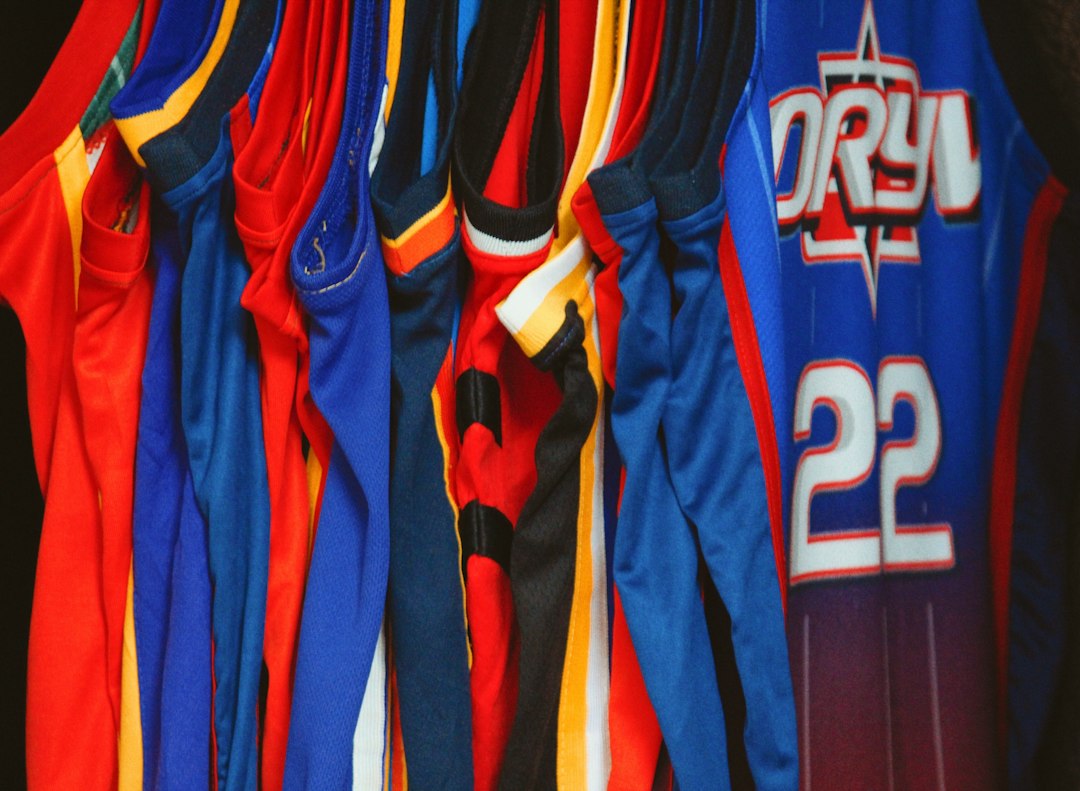




You remember it before you remember anything else about the game.
Not the final score. Not the opponent. The jersey — the specific weight of it in your hands when you pulled it over your head in the locker room, the way the mesh breathed (or didn't) on a gym that ran hot by the third quarter, the number on the back that felt, for two or three seasons, like your actual name.
Custom jerseys basketball players carry in their memory aren't the ones hanging in fan shops. They're the ones that fit a specific cut, carried a specific font, and represented a specific group of people who showed up at the same place every Tuesday and Friday for years. This article is for the player rebuilding that jersey — not a generic template, not a shelf-ready fan piece, but the one with the right armhole depth, the right mesh weight, and the font that actually matches what was on your chest when it counted.
If you've started looking at jersey customization options and found mostly the same four templates offered under different logos, you're in the right place.
What Makes a Custom Basketball Jersey Actually Custom
There's a version of "custom" that means your name on the back of a stock template. That's not what this is about.
Real custom jerseys for basketball start with decisions most design tools don't even surface — decisions that determine whether the finished jersey feels like your jersey or just a jersey with your name on it.
Mesh weight and construction is the first variable that separates the memory from the merchandise. Jerseys from the mid-80s through the late 90s used a heavier double-knit mesh, often with a visible texture you could feel through your fingers. By the early 2000s, synthetic performance mesh had taken over — lighter, faster-drying, with a different drape and silhouette entirely. If you're rebuilding a jersey from a specific era, mesh construction is the first specification worth locking down.


Armhole cut and side panel geometry is the second. The classic silhouette of a 1990s NBA-era jersey — think the deep-cut armhole aesthetic that defined franchises like the San Antonio Spurs and shaped the look of a generation of high school programs inspired by that era — sat differently on the body than today's athletic-fit cuts. The armhole drop, the side panel angle, and overall shoulder width changed significantly across decades. A jersey that looks "off" is usually wrong in one of these three dimensions, not in the color or the number.
Typography and application method is the third. Screen-printed lettering, tackle twill, embroidered tackle twill, and full sublimation each produce a completely different visual and tactile result. The tackle twill lettering on a 1990s high school jersey had a raised edge, a slight fabric thickness, and a specific sheen that sublimation printing — no matter how advanced — cannot fully capture in the same dimensional way. If you're chasing era accuracy, this is the specification that most differentiates an authentic custom build from a digital approximation.
In our experience, players who've gone through one round of custom jersey ordering and been disappointed almost always got the template right and the construction detail wrong. The name and number looked fine on screen. The jersey didn't feel like the memory when it arrived.
Era-Accurate Detail: The Design Decisions That Change Everything
Here's what the fan-market sites won't tell you, because they're not built for this search: the specific design elements of basketball jerseys changed dramatically across five-year windows, and the differences are legible to anyone who played in a specific era.
The Classic Era (1985–1998)
The defining characteristics of this period's jerseys for basketball were heavier mesh, wider body cuts, and block lettering with significant tackle twill depth. Team names on the front typically used a condensed block font with a drop shadow — often a contrasting color shadow rather than a simple black outline. Numbers were proportionally larger relative to the jersey body than contemporary cuts allow.
The aesthetic template that filtered down to high school programs across the country during this era came straight from the professional game: baggy silhouette, longer length, and a deliberately oversized number format. The evolution of NBA uniform design during this period is well documented and explains why so many programs from 1993 to 2001 share unmistakable visual DNA. If you graduated during those years, your jersey almost certainly carries that influence.
Color blocking on side panels — typically a contrasting stripe or insert — was standard in this era and is a detail worth specifying explicitly in custom orders today, because modern templates often default to solid sides.
The Transition Era (1999–2010)
The transition period moved toward performance fabrics, slimmer cuts, and simplified typography. Sublimation printing began displacing tackle twill in cost-conscious high school programs, which is why some jerseys from this window have a flatter, more printed quality to the lettering. Typography became more condensed and outlined rather than drop-shadowed, and jersey length shortened noticeably.
If your high school jersey is from this window, you're likely chasing something lighter than the classic era, with cleaner lettering and less physical texture on the letters. The good news: sublimation technology has advanced enough that the flat-print quality of this era is now more faithfully achievable than the dimensional tackle twill depth of the decade before it.
The Contemporary Era (2011–Present)
Contemporary custom bball jerseys are defined by athletic-fit cuts, moisture-wicking synthetics, and fully sublimated designs that allow gradient coloring and high-resolution graphics. The armhole is higher, the side panels are articulated for movement, and the overall silhouette is significantly more fitted than any earlier era.
If you're ordering for a team playing today — not rebuilding a memory but equipping a roster — this is the construction standard to specify. Performance has genuinely improved; a properly fitted contemporary jersey outperforms earlier era versions in every athletic metric. What it doesn't carry is the specific weight and drape of a jersey that spent three seasons folded at the bottom of a gym bag.
Marcus T., 38, Chased His Jersey for Two Years
Marcus T., 38, played point guard for a mid-sized Texas high school program that wore a specific royal-and-gold colorway with tackle twill lettering in a condensed block font — a jersey he described as "the most me thing I've ever worn." When he tried to rebuild it for a 20-year reunion scrimmage, he went through three different custom jersey suppliers before he found one that matched what he remembered.
The first two sent him contemporary athletic-fit cuts in the right colors. The letters were sublimated, not tackle twill. The armhole was wrong. The third supplier let him specify mesh weight, tackle twill construction, and a classic-era cut pattern — and when the jersey arrived, he said the moment he pulled it over his head in the parking lot before the game, he could smell the locker room.
That specificity of memory is exactly what this article exists to serve.
How to Design a Basketball Jersey That Matches Your Memory (Or Your Team's Vision)
Whether you're rebuilding a specific jersey from your playing days or equipping a team for a season starting next month, the design process for custom jerseys basketball follows a sequence that most people get backwards.
Most people start with color. Color is the last decision, not the first — because every earlier specification constrains what's possible with color.
The correct sequence:
-
Establish the silhouette first. Decide on body fit — classic relaxed, contemporary athletic, or something between — along with armhole depth, side panel design, and overall jersey length before you open any design tool. These are structural decisions and they constrain everything that follows.
-
Choose your construction method. Tackle twill, sublimation, screen print, or embroidery — each has different cost, durability, and aesthetic implications. If era accuracy matters, this is where you'll win or lose the memory match.
-
Specify your font. Most design jersey basket platforms offer 10–20 font options that look nearly identical at a glance. Find reference images from the era you're chasing and match the font family specifically: condensed versus expanded, serif versus sans-serif, the presence and color of a shadow or outline.
-
Finalize color. Once your silhouette, construction method, and font are locked, color becomes an execution decision — specific Pantone references if your team has existing brand standards, or a deliberate match to a reference image if you're building something from memory.
What to bring to any custom jersey consultation:
- A reference image, ideally from the specific era and program you're drawing from
- Specific color references — Pantone numbers, hex codes, or a physical swatch if you have one
- Your number and name exactly as they appeared — not "Marcus" but "TORRES" or "T. MARCUS" depending on your program's convention
- Preferred fabric weight — most suppliers categorize this as lightweight, midweight, or heavyweight mesh
The difference between a jersey that lands and one that disappoints is almost always in the brief. The more specific the brief before the first proof, the closer the first proof lands.
Team Orders, Deadlines, and the Details Most Programs Get Wrong
If you're ordering custom jerseys basketball for a full team — a high school program, a rec league, an AAU squad — production timeline and sizing accuracy become as important as the design specifications.
Sizing is where team orders most commonly come apart. Most programs order by standard S/M/L/XL, then discover that two players wearing the same "L" need different jersey lengths, different sleeve cuts, or different body widths. If you have the opportunity to take actual measurements rather than size-guessing, take it. The useful measurements: chest circumference at the widest point, jersey length from shoulder seam to hem, and desired armhole depth. Five minutes per player saves a full reorder cycle.
Timeline is the second common failure point. Standard production for custom jerseys basketball typically runs 3–4 weeks after artwork approval; rush production — 1–2 weeks — exists but significantly limits customization options and adds cost. For school programs ordering for a season, the practical lead time should be 6–8 weeks from first design conversation to delivery, accounting for proof review, revision cycles, and production.
Number duplication sounds obvious until it isn't. Team orders for recreational leagues where players self-report their number preferences produce at least one duplication conflict more often than not. Establish a master number roster before submitting the order and have a tiebreaker rule ready before anyone argues about it on delivery day.
The minimum order reality:
- Most custom jersey suppliers require minimum orders of 6–12 jerseys for full customization
- Below that threshold, customization options narrow significantly
- Single-unit custom orders carry a premium and longer lead times
- Confirm whether your supplier batches individual orders on a weekly or biweekly production window — this matters if you have a specific event date
The Broader Jersey Universe: What Great Design Looks Like Across Sports
One thing worth naming directly: jersey culture extends well beyond basketball, and the visual language of great jersey design crosses sport lines in ways that inform what makes a basketball jersey feel considered rather than assembled.
The design restraint that made the New York Yankees jersey a century-long icon — controlled typography, the absence of a name on the back, the timeless pinstripe — reflects the same principle that makes any jersey feel authoritative: coherent decisions, not maximum elements. The clean block lettering on a New York Mets jersey, the specific tonal restraint across the various eras of a San Antonio Spurs jersey, the bold color blocking that defines the Mexico national team jersey in soccer and inspires countless custom programs drawing on that visual tradition — these are expressions of the same underlying truth.
Jerseys for basketball that earn a second look share that quality. They don't announce themselves loudly. They look like they've always existed, like they were the only possible version of themselves. That's the goal when you sit down to design jersey basket-style custom work for your team or your memory: not more elements, but more intentional ones.
When our team looks at great custom bball jerseys submitted by players who ordered exactly what they wanted, the ones that land — the ones that actually get worn beyond the reunion scrimmage — are the ones where every decision was made on purpose. The colorway, the font weight, the panel geometry. Nothing defaulted.
Your jersey is still out there waiting.
Design yours in minutes and see your name and number exactly the way you remember it.
Frequently Asked Questions
How do I design a basketball jersey that matches a specific era or program I played for?
Start with reference images — the more specific, the better. A photograph of the actual jersey from that era and program will tell you everything you need to brief a supplier: the font family, the number size relative to the jersey body, the tackle twill depth, the shadow treatment on the lettering, and the color relationships across the panels. Bring those references into any custom jersey consultation and use them as your specification document, not just inspiration. The design tool comes second; the reference image comes first.
Can I design my own custom jersey as a single unit, or do I need a team order?
Single-unit custom jerseys are available, but expect different pricing and lead times than team orders. Most suppliers that specialize in individual custom pieces use on-demand sublimation rather than traditional cut-and-sew construction, which means construction-method options may be more limited than a full team order. If tackle twill lettering or specific mesh weights are priorities for a single jersey, look specifically for suppliers who offer full custom construction at single-unit minimums — they exist, but they're not the majority of the market.
What is a custom jersey, and how is it different from a fan or retail jersey?
A custom jersey is built to your specifications: your name, your number, your color scheme, your cut preference, your construction method. A fan jersey is typically a retail stock item — often produced in the style of a professional or collegiate team, available in standard sizes — with customization limited to name and number on a fixed template. Custom jerseys basketball players order through dedicated customization platforms exist entirely outside the licensed retail system: they're original designs built from your brief, not adaptations of anyone else's existing intellectual property.
How long does it take to get custom basketball jerseys made?
Standard production runs 3–4 weeks from final artwork approval. Rush production can compress this to 7–10 business days but typically limits customization options and adds cost. For team orders, build in 6–8 weeks from first design conversation to delivery to account for proof review and revision cycles. Individual custom orders sometimes carry longer lead times if the supplier batches single-unit production across a weekly or biweekly window — confirm this before committing, especially if you have a specific game or event date driving the deadline.
See also: personalized sports gifts vs. generic ones | jersey size chart to get the fit right | custom softball jerseys follow the same emotional logic | the psychology of why high school sports still matter to adults | adult recreational leagues where that jersey gets real use again