

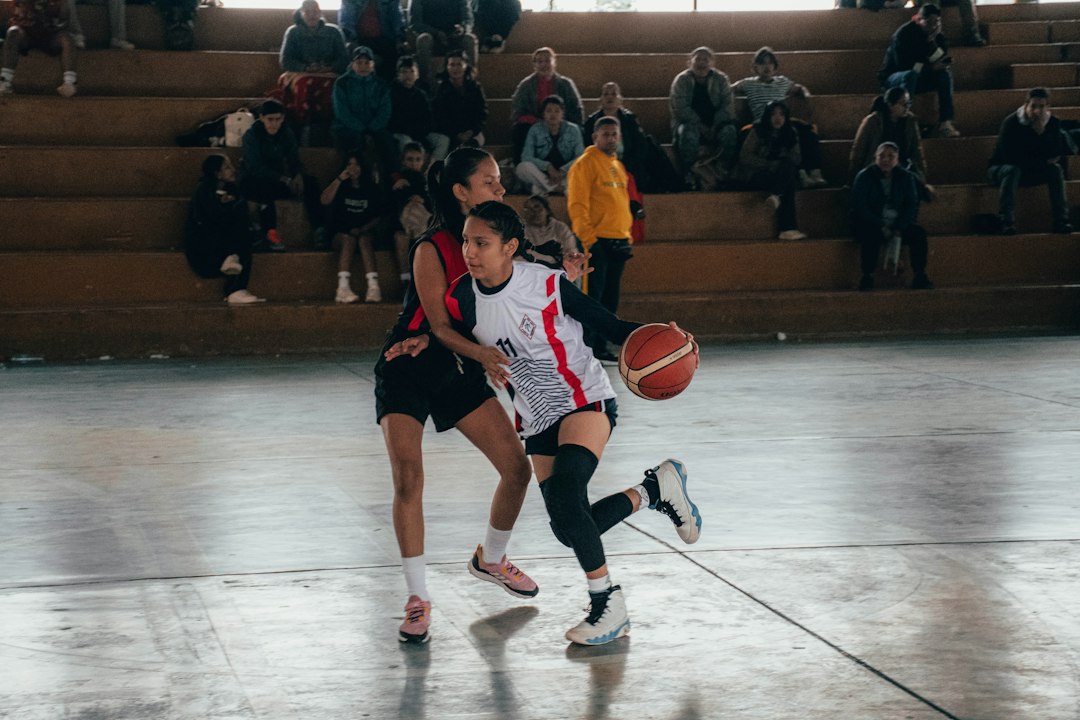




You remember the jersey. Not the color — you remember how it felt when you pulled it over your head before a game. The weight of it. The number on the back. That specific rectangle of fabric that told everyone on the court you were there to compete.
Finding a women's basketball jersey now — one that honors that memory without making you feel like you're wearing something that belongs to someone else — turns out to be harder than it should be.
If you've spent more than ten minutes on any custom uniform site, you already know the problem. The default options for womens basketball uniforms split into two categories that don't fit former female players: a youth girls' cut that runs small and hits wrong, or a men's unisex shell that hangs off one shoulder and pools at the hip. Neither of them is what you wore. Neither of them is what you want.
What the custom jersey industry hasn't caught up to — yet — is the former female player who played organized ball from the late 1970s through the early 2010s, before women's-specific athletic cuts became standard across the board. She needs a third path. It exists. Most pages don't tell her about it.
This guide does.
The Era Problem: Why "Women's" on the Tag Doesn't Mean What You Think
Here's the piece of context that changes every decision in this article.
Women's basketball uniforms went through three distinct manufacturing eras, and the cut that feels authentic to your playing experience depends almost entirely on which era you played in — not on what size you wore.
Era 1: Pre-1995 — The Unisex Shell Era
Before women's intercollegiate and professional basketball had real commercial momentum, most programs ordered from the same catalog as the men's teams. The cuts were unisex. Sizing ran men's small through men's XL. Jerseys were long, the armholes were wide, and the shorts had a high waist with a loose, rectangular cut. If you played in a community league, a YMCA program, a high school team before roughly 1995, or a women's club program in the early days of organized women's ball — this is the silhouette you remember.


If you order a standard men's unisex custom shell today, it will come closer to that silhouette than a current women's cut will. But it still won't be exactly right, for reasons we'll cover in the fit section below.
Era 2: 1995–2010 — The Transitional Cut Era
The WNBA launched in 1997. Title IX enforcement ramped up through the late 1990s. Women's-specific athletic cuts started appearing in team catalogs, but they weren't standardized. Some programs ordered women's-specific uniforms. Some still ordered unisex. The result: if you played in this window, your jersey might have been a true women's cut, a semi-fitted unisex, or something in between — depending entirely on your program's budget and equipment manager.
Players from this era often have the most difficulty at custom jersey sites because their memory doesn't match either current template cleanly.
Era 3: 2010–Present — The Performance Fit Era
By 2010, women's athletic cut uniforms had become the norm for organized programs. The jerseys were contoured at the waist, the armholes were set higher to allow full arm movement without fabric drag, and the lengths were calibrated for women's torso proportions. If you played in this era, a contemporary women's athletic cut custom jersey will come close to what you remember — provided you order it correctly.
Knowing your era is step one. Everything else — the cut, the sizing path, the sublimation choices — flows from it.
Womens Basketball Uniforms: The Three Fit Paths and Which One Is Yours
Most custom basketball uniform pages offer two cuts: men's/unisex and women's. In our experience, neither label maps reliably to what former female players actually need. Here's the practical breakdown of three paths and who each one serves.
Path 1: Contemporary Women's Athletic Cut
Who it's for: Players from the 2010–present era. Also for Era 2 players whose programs adopted women's-specific uniforms early, and for any former player whose priority is a clean, fitted look for current wear.
What it does: Tapers at the waist, sets the armhole higher than a unisex cut, and proportions the torso length for a women's frame. Sizes typically run XS through 3XL in custom sublimation programs. The shoulder seam sits on the shoulder — not two inches past it.
What to ask the supplier: Request the women's athletic cut flat measurement sheet before ordering. You want the chest measurement at the underarm, the waist measurement at the narrowest point, and the total length from the top of the shoulder to the hem. Size up one from your normal athletic wear size — sublimation jerseys have zero stretch in the body panels.
The limitation: This cut did not exist during Era 1. If you're trying to capture the feel of a jersey from before 1995, this silhouette will feel tighter and shorter than what you remember. That's not a defect — it's an era mismatch.
Path 2: Unisex Shell with a Women's Sizing Strategy
Who it's for: Era 1 players who want the authentic drape and silhouette of the ladies basketball uniforms they actually wore. Also the right path for any player whose program ordered unisex cuts regardless of era.
What it does: A men's/unisex shell ordered in a men's small or medium — depending on your measurements — captures the longer hem, wider armhole, and rectangular torso of the pre-1995 female basketball uniform more closely than any women's-labeled cut currently on the market.
What to ask the supplier: Get the flat chest measurement for men's small and men's medium. For most women ordering this path, men's small is the right starting point if your chest measures under 38 inches. Men's medium works for 38–42 inches. Do not order by your standard women's clothing size — those numbers don't cross-reference.
The limitation: The shoulder seam will sit slightly wide. The armhole will be lower than a women's-specific cut. This is accurate to Era 1 — but if you want a more fitted contemporary look, this path gives you the wrong silhouette for that goal.
Path 3: Custom Sublimation with Pattern Modification
Who it's for: Era 2 players whose memory sits between the two standard cuts. Also for any player who has tried both standard paths and found that neither fits correctly — often players with specific proportions that standard athletic sizing doesn't accommodate well.
What it does: Full custom sublimation programs — the kind that produce genuine team uniforms rather than off-the-shelf fashion pieces — allow pattern modifications at the manufacturing stage. You can request a women's athletic cut body with a wider armhole, or a unisex shell body with a tapered waist, or a modified shoulder drop. These modifications add cost and lead time (typically two to three weeks beyond standard production), but they produce a jersey that fits the specific body and the specific memory.
What to ask the supplier: Ask specifically whether they offer pattern modifications on their sublimation jerseys, not just size adjustments. Many suppliers who say "custom" mean custom graphics — not custom patterns. You want a supplier who works with a cut-and-sew production facility, not one that prints onto pre-made blanks.
What Former Players Get Wrong When Ordering Female Basketball Uniforms
There is one ordering mistake that comes up more consistently than any other with former female players — and it produces a jersey that doesn't feel right and a return process that's expensive on custom items.
Ordering by clothing size instead of flat measurements.
A women's large in athletic wear is not the same as a large in a custom sublimation jersey. Custom jerseys are cut for game use — they're meant to be worn over compression shorts and a sports bra, with room to move. They run larger than fitted athletic wear and smaller than fashion pieces. The only reliable way to size a custom jersey is to take your own flat measurements (chest, waist, hip, and torso length from shoulder to desired hem) and compare them to the supplier's flat measurement chart for the specific cut you're ordering.
This is not optional. Custom jerseys are non-returnable in nearly every case. Get the measurements right before you order.
Reading a Custom Jersey Spec Sheet: What Actually Matters
When you pull up a custom basketball uniform spec sheet, the list of options looks longer than it needs to be. Here's what matters for former female players specifically.
Fabric weight and weave Game-use basketball jerseys are typically 100% polyester, either a moisture-wicking mesh or a performance knit. For a commemorative jersey, fabric weight is mostly a personal preference. For a jersey you'll actually wear — to a reunion game, a pickup run, a photo shoot — request the mesh. It breathes. The performance knit holds heat.
Sublimation vs. tackle twill numbering Sublimation prints the number directly into the fabric. Tackle twill sews the number on as a separate raised layer. Tackle twill is the traditional look — the slightly elevated, textured numbers on classic team jerseys that you could run your fingers across. Sublimation is lighter and more durable through repeated washing, but it won't give you that tactile feel. If the raised number matters to you, ask specifically for tackle twill — some custom programs have moved entirely to sublimation and don't offer it as a standard option.
Side panel construction Higher-end custom programs offer mesh side panels for ventilation. Standard programs use a solid panel. For display jerseys, this is irrelevant. For wearable jerseys, the mesh side panel is noticeably more comfortable during any real activity.
Nameplate placement and font Standard placement for a basketball jersey nameplate is the upper back, centered, above the number. Some custom programs offer nameplate fonts that match specific team eras — block letters, arched lettering, old-English style. If your memory includes a specific lettering style, ask whether the supplier can match it. Many can. Few advertise it proactively.
Team-Inspired Designs vs. Custom Originals: A Practical Note
A lot of former players arrive at the custom jersey decision after looking at officially licensed jerseys from their favorite NBA or WNBA teams — and realizing those jerseys don't solve their problem.
A licensed New York Knicks basketball jersey, a Chicago Bulls basketball jersey, or an Orlando Magic basketball jersey gives you that team's colors and marks — but it doesn't put your name on the back. A phoenix suns basketball jersey from a licensed retailer, a basketball jersey 76ers fans would buy, a knicks basketball jersey from the team store — all of these are fan products built around someone else's story. What you're after is different: a jersey that says you played, not one that says you watched.
Custom sublimation can produce a jersey inspired by the colors and style of a team you loved without using any official marks or logos. Think of it as a tribute to an era and a palette — in the style of the teams you grew up watching, carrying your name and your number. That's a different product category entirely, and it's the one that actually honors your history.
Nike basketball jerseys — including Nike custom basketball uniforms available through Nike's team program and branded as nike custom basketball jerseys or nike basketball jersey custom — are worth knowing about for group orders. The Nike team channel requires a minimum order and a longer lead time than most independent custom sublimation suppliers. For a single commemorative women's basketball jersey, the Nike team program is not the most accessible path. For a team reunion order of twelve or more, it's worth requesting a quote directly through Nike's team sales channel.
For individual players ordering one jersey, or a small set of two or three for a reunion photo, a custom sublimation supplier with a women's athletic cut and no minimum order is the more practical and cost-effective path.
A Note from Someone Who Did This the Hard Way
Teresa M., 54, spent three weeks trying to find the right jersey before she landed on a custom sublimation supplier. She'd played point guard at a Division II program in Ohio from 1989 to 1993 — solidly Era 1. She ordered a contemporary women's athletic cut first, based on the label. It came back fitted at the waist with armholes that sat high and tight. "It looked like a current jersey," she said. "Not like my jersey."
She reordered using the unisex shell path and the flat measurement method — men's small, chest 36 inches, length to mid-thigh. The second jersey had the drape she remembered from 1991. Her number. Her name. The hang of it when she held it up. She had it framed.
The Ordering Checklist Before You Click Anything
Work through this sequence before you select a supplier or a cut.
- Identify your era (pre-1995, 1995–2010, or 2010–present) using the framework above.
- Based on your era, select your fit path: contemporary women's cut, unisex shell with women's sizing strategy, or custom sublimation with pattern modification.
- Take your own flat measurements — chest at underarm, waist at narrowest, hip at widest, and torso from shoulder to desired hem.
- Pull the supplier's flat measurement chart for the specific cut you've selected — not the general size guide.
- Cross-reference your measurements to the chart. If you're between sizes, size up.
- Confirm whether tackle twill numbering is available if the raised number matters to you.
- Confirm minimum order quantity — some suppliers require a team minimum even on "custom" orders.
- Confirm production and shipping lead time. Standard sublimation typically runs 10–14 business days. Pattern modifications add time beyond that.
The single most credible resource for understanding how sublimation printing specifications affect final fabric feel is SGIA's textile printing standards documentation — useful background if you're evaluating fabric weight and ink penetration claims from competing suppliers.
Your jersey is still out there waiting.
Design yours in minutes and see your name and number exactly the way you remember it.
Frequently Asked Questions
Can I order a single women's custom basketball jersey, or is there a team minimum?
Most custom sublimation suppliers have moved to no-minimum ordering for individual jerseys. Team uniform suppliers — including those offering Nike custom basketball uniforms through team channels — typically require a minimum of six to twelve pieces. For a single commemorative jersey, look specifically for suppliers who advertise individual custom orders and confirm the minimum in writing before submitting your design.
How do women's basketball jersey sizes compare to standard women's clothing sizes?
They don't cross-reference reliably. A women's large in athletic wear is not the same as a large in a custom sublimation jersey. Custom jerseys are cut for game use and run differently than fitted athletic wear or fashion pieces. The only reliable sizing method is to take your own flat measurements — chest, waist, hip, torso length — and compare them directly to the supplier's flat measurement chart for the specific cut you're ordering. Never order by clothing label size alone.
What's the difference between a custom sublimation jersey and a licensed team jersey?
A licensed team jersey — a Knicks basketball jersey, an Orlando Magic basketball jersey, a basketball jersey in 76ers colors sold through a licensed retailer — carries official team marks but cannot be personalized with your name and number. It's a fan product built around someone else's story. A custom sublimation jersey is built around yours: your name, your number, your colors, your cut. It carries no official team affiliation, but it's the version that documents your actual playing history.
How do I know if a supplier's "women's cut" is a true women's athletic pattern or just a smaller unisex shell?
Ask the supplier directly: "Is the women's cut a separate pattern with a tapered waist and higher armhole, or is it a scaled-down version of the unisex pattern?" A genuine women's athletic cut will have a different shoulder drop, armhole placement, and waist taper than the unisex version. If the flat measurement charts for women's and unisex differ only in chest circumference — with identical armhole and shoulder measurements — you're looking at a scaled unisex, not a true women's cut.
What if I want my jersey to look like a specific team's design from my playing era?
Custom sublimation can produce a jersey inspired by a team's color combination, stripe patterns, and lettering style from any era — without using official marks or logos. Tell the supplier the era, the colors, and the specific design elements you remember: side stripes, piping, number font, nameplate style. A supplier with historical design references can work from that description. What they cannot include are official team logos or licensed marks — those require a licensing agreement. Everything else — the palette, the style, the tribute to an era — is fair territory.
See also: how fit and cut affect the way former athletes feel in custom gear | personalized uniforms vs. generic team apparel | getting back on the court after years away from the game