

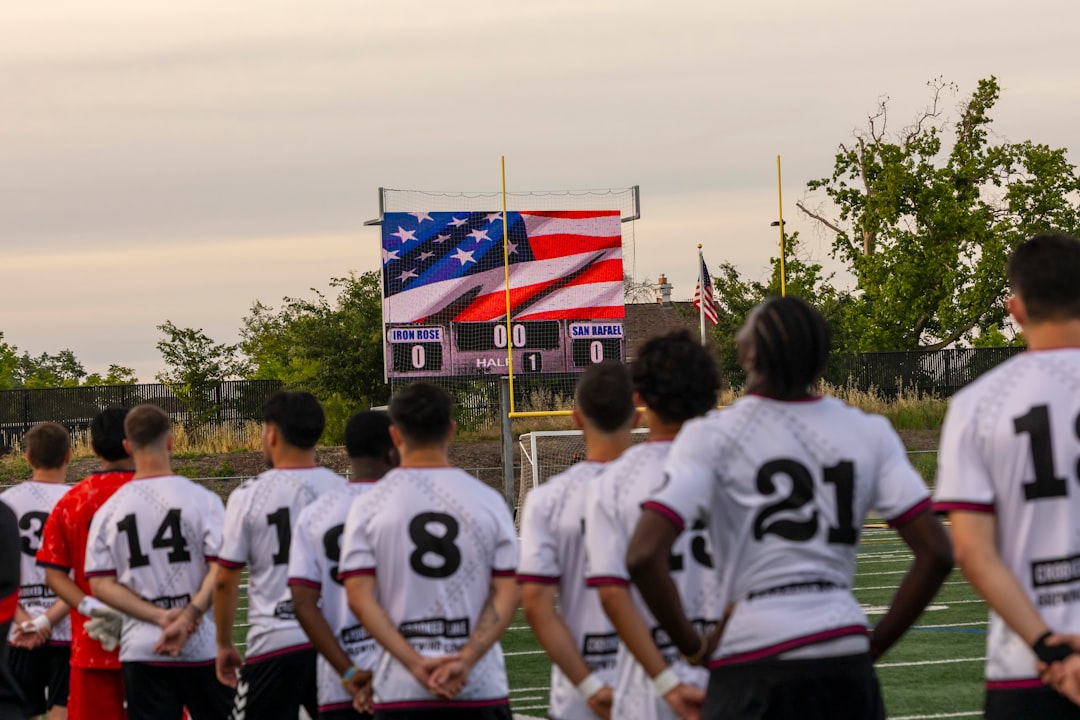




There is a specific smell (a combination of grass, eye black, and pre-game adrenaline) that takes former players straight back the moment they catch it at a Friday night game. If you played high school football, you didn't even need to read that sentence to know precisely what it smells like. And what playing high school football is like can be hard to capture until you've lived it.
It’s the kind of thing that ambushes you without warning. You’re walking past a freshly mowed lawn on a humid evening, or you catch a whiff of a particular kind of sweat and field paint at your kid’s youth game, and suddenly you’re seventeen again, standing in the tunnel, hearing the band tune up and feeling the concrete rumble under your cleats. That sensory shortcut is one of the few things that belongs only to people who earned it — people who logged the practices, wore the pads, and left something on the field.
It's genuinely hard to communicate to someone who wasn't on that sideline. The movies get parts of it right — the lights, the roaring crowd, the walk-off wins. They get most of it wrong. The real thing is stranger, harder, funnier, and more meaningful than any highlight reel suggests.
This is the account of what it actually felt like. The August practices nobody glamorizes. The Friday nights that exceeded every expectation. The things that seemed ordinary at the time and turned out to matter for the rest of your life.
August Two-A-Days: Before the Season Even Exists
The high school football experience begins not with a kickoff but with a two-a-day practice in August heat, in full pads, before the school year has started and before there's a crowd to impress.
Looking back, this is the part that filters out the casual participants from the ones who are actually going to be on the roster. Coaches rarely cut you for struggling. The real filter is voluntary: the decision to come back the next morning, and the morning after that, is entirely yours. Nobody's stopping you from walking to your car.


Two-a-days are what they sound like: two full practices in a single day. Morning session starts before the heat peaks. Afternoon session starts when the heat is at its absolute worst. You run routes until your legs stop responding the way you intend. You run conditioning drills — gassers, up-downs, bear crawls across sun-baked grass — until the purpose feels unclear and the only available motivation is that the guy next to you is still going. It is the same grind that, years later, becomes the August two-a-days you brag about, the ones you describe with a grin nobody who wasn't there quite understands.
There’s a particular kind of silence that falls over the team during the worst of it, somewhere between reps, when everyone is too tired to complain but too committed to stop. Maybe that’s the real initiation. You’d look around and realize that every player still standing had made the same unspoken choice. That mutual recognition — the nod you gave each other while gasping for air — built trust faster than any team-building exercise ever could.
Here is what nobody tells you about that experience: the bonding that happens in August conditioning is qualitatively different from anything that happens during the season itself. When you've collectively suffered through something optional and chosen to finish it anyway, the trust that results is the specific byproduct of shared voluntary suffering, not something manufactured.
The Playbook Nobody Warned You About
The physical demands of preseason are matched, and sometimes exceeded, by the cognitive demands. The playbook arrives — physical or digital depending on your era — and it is not a casual document. Offensive systems carry terminology, assignment keys, and formation variations that require genuine memorization.
You learn to see the field differently. A cornerback doesn't just watch the receiver — he reads the receiver's release, the quarterback's eyes, the shift in the offensive line's weight. A lineman doesn't just fire off the snap — he reads the defensive tackle's alignment at the line of scrimmage and adjusts his assignment accordingly.
And once you start seeing the game at that level, it changes the way you watch football for the rest of your life. Years later, sitting in the stands or on your couch, you can’t un-see the pulling guard, the disguised coverage, the slight hesitation that told you the blitz was coming. That mental framework becomes a permanent lens — one that makes you appreciate the intellect behind every snap.
The football intelligence required at the high school varsity level catches most freshmen completely off guard. The physical size gap between a 14-year-old and a 17-year-old is obvious. The gap in football IQ — built over years of practice repetitions — is less visible and equally large.
What Friday Nights Actually Feel Like
If the preseason is the chapter nobody romanticizes, Friday night is the chapter everyone tries to describe and mostly fails.
The preparation begins on Thursday afternoon. Walkthrough practice, lighter pads, final adjustments to the game plan. By the time Friday morning arrives, most of the team isn't fully present in class — they're running plays in their heads, reviewing assignments, managing the specific low-grade anxiety that comes from knowing precisely what the evening will ask of you.
The locker room before a game has an atmosphere that defies easy description. It is not a pep rally. It is not a casual gathering. It is a collection of 40 to 60 teenagers who have spent the last three months preparing for this specific evening, and who are now approximately 90 minutes from the opening kickoff. Music is playing. Tape is being applied to ankles and wrists. Eye black is going on. Nobody is talking about homework. That pre-game atmosphere — the feeling that no adult life ever quite recreates — is one of the memories that sticks hardest, long after the final whistle.
That hour of preparation is its own ritual. The taping of wrists in a particular pattern that became a superstition. The way your shoulder pads settled onto your shoulders after you strapped them on just a little tighter for a big game. The clack of cleats on the locker room floor as you paced, nodded along to the music, and stole a glance at your nameplate one last time before heading out. All of it was a countdown, and every player in that room felt the charge building.
The walk from the locker room to the field — through the tunnel, or across the parking lot, or through the gymnasium depending on your school's geography — is a moment that former players almost universally cite when asked what they miss most. The crowd noise that builds as you approach it. The lights hitting the field. The smell of the cut grass and the concession stand mixing together in the night air.
The Gap Between the Highlights and the Reality
Here is something the highlights don't show: the play itself accounts for only a slice of a football game. The rest of it is the 25 to 35 seconds between plays (the huddle, the communication, the alignment, the pre-snap adjustments), repeated 60 to 80 times over the course of an evening.
The play itself is over in 4 to 6 seconds. The preparation, execution, and reset cycle surrounding that play is where the game actually lives. A well-executed screen pass that gains 12 yards required 30 seconds of pre-snap communication, 5 seconds of execution, and happened because the receiving back has been practicing that release angle since August.
There is a version of this that plays out in every district in the country. A receiver catches a post route for a touchdown in the fourth quarter, and that is the play people ask him about for the next twenty years. What he remembers most clearly is the third-quarter slant he ran correctly that the ball never came his way on, and how he knew in that moment he had set up the coverage adjustment that made the fourth-quarter score possible. Nobody in the stands knew that. His quarterback did.
That kind of unseen contribution defines the game for so many role players. The blocking back who picked up the blitz that saved a sack, the defensive tackle who occupied two blockers so the linebacker could make the stop — most of the game’s quiet heroism never makes the stat sheet. But twenty years later, the guys who were in the huddle still know who did what. They still bring it up when they see each other because some debts don’t expire, and some blocks don’t need a highlight to matter.
The Things That Turned Out to Matter
There is a reason former high school football players return to homecoming games 20 years later and feel something specific standing at the chain-link fence watching a new team run the same drills on the same field. The game keeps going — the routines, the terminology, the two-a-day grind — and somewhere right now, a sophomore is learning the same playbook his dad learned. This season's Missouri Top 25 programs are running those same August sessions, building the same bonds on the same kind of fields. It is one of the high school football traditions that never actually die, handed down from one class to the next whether or not anyone bothers to write it down.
The experience adds up to something more specific than nostalgia for youth: the recognition that a set of lessons that felt like football lessons at the time were actually foundational lessons about accountability, collective effort, and performance under pressure.
What You Learned Without Knowing You Were Learning It
Accountability without excuses. Football has an unusual property: the film exists. Every play is recorded, reviewed, and discussed. Your assignment is traceable. If the cornerback got beat because he took a bad angle, the film shows the bad angle. There is no version of the Monday film session where the outcome is ambiguous. This creates a culture where accountability is a structural fact of the environment and not a motivational concept.
What it means to show up when you don't feel like it. Every player who makes it through a full high school football season played on days when they didn't want to practice, played through soreness that made it tempting to report an injury, played with a level of focus that the academic day had completely depleted. Doing that consistently, across 12 to 15 weeks of a season, teaches something about voluntary commitment that is difficult to acquire any other way.
The specific weight of being prepared versus unprepared. A player who has memorized his assignments and practiced his technique arrives at the game with a specific kind of confidence. A player who hasn't arrives with a specific kind of dread. The difference is entirely self-created. High school football makes this lesson visceral and immediate in a way that most environments don't.
I’ve seen those lessons resurface decades later in job interviews, parenting crises, and moments that demanded calm under pressure. When you’ve stood in a pocket with a defensive end bearing down on you, a conference room disagreement doesn’t feel nearly as intimidating. Football didn’t just teach you to hit; it taught you to keep thinking while the world was closing in. That’s a skill that shows up in boardrooms, emergency rooms, and anywhere else composure counts.
The Teammates You Didn't Expect to Matter
Ask most former players what they remember most about their high school football experience, and the answers converge on two things: the Friday night moments, and specific teammates.
Not always the stars. Not always the players who went on to play college ball. Often the specific teammate who helped them through the worst practice session of August preseason. The lineman who stayed after practice to run the freshman through his assignments. The senior captain who said the right thing at halftime when the game was slipping away.
I remember a nose guard who barely spoke to anyone off the field but who, during a two-minute drill when everyone was gassed, would grab the huddle and say three words: “We got this.” It wasn’t poetry, but when he said it, you believed it — because you’d watched him grind out every rep since June, never cutting a corner, never taking a play off. Some leaders don’t give speeches. They just show up, every single time, and that consistency becomes the standard you measure yourself against.
The social architecture of a football roster is unlike the social architecture of most high school environments. A 60-person roster includes players from different friend groups, different economic backgrounds, different academic tracks. The shared experience of the program creates relationships across those divides that often wouldn't form otherwise.
The Coaches Who Didn't Know They Were Shaping Things
Football coaches operate in a strange middle space between instructor, disciplinarian, and figure who matters more than they know. Most players, looking back, can identify a specific thing a specific coach said — often not in a big moment but in a quiet moment during a Tuesday practice — that shaped how they understood something fundamental.
For me, it was Coach M., who watched me botch a blocking assignment three times in a row, walked over, and instead of yelling, said, “Son, you’re thinking too fast. Your feet know what to do. Let them.” That small shift, trusting the preparation instead of trying to control every variable, has come back to me more times than any locker room pep talk ever did.
This isn't universally true. Coaches are human, and some of them get it wrong in ways that players also carry. But the genuine ones — the ones who are in it because they love the game and care about the players — leave specific marks that last longer than any individual season record.
What It Feels Like When It's Over
The end of a high school football career is one of the sharper emotional experiences in the athletic landscape, and it is significantly underacknowledged.
For most players, the last game is the last competitive game they will ever play. Unlike college players who lose in the playoffs and have the following season, a high school senior whose team loses in the quarterfinals is done. Not temporarily. Permanently. The next morning, the thing that has structured their autumns for four years simply no longer applies. That abrupt ending is where the feeling that you're a has-been at 25 begins, and it is why the loss lands harder than the people around you expect.
The numbers make the point better than any eulogy. According to NCAA data, only about 7.5% of high school football players go on to play at any NCAA division, all levels combined. The odds of a high school player eventually being drafted into the NFL are roughly 0.08%, about eight in ten thousand. NCAA's own probability-of-competing research lays it out plainly: for the overwhelming majority, the last snap of high school really is the last snap that counts for anything.
That statistic clarifies more than it saddens. If nearly everyone who ever puts on a helmet sees their competitive career end the same way, then the ending stops being a personal failure and simply becomes the shape of the game. The kid who went on to play Division III and the kid who never played again past senior year share the same truth: the thing they gave themselves to ended, fully, at an age when most people have not even started the part of their life that comes next.
That near-universal ending is exactly why it deserves honoring. When almost every former player you meet carries the same quiet loss, the loss stops being private and becomes something shared. When the conversation with another former player turns, without warning, to how much you miss it, you are not being sentimental about a rare achievement. You are speaking a language that millions of people understand, because nearly all of them walked off the field for the last time the same way you did.
Research on athletic identity consistently finds that the transition out of sport is one of the more disorienting experiences young athletes face, regardless of how successful the career was. The routine disappears. The team disperses. The Friday nights that defined the fall become something that happens to other people.
The scale makes it universal: football is one of the most-played high school sports in the country, according to the National Federation of State High School Associations, so millions of former players carry this same ending with them.
What former players most consistently report about that transition is surprise — not that it ended, but at how specifically they missed it. Not football in the abstract. The 6am conditioning. The particular smell of the equipment room. The specific people. If you want to keep those people close, you can design your own custom football jerseys and put your own name and number back on your chest.
The Homecoming Return
There is something worth noting about what happens when former players come back — for homecoming, for a reunion game, for the first time their own kid puts on a varsity jersey. What they feel in that moment runs deeper than nostalgia: the recognition that a specific version of yourself existed in that context and doesn't fully exist anywhere else.
The player you were on Friday night at 17, in full pads under those lights, making split-second decisions under pressure in front of your school — that version of you was real. The jersey you wore was the physical evidence of it. The number on your back meant something specific, to specific people, in a specific time.
That’s why so many former athletes eventually find themselves wanting something tangible that brings that version back into focus, something closer to a reminder than a costume. Something you can pull on at a homecoming tailgate or hang on the wall of your office and, for a moment, reconnect with the younger self who learned how to grind through August, how to trust the guy next to him, and how to stand under those lights and do the thing he’d prepared for. Turning your name, number, and school colors into a custom commemorative jersey doesn’t just honor the past — it reclaims a piece of your identity that the world too often tells you to leave behind.
The Part Nobody Nostalgizes
It would be dishonest to end this story without the other side of it. Not every former player looks back with uncomplicated fondness, and the accounts that resonate most with readers keep surfacing that truth for a reason.
Some guys played scared. Not of the other team. Of letting everyone down. The fear of being the one who missed the block, dropped the pass, or got beat deep and cost the season. That fear sits in your chest through every snap and doesn't fully leave when the lights go off. Plenty of former players will tell you they carried it quietly, and that it made the game heavier than anyone on the sideline could see.
Then there's the physical toll, which the highlight reels airbrush away. Most players who took the field week after week learned what it felt like to play hurt — not just the soreness of August gassers, but a shoulder that clicks, an ankle taped so tight you stop feeling it, and the quiet question of how badly the next hit might land. Some carry that body-awareness for the rest of their lives: knees that ache before it rains, and a hard-won understanding of what a serious injury can do to a seventeen-year-old body. Playing in fear and playing hurt were real parts of the deal, even for the guys who loved every minute of it.
Coaches' favoritism was real in plenty of programs too — the player who got snaps his effort didn't earn while a harder worker watched from the sideline. That leaves a mark that has nothing to do with the scoreboard.
None of this cancels the good parts. It's what makes them true. The brotherhood meant what it did partly because the fear and the hurt were real as well. You don't honor the whole experience by airbrushing the hard half of it — you honor it by remembering all of it. And that's what makes the jersey worth wanting back: not a costume, but a reckoning with something that was genuinely, complicatedly yours.
Your jersey is still out there waiting.
Design yours in minutes and see your name and number the way you remember it.
Frequently Asked Questions
Is high school football as intense as it looks from the outside?
In some ways, yes — and in some ways it's more intense than it looks. The physical demands of preseason conditioning and the cognitive demands of learning a complex system both surprise most players who haven't been through it. What looks from the outside like a game on Friday night represents roughly 15 hours of practice and preparation per week from August through November. The intensity is real. So is the reward on the other side of it.
What position is hardest to play in high school football?
This depends significantly on the offensive and defensive systems a program runs, but quarterback is consistently the most cognitively demanding position across most systems. A quarterback is responsible for pre-snap reads, protection adjustments, and post-snap decisions — all in real time, against defenses designed specifically to disguise their intentions until after the snap. Offensive lineman is physically demanding in ways that receive less public recognition: reading defensive alignments, communicating protection assignments, and executing technique against players who are specifically studying your tendencies is a full-game cognitive and physical challenge.
Do the friendships from high school football actually last?
More consistently than most people expect. The specific nature of the shared experience — voluntary suffering, high stakes, genuine interdependence — creates a different category of bond than most shared adolescent experiences produce. The degree to which those friendships remain active depends on geography and circumstance, but the recognition when former teammates reconnect is typically immediate and specific, even after decades. You remember precisely who showed up when it mattered. That doesn't fade.
What do most former players say they wish they'd appreciated more while they were in it?
Almost universally: the ordinary Tuesday practices. The moments that didn't feel like moments — the specific drill repetition, the walk back to the huddle, the time in the weight room before school. The Friday nights are vivid because they were vivid. The Tuesday practices are vivid because, in retrospect, that's where the actual thing was happening. Former players who could go back almost always say they'd slow down the ordinary moments, not the highlight moments.
Why does looking at my old number still feel so significant after all these years?
Because that number wasn’t just a piece of fabric — it became shorthand for who you were in that arena. Coaches called it out on the field. Teammates associated it with how you played, how you showed up, and what you stood for in the huddle. Seeing it again, even decades later, can unlock memories that you hadn’t accessed in years. It’s a portal to a version of yourself that still exists, and wearing it again — on a jacket, a hoodie, or a custom jersey — can feel like coming home to a part of you that nobody can take away.
How can I reconnect with my football past in a meaningful way?
There are a number of paths. Attending alumni gatherings or homecoming games is a classic choice, and reaching out to old teammates can lead to impromptu reunions that mean more than you’d guess. Many former players also find that creating a tangible symbol of their playing days — something that carries your own name and number in your school’s colors — serves as a daily reminder of the lessons and relationships that were forged on that field. It doesn’t have to be complicated; sometimes just having that keepsake in your closet or on display is enough to keep the connection alive.
See also: what high school sports actually teach you | the grief that comes when the season ends for good | what playing under the Friday night lights actually felt like | how athletic identity doesn't just disappear after high school