

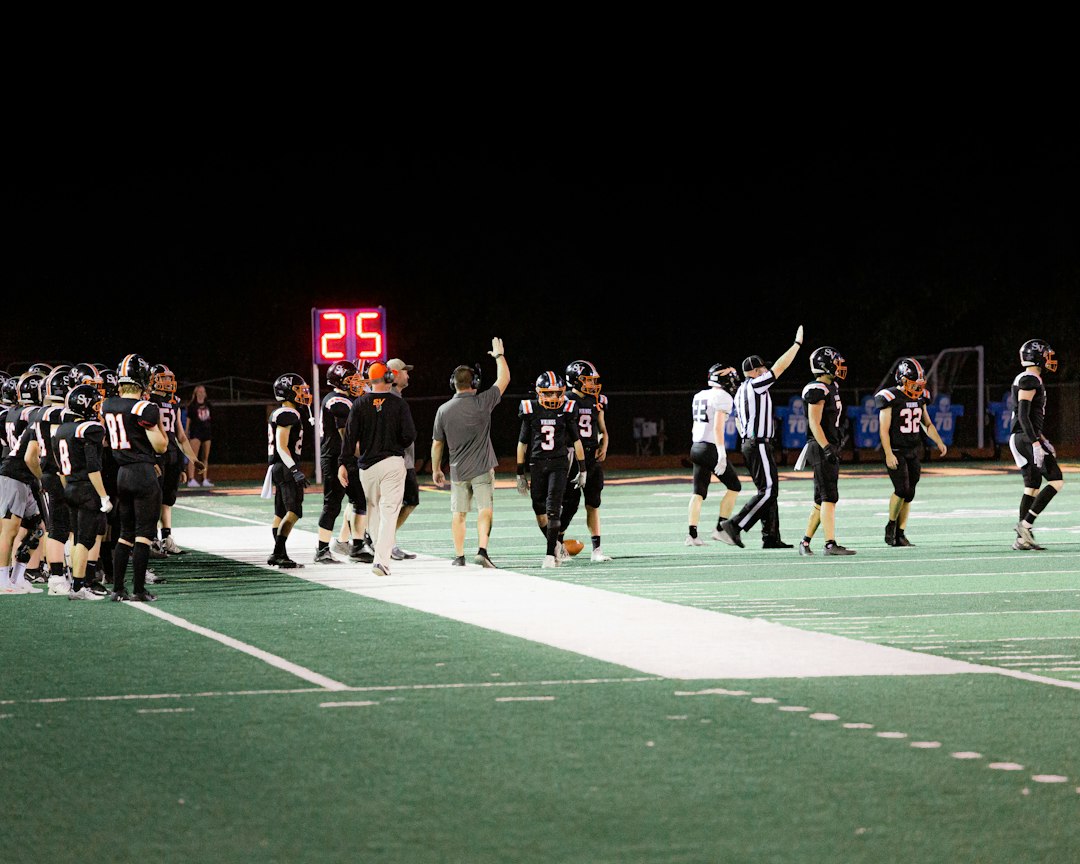




What Friday night scores still mean to everyone who ever played is something no box score has ever been built to measure. Maryland high school football delivered that reminder on October 23, 2026 — a full slate of final scores that, to the outside world, look like two columns of numbers separated by a hyphen, and to former players look like an entire compressed life.
St. Frances dropped their third consecutive loss. Other results reshuffled the High School On SI Top 25 conversation just enough to matter to the programs involved. Scouts, parents, and fans were already refreshing their phones from stadium parking lots before the bus engines turned over.
This piece isn't a recap of those scores. It's about what those scores feel like when you've lived them from the inside — not from the bleachers, not from a phone screen, but from the sideline with a helmet in your hand and a week's worth of preparation sitting in your legs.
The Scoreboard Never Forgets You
There's a particular kind of Friday night that takes up permanent residence in the body of anyone who ever played high school football. It doesn't announce itself. Weeks go by and you're not thinking about it. Then a score drops — a program loses unexpectedly, a streak ends, a powerhouse stumbles for the third time in a row — and something in your chest recognizes the feeling before your brain has finished reading the headline.
That's the St. Frances feeling circulating right now among everyone who's ever worn a jersey for a program that wasn't built to lose.
Three straight losses for a team whose identity is built around the idea that losing isn't in the vocabulary. Anyone who played for a program with that kind of standard already knows exactly what the locker room sounds like after game three. The particular silence that settles over a group of young men who believed — completely, not performatively — that they were going to win, and didn't. Again.


The scoreboard doesn't care about belief. It only records what happened.
And yet the scoreboard becomes part of you permanently. Whether it reads in your favor or against you, those numbers from a Friday night in October follow you into conference rooms and backyard cookouts and quiet Tuesday mornings for the rest of your life. Former players don't carry trophies everywhere they go. They carry scores.
Every Former Player Knows This Moment
Remember when the final whistle blew and you didn't know what to do with your hands?
You'd been in motion for the better part of three hours — or two hours and forty minutes, or whatever the specific brutal length of your specific brutal game turned out to be — and then suddenly the officials were walking off the field and the crowd was either roaring or going quiet, and you were just standing there on the turf, helmet hanging at your side, trying to figure out what your body was supposed to do now that the thing it had been preparing for all week was finished.
If you won, the feeling arrived too large to hold in one piece. It came out in fragments — a shout, a shove at a teammate's shoulder pad, a sprint toward the student section that you will never be able to fully explain to anyone who wasn't inside it.
If you lost — especially the third loss, the one that makes you start doing math you don't want to do about the rest of the season — the feeling was different. It settled into your chest like something dense and specific. Not grief exactly. Not anger exactly. Something more complicated than either of those, something coaches called character-building and that you called, privately and precisely, unbearable.
Every former player reading Maryland's Friday night results felt one of those two things. Some felt both simultaneously.
What the Top 25 Actually Measures
The High School On SI Top 25 rankings do something that reads as clinical from the outside and registers as entirely electric from the inside.
They create consequence.
When you play for a ranked program — or against one — the stakes of a single Friday night multiply in ways that a regular-season record alone doesn't capture. A loss for a Top 25 team isn't just a loss. It's a data point the entire country sees. It travels to recruiting offices, to college coaches' morning film sessions, to text threads between scouts comparing notes on players two years from making a college decision.
For the players living inside those scores right now, that weight is simultaneously an honor and a burden. They feel it at Tuesday practice. They feel it when a coach cuts a drill short and goes quiet for a few seconds in a way that means he's replaying something from last Friday that he doesn't want to say out loud yet.
Former players know that weight. It doesn't leave when you leave the program. Ask anyone who played for a nationally ranked team what year their program last appeared in the conversation, and they'll tell you the exact ranking, the exact game where the trajectory shifted, the exact play they can still see with their eyes closed.
The scoreboard keeps score. The rankings keep memory.
Marcus T., 34, Ran Kickoffs Back for a Maryland 3A Program in 2009
Marcus still has the game program from the October night his team beat their district rival by four points to stay undefeated through week eight. He keeps it in the top drawer of his desk — not because anyone would notice or ask about it, but because on the hard weeks, the ones where nothing goes right and the clock seems to move in the wrong direction, he opens the drawer and looks at it for about thirty seconds.
"I wasn't even the best player on that team," he said. "But I was on that team. That score belongs to me too."
That's the thing about Friday night final scores from high school. They don't belong exclusively to the star quarterback or the all-state linebacker. They belong to everyone who wore the number. Everyone who ran the scout team on Wednesday afternoon. Everyone who stood on the sideline in a uniform, part of the thing even in the moments they weren't on the field.
Marcus checks Maryland high school football scores every October. Not obsessively — he's not tracking every statistic across every classification. He just looks at the results on Saturday morning and feels a specific private connection to whoever those young players are right now, wherever they are, helmet in hand, figuring out what their body is supposed to do next.
The Third Loss Is Its Own Category
Let's be specific about what St. Frances is carrying, because former players understand something about a third consecutive loss that outside observers tend to underestimate.
The first loss is a system shock. The season has been moving in one direction and suddenly it isn't. You leave the stadium more confused than anything else — processing, not yet grieving.
The second loss is where the weight fully arrives. The narrative starts forming in the press, in the rankings conversation, in the team meeting where a coach uses words like "response" and "adjustment" while everyone in the room understands that the real conversation is about something harder to name. You leave that stadium feeling the season's shape changing around you in real time.
The third loss is its own category entirely.
By loss number three, the mental work is no longer purely about football. It becomes about the choice every player has to make between the story the scoreboard is telling and the story they're going to keep telling themselves. It's about whether the thing they believed before the season started — about this team, these teammates, this program — is solid enough to carry into week ten when everything external is pushing in the opposite direction.
Programs that come back from three straight losses and do something meaningful with the remainder of their season don't manage it through strategic adjustment alone. They manage it because of something that happens in a locker room, or at the end of a Tuesday practice, or in a specific thirty-second exchange between two players that no scoreboard ever captures and no rankings panel ever sees.
Former players know what that moment looks like. Some of them lived it and carried it forward. Some of them wish they'd handled it differently. Both groups still think about it.
Friday Night Lights Never Stop Burning
Here's something that doesn't come up enough in conversations about what high school sports leave behind: the lights don't go out for former players. Not completely.
Every October, every Friday night, across Maryland and across every state where football is the shared language of autumn, former players are checking scores for teams they haven't suited up for in ten or fifteen or thirty years. They follow programs they played against. They notice when a rival school has a good year. They feel a specific combination of pride and longing when a program they loved wins something significant.
It isn't nostalgia in the passive sense — that word is too gentle for what it actually is. It's more like a frequency you were tuned to for four years that your nervous system never fully abandoned. The Friday night transmission is still coming through, even decades later. Most former players couldn't turn it off entirely if they wanted to. And honestly, most of them don't want to.
Because what the Maryland scores from October 23rd represent — every number, every streak, every ranking movement — is proof that the thing you were part of continues. The field is still lit. Somewhere in a stadium tonight, a player is standing on a sideline in the final minutes of the fourth quarter having a feeling so large and specific that they won't be able to put language to it for years.
You were that player once. That score was yours once.
In our experience covering the former-player community, the people who stay most connected to high school sports long after graduation aren't chasing glory or trying to relive something lost. They're the ones who understand, usually without being able to articulate it directly, that what happened on those Friday nights formed them. The score was the punctuation. The game was the sentence. And some sentences you carry your whole life.
The Number on Your Back Still Belongs to You
There's a direct line between the Friday night score you lived through and the jersey you wore when you lived it.
Numbers don't only track yards and points. They track moments. A number on a scoreboard corresponds to a number on a back, and that number on a back belongs to a specific person who stood on a specific field during a specific October that gave them something permanent.
What our team hears most consistently from former players is this: they aren't looking for something inspired by a famous program's moment or a tribute to someone else's playing days. They're looking for their moment. Their number. Their school colors. The specific combination that, when rendered exactly right, takes them directly back — to the locker room before kickoff, to the field at halftime, to the parking lot after the final whistle when the weight of what they'd just been part of was still settling into their bones.
The Maryland scores from this Friday will become memories. Some of them will become the defining memories of a player's entire athletic life. And years from now, some of those players will want to hold something that takes them back to being the person who was inside it.
Your jersey is still out there waiting.
Design yours in minutes and see your name and number exactly the way you remember it.
Frequently Asked Questions
What happened with St. Frances in Maryland high school football this October?
St. Frances, one of Maryland's most prominent high school football programs, suffered their third consecutive loss in the October 23, 2026 results — a significant streak for a program built on elite, consistent performance. The losses have shifted their positioning in national high school rankings conversations and placed additional focus on how the program and its players respond in the final weeks of the season. For former players who know what a third straight loss feels like from the inside, the result carries weight that goes well beyond the scoreboard.
How does the High School On SI Top 25 affect Maryland programs?
The High School On SI Top 25 rankings carry real recruiting and reputational consequences for Maryland programs. A loss from a ranked team doesn't stay local — it enters a national conversation that college coaches, scouts, and recruiting analysts follow week to week. For players currently on those rosters, being part of a ranked program changes the pressure profile of every Friday night. For former players who suited up for ranked programs, those rankings remain a permanent part of how they understand their own playing history.
Why do former players still follow high school football scores years after graduating?
Because the field doesn't stop being yours the moment you graduate. Former players across Maryland — and across every state where Friday night football is a cultural institution — check scores, follow programs, and feel genuine emotional connection to results from teams they played for or competed against years or decades ago. The connection isn't about living in the past. It's the persistence of an identity formed on those fields, in those uniforms, during those specific Friday nights. When a program loses three straight, former players feel something specific and familiar in their chest. They know exactly what that something is because they've felt it before.
What's the best way for a former player to honor their high school playing days?
The most personal way former players describe marking their playing days is through a custom jersey built around their own experience — their actual name, their actual number, their actual school colors from the season that shaped them. Unlike off-the-shelf sports merchandise, a custom jersey tied to your specific playing history is personal in a way that nothing else available to former athletes quite matches. It's the artifact that corresponds directly to the memory, a tribute to the Friday nights that still light up something in your chest when the October scores roll in.
See also: why high school sports still matter to adults | what playing under the lights actually felt like | why your senior season memories are so vivid | why you still dream about those games