

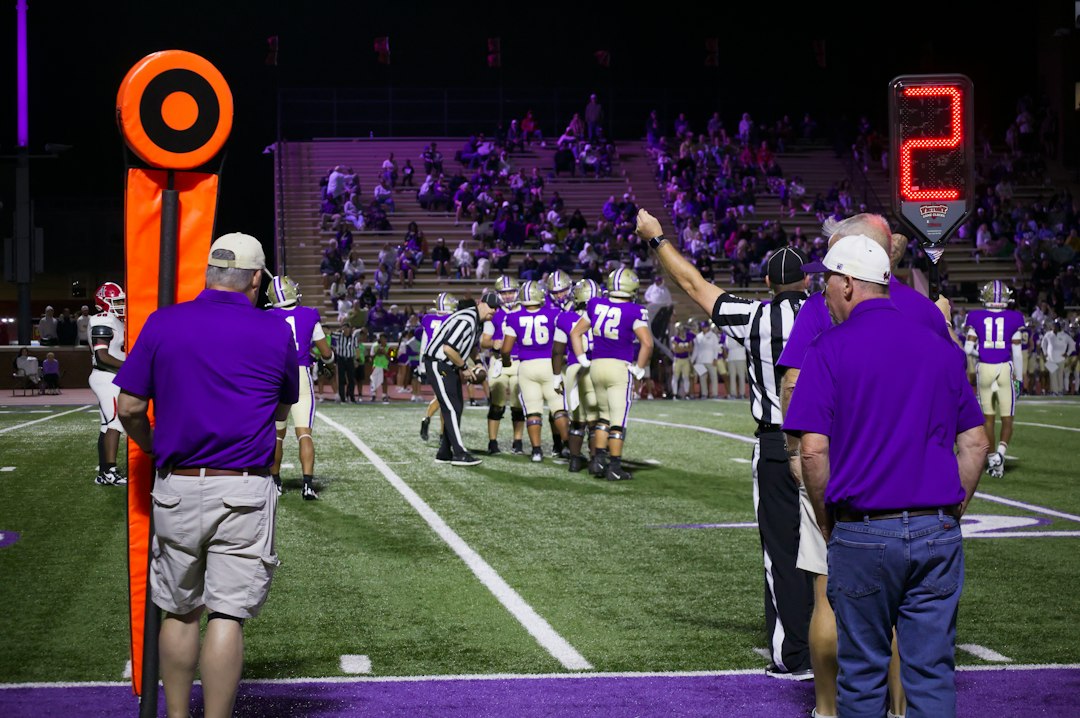




You saw the headline. You weren't even looking for it.
Maybe you were scrolling through something else entirely — a news feed, a sports tab, whatever pulls your thumb on a Thursday morning. And then there it was: Colorado High School Football Top 25 State Rankings. A list of team names and numbers. Nothing more.
But it wasn't nothing, was it?
For anyone who ever pulled on a jersey on a Friday night, laced up cleats in a locker room that smelled like old shoulder pads and Icy Hot, and ran out of a tunnel into the particular cold of a Colorado autumn — a list like this doesn't stay on the screen. It moves through you. It lands somewhere behind the sternum and just stays there for a while.
Colorado's latest Top 25 high school football rankings dropped this week through SI High School Sports, covering a light opening playoff week in which only six ranked teams were in action. The report notes the action will ramp up significantly in the days ahead as the bracket tightens and the stakes climb. Six games. Twenty-five ranked programs. The whole beautiful machinery of Friday night football humming into its most important stretch of the year.
And somewhere in Colorado right now, there's a kid wearing a number on his back who has no idea how fast this goes.
The Rankings Are for the Players. The Feeling Is for Everyone Who Used to Be One.
Here's the thing about a Top 25 ranking in high school football: it means everything and almost nothing at the same time.
It means everything to the kids who are living it. To the starting linebacker who checks his phone between fifth and sixth period to see if his school cracked the list. To the offensive lineman who doesn't get his name in the box score but whose teammates know exactly why they're ranked where they are. To the head coach who's been building toward November since the first two-a-day practice in August heat.


But for anyone on the other side of their playing days, a ranking like this means something different. Something quieter. Something harder to name but immediately recognizable.
It means you remember.
You remember what it felt like to be on a team that people were watching. Or on a team that nobody was watching — and what that taught you about working for something nobody could rank or rate. You remember the Friday morning energy in the hallways of your school, the way everything felt slightly surreal, slightly charged. The game jerseys worn to class. The way lunch tasted different on game day because your stomach was already somewhere else.
Every former player knows this: you spend your whole career wanting to be watched. And the moment it's over, you spend the rest of your life quietly watching others. Reading rankings. Following scores. Clicking on headlines you weren't even looking for.
What Six Ranked Teams and a Light Playoff Week Actually Tell You
The SI report frames this as a light week — only six ranked teams saw playoff action in the opening round, with the full bracket expected to ignite in the days ahead. That framing is accurate from a data perspective. Six games is a small sample. The real reckoning comes next.
But if you played high school football in Colorado — or anywhere, honestly — you know that there's no such thing as a "light week" once the playoffs start. Not for the kids on those six teams. Not for the coaches running film at midnight. Not for the parents in the stands who drove forty-five minutes in November cold to watch their kid play what might be his last competitive football game.
The bracket is unforgiving in ways that regular season rankings are not. You can be Top 5 in the state and lose on a bad snap in the first round. You can be a team nobody picked and go on a run that changes what an entire town talks about for the next twenty years. The rankings tell you who the best teams probably are. The playoffs tell you who they actually were.
In our experience watching how these November stretches unfold, the teams that surprise you in the postseason are almost never the ones that were overlooked because they were bad. They're the ones that were overlooked because someone didn't understand their specific kind of tough.
That's a truth that doesn't appear in a Top 25 list. But every player who ever went on a playoff run when nobody expected it knows exactly what it feels like.
Remember When Your Name Was on That List?
Or when it wasn't — and you played like you had something to prove because of it?
This is where rankings get complicated for former players. Because the memory isn't always about being ranked. Sometimes the memory is about being overlooked. About playing for a program that never cracked a Top 25, never got a headline, never had anyone from outside your own county show up to watch.
And somehow, impossibly, those are some of the most vivid memories anyone carries out of their playing days.
Maria C., 34, who played varsity soccer and ran track in a small district outside Denver, describes it this way: her school didn't appear in any statewide rankings for either of her sports. But she remembers every single teammate by name, remembers the specific sound of a stadium that held maybe four hundred people on its biggest night, remembers the feeling of winning a game nobody else knew was happening. "There's something about competing when no one's watching," she says. "It made everything feel like it was ours. Just ours."
The rankings name the teams that the state is watching. But the feeling of playing — the actual lived experience of Friday night football or any Friday night sport — belongs to everyone who ever suited up. Ranked or not.
Every former player knows the moment. The one that comes back when you least expect it. The smell of the grass. The weight of the pads settling onto your shoulders before warm-ups. The sound of a crowd you couldn't distinguish individual voices from anymore because it had become one continuous noise. The way time moved differently during a game — faster than anything else in your life until that point and, for many people, faster than anything that came after.
That's what a Colorado Top 25 ranking pulls out of you. Not the specific teams. Not the specific numbers. The feeling.
What Playoff Football in Colorado Looks Like Right Now
For the teams currently in the bracket, here's the reality on the ground as the action ramps up:
Six ranked programs opened their postseason runs in the first round. The report from SI High School Sports indicates that this week brings a significantly heavier slate of games as more programs enter playoff competition. Colorado high school football operates across multiple classifications — from the largest metro programs to the small-school brackets where a roster of thirty-five kids competes with the same intensity as programs ten times their size.
The Top 25 rankings function as a statewide barometer, but every former player understands that the classification structure means the conversation is actually several conversations happening at once. A team ranked in the top five of a smaller classification is running a program that, for their community, carries the same weight as any blue-chip program carries for theirs.
That's worth sitting with. The stakes aren't smaller because the stadium is smaller. The feeling isn't diluted because the ranking list is shorter. If anything, in our experience watching how smaller-school playoff runs develop in Colorado and across the country, the intensity of meaning — per player, per family, per community — is often higher when the resources are fewer and the bond between team and town is tighter.
The action ramps up this week. That phrase, light as it reads in a news brief, carries enormous weight for the people inside it.
The Jersey You Wore Still Means Something
Here's what nobody tells you when you're in the middle of it: the number on your back doesn't expire.
The team you played for, the colors you represented, the name on your chest — those don't belong to that one season. They belong to the whole arc of who you became after. The lessons from a Friday night loss in November travel with you into every professional setback you ever navigate. The discipline of a two-a-day practice in August heat becomes a reference point your body and mind return to whenever you're asked to do something hard.
The ranking didn't capture any of that. Rankings don't. They capture a moment, a snapshot, a data point that matters enormously for seven days and then becomes history.
But the jersey? The jersey captures something else. The jersey is the artifact that holds the feeling.
Former players who come through iPlayedFor talk about this constantly — not in those exact terms, but the shape of what they're describing is always the same. They want their jersey back, not because they're trying to relive a season, but because they want to hold the physical thing that represents what that season made them. The name. The number. The colors. The proof that they were there, that they played, that they were part of something.
A Colorado Top 25 ranking is a list. What you carried off that field is not a list.
Your jersey is still out there waiting.
Design yours in minutes and see your name and number exactly the way you remember it.
Frequently Asked Questions
Why do high school football rankings matter during playoff season specifically?
During the regular season, rankings function primarily as a way to identify the strongest programs and generate statewide conversation. But once the playoffs begin, rankings carry additional weight because they become seeding context — they help fans and media understand the competitive hierarchy going into single-elimination competition. A team ranked in the Top 5 entering the playoffs carries different expectations than a team that enters as an unranked qualifier. For former players, playoff rankings are the most emotionally resonant version of the list because they represent the highest-stakes version of the game they remember playing.
Does Colorado's Top 25 ranking cover all classifications?
Colorado high school football is organized across multiple classifications based on school enrollment size. The Top 25 statewide ranking typically aggregates the strongest programs across those classifications into a single list, though classification-specific rankings and brackets also exist. This means a team from a smaller enrollment classification can appear alongside large metro programs when their overall performance warrants it. The multi-classification structure is part of why Colorado's postseason produces the kind of unexpected results and storylines that keep former players checking scores long after their own playing days have ended.
How do former players stay connected to high school football in their state?
The most common ways former players stay connected are following local team scores and rankings through outlets like SI High School Sports, attending games when geography allows, and maintaining connections to their former programs through alumni networks and social media. Many former players describe a renewed interest in high school football when they have children approaching playing age, or when a team from their own school or district makes a notable playoff run. The connection rarely fully disappears — it just changes shape over time, moving from participant to observer without losing the emotional charge that came from being inside the game.
What makes a high school football playoff run different from regular season wins?
Playoff wins carry a finality that regular season wins don't. In the regular season, a loss is recoverable — you can play your way back into contention, improve your ranking, and correct course. In a single-elimination playoff bracket, every game is both a destination and a potential ending. Former players almost universally identify their playoff experiences — wins and losses — as the games they remember most vividly. The stakes sharpen memory in ways that a mid-October regular season game typically doesn't. That's the specific texture of November high school football, and it's what makes a "light playoff week" feel like anything but light to the people inside it.
See also: why high school sports still matter to adults long after the final whistle | the athletic identity that stays with you long after your playing days end | the science behind why your senior season memories are so vivid | how football culture stacks up differently across the country