

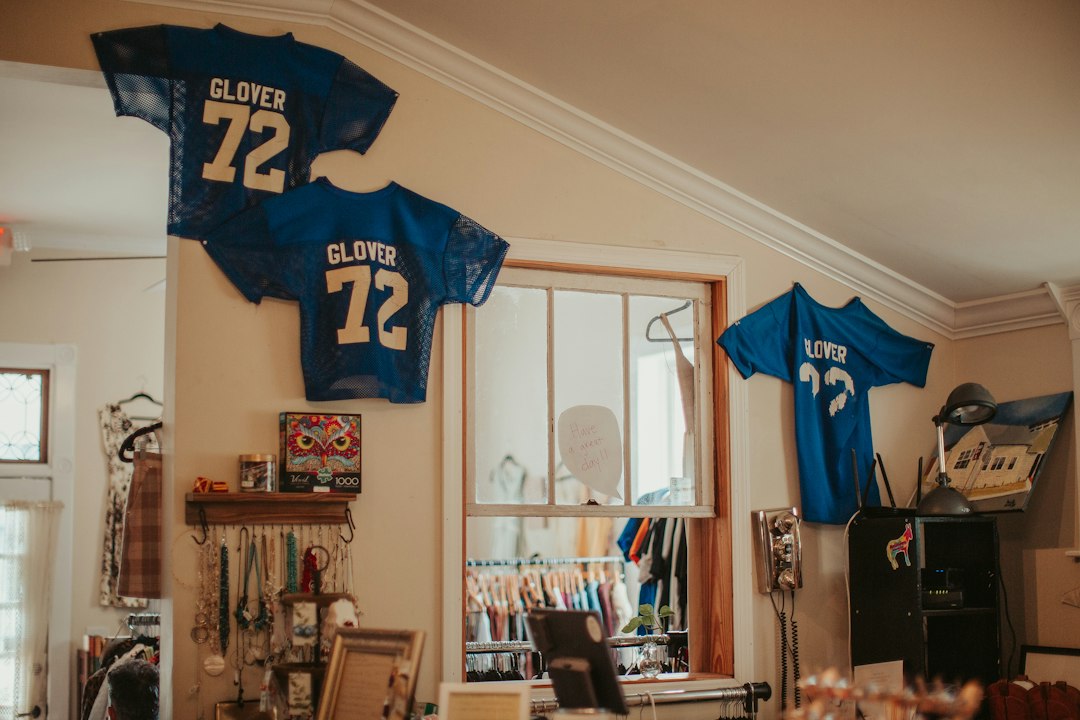




There's a specific moment that happens in sporting goods stores and on team shop pages across the country. A former player — maybe former high school, maybe college, maybe rec league at a level that mattered deeply to them — stops in front of a rack of throwback sports jerseys and feels something complicated.
The jerseys are beautiful. The throwback designs are genuinely evocative. But something doesn't sit right, even before they've tried one on.
They're looking at a Philadelphia Eagles throwback jersey with someone else's name on the back. They're looking at a Seattle Seahawks throwback jersey in a colorway that sends them straight to a specific autumn Saturday — but the number belongs to a player they watched, not a number they wore.
The feeling is hard to name. Buying guides never name it, which is why this one exists.
If you played — at any level, in any sport, in any era — you are not a fan looking for team representation. You are a former athlete looking for a personal artifact. Those are different purchases. They require different criteria. And right now, the entire throwback jersey market is organized around the fan, not the player.
That gap is what this guide addresses.
The Distinction Nobody in the Jersey Market Makes
Pick up any buying guide for throwback jerseys — any of the top results ranking for this search — and you will find the same framework repeated. Authentic vs. fan-grade. Stitched vs. screen-printed. Mitchell & Ness throwback jerseys vs. off-brand alternatives. Price points. Fabric weights. Licensed vs. unlicensed.
All of it is organized around one assumed identity: the fan.
The fan's buying criterion is team representation. They want a jersey that looks accurate to a specific era of a team they love. The 1978 Pittsburgh Steelers throwback jerseys are popular because that Super Bowl era is beloved by Steelers fans. The Mitchell and Ness throwback jersey market exists almost entirely to serve that need — to let a fan wear history that belongs to a player they admired.


That is a legitimate and beautiful thing. It is not the only thing.
There is a second reader standing at this rack. They wore a number. They suited up. Their body ran a route, took a charge, tracked a fly ball, set a screen. The jersey they are looking for is not a representation of a team they watched — it is an artifact of something they actually did. The distinction is not sentimental. It is structural. It changes every single buying criterion.
What a Fan Jersey Is Actually Doing
A fan jersey — including most licensed throwback jerseys in the market — is performing team loyalty. It is a symbol. It says: I belong to this community. This era, this team, this legacy matters to me.
The Mitchell & Ness throwback jersey market perfected this. Their NBA and NFL archives are genuinely impressive — accurate fabrics, correct numbering systems, period-correct colorways. The Philadelphia 76ers throwback jersey produced in tribute to the 1982–83 championship season is a legitimate piece of historical recreation. If you are a Sixers fan and that team defined your childhood, that jersey does exactly what it is supposed to do.
It represents a game you watched.
What a Player Jersey Is Actually Doing
A player jersey — and this is the category the market doesn't have language for yet — is performing personal history. It says: I was there. This happened to my body. This number belonged to me.
The Spurs throwback shirt a former player reaches for isn't about Tim Duncan. It's about the season they played under that banner, in that colorway, with their own name across the shoulders. The Manchester United retro jersey an aging midfielder considers isn't about Sir Alex Ferguson's treble — it's about the Saturday league where they wore those colors and their knees still worked.
These are not interchangeable motivations. They require completely different products.
The Authentic vs. Fan-Grade Framework — and Where It Breaks Down
The dominant framework for evaluating throwback jerseys runs along a spectrum from fan-grade to authentic construction. Here is what that spectrum actually measures — and why it stops short for the former player.
Fan-grade jerseys are built for the stands: screen-printed numbers, lighter twill construction, designed to look like the real thing from ten rows back. They are not made to survive contact. Price range typically $50–$100.
Authentic-construction jerseys are built to match what players wear on the field: tackle twill, heavier fabric, stitched numbering, dimensions cut to professional specifications. They hold up under broadcast lighting and look right at close range. Price range $150–$350.
Neither of these options addresses the former player's actual need.
The former player is not asking whether the fabric matches what professional players wear today. They are asking whether the jersey can carry their history — their name, their number, their team colors from their specific era. A $300 authentic-construction NFL throwback jersey with another player's name on the back serves that need exactly as poorly as a $60 fan-grade version. The entire spectrum is organized around fidelity to professional product, not fidelity to personal history.
This is the framework failure. It explains why former players often walk away from the throwback market feeling vaguely unsatisfied by purchases that are objectively excellent products — just not the right product for what they actually needed.
The One Question That Reorganizes Every Decision
Here is the criterion no jersey guide states directly: Is this jersey representing a game you played, or a game you watched?
That question reorganizes everything that follows.
If the answer is "a game you watched": The licensed throwback market is built for you. The Mitchell & Ness throwback jerseys, the NFL throwback jerseys through official channels, the Eagles throwback jersey from the official Eagles shop — these products do what you need them to do. They represent teams and eras accurately. The authentic vs. fan-grade spectrum is the right framework for your decision, because your criterion is accuracy to professional product.
If the answer is "a game you played": The licensed throwback market cannot serve you, because it cannot put your name and your number on a jersey that represents your era of your sport. What you need is a custom throwback jersey — a jersey built to your specifications, in your colors, with your name and number, in a design that reflects the era you played in.
These are not the same product category wearing the same name.
The Four Questions That Identify Your Real Purchase
Before spending money on any throwback jersey — licensed or custom — answer these four questions honestly.
-
Whose name goes on the back? If the answer is yours, you are not looking for a licensed product. If the answer is a player you admired, the licensed market serves you well.
-
What era does this jersey need to represent? If it's your era — the years you played, the uniform your team actually wore — then accuracy to your specific uniform matters more than accuracy to a professional team's uniform.
-
What is this jersey actually for? Display artifact? Recreational wear? The specific feeling of suiting up again? The answer changes which construction details matter most.
-
What happens when someone asks you about it? If the honest answer involves a story about a game you played, a season you survived, a number you earned — then the jersey is a personal artifact. It should be built like one.
Marcus D., 44, played four years of Division III basketball in the early 2000s before a knee injury ended his career. He spent three years looking for a throwback jersey that felt right before he understood what he was actually looking for. "I kept buying jerseys with other guys' names on them," he said. "They were beautiful. But I'd put them on and feel like I was dressed as someone else. What I wanted was to be me — number 23, same colors, same era. Once I understood that, I stopped looking at fan jerseys entirely."
What Custom Throwback Jerseys Actually Make Possible
Custom throwback jerseys — jerseys built to a former player's specifications rather than a licensed player's specifications — address the personal artifact need directly.
Here is what the custom build unlocks that the licensed market cannot provide:
Your name. Your number. This is the foundational distinction. No licensed throwback jersey will carry your name unless you were a professional player. A custom build carries exactly the name and number that belonged to you.
Your era's design vocabulary. Throwback design is well-established territory — the striping patterns, the color blocking, the font choices that signal specific decades of specific sports. A skilled custom builder working with that vocabulary can produce a jersey inspired by your era without reproducing protected team marks. You get the visual language of your playing years without the legal complications of licensed insignia.
Your sport's construction standards. Whether you played football, basketball, baseball, soccer, or hockey, the construction requirements differ. The right builder produces a jersey that functions like the one you played in — not like a display piece that was never meant to move.
Your specific team colors, even if your team was never a professional franchise. This is where the licensed market fails the former player most completely. If you played high school, college, or amateur league ball, your colors may not correspond to any licensed product in existence. A custom build matches them exactly.
The Licensed Throwback Market at Its Honest Best — And Its Structural Limits
To be fair to the licensed market: the best products in this category are genuinely impressive.
The Pittsburgh Steelers throwback jerseys paying tribute to the 1970s Steel Curtain era are among the most iconic pieces of American sports uniform history. The Seattle Seahawks throwback jersey honoring the pre-2002 Northwestern Striped colorway has an authenticity that fans of that era find deeply satisfying. The Philadelphia Eagles throwback jersey in kelly green provokes exactly the nostalgic response it was designed to provoke.
These products excel at what they were built to do. For the fan whose identity is organized around these teams and eras, they represent the right purchase.
The structural limit is simple: they cannot extend their function to the former player's need. The Seahawks throwback jerseys do not carry your number. The Eagles throwback jersey does not carry your name. The Philadelphia 76ers throwback jersey does not represent your season.
This is not a criticism of these products. It is an honest observation about what they are designed to do — and what falls outside that design.
How to Evaluate a Custom Throwback Jersey Builder
If you have worked through the four questions above and landed in the custom category, here is what to evaluate in a builder — specifically, not generally.
Design fidelity to era. Can the builder demonstrate familiarity with the design vocabulary of your sport's specific decades? Striping patterns, number fonts, sleeve detailing — these elements are what make a jersey read as "1987" versus "2003." Ask to see examples from your era before committing.
Name and number placement accuracy. Placement is not arbitrary. The distance from collar to nameplate, the arc of numbers on a football jersey, the font weight on a basketball uniform — these are specific and period-appropriate. A quality builder knows these specifications without being prompted.
Fabric construction appropriate to intended use. If you are wearing this jersey in a recreational league, you need different construction than if it is going on a display hook. Sublimated fabric allows for all-over design complexity; tackle twill delivers the traditional stitched-letter feel that most players remember from their playing days. Both are appropriate in different contexts.
Turnaround and revision policy. A personal artifact deserves iteration. Your name deserves to be right. Look for builders who provide proofs before production and include at least one round of revisions in the base price.
Your jersey is still out there waiting.
Design yours in minutes and see your name and number exactly the way you remember it.
Frequently Asked Questions
Can I get a custom throwback jersey that looks like an NFL or NBA team's throwback design?
Custom jerseys can use the design vocabulary of specific eras — color blocking, striping patterns, number fonts — without reproducing licensed team marks. A quality builder will create a jersey inspired by your era and your sport without incorporating protected team logos or licensed colorways. If you want an official licensed team jersey, that is a separate product available through official channels. If you want a jersey that carries your name and number in a design that reflects your playing years, custom is the category for you.
What is the actual construction difference between fan-grade and authentic-construction throwback jerseys — and does it matter for a former player?
For a fan, that construction spectrum matters because it measures accuracy to professional product. For a former player buying a licensed jersey, neither option carries your name — so the spectrum is less relevant to your core need. For a former player buying a custom jersey, the equivalent distinction is build method: sublimated fabric (full-color, lighter weight, ideal for complex or multi-color designs) versus tackle twill (stitched lettering, heavier, closer to what most players actually wore at the amateur and college levels). Tackle twill typically costs more and lasts longer under real use; sublimation opens up design possibilities that stitching cannot achieve.
Are Mitchell & Ness throwback jerseys worth the price for a former player?
Mitchell & Ness throwback jerseys are among the best-constructed licensed throwback products on the market. If you are a fan of the teams and eras they cover, the quality is worth the premium. If you are a former player looking for a jersey that carries your personal history — your name, your number, your era — a Mitchell & Ness product cannot serve that need regardless of quality or price, because it is built to honor a professional player's history, not yours. The worth-it question depends entirely on which purchase you are actually making.
How do I find the right era design reference for a custom throwback jersey?
Start with the years you played and research what teams at your level wore during that period. For professional teams whose design vocabulary you want to draw inspiration from, uniform history databases document colorway and design changes by year. For high school or amateur programs, old yearbooks, team photos, and local sports archives are often the best reference sources. A custom builder with throwback experience will ask for reference images before designing — bring as many as you can find from your specific years.
See also: what actually makes a former athlete feel seen | the difference between a sports fan and someone who actually played | athletic identity after high school