

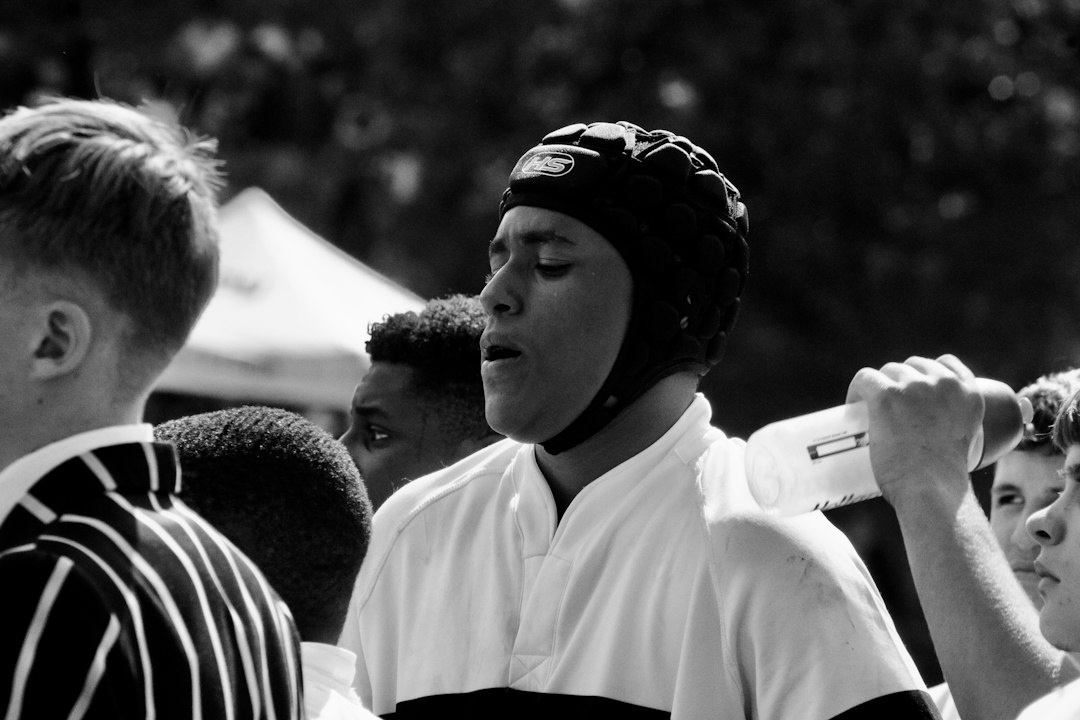




You already know what the voice sounds like. You just haven't heard it in a while.
It was there between every pitch — that low, continuous negotiation with yourself that no coach could hear, no scorecard could measure, and no highlight reel would ever capture. The internal monologue athlete baseball players carry through a game is one of the least-documented and most universal experiences in sport. Everyone who has ever dug into a batter's box or stood on the mound with a 3-2 count has had it. Almost no one talks about it. And the articles that try to teach "baseball self-talk" treat it like a technique — a list of approved phrases to repeat, a cognitive drill you run before games.
That's not what it was.
What it actually was is messier, more human, funnier, and more desperate than any sports psychology worksheet admits. This is an attempt to recreate it — not to teach you something, but to put you back in the moment where it lived.
Standing In: The 12 Seconds Between Pitches
The pitcher steps off the rubber. You step out of the box. You adjust your batting gloves even though nothing is wrong with them.
This is where the athlete inner voice lives. Not in the pregame speech, not in the walk from the on-deck circle. In these twelve seconds, in the particular silence between competitive moments, when the game gives you just enough room to think and just enough time to ruin yourself with thinking.
The voice had registers. You cycled through them without realizing it.
Register one: The scouting report you invented in real time.
He went inside twice. That means — no, that doesn't mean anything. That could mean he's setting up the away fastball. Or he just wanted to establish inside. Or he has no idea what he's doing either. Okay. Okay. Just stay through the ball.


This was the analytical voice — the one that watched pitcher tendencies from the bench and tried to build a model in the middle of an at-bat. It sounded smart. It almost never helped. The problem was that it was doing real-time pattern recognition on a sample size of three pitches while also trying to maintain a hitting stance and not look nervous in front of your teammates.
Register two: The superstition maintenance voice.
I haven't touched the dirt since I got on base in the third. Don't touch the dirt. Left foot first out of the box. Left foot first. You touched the dirt last time and struck out — no, that was a different game. It doesn't matter. Left foot.
The rituals weren't irrational. They were attempts at control in an environment built to strip you of it. Your high school baseball mental dialogue was full of these tiny contracts — with the universe, with momentum, with the particular logic of a game where failure 70% of the time means you're very good.
Register three: The pep talk you gave yourself when you were too far inside your own head.
Just see the ball. Just see the ball. That's it. See the ball, hit the ball. You've been hitting this your whole life. You know how to do this.
Simple. Almost embarrassingly simple. And somehow, in those moments, that was the right level of simple. The game had gotten too big. The pep talk was your way of shrinking it back down to something you could physically do in the next four seconds.
From the Other Side: The Mound Between Pitches
The pitcher's internal monologue was operating on a different frequency — and if you ever pitched, you remember it in a completely different part of your body.
Standing on the mound between pitches is one of the lonelier experiences in team sports. You are the only player in a game involving eighteen people who must act alone, in full view of everyone, with nowhere to hide.
The voice on the mound went like this:
Don't shake off again. You shook off twice already. He's going to come out. Just throw the fastball. Where does he want it? Low and away? Low and away. Okay. Low and away. But the last one caught too much plate. So lower. And more away. So basically off the plate. Am I overthrowing? I'm overthrowing. Stop overthrowing.
There was a particular kind of panic that lived in the space between the catcher's signal and your first movement into the windup. Not the big dramatic panic of a blowup — just the low-grade mechanical anxiety of wondering whether the fastball you threw ten thousand times in your life was going to show up tonight, in this inning, in this count.
Sports psychologists studying baseball self-talk have noted that elite pitchers tend to shift from outcome-focused internal language early in counts to process-focused language in high-leverage situations — something any high school pitcher discovered by feel, without ever reading the research. When it got tight, you stopped thinking about striking him out. You thought about your front side staying closed. About finishing toward the plate. About the exact mechanical cue that made you feel like yourself again.
The body-cue monologue. That was the real one. That was baseball.
The Voices No One Admits To
There's a version of the baseball mental game that gets discussed openly — the focused, disciplined, champion-mindset version. Breathe. Reset. Compete.
And then there are the voices underneath that no one files a mental performance report about.
The comparison voice. Henderson is 2-for-3 and I'm 0-for-2. Coach is watching his at-bats differently. If I go 0-for-3 tonight, that's three straight games under .250. What does that do to the lineup?
You were doing live statistics on yourself during a live game. Everyone did this. No one admits it. The comparison voice was exhausting and completely involuntary — it ran like background software while you were trying to execute in the foreground.
The outside-noise voice. The one that heard your parents in the third row. The one that registered what the opposing dugout was saying. The one that noticed the scout with the radar gun and started thinking about radar guns instead of pitches.
This one was sneaky because it could arrive without warning and completely replace whatever useful interior process you had been running. One second you were locked in; the next second you were thinking about what you'd say after the game if you went deep.
The forgiveness loop. The voice that came after a strikeout, a throwing error, an inning that got away from you on the mound. Okay. Okay. Next pitch. Forget it. That one's gone. Next pitch.
This was the voice that actually mattered most — not because it was the most sophisticated, but because a player's ability to run this loop cleanly, to genuinely move on, was the single largest predictor of whether the next at-bat was affected by the previous one. The mental reset between failures. It happened in the dugout, on the way back to position, in the two seconds between putting on your helmet and stepping into the box.
The best players you played with ran it faster than anyone else. You noticed it even if you couldn't name what you were noticing.
Marcus T., 29, grew up playing shortstop in a small-town Georgia league where the fielding was inconsistent and the late-game throws were always a question mark. He remembers the specific voice he ran after booting a grounder in a conference semifinal: "It wasn't even a sentence. It was just 'next one.' I said it out loud. I don't know if anyone heard me. I just needed to say it into the air." He made the next play cleanly. His team lost the game anyway. He still thinks about that reset more than the error.
The Catcher's Monologue: Running the Game From the Ground Up
The catcher's internal monologue was arguably the most complex athlete inner voice on the field — a parallel track of information-processing that never fully stopped.
Calling a game from behind the plate at the high school level meant running a continuous probability model on your pitcher's stuff, the opposing lineup's tendencies, the inning, the score, and what your pitcher actually believed in his gut right now — which was different from what he believed three innings ago and different again from what he could actually execute tonight.
He's starting to overturn the curveball. It's flattening out. If I keep calling it, it's going to get hurt. Switch to changeup early in the count instead of running it into two-strike counts. But he doesn't trust the changeup right now — I can see it when I put it down. He shakes. So I'll go fastball-fastball and set it up. Set it up once. Just once. Then go off-speed.
This was real thinking. This was not a list of focus phrases. The catcher's monologue was the game within the game — and high school catchers who called their own games were doing something genuinely intellectually complex without the vocabulary to describe it as such until years later.
If you caught, you know the specific weight of that responsibility. The way it felt to put down a sign and then watch your pitcher shake it off. The micro-calculation of whether to insist or defer. The read on body language from forty feet away.
That was your voice, too. It just spoke in pitch sequences.
What the Voice Actually Got Right
Here's the thing the sports psychology curriculum never quite captures: the high school baseball mental dialogue, for all its noise and superstition and catastrophizing, was often doing exactly what it was supposed to do.
The comparison voice was running performance awareness — keeping you calibrated to the competitive context.
The pattern-recognition voice was building real-time strategic models from limited data, which is a genuinely sophisticated cognitive task.
The ritual-maintenance voice was executing the kind of procedural anchoring that high-performance environments require — using consistent sensory routines to maintain access to trained motor programs under stress.
And the forgiveness loop — the fastest reset players learned — was emotional regulation. Applied in real time. Without a therapist, without a framework, without a name for what it was.
The athlete inner voice in baseball is not a problem to be solved. It is not noise to be suppressed. It is the actual cognitive architecture of competing — the continuous interior work of staying in the present tense when the past and future keep pulling at you from either side.
You figured this out in cleats and a batting helmet before you knew it was a thing to figure out.
The Version of the Voice You Hear Now
You are not in the box anymore. The game is finished — not because anything ended badly, but because games end. That's what they do.
The voice you carried between pitches doesn't disappear. It migrates. You hear it in other high-pressure moments — in negotiations, presentations, athletic competitions that have nothing to do with a pitcher's release point. The same register shifts, the same pep-talk simplification, the same forgiveness loop running when something goes wrong in the third inning of a different game entirely.
What's different now is that you can name it. You can hear it operating and recognize it as the same voice that stood in against a 1-2 curveball with two outs in the seventh and told you: Just see the ball. That's all. Just see it.
That voice was yours. It was real. It was doing something important.
And the uniform you wore while it was running — the number on your back, the name on your chest, the specific set of colors that meant your team, your season, your version of that game — that wasn't just fabric. It was the container for all of it.
Your jersey is still out there waiting.
Design yours in minutes and see your name and number exactly the way you remember it.
Frequently Asked Questions
What is the internal monologue athlete baseball players experience between pitches actually called in sports psychology?
Sports psychologists refer to it broadly as self-talk — the internal verbal and sub-verbal stream of thought that athletes use to regulate focus, emotion, and performance. Research distinguishes between instructional self-talk (technique cues: "stay through the ball," "front side closed") and motivational self-talk ("you've got this," "next pitch"). High school baseball players use both spontaneously and shift between them based on game situation, often without formal training. The voice you remember is a real, documented cognitive phenomenon — not a quirk unique to you.
Does baseball self-talk actually affect performance, or is it just mental noise?
It affects performance — both positively and negatively, depending on the type. A 2017 meta-analysis published in Perspectives on Psychological Science found that self-talk interventions reliably improve performance outcomes in sports requiring both fine motor skill and decision-making. Instructional self-talk (focused on mechanics) tends to help more during learning phases and high-pressure situations. Motivational self-talk helps sustain effort and emotional regulation. The forgiveness loop — resetting quickly after errors — is one of the most practically significant self-talk behaviors in baseball, where failure is structurally built into the game.
Is the high school baseball mental dialogue different from what professional players experience?
In structure, no — the same registers appear at every level. In volume and discipline, yes. Professional players often develop more systematic cue words and pre-pitch routines, reducing the noise by designing the signal in advance. High school players run a noisier, more improvisational version of the same process. The comparison voice and superstition maintenance tend to be louder at younger levels because the player has less performance data to trust and fewer rehearsed coping routines. The underlying architecture — scouting, pattern recognition, emotional regulation, mechanical cue-ing — is the same at every level of the game.
Can you train yourself to have better self-talk in baseball, or is it something you're born with?
You can absolutely train it, and most high-level players do — deliberately or by accumulation of experience. The most effective approach is building a small set of cue words or phrases that are physically anchored (a specific grip adjustment, a breath, a specific eye focus point) and practiced in low-stakes situations until they become automatic. The goal is not to eliminate the internal monologue but to have a reliable signal — a trained phrase or cue — that you can drop into the noise to bring yourself back to process focus. You were doing a version of this naturally whenever you said "just see the ball." You were training it without a plan.
See also: athletic identity that followed you off the field | why those moments are still so sharp decades later | the mental weight of games you still dream about