

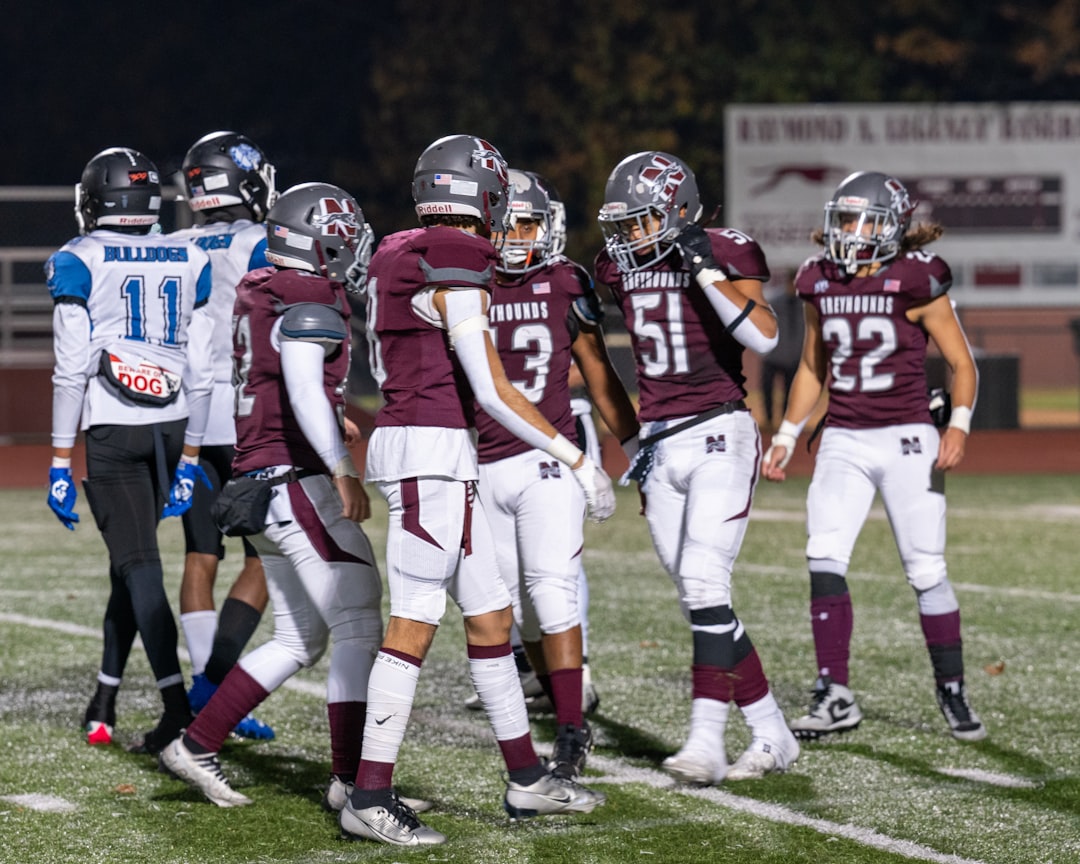




There is a specific weight that settles on a small town on a Friday night in October. You know it even now: the particular quality of the air, the way the parking lot fills up two hours before kickoff, the sound of the band warming up somewhere beyond the tree line. Hometown high school football pride isn't something you can explain to someone who didn't grow up inside it. It's something you absorbed through the soles of your cleats before you were old enough to understand what it meant.
And here's what most people who write about small-town athletics miss entirely: the weight of it doesn't leave when you do.
You graduated. You left. You built a career, maybe a family, maybe a life that looks nothing like the one you imagined in that locker room. But something specific traveled with you, a low-frequency hum of responsibility to the place that showed up for you every single Friday. This article is about that weight. What it is, where it comes from, and why carrying it is not a burden at all.
The Town Was Watching Before You Were Ready
There's a particular kind of pressure that only happens in small communities. It isn't the pressure of a massive stadium crowd, anonymous, indifferent, there to see the event; it's the pressure of recognition.
The woman who ran the diner knew your name. Your history teacher was in the third row of the bleachers. The man who fixed your family's car was on the booster committee. These were not strangers applauding a performance. These were people whose investment in you was personal, specific, and long-standing.
Every former athlete who grew up in a town where Friday nights meant something remembers the first time they truly understood this. Maybe it was the season opener your sophomore year, when you looked up into the stands from the field and recognized a face — your neighbor, your pastor, the guy who delivered your family's heating oil — and understood that they hadn't come to watch football. They had come to watch you. Not you as a player. You as the kid they'd been watching grow up for fifteen years, finally out there under the lights doing something that mattered to all of them collectively.

That moment of recognition does something to a young athlete. It expands the definition of what you're playing for. You're no longer playing for the score. You're playing for the story they'll tell at the diner tomorrow morning.
In my experience as a former player, the athletes who internalized that weight earliest were rarely the most talented on the field. They were the most attuned. They felt the social contract of the bleachers without anyone explaining it to them. And that attunement, it turns out, is one of the most transferable skills the game ever gave them.
What "Showing Up" Actually Costs a Community
It is easy, in retrospect, to romanticize the Friday night crowd. What's harder, and more honest, is to account for what it actually took for those people to be there.
The farmer who left his fields at 6 PM on a harvest night. The mother who worked a double shift on Thursday so she could take Friday off and be in the stands. The elderly couple who hadn't missed a home game in twenty-two years, who drove fourteen miles of rural road in the dark to get there, who stayed for the full four quarters regardless of the score.
These are not small things. These are people voting with the most finite resource they have — time — in favor of something they believed was worth it. Worth it because the game meant something to the town's sense of itself. Worth it because they believed in what young athletes were learning to become.
If you played, you know the specific feeling of being on the receiving end of that vote. It doesn't make you feel celebrated. It makes you feel obligated, in the best possible way. Obligated to play hard not for the scoreboard but for the people who rearranged their lives to be present.
That obligation is not a psychological burden; it is a form of love: the specific, demanding, community-scale love that small towns specialize in. And the athletes who felt it most clearly are, in many cases, the ones who went on to build the strongest sense of civic responsibility in their adult lives.
The Jersey Was Never Just Yours
Marcus T., 41, a former defensive end from a town of about 4,000 in rural Georgia, keeps his high school jersey in a shadow box above his desk. Not because he's living in the past. Because, as he puts it, "that jersey has three names on it: mine, my school's, and my town's. Taking one down means taking down all three."
That framing — the jersey as communal object, not personal trophy — captures something real about what happens when a small community adopts an athletic program as its shared identity.
The name on the back was yours. The name on the front belonged to everyone. The number belonged to the position, the history of every player who'd worn it before you, and the legacy of every player who would wear it after. You were the steward of that number for exactly the time you wore it. The town trusted you with it, which is why the championships nobody outside your town remembers still feel as significant today as they did the night you won them.
This is why former high school athletes, particularly those from tight-knit communities, often struggle to explain why their jersey matters to them so much later in life. It isn't nostalgia for their own youth; it's something more structural: the jersey was a physical representation of a social contract they entered into as teenagers, and honoring that contract didn't stop when they graduated.
The number you wore was part of a story that predated you and continued without you. But you were a chapter of it. And chapters don't stop mattering just because the page turns.
The Identity You Built Under Those Lights
There is a difference between what sports teach you and what sports make you. The technical skills — the footwork, the reads, the conditioning — those are teachable. What the Friday night crowd forged in you was something that no drill could ever create.
It made you someone who performs under observation. Someone who understands that individual effort has collective consequences. Someone who knows, at a cellular level, that the people around you are counting on something that only you can deliver in this specific moment.
Every former athlete remembers the internal experience of that pressure: the way time slows slightly in a critical play, the way your training surfaces automatically while your conscious mind watches from a slight remove, the way the crowd noise becomes indistinct and irrelevant and what's left is only the task and the people in the huddle with you. And then the opposite happens: the moment the crowd got loud and you were the reason, when the noise was anything but background. That state is what the Friday night crowd helped create in you: that specific cognitive and emotional experience. They needed you to perform. You needed to be someone who could.
That formation process doesn't end on the last play of your senior season. The seasons that should have gone further, the ones that ended too soon, often do as much to shape you as the ones that went the distance. It becomes the architecture of how you handle professional pressure, personal crisis, and community responsibility for the rest of your life. The town that showed up every Friday was not just supporting a sports team; it was, whether it knew it or not, forging the character of the adults those teenagers would become.
Why the Responsibility Follows You Home
Here is the thing about being shaped by a community's belief: you don't get to put it down when you leave.
It becomes part of how you identify yourself. Not "I used to play football." But "I'm the kind of person who played Friday night football for a town that needed it." The distinction sounds subtle. It isn't.
The first framing is biographical. It locates the experience in the past, as a fact about your history. The second framing is constitutive. It locates the experience inside your character, as something that explains who you are now and how you operate in the world.
Athletes who feel the pull of their hometown identity most strongly — who feel a genuine sense of ongoing responsibility to the place that formed them — are rarely paralyzed by it. More often, they channel it. They become the people in their professional environments who understand accountability as something that exists toward a community, not just toward a supervisor; they become the coaches, the mentors, the volunteers who show up consistently because they remember, viscerally, what it felt like when the town showed up for them.
A 2013 study from the Positive Coaching Alliance found that athletes who reported feeling a strong sense of community identity through their sport demonstrated significantly higher rates of civic engagement in adulthood. The Friday night crowd wasn't just watching a game. It was building future neighbors.
The responsibility you still feel to that place? That's not nostalgia. That's the evidence that the formation worked.
The Long View: What Small-Town Athletic Culture Actually Produces
Step back far enough, and a pattern emerges across the thousands of small towns that organize their social calendars around Friday nights.
The towns that sustain consistent athletic culture — where the community shows up regardless of record, regardless of weather, regardless of competing demands on their time — tend to produce athletes who carry a specific set of traits into adulthood:
- A tolerance for being watched under pressure, which transfers directly into professional environments that require public performance and accountability.
- A deep, practiced sense of team interdependence: the understanding that individual performance only matters within a collective structure.
- An unusually strong connection to place and community, which often manifests as a felt obligation to contribute to civic life wherever they end up.
- A high threshold for discomfort and a low threshold for making excuses, because the town was watching, and the town remembered.
These are not the lessons of any single coach or any particular playbook; they are the lessons of being a young person at the center of a community's collective investment, Friday after Friday, for three or four years of your formation.
The game ends. The lessons don't.
Your Jersey Is Still Out There Waiting
You wore that number for a reason. The town put it on you, and you carried it in a way that meant something: to them, and in ways you're still discovering, to yourself.
Design yours in minutes and see your name and number exactly the way you remember it.
Frequently Asked Questions
Why do former high school athletes feel such a strong connection to their hometown teams long after they stop playing?
The connection is less about the sport itself and more about the community structure that surrounded it. When a town organizes itself around a team — when the bleachers fill with people who know you by name, not by jersey number — the athletic experience becomes inseparable from the experience of belonging to a place. That belonging doesn't dissolve after graduation. It becomes part of how former athletes understand themselves and their relationship to community for the rest of their lives. The pull toward the hometown team is really a pull toward the specific people and relationships that made those Friday nights feel significant.
Is hometown high school football pride specific to small towns, or do suburban and urban athletes feel it too?
The intensity of the feeling tends to correlate with the degree to which the team served as a central organizing feature of community life. In smaller towns, where the Friday night game is often the most significant shared public event of the week, the feeling is typically strongest. But suburban athletes who played in communities with strong booster cultures, consistent crowd support, and real local media coverage report very similar feelings of communal responsibility. The common thread isn't geography — it's the experience of being seen and supported by people who were personally invested in your development, not just your performance.
How do former athletes typically process the feeling of responsibility to their hometown communities as adults?
Most process it through action. The former athletes who report the healthiest relationship with their hometown identity are those who found ways to continue contributing — through coaching youth sports, mentoring younger athletes, returning for homecoming events, or simply maintaining genuine relationships with the people and places that formed them. The responsibility doesn't have to feel heavy if it's channeled into something productive. In many cases, it becomes the quiet engine behind a lifelong pattern of civic engagement and community investment that the athlete traces directly back to those Friday nights.
What does the high school jersey represent to former athletes who keep it decades later?
For most, it represents a specific period of formation — a time when they were being shaped by community belief into something more capable and more responsible than they would have become alone. The jersey is a physical anchor to that experience. It holds the name of the place that invested in them and the number that made them accountable to that investment. Keeping it isn't about living in the past. It's about maintaining a tangible connection to the version of yourself that first understood what it means to be part of something bigger than your own performance.
See also: why high school sports still matter so much to adults | what playing under the Friday night lights actually felt like | the grief that comes when your athletic career ends at 18 | how athletic identity reshapes who you become after high school | the most football-obsessed states where this Friday night culture runs deepest