

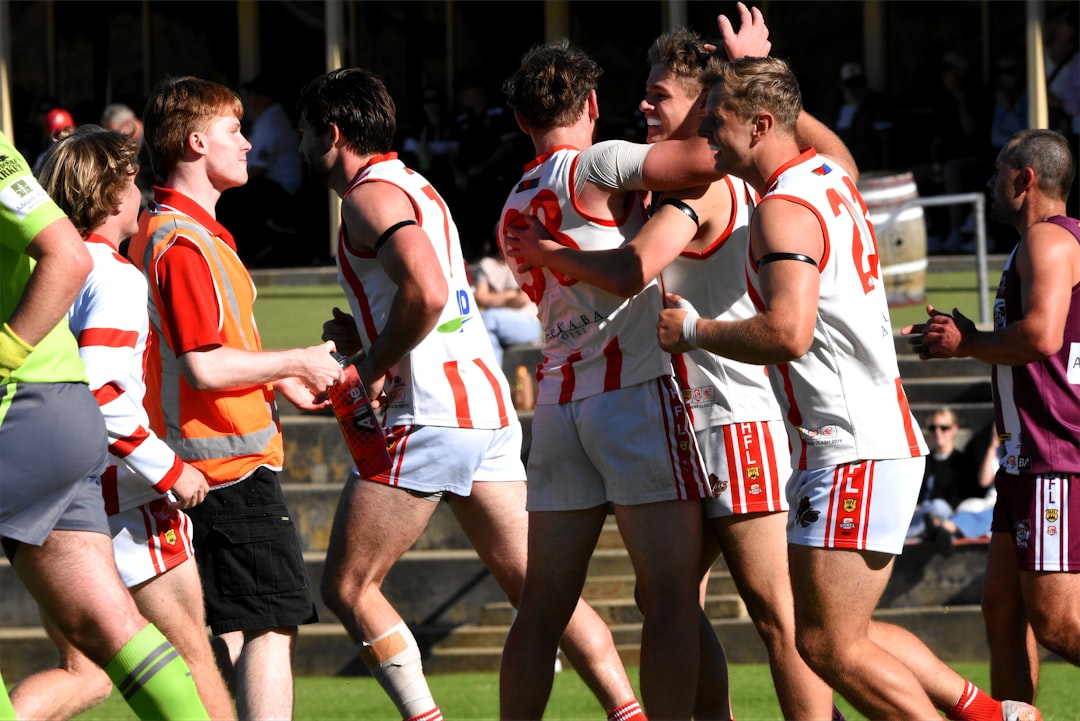




There is a person you played with (not just alongside, but genuinely with) who shaped the way you compete, the way you handle pressure, the way you show up for people you care about. The sports teammate bond you formed during one particular season didn't dissolve when the final buzzer sounded or the last out was recorded. It calcified into something permanent. It became load-bearing in the architecture of who you are.
You may not talk to them every week. You may not talk to them every year. But they are present in the way you handle a crisis at work, the way you push through when your body wants to stop, the way you recognize real effort in the people around you. You learned that from watching them. From competing beside them. From suffering through the same two-a-days, the same bus rides, the same coach who believed in both of you before either of you believed in yourself.
Every former athlete carries someone like that. This is about that person, and the season that made you both.
The Moment You Knew This Was Different
Every team produces relationships. Not every team produces that one.
You can feel the difference even while it's happening, if you're paying attention. There is a teammate (sometimes it takes half a season to figure out who they are) with whom the dynamic is categorically unlike every other friendship you've made. The calibration is different. The tolerance for honesty is higher. The willingness to push and be pushed carries none of the social friction it would carry anywhere else.
The relationship almost never starts with warmth. It starts with competition. You're both after the same spot in the lineup, the same playing time, the same recognition from the coaching staff. There's friction before there's anything else. And then something shifts — a practice where everything goes wrong at once, a game where the whole team needs both of you to hold it together, a moment where the mask that athletes wear around people they're still sizing up simply falls off because there isn't time for it — and you see each other clearly.


That's the moment. That's when the bond calcifies from "guy I play with" into something that doesn't have a clean name in adult vocabulary but that every athlete understands immediately.
If you played, you know the specific person I'm describing. You probably just pictured their face.
What Shared Suffering Actually Builds
There's a reason military psychologists, organizational behavior researchers, and team-building consultants have spent decades studying athletic teams: the conditions that produce deep cohesion inside a locker room are almost impossible to recreate anywhere else in civilian life. The combination of shared physical suffering, high-stakes performance pressure, and the complete transparency that comes from living in close quarters with people for months at a time creates a psychological environment that accelerates trust formation in ways that years of ordinary friendship cannot match.
Research from the Journal of Sport and Exercise Psychology has documented what athletes describe anecdotally: teams that experience significant adversity together (a losing streak, an injury to a key player, a coaching change mid-season) often emerge with stronger cohesion than teams that don't. The suffering isn't incidental. The suffering is the mechanism.
This is why your sports teammate bond with that specific person carries weight that your friendships from every other context in your life don't. You weren't just in the same room with them. You were in the same crucible. You watched them fail and then get back up. They watched you. Neither of you had the option of performing wellness or manufactured confidence — the sport strips that away eventually, for everyone. What you saw in each other underneath the performance was real. You built your understanding of each other on that foundation, not on curated social presentation.
That foundation doesn't erode.
The Season That Was the Making of Both of You
Not every season does it. Some seasons are ordinary — good enough, worth playing, but not transformative. The season that made you both is identifiable in retrospect by a specific quality: it asked more of you than you knew you had to give.
Maybe the team was undermanned and you were asked to carry weight you hadn't earned yet. Maybe there was a game (or a stretch of games) where the margin for error was zero and both of you found out what you were actually made of under that pressure. Maybe the season ended badly, and the way you and this teammate processed that together in the weeks after revealed character in both of you that the winning hadn't.
Every former athlete remembers a specific practice, a specific bus ride home, a specific night in a hotel room on a road trip where the conversation got real in a way that conversations rarely do. Where you were both too tired to perform and too invested in the outcome to be dishonest. That's where the most important conversations happen between teammates — not in the celebration, not in the triumph, but in the exhaustion, in the aftermath, in the moments when maintaining any facade would cost too much energy to be worth it.
Marcus T., 34, played two years of college lacrosse before a knee injury ended his playing career in his junior year. He still talks to his roommate and fellow midfielder from that team every week. "The year we went 4-11 made us closer than the year we went 11-4," he says. "When things were going well, everybody was friends. When we were losing every other game and the coaches were restructuring everything and I was playing hurt and not telling anyone — that's when I found out who actually cared about what happened to me versus what happened to the team record."
That's the season. The one that sorted for the real thing.
Why That Bond Outlasts Everything Else
Adult life is not designed to produce the conditions that created the relationship you had with this teammate. The transparency isn't available. The shared stakes aren't present in the same way. You can work with someone for a decade and never know what they're like when everything is on the line and they've been awake for two days and they're being asked to perform beyond what their body wants to do.
You knew that about your teammate. In some cases, you knew it before you knew anything else about them. Their resilience, their character under pressure, their specific brand of competitive fire. You have firsthand evidence for all of it. That's a different kind of knowing than anything adult professional life offers.
This is why the bond outlasts proximity. It outlasts regular contact. It outlasts the natural drift that happens when two lives move in different directions after a shared chapter closes. The foundation is evidence-based in a way that almost no other relationship is. You're not operating on faith about who they are when it matters. You saw it. They saw the same in you.
The relationship also carries something that most adult friendships don't: mutual witness. They were there for a version of you that no longer fully exists — the version that was being formed, that hadn't yet hardened into the person you became. You were there for the same version of them. There is an intimacy to that witnessing that doesn't require maintenance the way ordinary friendships do. You can go a year without talking and pick up exactly where you left off, because the thing the relationship is built on doesn't require regular reinforcement. It's already been proven.
What They Still Teach You
The strangest part of this kind of bond is how long it continues to operate as a reference point.
You find yourself, in the middle of a hard moment at work or in a difficult conversation in your personal life, reaching back to something this teammate did. The way they stayed composed when the other team went on a run and the crowd got loud and the coaching staff got anxious. The way they came out of the locker room after the worst half of the season and ran harder in the second half than they had in the first. The way they pushed you, specifically: not generally, not inspirationally, but in the specific granular way that someone pushes you when they know exactly what you're capable of and refuse to accept anything less.
That footage lives in you. It's been incorporated into your operating system in ways you may not be fully conscious of until you notice yourself doing something you learned from watching them — and then you're twenty-two years old again, on a field or a court or a track, watching someone you competed beside figure out who they were in real time.
The athletes who form the deepest teammate bonds are the ones who were each other's mirrors during a period of formation. You didn't just see each other clearly. You helped each other become more clearly yourselves. That's the function the relationship served at its core — not just mutual support, but mutual clarification. Who am I? I am the person who competed beside that person, who held up under the same pressure they held up under, who came out of that season shaped by what it asked of me and shaped by what they showed me was possible.
The Brotherhood and Sisterhood That Never Goes Away
There is specific language that athletes use for this that non-athletes sometimes misread as hyperbole: brotherhood. Sisterhood. The family metaphors.
They are not hyperbole. They are accurate descriptions of a psychological reality.
Families (functional ones) operate on the same foundation as that teammate bond: unconditional witnessing, shared formative experience, the knowledge that you have seen each other at your worst and chosen to stay. The season gave you both of these things. You saw each other at some version of worst — exhausted, failing, scared, uncertain — and you chose to keep showing up for each other. That's the functional definition of family.
This is why so many former athletes describe their teams as their closest relationships, even when the sport is long over and the team is dispersed across different cities and different lives. The relationship category was different from the start. It wasn't constructed from shared leisure or compatible personalities or geographic convenience. It was forged under conditions that most people never experience together, and it left a mark on both of you that other relationships simply cannot recreate.
If you've ever tried to explain this to someone who didn't play — the way you still feel about a teammate you haven't seen in years, the way a single conversation with them cuts through the noise of your current life and gets immediately real — you know how hard it is to translate. The words exist. The words don't quite carry it. You eventually settle for: we played together. And anyone who played at all knows exactly what you mean.
Your jersey is still out there waiting.
Design yours in minutes and see your name and number exactly the way you remember it: the number you wore during that season, on the team that made you who you are.
Frequently Asked Questions
Why do sports teammate bonds feel stronger than most adult friendships?
Athletic bonds form under conditions that accelerate trust in ways ordinary friendships don't encounter: shared physical suffering, high-stakes performance pressure, and the involuntary transparency that comes from competing and traveling together for an extended period. You see each other without the social performance most adult relationships maintain indefinitely. That unfiltered witnessing creates a foundation of real knowledge — not faith or assumption — about who the other person is when it actually matters.
Is it normal to still think about a teammate years or decades after playing together?
Completely normal, and more common than most former athletes initially realize. The relationship wasn't ordinary — it was forged during a formative period under unusual conditions. The person you were becoming during that season was shaped in part by that specific relationship. Carrying them forward isn't nostalgia for its own sake. It's the recognition that they are genuinely part of who you became, and that doesn't stop being true because the season ended.
How do I reconnect with a teammate I've lost touch with?
The characteristic of these bonds is that they don't require elaborate re-establishment. A direct message, a text, a call — even after years of silence — almost always lands immediately. You don't need a reason beyond "I was thinking about that season." Former teammates who shared the kind of bond this piece describes will understand exactly what that means and why you reached out. The relationship doesn't need to be rebuilt from scratch. The foundation is still there. You're just picking it back up.
Why does wearing a jersey from that team or era still feel significant?
The jersey is the physical artifact of the identity you built during that period. It carries the weight of everything that season asked of you — the people you played beside, the version of yourself that emerged from that crucible. Wearing it, or seeing your name and number on it, is a specific form of recognition: I was there. I did that. That made me this. For former athletes, that recognition is among the most grounding things available in adult life.
See also: why the bonds formed through high school sports stay with you long after the final whistle | the grief that comes when that shared season ends | why your senior season memories feel more vivid than almost anything else from your youth | how to find and reconnect with the teammates you've been thinking about | what that shared experience on the bus ride home after a loss really meant