

You already know this is true. You've known it for years, maybe decades: the people you suited up with in high school occupy a completely different room in your memory than every other friend you've ever made. The high school teammate bond doesn't feel like a stronger version of regular friendship. It feels like a different thing entirely. And you've probably never quite had the words for why.
This article is those words.
Not a list of feel-good platitudes about teamwork. Not a motivational speech about the value of sports. A genuine, substantive look at what actually happens (biochemically, psychologically, and relationally) when a group of teenagers endure shared suffering together, chase a collective goal under real pressure, and witness each other fail in front of a crowd. Because the science here is extraordinary, and it maps almost perfectly onto what you already knew in your gut.
What Happens to Your Brain When You Suffer With Someone
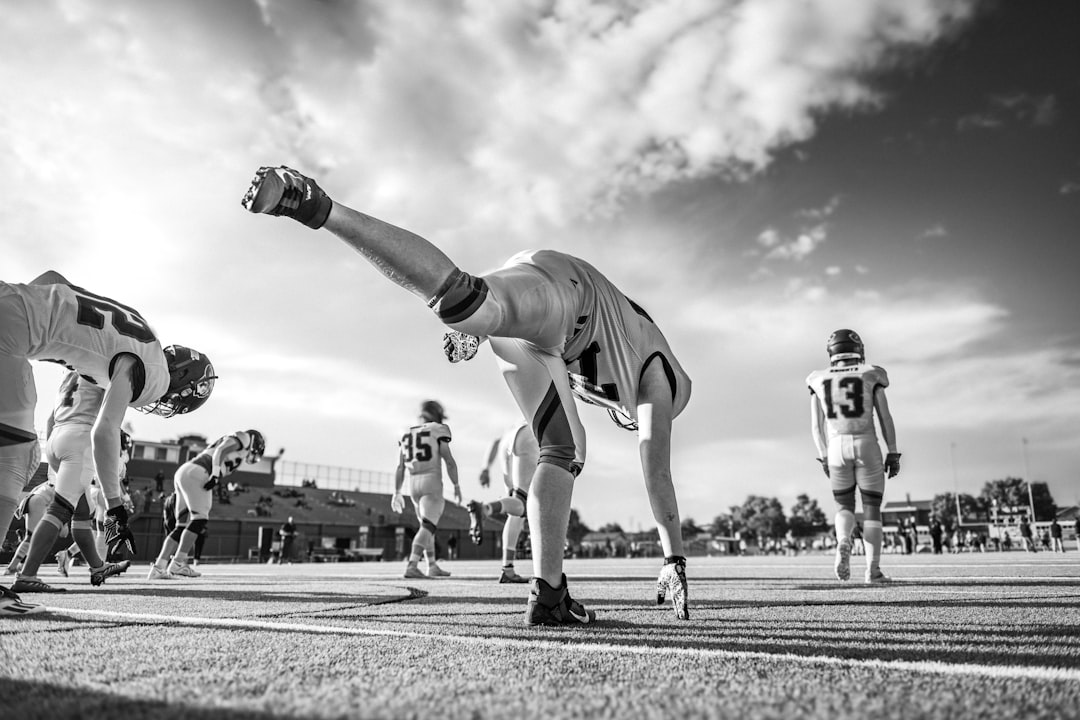
The most important thing to understand about the bond between athletes and teammates is that it is not built in the locker room. It is not built in the victory. It is built in the worst moments: the two-a-days in August, the fourth quarter when you're down by fourteen, the conditioning drill at the end of practice when your legs have already given everything they have.
This is not an accident. It is a feature of human neurobiology.
When human beings experience physical stress together, their bodies release oxytocin, a bonding hormone more commonly associated with maternal attachment and romantic love. Research published in Psychoneuroendocrinology has documented that synchronized physical exertion between individuals, particularly exertion that involves discomfort, produces measurable increases in oxytocin and corresponding increases in reported feelings of social bonding and trust. Your body, at the molecular level, was treating your teammates like family. Because the same chemistry that bonds a mother to a newborn was being activated every time you suffered alongside someone who wore the same number on their back.

This is the first and most foundational reason the teammates vs friends difference is so stark. You may have known your childhood friends for years before you felt real trust with them. Your teammates earned a different category of trust in weeks, because your nervous system processed the shared suffering as evidence of a bond, not just a preference.
And here is the part most people miss: that biochemical bonding is permanent in the way that emotional memories are permanent. You can lose touch with a teammate for fifteen years and feel the warmth of that original trust the moment you see them again. The chemistry imprinted. The bond does not expire.
Collective Goal Pursuit Under Real Conditions
Most friendships are forged through shared enjoyment. You and a friend both love the same music, the same movies, the same places. That shared preference creates genuine connection, but it is connection that has never been tested.
The bond between athletes and teammates is forged through something categorically different: collective goal pursuit under conditions where failure is public, meaningful, and real.
When your team lost a game that mattered, the loss was not abstract. It happened in front of people. It happened in front of opponents who were actively celebrating your failure. It happened in front of parents, coaches, classmates who had driven to watch. And you processed that failure not as an individual but as a collective, which creates a form of shared vulnerability that most adult friendships will never reach.
Consider what shared vulnerability actually requires. To be vulnerable with another person is to allow them to see you at a moment when you are not performing competence. Most friendships manage vulnerability carefully and selectively. We choose when to let people in, in controlled conditions, usually in private. We decide which pieces of ourselves to show.
Your teammates saw you fail. They saw you miss the shot, drop the ball, blow the coverage. They saw you cry when the season ended. They saw you at physical exhaustion, at emotional depletion, at the very limits of what you were capable of. You did not choose that visibility. The conditions of the sport imposed it. And they were standing right there when it happened.
That involuntary, repeated, witnessed vulnerability is the mechanism that separates high school sports friendships from almost everything that comes after. You cannot manufacture that in an adult friendship. It requires the specific conditions of athletic competition: real stakes, real public failure, real proximity.
The Non-Verbal Language You Built Together
Mia C., 34, played club volleyball through high school and still meets up with her setter from her junior year whenever she's back in town. "We barely have to talk to catch up," she says. "I know what she's thinking before she says it. That's something I've never had with anyone I've met as an adult. Not even close."
What Mia is describing has a physical explanation. It is the result of thousands of hours of shared physical practice building something researchers call action-perception coupling, the neural encoding of another person's movement patterns so deeply into your own motor system that you can anticipate their actions before they occur. Athletes who practice together long enough develop a form of non-verbal communication that functions below conscious awareness. The setter and the hitter don't think. They read and respond.
But the implications extend beyond the game. When you spend that many hours attending to another person's body language, movement, and physical state, you become calibrated to them in ways that most relationships never achieve. You know when a teammate is off before they say a word, because you've been reading them in high-stakes conditions where missing that signal had consequences.
This is why teammates are special in a way that is genuinely difficult to recreate. In regular friendship, emotional attunement develops slowly through conversation. With teammates, it develops rapidly through physical co-presence, and it develops at a depth that conversation alone rarely reaches. You were forced to know each other in a way that felt almost intrusive. And that forced knowing became a form of intimacy.
The Identity That Was Forged, Not Chosen
Every other category of friendship in your life was chosen. You gravitated toward people you liked. You spent time with people who felt easy and comfortable. You built relationships at a pace and depth that you controlled.
Your teammates were assigned. And that assignment (the fact that you didn't choose each other) is one of the most psychologically significant elements of the whole experience.
Joseph Campbell's framework for the hero's journey identifies something called the "band of brothers" — the companions the hero does not recruit but receives. These companions are not optimized for compatibility. They are thrown together by circumstance, by necessity, by the demands of a shared mission. And it is precisely the un-chosen nature of that fellowship that makes it formative. You don't get to learn only about the kinds of people you already prefer. You learn to understand, trust, and genuinely care for people you might never have approached on your own.
The teammate who drove you absolutely insane in practice, whose habits you found infuriating, whose personality you would never have sought out in normal circumstances — that person is often the one you remember most vividly, and sometimes the one you miss most genuinely. Because you learned something from that friction that chosen friendships protect you from learning.
This is what former athletes mean when they say that sports made them who they are. Sports did not teach them discipline in the abstract. A specific group of non-chosen people demanded specific things from them in specific pressure conditions, and they either rose to those demands or they didn't. The identity that emerged from that experience was precise, and it belongs to that team, in that gymnasium, on that field.
It Wasn't Friendship — And That's the Point
Here is the paradox that confuses people who never played: for a lot of athletes, teammates were not hangout friends. You were inseparable at practice, in the locker room, on the bus ride home — and you almost never saw each other on the weekend. Sport psychology researchers draw a hard line between "sport friends" and "hangout friends," and the two groups are often not the same people at all. The relationship was real, but it was context-specific: it lived inside the gym, the field, the season, and it didn't always survive a Friday night away from them. That does not weaken the bond. It is the reason the bond is its own category. Calling it "friendship, only stronger" misses what it actually was — a relationship that was neither ordinary friendship nor mere acquaintance, but a third thing with its own rules.
And here is the second honest layer: your teammates were also your competitors. You fought the same people you loved for playing time, for positions, for the coach's attention. Jealousy, resentment, and rivalry lived right alongside loyalty, and they never fully canceled each other out. The relationship was friendship laced with competition — and that tension is part of why it shaped you. The best teammates found a way to be their best while bringing out the best in the people they were competing against, because the shared mission always outlasted the fight over who started. The season needed both of you. The bond endures not because competition was absent, but because the collective goal was always bigger than the rivalry.
Why This Bond Doesn't Fade the Way Other Friendships Do
Here is something that might resonate: you have probably lost touch with some of your best childhood friends over the years. Natural drift — life moved, contact faded, the connection didn't survive the distance. But your teammates? Even the ones you haven't spoken to in a decade? There's a specific warmth there that doesn't seem to diminish the way other friendships do.
What you are feeling is the durability of identity-level bonding versus preference-level bonding, not sentimentality.
Most friendships are, at their foundation, preference-based. You like the same things. You enjoy each other's company. When life changes enough that the shared preferences are no longer activated — different cities, different life stages, different schedules — the friendship requires deliberate maintenance to survive. Without that maintenance, it fades. That fade is a structural feature of how preference-based connection works, not a failure of love.
The teammate bond was forged at the identity level, specifically during the period of adolescence when identity is actively forming. Your teammates didn't just know what you liked. They knew who you were trying to become. They witnessed the gap between who you were and who you were working to be, every day, in real conditions. That witnessing happened during the most formative developmental window of your life. It is encoded differently than memories formed in adulthood, in the part of the brain that organizes self-concept rather than event memory.
This is why a twenty-year reunion with a teammate doesn't feel like catching up with an old acquaintance. It feels like resuming something. Because the connection isn't stored as "person I used to spend time with" — it's stored as "person who was there when I became myself."
Your jersey is still out there waiting.
Design yours in minutes and see your name and number exactly the way you remember it.
Frequently Asked Questions
Why do I feel closer to my high school teammates than friends I've known longer?
The length of a relationship is not the primary determinant of closeness — the conditions under which the relationship was formed are. Your high school teammates were present during a convergence of factors that most long-term friendships never experience: shared physical stress, public vulnerability, collective failure, and identity formation during adolescence. Oxytocin released during shared physical suffering accelerates bonding in ways that shared time alone cannot reproduce. A teammate you practiced with for two years may be encoded in your memory more deeply than a childhood friend you've known for twelve, because the conditions of your relationship operated at a different neurological register.
Is the teammate bond different depending on the sport?
The core mechanisms — shared suffering, collective goal pursuit, public failure, involuntary vulnerability — are present across all team sports, but the specific texture of the bond varies by sport. Contact sports that involve physical risk tend to intensify the protection-based elements of bonding. Sports with extended seasons or year-round training (swimming, cross-country, wrestling) create more time for non-verbal attunement to develop. Individual sports practiced in team settings (track and field, gymnastics, tennis) produce a distinctive hybrid: individual performance within a collective identity, which creates a specific kind of loyalty — rooting for your teammate as sincerely as you root for yourself, because their success is yours and yours is theirs.
Why do I still think about specific moments with my teammates decades later?
Emotionally intense experiences — particularly those involving physical exertion, public stakes, and social bonding — are encoded by the brain with greater vividness and durability than ordinary events. The amygdala tags experiences with emotional intensity, and those tagged memories receive preferential long-term storage. Your brain processed your competitive athletic experiences as high-stakes social events (which they were), and the people present in those moments are neurologically linked to your most durably stored memories. When you think about a specific play, a specific loss, a specific locker room moment, you are not being sentimental. You are accessing precisely the memories your brain was designed to preserve most carefully.
Can adult friendships ever reach the same depth as the teammate bond?
Adult friendships can reach comparable depth, but the conditions required to produce it are rare and largely outside our control. The closest adult analogs tend to involve the same convergent factors: shared adversity (military service, medical crisis, a demanding shared project with real stakes), involuntary vulnerability (circumstances that strip away performance), and identity-level exposure (someone seeing who you actually are rather than the version you present). Most adult friendships, formed in environments designed for comfort and preference-matching, do not naturally generate those conditions. The teammate bond is partly so durable because it is produced during a window — adolescence — when the stakes of identity formation are uniquely high, and the conditions of competitive athletics impose precisely the experiences that produce the deepest human bonds.
See also: why high school sports still matter so deeply to adults | how athletic identity shapes who you become after the sport ends | the grief that comes with the end of your high school playing days | how to find and reconnect with the teammates you've lost touch with | the shared silence of the bus ride home after a tough loss