

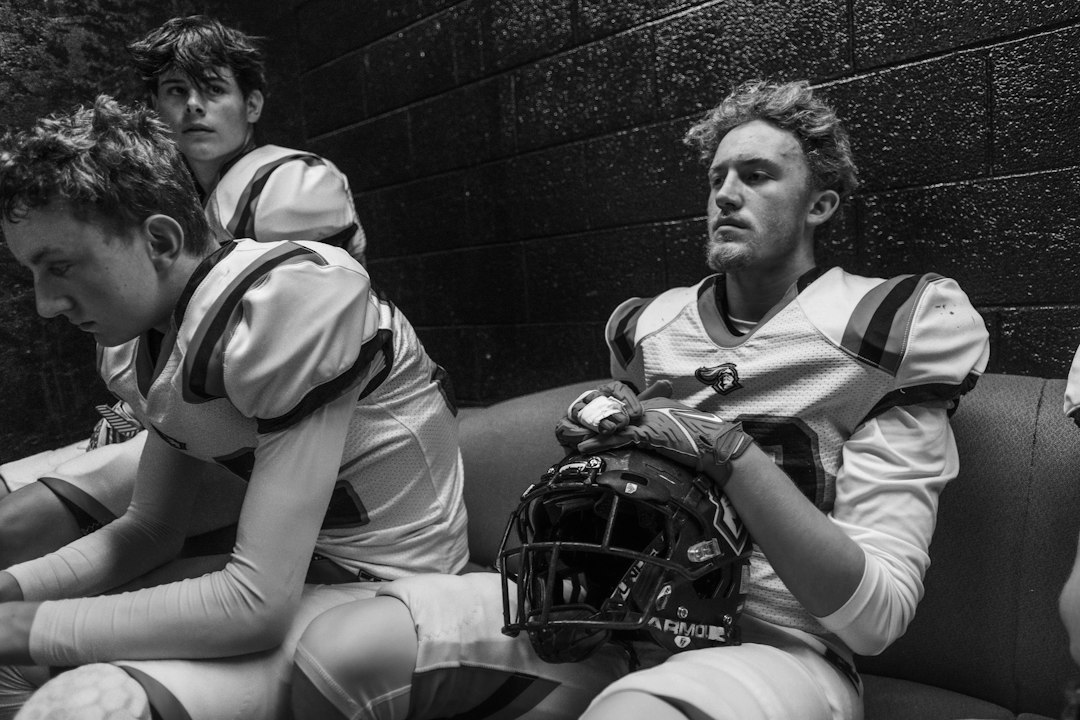




Why athletes identify with their jersey number runs deeper than superstition, deeper than habit, and far deeper than anything a "what your number says about your personality" listicle has ever managed to reach.
That attachment is specific. It's physical. And it belongs entirely to the person who wore the number — not to the digits themselves. The search results for this topic are cluttered with sports-horoscope content that treats 7 as inherently something and 44 as inherently something else, as though the number arrived with meaning pre-loaded. It didn't. The meaning came from you. The number just happened to be on your back while you were becoming who you are.
That's the real story — and it's the one worth telling.
The Number Came First. The Meaning Came From You.
There's a version of this conversation that opens with numerology and ends with "players who wear 23 share traits with Michael Jordan." That version is easy to write and returns nothing of value to anyone who actually played.
Here is the version that holds up.
You were handed a number — or you chose one, or you lobbied for one — and from that point forward, something happened that sports psychologists have documented and athletes have felt for as long as organized competition has existed: the number became you, because you became it.
The formal term for what develops inside an athlete's relationship to a jersey is identity fusion — a psychological process in which a person's individual identity merges with a symbol or group until the symbol is experienced as genuinely part of the self, not merely associated with it. Research published in the Personality and Social Psychology Review has examined how this fusion operates across different kinds of group membership and found that it activates the same cognitive architecture as self-representation. When the fusion takes hold, the symbol isn't a reminder of who you were. It is who you were — and in some real sense, who you still are.


Your sports jersey number was never a logistical sorting mechanism. It was the visible marker of a self you were actively building.
That construction is exactly what the clickbait articles miss. They treat the number as the independent variable — as though wearing a 44 jersey produces something in an athlete the way a compound produces an effect in a reaction. But the causality runs the other direction. The athlete produces something in the number. Every early practice, every contested rep, every moment of grinding through something that didn't feel survivable — all of it accumulates inside those two digits on your back. By the time you've worn a sports jersey number through a full season, it has absorbed a version of you that no other object holds in quite the same way.
Which is why losing the number — being reassigned, watching someone else pull it over their head — registers as genuine loss. Not ego. Not drama. The specific discomfort of watching something that carries your story pass into someone else's hands.
What "Earning" Actually Means Inside a Program
The phrase earning your jersey number moves through athletic culture freely, but the mechanism beneath it deserves a closer look — because it explains why the attachment lasts as long as it does.
In most competitive programs, numbers aren't distributed randomly. They move through a hierarchy the athletes inside the program understand intuitively, even when it's never been written down. Seniors choose first. Veterans pass numbers down to players they believe have earned the right to carry them. Some numbers are retired entirely because the story inside them belongs to one person and cannot be handed forward without losing something essential. And even in programs where numbers are assigned by position without ceremony, the act of keeping that number — of filling it, of making it recognizable on film, of having a teammate call it out across a loud gym — is itself an ongoing act of earning.
This matters psychologically because of what researchers call the effort justification effect: the more we invest in something, the more we value it. This isn't a defect in human reasoning. It's honest accounting. You didn't simply wear 44. You ran two-a-days in August heat in 44. You sat in the training room with ice on your knee in 44. You played through things in 44 that you've never fully put into words for anyone. The number was present for all of it.
So when someone asks why that sports jersey number still carries weight twenty years later, the accurate answer is: because twenty years of your most focused, most pressured, most fully-alive self went into it. The number didn't give you an identity. You gave it one.
Three Athletes. Three Numbers. Three Stories That Cannot Be Generalized.
Marcus T., 34, former defensive end: Marcus wore 72 through three seasons of high school football in rural Georgia. He had wanted 90 — an older teammate's number he admired. But 72 was what the equipment manager handed him as a sophomore, and 72 was what he started in when his team reached the playoffs for the first time in eleven years. "By the end of that season," he said, "72 was mine. I couldn't have explained it exactly, but I would have argued with anyone about it. It just was."
Renata V., 28, former club volleyball player: Renata wore 11 from her first travel season at age twelve until she stopped playing competitively at nineteen. She originally chose it because her older sister had worn it. By fifteen, that origin story had been entirely overwritten by her own. "It became mine," she says. "My sister had a completely different relationship to that number. We wore the same digits but lived inside different 11s."
Jason O., 41, former high school basketball player: Jason wore a 44 jersey — not because of Hank Aaron, not because of Pistol Pete Maravich, though he knew both references. He wore it because it was available when he made varsity as a sophomore, and it was the number on his back the night he scored 31 points in a regional semifinal in front of his father, who had driven four hours to be there. "44 is that night," Jason says, without elaboration. "That's all it has ever been."
Three numbers. Three entirely different stories living inside the same digits. No personality quiz touches any of it. The personal stories of jersey numbers are always, without exception, specific — and that specificity is the whole substance of the attachment.
The Psychology of a Number That Still Lives in the Body
Jayla M., 22, ran the 400 meters in track and field through her senior year of high school. Her bib number was 108 — a number most field athletes would call unremarkable. She can still feel the specific weight of it against her chest before a race. "It's physical," she says. "When I think about competing at my best, I see 108. Not my face. That number."
What Jayla is describing is a well-documented feature of how athletic identity is stored in memory. Performance psychologists note that athletes encode peak experiences with the full sensory context surrounding them — the uniform, the number, the surface under their feet, the ambient sound of the venue. The number becomes what researchers call a somatic marker: a physical signal the brain uses to access an entire emotional and experiential state.
This is why the meaning of a jersey number to an athlete isn't abstract. It lives somewhere between memory and body. The number is a retrieval cue — and what it retrieves is the version of you that was operating at your highest, most concentrated level.
That version deserves more than a quiz result.
Why Athletes Identify With Their Jersey Number — And Why the SERP Misses It
A scan of what currently ranks for searches around athlete jersey number identity reveals the same content pattern repeated across dozens of pages: astrology-adjacent material that assigns fixed personality traits to specific digits. Athletes who wore 7 are "natural leaders." Athletes who wore 1 are "fiercely independent." Athletes who wore 32 are, apparently, something the article specifies — something that has nothing to do with the fact that your 32 is the number you wore the season you tore your ACL and came back from it anyway.
This content is easy to produce because it asks nothing of the reader and reflects nothing real. And the actual psychological story — which is not about the number at all, but about the athlete, and what the athlete did inside that number — goes entirely untold.
The cost of that framing is personal. When you describe the meaning of sports jersey numbers in fixed, universal terms, you implicitly suggest the meaning arrived from outside the athlete. From the digits themselves. From some cultural inheritance. From a table someone assembled. You erase the most important element: the specific, unrepeatable human story that produced the meaning.
Your number doesn't mean something because of what it is. It means something because of what you were when you wore it.
How Identity Attaches — and Why It Doesn't Release
There's a framework in developmental psychology called narrative identity — the idea that we construct a coherent sense of self by organizing the significant chapters of our lives into a continuous story. Psychologist Dan P. McAdams, whose research on narrative identity at Northwestern University spans decades, describes identity as fundamentally biographical: we are the stories we assemble about ourselves, with specific scenes, recurring characters, and anchoring symbols that hold the entire structure together.
Your jersey number is one of those anchoring symbols.
It marks a chapter — often one of the most formative ones — that occurred during adolescence, when identity formation is at its most active and consequential. The number was present for the version of you who was testing what you were capable of, discovering your limits, pushing past some of them, and failing at others in ways that mattered. That version of you remains a living part of your self-story. The number is its shorthand in a way nothing else quite matches.
This is why athletes who went on to compete at higher levels — who were assigned entirely different numbers at every new stage — often report the strongest emotional pull back toward their high school number. The professional number belongs to a career. The high school number belongs to becoming.
What You Do With That Number Now
The attachment doesn't require justification. It doesn't need explaining to anyone who hasn't felt it, and anyone who has felt it doesn't need the explanation.
What it does deserve is a physical home — something beyond memory, beyond a photo in a shoebox or a game program in a drawer.
In our experience talking with athletes across dozens of sports, the moment a person sees their name and their number together on a custom jersey — the actual number, their number, in the colors and style of the program where they earned it — something shifts. It isn't about the object. It's about acknowledgment. The recognition that the chapter was real, the number meant something, and the story inside those digits is worth keeping visible.
A custom jersey built as a tribute to your playing days isn't a licensed team product. It's inspired by the uniform you wore, carrying the number you earned, with your name across the back. That's a different thing entirely. That's yours.
Your jersey is still out there waiting.
Design yours in minutes and see your name and number exactly the way you remember it — the number you earned, not just wore.
Frequently Asked Questions
What do the numbers on sports jerseys mean?
Sports jersey numbers began as a purely functional tool — a way for officials, coaches, and scorekeepers to identify individual players during competition. Early professional leagues standardized numbering by position in the 1920s and 1930s, which is why certain position groups in football still cluster around specific number ranges today. But the functional origin doesn't capture what a number becomes over time for the athlete who wears it. For most competitors, the sports jersey number transitions from identifier to identity marker — a symbol loaded with personal history, specific performance memories, and a felt sense of self that persists long after the playing days have ended. The digits don't carry meaning on their own. The athlete pours meaning into them.
Does a jersey have to have a number?
In any officially sanctioned competitive sport at the high school, collegiate, or professional level, yes — a jersey must display a number. Governing bodies including the NFHS (National Federation of State High School Associations) mandate numbered uniforms for player identification and officiating purposes, with specific size and contrast requirements to ensure legibility during play. For custom or commemorative jerseys — the kind made to honor a specific chapter of a playing career rather than to compete in — there's no regulatory requirement, which means a custom design can display any number the wearer chooses, in whatever treatment fits the memory being honored.
What are jersey numbers for beyond identification?
Beyond their practical function as player identifiers, jersey numbers carry several additional roles that have developed over time. They create legacy — when a program retires a number, it acknowledges that one person's story inside those digits was unrepeatable and shouldn't be carried forward by anyone else. They create mentorship and lineage — when a veteran passes their number to a younger player, it's a deliberate act of transmission, not logistics. And at the individual level, they function as psychological anchors: performance cues that athletes associate with their most capable and present competitive states. A sports jersey number, worn through enough seasons, stops being something you put on and becomes something you inhabit.
Why do athletes identify with their jersey number so specifically?
The attachment runs deeper than habit or nostalgia. Why athletes identify with their jersey number so specifically comes down to the period in which the bond formed — typically adolescence, when identity formation is at its most active — and the intensity of what happened inside it. The number becomes both a somatic marker and a narrative anchor: a physical retrieval cue that accesses a complete emotional and experiential state, and a biographical symbol that holds a specific, formative chapter of a person's self-story. The attachment is proportional to investment. The more an athlete poured into the seasons they wore that number, the more the number carries. This is why the connection is always personal and specific, never generic.
Why do sports jerseys have numbers?
Sports jerseys have numbers because organized competition requires a reliable method for identifying individual players — to officials who must enforce rules, to opponents who must track assignments, and to spectators who want to follow specific athletes. The practice became standardized across American sports between the 1910s and 1930s. The NFL made numbers mandatory in 1915; Major League Baseball followed in 1929 when the New York Yankees became the first team to permanently number their roster. What started as a practical solution to player identification has become one of sport's most psychologically resonant symbols — a number that athletes often carry with them, emotionally if not literally, for the rest of their lives.
See also: athletic identity after high school | why high school sports still matter to adults | the grief that comes with the end of your athletic career