

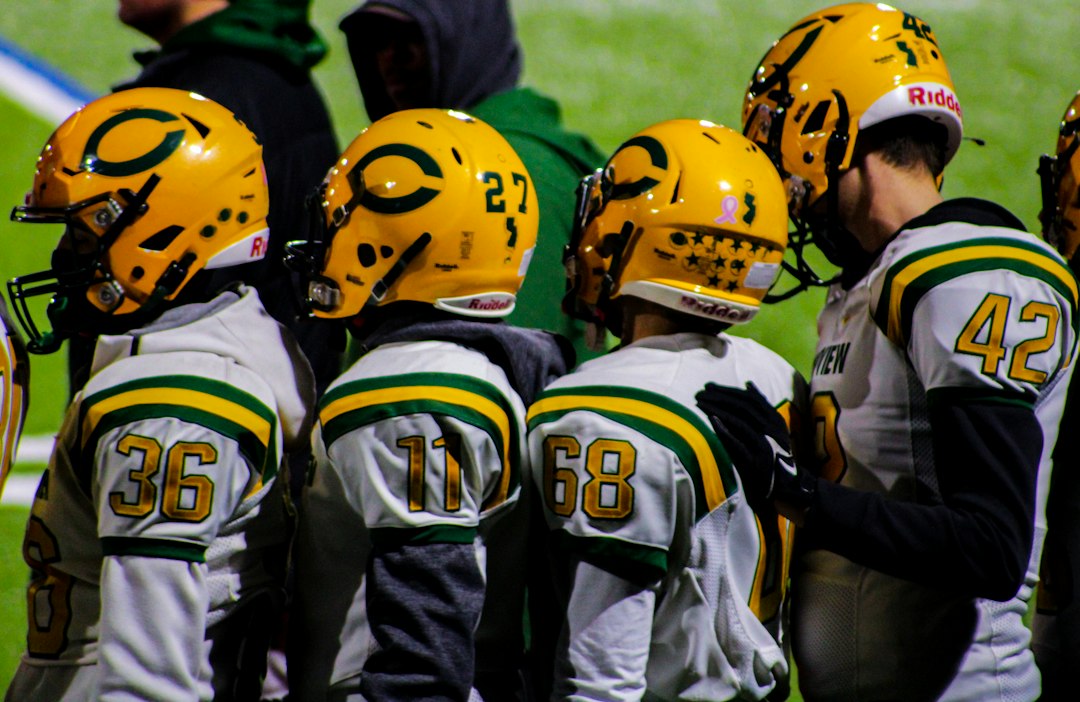




You were wearing the wrong clothes.
That's the detail nobody talks about when they tell injury stories — not the diagnosis, not the timeline, not the physical therapy. The detail that actually lodged itself somewhere permanent was the clothes. Street clothes on game day. Standing at the edge of the field or the court or the pool deck while everyone else was dressed for what you had trained all year to do.
If you played high school sports — any sport, any level, any era — and you lost time to injury, you already know what those clothes felt like. That is your entry point into one of the most disorienting chapters of a young athlete's life: the high school sports injury experience. Not just the physical side of it, but the psychological excavation that happens when the thing you use to define yourself is suddenly, medically, unavailable.
This is not a recovery guide. This is a reckoning with what that time actually taught you — about the game, about the people beside you, and about the version of yourself that turned out to be far more durable than a hamstring.
The Sideline Is a Classroom Nobody Signs Up For
There is a particular kind of silence on an athletic sideline when you are injured. Not the silence of the crowd pausing — the opposite, actually. The crowd is loud. The game is loud. Your teammates are in it, fully in it, and the noise that surrounds you is the same noise you have existed inside of for years.
Except now you are outside of it.
Every former athlete who has sat in street clothes on a bench during a game they should have been playing remembers the strange, awful clarity of that view. You have watched this sport your whole life. You have competed in it. But you have never actually seen it the way you see it from the sideline with nothing to do but watch.


You see things you never noticed when you were playing. You see your coach's decision-making in real time — not just the call, but the calculation before it. You see how your teammates move when you are not beside them. You see the gaps where your presence would have changed the shape of the play. You see what you actually contributed, made suddenly visible only by its absence.
That is the first lesson the sideline teaches, and it is one of the most uncomfortable: you cannot see your own value when you are inside of it.
The injured athlete, watching from the periphery, gets a view of their sport that healthy competitors almost never access. It is involuntary. It is painful. And in retrospect, it is one of the clearest windows into the game that an athlete ever gets.
What Watching Taught You That Playing Couldn't
When you are playing, you are managing. Executing. Your mind is running the sequence — read, react, execute — and there is almost no cognitive space left for observation. This is how it should be. Elite athletic performance requires this kind of focused, narrow attention.
But that focused attention comes at a cost: it makes you nearly invisible to yourself.
The injury forced a different kind of attention. Sitting out, you became a student of the game in a way that competing never required. You started reading patterns you had previously only reacted to. You started understanding why certain plays worked, not just experiencing them from inside the action. You began, perhaps for the first time, to develop what coaches call "the eye" — the ability to see the whole board.
Many former athletes describe this as the injury giving them a kind of coaching awareness years before they were ready to coach. Not because the injury was good, but because the forced observation unlocked a layer of comprehension that playing hadn't yet produced.
There is also something deeper here: the recognition that your sport is larger than your participation in it.
Before the injury, the game existed primarily as the stage for your performance. This is not ego — it is the natural psychology of a competitor. The game is where you go to do something. But watching from the sideline, you begin to see the game as its own living entity — something that continues and breathes and matters whether or not you are on the field. That realization is quietly profound. It is the beginning of a relationship with your sport that extends beyond your playing days into something that stays with you for the rest of your life.
The Team You Only Saw Clearly When You Were Out of It
Here is something that takes most former athletes years to say out loud: the injury showed you who your people actually were.
When you are healthy and competing, your relationships with teammates are built around shared performance. You trust each other in the context of the game. You know who you can count on in the fourth quarter, who slows down when it hurts, who rises. These are real bonds, but they are bonds forged in a specific kind of pressure.
The injury pressure is different. And it reveals different things.
Some teammates — the ones you already suspected were the real ones — showed up in ways that had nothing to do with the game. They saved you a seat on the bus. They gave you the same status in the huddle even when you couldn't contribute to the play. They talked to you about the game like you were still part of the team's thinking, because to them, you were.
Others faded. Not maliciously — the social architecture of a team reorganizes itself around who is available and performing, and that is simply how group dynamics work. But you noticed. The injury, in this way, functioned as a kind of social stress test that revealed the actual structure of your relationships beneath the surface of the lineup.
Maya T., 34, played varsity volleyball through two ankle sprains her junior year and spent eight weeks watching from the team's bench. What she remembers most isn't the frustration of not playing — it's that her setter, a girl she had competed beside for three years, came and sat next to her during every timeout. "She didn't have to do that," Maya says. "She was the one running the whole offense. But she always came back to where I was sitting. That's the thing I actually remember about that season."
That setter is probably still someone Maya would call if something hard happened. That is what the injury revealed: not the scoreboard, but the people.
The Identity Question Nobody Warned You About
Here is the part that nobody in athletic culture prepares you for.
When the sport is unavailable — truly unavailable, not just postponed by a rest day or a travel schedule — you are left with the question underneath all the training, all the competition, all the identity construction that happens in an athletic environment:
Who are you when you are not an athlete?
This is not a dramatic question. It is a quiet one. It arrives in the gap between when your teammates leave for practice and when you are done with your physical therapy exercises. It arrives when someone asks how the season is going and you have to explain, again, that you are not playing right now. It arrives in the moment you realize you don't know what to do with an afternoon that used to be automatically structured by your sport.
For many young athletes — and this is one of the most consistent findings in sports psychology research on athletic identity and injury — the injury period is the first time they are forced to confront how completely they have organized their self-concept around athletic performance. When the performance is removed, the identity wobbles.
This is not a failure of character. It is, in fact, evidence of the depth of commitment the athlete brought to their sport. You have to care enormously about something for its loss to feel destabilizing. The wobble is proportional to the investment.
But the wobble is also an invitation.
Because the athlete who comes through an injury period and returns to competition — or doesn't return, but moves forward — has been given a question that most people don't encounter until much later in life: what is the foundation beneath the thing I'm known for? The injury makes that question urgent at seventeen or eighteen, and the answer, once found, tends to be more durable than any athletic achievement.
Most former athletes, looking back, identify their injury period as the first time they understood themselves as something more than their performance. The sport was the context. The identity underneath it — the persistence, the tolerance for difficulty, the ability to be part of something larger than themselves — turned out to be the actual thing.
That thing travels with you into every room you walk into for the rest of your life.
The Return (And What It Meant When It Finally Came)
If you came back — and many do, and some don't, and both outcomes matter — the return was nothing like you expected.
You expected it to feel like relief. A return to normal. A resumption of the thing that had been interrupted.
What it actually felt like was different in ways that are hard to articulate. The game was familiar, but you were not the same person who had left it. The sideline had changed your vision. The social stress test had clarified your relationships. The identity question had been at least partially answered. You returned to the same sport, but you were playing it from a different interior.
Some former athletes describe their post-injury play as more deliberate. More present. Not better in every measurable dimension — speed and timing can take time to fully return — but more aware. More grateful in a way that is not performative but structural. The game felt more clearly like something that could be taken away, because it had been, and that knowledge changed how it felt to be back inside it.
Others describe a different outcome: the return to competition made them realize that the thing they had been mourning was not actually the sport itself but the identity and structure the sport provided. That realization sent some former athletes toward different arenas where the same qualities — discipline, team orientation, high-stakes performance — could be applied. Coaching. Leadership. Business. The military. Creative work that required sustained commitment and tolerance for failure.
The sport was not the destination. It was the training ground. The injury, by temporarily removing the destination, revealed the training.
What Stays With You
Every former athlete carries the physical memory of their sport in ways that the body does not forget — the instinct to plant and pivot, the specific weight of a ball in the hands, the sound the gym makes at capacity on a Friday night in January.
But the injury carries something different. It carries a set of earned understandings that only arrive through forced interruption.
Here is what tends to stay:
- The faces of the teammates who showed up when you were out — not the ones who said the right things, but the ones who actually came and sat with you.
- The strange clarity of watching something you love from a distance and seeing it more completely than you ever had from inside it.
- The first moment you realized that your identity was not rented from your sport but was something you had been building all along.
- The specific, quiet pride of returning to something you had lost, having learned, in the losing, that you were capable of more than you thought.
These are not lessons that anyone teaches explicitly. They are the curriculum of the sideline, delivered involuntarily to athletes who would have chosen not to be there.
But most former athletes — given enough distance and enough honesty — will tell you that those lessons shaped them in ways that the victories didn't.
The victories confirmed what they hoped about themselves. The injury revealed what was actually true.
Your jersey is still out there waiting.
The number you wore. The name on the back. The colors that meant something specific to a specific group of people who went through something real together — including the hard parts.
Design yours in minutes and see your name and number exactly the way you remember it.
Frequently Asked Questions
Is it normal to feel a loss of identity during a sports injury?
Yes — and it is more common than athletic culture typically acknowledges. Research in sports psychology consistently identifies what is called "athletic identity foreclosure," where an athlete's self-concept becomes so tightly organized around their sport that an injury creates genuine psychological disruption, not just physical inconvenience. This is especially prevalent in high school athletes who have trained intensively in a single sport. The feeling is real, it is proportional to the depth of commitment, and it tends to resolve as the athlete discovers the qualities underneath the sport that were always theirs.
What do former athletes say they learned from being injured that they couldn't have learned otherwise?
The experiences most commonly cited are: a deeper observational understanding of their sport, a clearer read on the actual quality of their relationships with teammates, and an early confrontation with the identity question — who am I without this? — that most people don't face until much later in life. None of these lessons were welcome at the time. Most former athletes, in retrospect, identify them as among the most formative chapters of their athletic careers.
How does the high school sports injury experience differ from injuries at other levels?
The high school context is particularly significant because it coincides with a developmental period when identity formation is already the central psychological task of adolescence. An injury during high school doesn't just interrupt a season — it interrupts the primary arena where a young person is constructing their sense of self. This makes the experience both more destabilizing in the short term and more formative in the long term than injuries sustained later in athletic careers, when identity tends to be more diversified and resilient.
Does not returning to the sport after an injury mean the experience was a failure?
No — and this distinction matters. The value of the high school sports injury experience is not contingent on a return to competition. Many former athletes who ended their playing days due to injury carry exactly the same earned understandings — about team, about identity, about their own resilience — as those who came back. The sideline education happens regardless of what comes after it. The playing career's length does not determine the depth of what the sport gave you.
See also: what high school sports actually teach you that nothing else could | athletic identity you built over years of competing | grief that comes with suddenly stepping away from the game | why high school sports still matter so much to the adults who played them