

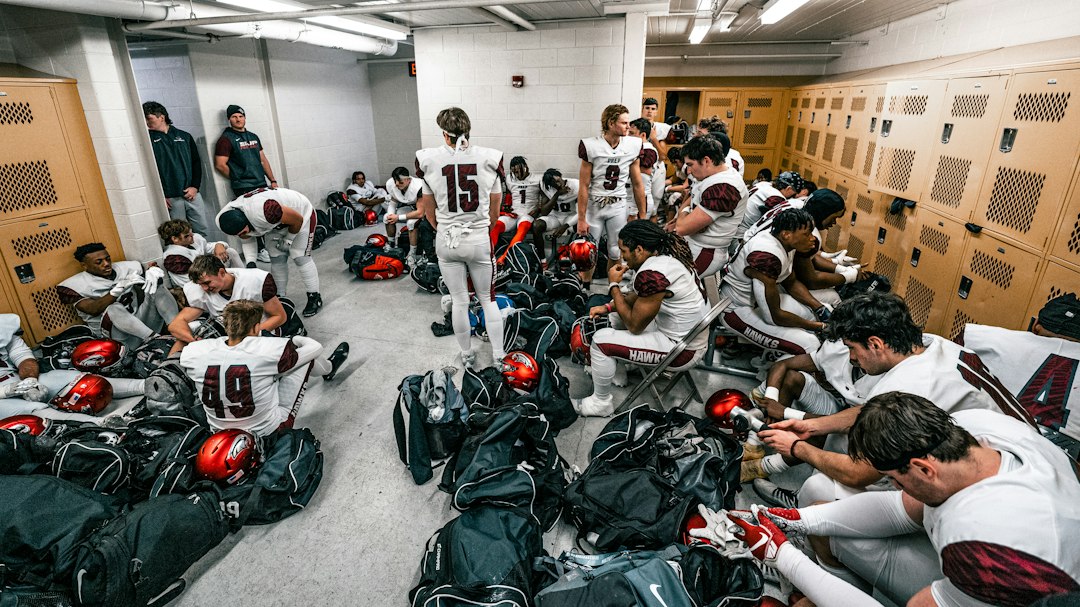




Reliving the glory days is something almost every former athlete does — but the version of it that serves you looks almost nothing like the version that quietly holds you back.
Most people fold both into a single word — nostalgia — as if the feeling itself is what determines the outcome. It isn't. The feeling is neutral. What changes everything is the direction you assign it: backward, as a measure you can never stop falling short of, or forward, as the bedrock of something you're actively building. This is about the forward direction. The one that puts everything you built to actual use.
You Didn't Retire From Being an Athlete. You Just Changed Arenas.
The post-sport conversation has a persistent blind spot: it frames the playing years as a chapter that closed, and everything after as the "real life" that started once the season ended. As if the discipline, the competitive instinct, the capacity to perform under genuine pressure, the specific knowledge of what it feels like to be inside something that demands your full self — as if all of that lived in a uniform that got handed back.
It didn't live there. It lives in you.
Every former athlete carries a psychological architecture that competition assembled. The way you process being outperformed — not with indifference, but with the particular hunger to understand the gap and close it. The way you read a room's dynamics instinctively: who's leading, who's struggling, who needs cover and who needs the responsibility. The way preparation feels like a moral obligation to you in a way it simply doesn't register for people who never competed at a level where showing up underprepared had immediate, visible consequences.
None of that relocated when the final whistle blew. It's still running.
The question isn't whether your athletic identity is still active. It is. The question is whether you're giving it a destination — or whether it's idling in the background, a little restless, waiting for you to point it at something.


In our experience covering the stories of former athletes across dozens of sports and multiple decades of playing careers, the ones who navigate post-sport life with the most coherence are not the ones who amputate the playing years from their identity. They're the ones who carry them forward deliberately — with intention rather than sentiment.
What the Nostalgia Is Actually Trying to Tell You
If you played, you already understand that the feeling comes in two distinct forms that share a name but almost nothing else.
The first version arrives at a team reunion, or when a particular song surfaces from that era, and it leaves you more energized than it found you. You remember what you were capable of — the specific version of yourself that existed inside the structure and stakes of competition — and somehow that memory makes the current version of you feel more capable, not less. You leave the conversation taller.
The second version operates differently, and you recognize it the moment it shows up. It's the wistfulness that surfaces when the present feels like it isn't keeping pace. When you catch yourself holding your current life up against a scoreboard that stopped running years ago and noticing the numbers aren't what you'd want them to be. When the clearest version of yourself you can access is the one wearing a number on their back, and that clarity feels like an accusation rather than an asset.
The first version is your athletic identity delivering accurate information: that capacity is still in you, and it's looking for a channel.
The second version is the same identity delivering a different message: you haven't given it one.
Research in sport psychology has consistently shown that athletic identity — the degree to which a person's self-concept is organized around their role as a competitor — doesn't dissolve when competition ends. It shifts. For many former athletes, the transition out of sport is among the most psychologically significant identity reorganizations they'll navigate. The playing years weren't just something they did. They were a primary architecture of who they understood themselves to be.
That depth is not a liability. It's a resource that hasn't been fully directed yet.
Every Former Athlete Remembers the Last Time
Every former athlete remembers the last time — the final game, the last practice, the last moment on the field or court or ice when they were precisely what years of preparation had made them.
Most of us didn't recognize it as the last time when it happened. It arrived dressed as just another contest: the final loss of a playoff run, the closing day of a senior season, an injury that turned what should have been a comma into a full stop. Some last times arrive with ceremony. Most slip past without a marker.
What almost no one tells you in the months that follow is that the grief is proportionate. Not excessive, not self-indulgent — proportionate. You lost something that was genuinely load-bearing. The competition itself, yes. But more specifically: the daily structure that gave your effort a visible destination. The teammates who knew something about you through shared experience that words don't fully carry. The particular clarity of inhabiting a role completely — of knowing, without ambiguity, exactly what you were there to do and what it would take to do it at the level it deserved.
Grief that specific deserves to be named before it gets reframed.
The reframe doesn't start by minimizing the loss. It starts by understanding it with precision — by identifying exactly what functions the playing years served in your life, and then asking the more useful question: where are those functions available to me now?
Marcus T., 44 — Former College Swimmer
Marcus T., 44, swam competitively through college and spent the better part of a decade afterward avoiding anything that pulled him back toward the water. "I told myself I'd moved on," he said. "What I'd actually done was pack that part of my life into a box and put it somewhere I didn't have to look at it."
It wasn't until his daughter joined a club swim team that he found himself on the pool deck again — not competing, just present. Something shifted. He started coaching on weekends. He got back in the water himself, just to feel what it felt like again. He ordered a custom jersey from iPlayedFor in his college team's colors — a tribute to the years he'd spent in that program — with his name and number across the back. Not to perform a younger version of himself, but because wearing it let him finally stop treating his athletic identity like something requiring an apology.
"I thought honoring that part of my life meant I was stuck in it," he said. "Turns out, pretending it didn't exist was what was actually keeping me from moving."
The Reframe: From Museum to Foundation
There are two ways to hold your athletic past in relation to your present. Understanding the difference between them is the whole thing.
The first is the museum version. Your playing years are preserved behind glass — visited for comfort, kept deliberately separate from the present so neither contaminates the other. This approach feels respectful at first. It's actually a form of containment that costs you the use of something you spent years constructing.
The second is the foundation version. The playing years are not the peak of the story but the structural base of it. Everything competition gave you — the discipline, the instinct for pressure, the specific experience of performing when something real was at stake — is load-bearing. You are standing on it right now. It is making the current floor possible.
The museum version produces the hollowing kind of nostalgia. The foundation version produces something that works.
Here is what the foundation version looks like when it's actually operating:
Your competitive instinct is a developed skill, not a leftover personality trait. The drive to prepare seriously, to push through resistance when the outcome is uncertain, to want to win and to understand at a granular level what winning requires — these are not charming remnants of your playing days. They are rare, deliberately built capacities that the majority of people around you did not develop under the same conditions. The former athlete who enters a high-stakes professional environment, a difficult creative project, or a physical challenge carrying that instinct is not running on sentiment. They're running on a toolkit that was constructed under pressure most people never experience.
Your team experience is a working template, not just a memory. If you competed at any meaningful level, you have lived inside a functioning team — with defined roles, genuine stakes, and the specific texture of both supporting others and being supported by them. Most people describe wanting that quality of collaboration in their professional and personal lives without having a real reference point for what it feels like from inside. You have that reference point. It transfers in ways that are practical, not nostalgic.
Your capacity for pressure is transferable across every arena you enter. The former athlete who learned to perform when the moment demanded it — to show up prepared when preparation required sacrifice, to compete with integrity when losing was a genuine possibility — built something that compounds. It was not stored in the uniform. It is stored in the pattern of decisions you made under conditions that tested you.
How to Carry It Forward Without Performing It
There is a version of athletic identity that curdles into performance, and anyone who has been in the community long enough recognizes it immediately: the person who steers every conversation back to their playing years, whose self-concept froze at the age they were most celebrated, who makes every new relationship into an audience for a story that peaked decades ago. That is the museum with the lights left on and the door propped open. It is not what we are describing.
Carrying it forward is quieter and considerably more useful.
Direct the competitive instinct at a deliberate target. Former athletes frequently describe a persistent restlessness — a driven quality that can't seem to find purchase. The source is almost always the same: the competitive instinct is running without a sanctioned outlet. Give it one. A physical challenge with measurable stakes. A professional goal that demands the same quality of preparation and execution that competing required. A creative project with a genuine deadline and a real possibility of coming up short. The instinct doesn't need to be managed down. It needs somewhere to go.
Maintain connections with people who played. There is a particular fluency among former athletes that exists independent of sport, era, and level of play. The shared experience of performing under pressure, of belonging to a team with real consequences, of the specific culture built inside a locker room — these create a shorthand that doesn't require translation or explanation. Maintaining those relationships, or building new ones through recreational leagues, coaching, mentorship, or organizations that serve former athletes, is not a form of nostalgia management. It is identity maintenance.
Keep objects that anchor the identity in the present tense. A custom jersey in the colors of your program — inspired by the uniform you wore, carrying your name and your number — is not decoration and it is not regression. It is a physical statement that something real happened, that it shaped you, and that you are not putting it behind glass. For many former athletes, that kind of concrete acknowledgment is what finally makes integration possible: not just visiting the playing years, but actually incorporating them into who you are right now.
The Story You Tell About Those Years Is a Choice
Here is the part the standard "glory days" conversation consistently skips, and the part that makes the most practical difference.
The narrative you carry about your athletic years is not a fact. It is a frame. And you are the one selecting it — whether or not you are making that selection consciously.
The "glory days were back then" frame installs the past as the peak and makes everything that follows a gradual recession. In that frame, nostalgia is indistinguishable from grief, and the present is permanently a diminished version of something better. That frame is not an honest reading of your story. It is a default that calcifies into something that feels like truth because it has been running unexamined.
The "those years built this person" frame runs differently. In that frame, the playing years are not the ceiling — they are the structural work that made the current floor possible. The peak is not behind you. The peak is what you are building now, on the foundation that all of that preparation created. The discipline was practice for something beyond the sport. The competition was training for something that extends past the final buzzer. The experience of performing when something genuinely mattered — of knowing what it feels like to be ready for something real — was preparation.
For exactly what you are doing now, and what comes next.
If you played, you know that the wins that meant the most rarely felt the way you imagined they would before they happened. They felt earned. They felt like confirmation that the preparation had been worth the cost. They felt like the arrival of something that began long before anyone was paying attention to it.
That feeling is not locked in the past. It is available to you now — in whatever arena you are currently competing in, at whatever level the current chapter demands.
The glory days were not then. They are what you do with everything those years gave you, starting from exactly where you are.
Your jersey is still out there waiting.
Design yours in minutes and see your name and number exactly the way you remember it.
Frequently Asked Questions
Is it normal to feel grief after a playing career ends, even years later?
Yes — and naming it as grief is the most productive first move. Athletic identity is a significant organizing structure for anyone who competed at a meaningful level, and the end of that chapter is a genuine loss. Research in sport psychology consistently documents that the transition out of competition is one of the more psychologically complex identity shifts a person navigates. The grief doesn't indicate something is wrong with how you're processing the experience. It indicates the experience carried real weight. The goal is not to eliminate the feeling but to understand what it's signaling — which is almost always some form of intentional reconnection with what made competing meaningful in the first place.
How do I tell the difference between honoring my athletic past and being stuck in it?
The clearest indicator is directionality. If your relationship with your playing years makes you more energized, more capable, and more connected to who you are working to become, it is functioning as a foundation. If it primarily makes the present feel like a lesser version of the past — if the main use of your athletic history is to make the current chapter feel inadequate by comparison — it may be functioning as a ceiling rather than a floor. The practical test: does thinking about those years produce an impulse to do something now, or does it produce a feeling that now simply cannot compete? One of those directions is useful. The other one costs you something.
What does carrying your athletic identity forward actually look like in daily life?
Less dramatic than most people expect, and that is precisely the point. It shows up in how you approach preparation — taking it more seriously than most people in your current context because you absorbed early that preparation is the only thing that makes confidence legitimate. It shows up in how you read team dynamics in professional environments, because you have lived inside a functioning team and understand its roles without needing them explained. It shows up in how you respond to setbacks — not without difficulty, but with a framework for difficulty that competition gave you. And sometimes it shows up in concrete, physical terms: staying active, coaching youth athletes, maintaining relationships with former teammates, or keeping something — a jersey in the style of your old program's colors, a photograph, a piece of gear — that anchors the identity in the present rather than archiving it in the past.
See also: athletic identity after high school | grief that comes with the end of your athletic career | the psychology of athletic nostalgia