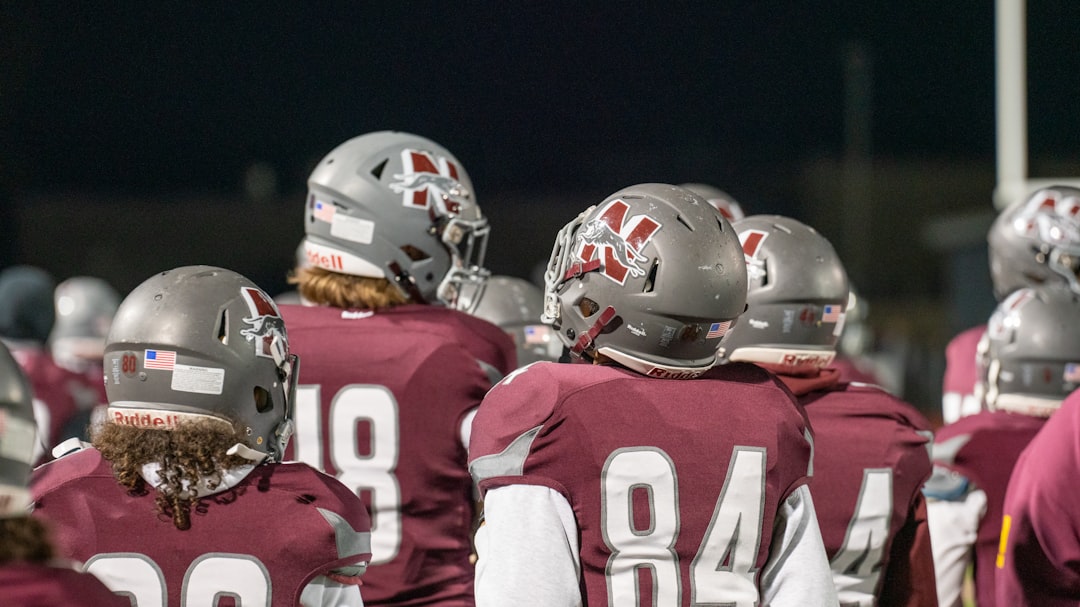
You can close your eyes right now and be back there.
The smell of the gym floor. The specific weight of the ball in your hands. The sound — not the crowd as a whole, but one voice cutting through. The way time moved differently in that moment, slower and sharper at the same time, like the world had decided to pay attention.
Unforgettable high school sports moments don't feel like memories. They feel like rooms you can still walk into.
This isn't nostalgia in the conventional sense — the soft, generalized warmth of "those were good times." This is something more precise. You have plays, possessions, entire halves archived in your nervous system with a resolution that your last birthday, your last vacation, your last ordinary Tuesday cannot touch.
Why?
Why does a JV game on a cold Wednesday night in November — a game that made no newspaper, drew no scouts, and meant nothing to anyone who wasn't there — stay with you more vividly than hundreds of hours of daily life that came after?
The answer sits at the intersection of neuroscience, peak experience psychology, and something specific about what it means to be a young athlete in a moment that is completely, irreversibly real. This article explains what actually happened in your brain during that moment — and why that explanation makes the memory something more than just a story you tell.
Your Brain Didn't File That Moment. It Framed It.
The standard model of memory is that experiences are recorded and stored, like files on a hard drive. Strong emotions make stronger files. This is partially true but misses the mechanism that explains why athletes remember certain plays with a specificity that dwarfs almost anything else in their autobiographical memory.
The real process is more selective — and more meaningful.
When you experience something that involves high emotional arousal, physical stakes, social significance, and personal identity all at once, your brain releases a specific cocktail of neurochemicals — primarily norepinephrine and dopamine — that directly enhance the consolidation process in the hippocampus. The amygdala, which processes emotional significance, essentially tags the event: this one matters, encode it fully.
But here is what most explanations of memory leave out: the amygdala doesn't just flag emotional intensity. It flags meaning. Not consciously assigned meaning — biological meaning. The meaning the body registers when survival, identity, belonging, and achievement all activate simultaneously.
A high school athlete in a defining game is experiencing all four at once.
Your body doesn't know the difference between a championship game and a genuine threat. The stakes feel existential because, to your nervous system at that age, they were. Your identity — who you were among your teammates, your coaches, your school, your own sense of self — was genuinely on the line. That is not teenage drama. That is the accurate report of a nervous system doing its job.
There's a name for why memories from this period are so disproportionately vivid: the reminiscence bump. Research on autobiographical memory has consistently found that people recall far more events from ages 10 through 30 than from any other period of their lives — and within that window, moments of high emotional and identity significance are the most deeply encoded. Your high school athletic career sits squarely inside the reminiscence bump, and the games that mattered most sit at its peak.
The result is a memory encoded with what researchers since Brown and Kulik's foundational 1977 study have called flashbulb quality — not photographic accuracy in the literal sense, but a subjective experience of completeness. You remember the sensory field. You remember your own body. You remember what other people said. The normal compression that editing memory creates is suspended, and you get something closer to the full, uncompressed experience.
This is why you can replay it in slow motion. You didn't memorize it. You lived it at a different frame rate.
The Tuesday Night Game Nobody Watched
Here is what the content about famous sports moments always gets wrong: it assumes that significance requires an audience.
It does not.
The games you never forget as an athlete are almost never the ones that made the newspaper. They are the ones where something internally irreversible happened — where you crossed a threshold that changed what you believed was possible, or where you confronted a limitation so honestly that it rewired your understanding of yourself.
Marcus T., 34, still talks about a JV basketball game his sophomore year — a road game on a Tuesday, maybe forty people in the stands, a team his school was supposed to beat easily. They didn't. His team lost by one on a play he was directly involved in. He can describe every second of the final possession. Twenty years later, he says it's the moment he learned that effort and outcome are genuinely separate things — and that the effort still meant something anyway.
That game doesn't exist in any archive. There is no highlight reel. No one outside of those forty people will ever know it happened.
And yet it is lodged in his nervous system with the precision of a surgical instrument.
This is the point. The most memorable moment in high school sports, for most former athletes, is a personal threshold event — not a public spectacle. The neuroscience explains why. The emotional encoding process doesn't care about crowd size or press coverage. It cares about internal stakes, identity activation, and the quality of presence the athlete brought to the moment.
You were fully there. Your body knew it mattered. That's the entire formula.
Maslow's Peak Experience and the Athlete
Abraham Maslow spent years studying what he called peak experiences — moments of extraordinary perception, complete absorption, and a temporary dissolution of the boundary between self and activity. He described them as among the most meaningful events in a human life: moments where a person feels most fully themselves, most completely present, and most clearly connected to something larger than their ordinary concerns.
Athletes know this experience by a different name. They call it being in the zone. But the zone is not just a performance state — it is a memory-formation state.
Peak experiences in high school athletics produce memories of unusual completeness because the conditions for peak experience and the conditions for deep encoding are almost identical:
- Complete absorption — no divided attention, no passive observation, full investment of the self
- Physical embodiment — the experience is happening in your body, not just your mind
- Authentic stakes — the outcome genuinely matters to you, not abstractly but personally
- Social belonging — you are inside a group of people having a shared, unrepeatable experience
When all four conditions align, the experience registers differently. Maslow's research suggested that people who have had peak experiences often describe them as the emotional reference points of their lives — not the highlights, but the benchmarks. The moments against which everything else is, quietly, compared.
Your high school athletic career was one of the few environments in your life where peak experience conditions were regularly in place. The gym, the field, the court — these were peak experience laboratories. You didn't know that at the time. You were just playing.
But your nervous system was paying very close attention.
The Losses That Stay Longer Than the Wins
There is something important that any honest account of unforgettable athletic moments has to address: the painful ones don't fade either.
Sometimes they stay longer.
The playoff loss. The dropped pass. The missed free throw in a game that ended a season. These memories carry the same neurochemical weight as the great ones — sometimes more. The same emotional encoding process that preserves triumph also preserves the specific quality of loss at high stakes.
This is not punishment. It is information.
Peak experiences in high school athletics include peak failure experiences, and the brain encodes those with the same care because they represent the same level of genuine engagement. You were not a passive observer of that loss. You were completely present in it. Your identity was fully invested. Your body registered the outcome as meaningful.
The grief that attaches to certain athletic losses — losses that might look small from the outside — is real grief. It is not disproportionate to what you experienced. It is precisely proportionate to how fully you were present when it happened.
What this means, practically, is that the memory is not a wound that failed to heal. It is evidence of how completely you gave yourself to something. The sting is the proof of the investment.
Former athletes who understand this reframe those memories differently. Not with forced positivity — not "it made me who I am" as a way to skip the actual feeling — but with a clearer recognition of what the memory is actually reporting: you were fully there. You cared completely. Nothing was held back.
That is not a failure memory. That is a presence memory. The loss was part of it, but the presence was the whole thing.
Why These Moments Don't Diminish With Time
Ordinary memories fade through a process called reconsolidation — every time you recall a memory, you slightly rewrite it, and the rewritten version gets stored in place of the original. Over time, ordinary memories drift. They soften, compress, and lose their edges.
Peak athletic memories resist this process in a specific way.
The sensory and physical components of those memories — the feel of the floor, the sound of the crowd, the weight of your own body in motion — are encoded through pathways that involve procedural and somatic memory, not just declarative memory. Your body remembers those moments independently of your narrative about them.
This is why telling the story of the game is different from remembering the game. The story is a verbal reconstruction. The memory is a full-system replay. Athletes often describe this distinction without knowing the neuroscience: "It's not like remembering. It's like being back there."
That's not poetry. That's an accurate description of how the memory was stored — in your muscles, your vestibular system, your sensory processing, not just in the verbal archive of your life story.
And because the memory is distributed across multiple systems, it is also more resistant to the usual erosion. The story can change. The feeling doesn't.
These memories are also actively reinforced every time you retell the story. Researchers call this social rehearsal, and it strengthens the neural trace each time the memory is accessed. The teammate you see at reunions, the old friend who remembers the same play from the same angle, the retelling that adds one more detail each time — these aren't just social rituals. They're memory maintenance. Every retelling reactivates the original encoding pathways and deepens the consolidation, which is why a memory from twenty years ago can still feel more immediate than a memory from last month. This is also why the memories that get retold with teammates stay sharper than the ones kept private: the social reinforcement loop actively preserves what would otherwise fade.
What To Do With a Memory That Won't Leave
Peak experiences in high school athletics don't require anything from you. They are complete as they are. But former athletes who consciously engage with these memories — who look at them with curiosity rather than just nostalgia or residual pain — often find that the memories have more to offer than they thought.
A few approaches that change the relationship:
-
Name what the memory is actually about. Not the score, not the opponent — the internal threshold. What did you discover about yourself? What did you prove or disprove? The most memorable high school sports moments are rarely about the game. They are about a question the game answered.
-
Notice the sensory inventory. Deliberately walk through what you can still access — the light, the sound, the physical sensation. This is not indulgence. It is a recognition of how fully you were present. The richness of the sensory record is the record of your own engagement.
-
Let the loss memories be complete. Don't rush to the lesson or the silver lining. The loss was real. The investment was real. Letting the memory be complete — including the parts that still hurt — is more respectful of what you experienced than converting it immediately into a growth narrative.
-
Recognize the rarity. Most people move through their lives without creating memories of this quality. You created several of them before you were eighteen. That is not a small thing.
Your jersey is still out there waiting.
Design yours in minutes and see your name and number the way you remember it.
Frequently Asked Questions
Why do I remember a losing game more vividly than games we won?
The emotional encoding process is driven by intensity and personal stakes, not outcome. A painful loss at high stakes activates the amygdala as strongly — sometimes more strongly — than a win, because the emotional arousal is high and the personal identity investment is fully activated. The memory is vivid because you were completely present in it, not because the outcome was positive. Many former athletes report that their most precise athletic memories are losses, for precisely this reason.
Is it normal to still feel strong emotions about high school sports moments years or decades later?
Completely normal — and the neuroscience explains why. Peak athletic memories are encoded with physical and sensory components that don't fade the way narrative memories do. When you access those memories, you're not just recalling a story; you're activating a distributed memory that includes somatic and sensory data. The emotional response isn't a sign that you haven't moved on. It's a sign that the memory was stored at a depth that ordinary memories don't reach.
Why can some former athletes describe a single play in precise detail while barely remembering the rest of the season?
This is a direct result of selective encoding. The brain does not record experiences uniformly — it allocates encoding resources based on emotional significance, physical stakes, and identity relevance. A single play that concentrates all three of those signals in a brief, high-intensity window will be encoded with far greater detail than hours of practice or ordinary game action. The play isn't more important because you remember it better. You remember it better because your nervous system judged it to be the most important thing happening at that moment — and it was probably right.
Do peak athletic experiences in high school actually influence how athletes perform and think later in life?
Research on peak experiences suggests that they function as psychological reference points — moments people return to when assessing their own capabilities, resilience, and identity. For former athletes, high school peak experiences often serve as early evidence of what full engagement and genuine presence feel like. That reference point doesn't disappear when the athletic career ends. It becomes part of the internal framework through which the person understands what they are capable of when they are fully invested in something.
See also: why high school sports still matter so deeply to adults | the science behind why your senior season memories are so vivid | why you still dream about those high school games | what playing under the lights actually felt like | the grief that came with the end of your athletic career