

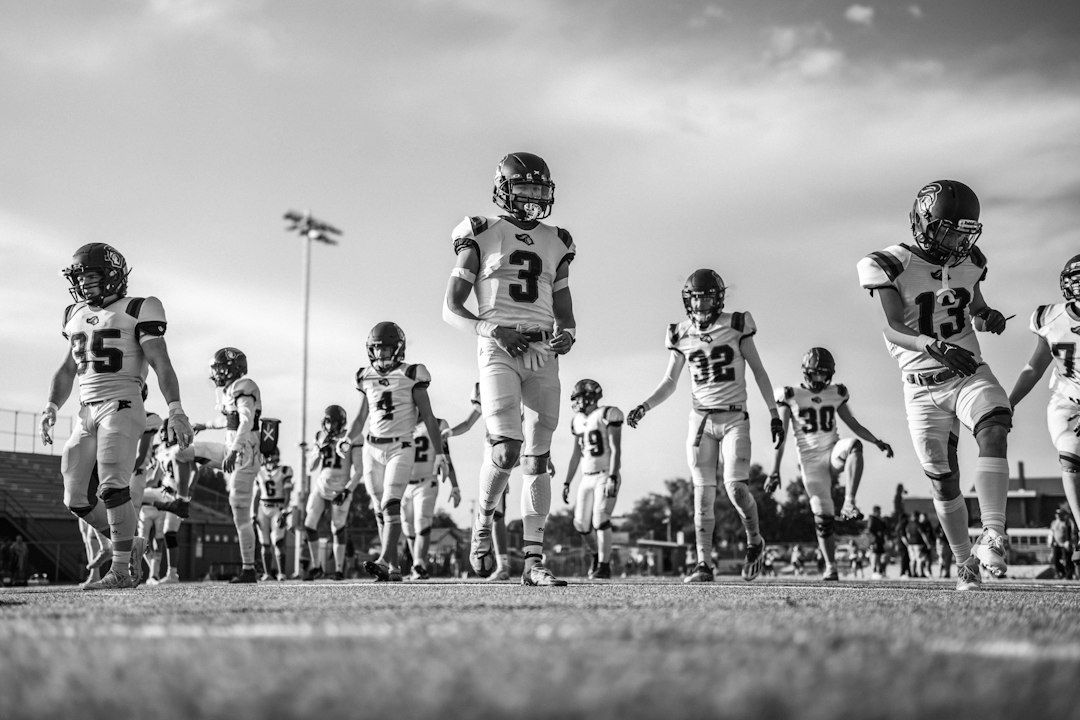




Every athlete carries a specific moment in their body. It lives somewhere in the second half, the late innings, the final period — when everything that's left in the tank has already been spent and the only thing moving you forward is the thing your coaches built before you knew they were building it.
The military doesn't call that a breakthrough. They call it a Wednesday.
This Veterans Day, the bond between competitive sports and military service earns more than a hashtag. The connection runs structural — it lives in the habits, the reflexes, the internal wiring that forms under sustained pressure alongside other people who have no choice but to trust you. For the millions of Americans who competed at any level — rec leagues, varsity, college, semi-pro — and then stepped into a different kind of uniform, the transfer wasn't symbolic. It was operational.
The discipline, the brotherhood, the sacrifice: veterans day sports conversations keep returning to these three words because the athletes who served, and the veterans who competed, recognize something that's nearly impossible to explain to someone who only lived one of those worlds.
The locker room and the barracks run on the same code.
What the Locker Room Was Actually Building
Not the plays. Not the win-loss record. Not the trophy case bolted to the hallway wall outside the gymnasium.
The locker room was building something harder to name. It was teaching you how to function inside a group of people you didn't select, extend trust to them anyway, and return the next morning having been through something together — win or lose. It was showing you that shared difficulty forms bonds that shared celebration rarely does. The teammate who drove you insane in the first week of August was the one you'd take a hit for by the final game of November.


That isn't athletic training. That's a foundational life skill.
In our experience engaging with athletes who went on to serve, the transfer they identify most consistently isn't physical conditioning or even the broad category of mental toughness. It's something more precise: the weight of being accountable to the specific person beside you. Not to an organization. Not to a concept. To the actual human being in the next locker who trusted you to do your job when it mattered.
Sports rehearses this accountability in a way that few other civilian experiences can match. The team wins together or loses together. No partial credit exists. No grading curve softens the result. When the final whistle blows, whatever you gave — or withheld — is already written into the record.
The military doesn't ask athletes to reach a depth they've never touched. It asks them to hold that depth longer, with far higher consequences on the line. The athletes who understood this didn't find the asking foreign. The depth was already mapped.
The Practice Field as Boot Camp
Strip a serious high school or college practice down to its bare structure and look at what you're actually describing.
You rise before daylight. You perform physical tasks past the comfortable threshold under the direction of authority figures who don't invite negotiation. You repeat it the next day. You perform it in cold weather. You perform it while carrying unresolved weight from last week. You do it because the person beside you is doing it and you are not going to be the reason the group falls short.
The vocabulary changes. The uniform changes. The stakes escalate dramatically. But the interior framework — the architecture an athlete assembles to function through a brutal late-season practice when the body is spent and the season depends on what you do right now — that framework doesn't get left at the last game. It travels.
This isn't an accident of culture. It's why military recruiters have tracked competitive athletes for generations, and why coaches at every level have always described their work in terms that reach past the sport itself.
The Specific Skills That Cross Over
Ask a veteran who competed seriously at any level what transferred, and the answer arrives in specifics, not abstractions.
Fatigue management. Not the suppression of exhaustion — that's a path to injury and breakdown. Performance inside it. Knowing by feel the difference between pain that signals stop and discomfort that signals keep moving. Every athlete who trained with real intensity develops this internal compass. The military formalizes and extends it, but the athlete already owns the instrument.
Unit cohesion under pressure. A missed assignment on a single football play can cost a score. The team adjusts, realigns, communicates, and returns to formation. In a squad under operational pressure, a missed assignment carries weight no scoreboard measures. The cognitive and emotional skill — stay in your lane, trust your teammate's lane, communicate with speed and clarity — is structurally identical. The athlete practiced it thousands of times in lower-consequence environments. Those reps were real preparation.
Operating under authority you didn't choose. Sports introduces this early. The coach isn't always right. Isn't always fair. Isn't always someone you would have selected as a guide. You perform at full effort for them regardless, because the team requires it and because debating fairness during a fourth-quarter drive costs everyone on the field. Veterans describe this same dynamic precisely — the sergeant you respected because the mission demanded respect, not because everything about the person was admirable. Athletes recognize this from the first season they watched less-talented players ahead of them in the depth chart because of seniority.
Stability of identity inside chaos. This one resists easy definition but reveals itself clearly under pressure. When the game is out of hand in either direction, the well-coached athlete doesn't dissolve into the scoreboard. They execute their assignment. They play their position. They locate the next controllable variable and perform it. Composure — real composure, not the performed version — is one of the most transferable attributes serious athletic training produces.
The Athletes Who Became Veterans
Marcus T., 41, played three varsity seasons of baseball in rural Tennessee before spending eight years as a combat engineer in the Army. He keeps his high school jersey in the same footlocker as his deployment photographs. Not sentiment, he says. Because they're chapters in one story.
"My coach used to say that how you practice is how you play. My drill sergeant said the exact same thing on day one using different words. I thought about Coach Davis more than once over there. That might sound strange, but it's true. He built something in me that I didn't fully understand until I needed it."
This through-line is not rare. The path from the practice field to service runs through millions of American lives, most of them quiet. Research supported by the Pat Tillman Foundation — which backs veteran scholars across the country — surfaces the same themes repeatedly in veteran narratives: team identity, mission clarity, pressure performance, and the particular grief of leaving a unit behind, whether that unit was a roster or a squad.
Pat Tillman was the most visible expression of this story: an NFL safety who walked away from a $3.6 million contract to serve as an Army Ranger after September 11. But the story belongs to millions of people who played at levels no camera covered and served in roles no headline acknowledged, and who came home carrying both identities with the same quietness they carried everything else.
The Veterans Who Competed After They Came Home
The transfer doesn't move in only one direction.
Veterans who returned to competitive athletics — through the Post-9/11 GI Bill at the collegiate level, through recreational and masters leagues, through the Warrior Games and Paralympic competition — bring something onto the field that most of their competitors have never developed.
They bring a calibrated internal scale for what difficult actually means.
This isn't a claim of superiority. It's a description of recalibration. Athletes who have served tend to manage competitive adversity differently — not because the nerves have gone quiet, but because the internal measuring instrument has been reset against a different reference point. The competitive moment that derails other athletes lands on a different part of the scale.
The unit loyalty travels with them as well. Veterans who compete after service describe their teammates in the same register they use for their squad. The commitment runs to the actual person beside them — not the institution, not the jersey, not the abstraction of the team — and it carries the same force it carried downrange.
Athletic communities don't always know how to receive this. But the teams these veterans join tend to change in ways that are difficult to attribute to any single source and impossible to miss.
What Veterans Day Means When You Wore Both Uniforms
It isn't a long weekend. It isn't a mattress sale or the unofficial start of the holiday season.
For athletes who served, Veterans Day arrives in the middle of football season — carrying the specific smell of fall practice, the particular quality of late-October stadium light — and lands beside the other identity that also lives in the body. The two don't separate cleanly. They don't compete for space.
The jersey number. The unit designation. The position. The rank. Different vocabularies asking the same fundamental question: who are you when the situation requires everything you have?
The athletes who served don't tend to describe their playing career and their service as separate chapters. They describe them as the same chapter in different gear. The values didn't shift between the practice field and deployment. The people who mattered were the same kind of people wearing different colors. What was asked of them — presence, accountability, controlled performance under sustained pressure, loyalty to the person beside them — was the same thing asked in a louder register with higher stakes attached.
This Veterans Day, that continuity deserves to be named directly.
The discipline sports built was never just about sport. It was preparation for a life that would demand exactly that discipline, at a scale and duration that youth athletics only begins to suggest. The brotherhood the locker room produced was never really about winning seasons. It was about the particular human bond that forms when people suffer and succeed and return and do it again, together. The sacrifice competitive athletics asks — of time, comfort, ego, and the short-term version of yourself — was rehearsal for a larger offering that many of those athletes made without hesitation.
Not because sports manufactured heroes. Because sports built people who were ready when the call arrived.
Your Jersey Is Still Out There Waiting
Your jersey is still out there waiting.
Design yours in minutes and see your name and number exactly the way you remember them — a tribute to the competitor who was building something far bigger than a season record.
Frequently Asked Questions
Does competitive sports genuinely prepare athletes for military service, or is the connection overstated?
The preparation is real but bounded. Sports builds specific transferable skills — performing under pressure, operating within an assigned role inside a team structure, managing fatigue, and maintaining function when conditions deteriorate. What it doesn't fully prepare athletes for is the scale and permanence of military stakes, the sustained duration of deployment, or the specific psychological weight of combat situations. Veterans who played sports at a serious level consistently describe the athletic background as a genuine functional foundation — useful and real, but not a complete structure.
Which sports tend to produce the most transferable preparation for military service?
Team sports built around complex role assignments and high physical demand — football, basketball, soccer, wrestling, rowing — tend to produce the most direct transfers. The determining variables aren't the sport itself but the training intensity and the degree to which the athlete was required to execute a specific function within a system dependent on collective performance. An athlete who played a supporting role on a disciplined team often transfers more effectively than a standout player whose individual talent compensated for structural failures around them.
How do veterans generally respond to comparisons between sports and military service?
Responses vary by individual experience. Veterans who competed seriously before or after service tend to find the comparison accurate and meaningful. Veterans who came to sport after service — particularly adaptive athletes competing in the Warrior Games or Paralympic programs — frequently describe athletics as central to reintegration and identity reconstruction. Some veterans who didn't have athletic backgrounds find the comparison overstated and prefer the two worlds kept distinct. The respectful approach is always to let veterans define the connection on their own terms.
Are there formal programs connecting sports organizations with Veterans Day recognition?
Yes. The NFL, MLB, NBA, and NHL each maintain formalized Veterans Day and Veterans Month recognition programming, including on-field ceremonies, discounted tickets for active-duty military and veterans, and partnerships with veteran support organizations. The Pat Tillman Foundation operates scholarship programs for veteran-athletes pursuing higher education through collegiate athletics. USA Powerlifting, USA Weightlifting, and several other national governing bodies have built veteran-specific divisions and programs for returning service members entering competitive sport.
See also: what high school sports actually teach you that nothing else could | the athletic identity you carried long after your last game | the grief that comes when a defining chapter of your life ends