

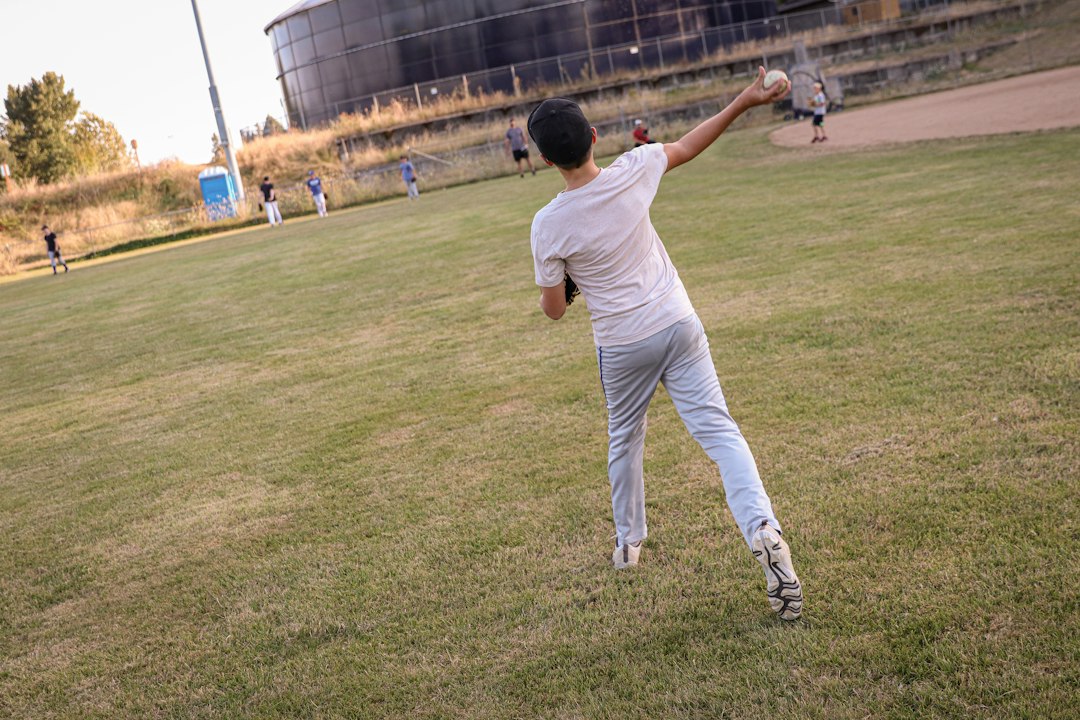




Nobody handed you a life manual during warmups. You were just trying to earn a spot in the lineup.
The alarm went off before sunrise, and the neighborhood was still dark. No one was tracking your tee work. No coach was standing in the cage when you stayed late to iron out the mechanical flaw you'd felt creeping in all afternoon. You identified the problem, corrected it, and came back the next day ready to repeat the process. The work ethic learned from sports wasn't something you studied — it was something you lived, one early morning and one unglamorous repetition at a time.
And it didn't stay on the diamond.
Most former athletes spend years giving credit outward — to coaches, teammates, organizations, mentors — without pausing to acknowledge the version of themselves who set that alarm in ninth grade and meant it. This piece is written for that version of you. The one who built a baseline that is still governing your professional life right now, whether or not you've ever stopped to name it.
The Morning Routine You Never Actually Quit
Sit down with a former high school baseball or softball player and ask them to walk you through a typical weekday morning. You'll hear something unmistakable: up early, moving through a sequence, organized before most people have opened their eyes.
They rarely describe it as a routine. But that's exactly what it is — and the source is not a productivity book.
Morning practice was non-negotiable in competitive high school programs. Pre-school workouts at six AM. Saturday cage sessions. Sunday bullpen work in weather that made you question your life choices. The discipline from athletics wasn't delivered as a lecture or illustrated on a whiteboard. It was installed through repetition, accumulated across four years of seasons, until waking up before daylight stopped registering as hardship and started registering as the correct way to begin.


When a former athlete sets the alarm the night before and rises without negotiating with themselves for twenty minutes, they're running a neurological groove carved across hundreds of early mornings where being late had real, immediate consequences. The behavior became structural. The context changed. The behavior didn't.
According to the American College of Sports Medicine, athletes who engage in long-term structured training develop habitual behaviors tied to preparation and self-regulation that persist into adulthood — patterns reinforced not by willpower but by years of consistent environmental cues and reward structures. High school athletics, with its built-in feedback system of playing time, coaching recognition, and team membership, produces some of the most durable behavioral loops a teenager can build.
The schedule you run as an adult wasn't invented during new-employee orientation. It was drafted in your junior year when your head coach looked at you after a slow sprint and said the field doesn't adjust for how you feel.
The Specific Habits That Carried Forward
The early morning is the most visible transfer, but it isn't the only one. Three patterns surface repeatedly in conversations with former high school players about how their athletic background shaped their adult professional behavior:
- Preparation before the moment. You don't work out your swing mechanics during an actual at-bat. You build them in the cage so that the at-bat itself is execution, not problem-solving. Former athletes approach high-stakes professional moments — presentations, negotiations, client conversations — with the same architecture. The thinking happens before the room. The room is just the game.
- Internal error correction. A hitter with developed feel knows they've rolled over a pitch before the ball reaches the infield. The diagnosis is immediate and self-generated. That same mechanism — noticing the error, identifying the cause, adjusting before the next opportunity — is exactly how high-performing professionals operate in environments where formal feedback arrives quarterly at best.
- Capacity for the undramatic rep. No one enjoys taking ground balls in a cold drizzle for the fourth consecutive afternoon. No one finds their fourth pass through a financial model particularly thrilling either. The habits of an athlete include — most critically — the ability to do the necessary, unglamorous work that makes the visible results possible. That capacity isn't common. It was built.
Perseverance in Sports Had a Simpler Name: Tuesday
There's a reason former athletes tend to move through the early stages of professional life faster than their peers, and it has almost nothing to do with physical conditioning. It has everything to do with how they've been trained to understand the relationship between consistent effort and delayed outcome.
In most adult professional contexts, the feedback loop is long and unclear. You work hard through a quarter and the promotion may or may not materialize. You put in extra preparation and the results may surface in six months or not at all. The emotional difficulty of operating through that kind of ambiguity is significant — and most people have never been specifically trained to handle it.
High school athletes have been.
Perseverance in sports wasn't a motivational concept. It was a Tuesday. You had a poor game Friday. By Monday you were back in the cage. By Tuesday you were running the same reps as any other week, not because someone had guaranteed the results were coming, but because that was the structure and the structure didn't pause for a bad Friday. The habit of continuing through an unconfirmed outcome was reinforced hundreds of times over four years. By graduation, the behavior was automatic.
That's not a personality trait you were born with. It's a trained response.
Jessica M., 34, played outfield for a competitive Class 5A softball program in Texas and now manages a regional sales team. "Junior year we lost seven straight," she says. "Our coach didn't change anything — same drills, same expectations, same standards at every practice. We came out of it and won eight of our last ten. What I carry from that is the understanding that the work doesn't shift based on whether the results are visible yet. I run my team the same way now."
The losing streak didn't compromise the program. It stress-tested the system and confirmed it. Former athletes who carry that lesson into professional life hold a structural advantage over colleagues who have never experienced a long, unproductive stretch that eventually turned — because they've seen that arc before and they know what produces the resolution.
The Quality of the Rep, Not Just the Number of Them
There's a concept that skilled athletic coaches develop in their players called the quality rep — the recognition that one fully present, mechanically correct repetition produces more development than ten distracted, sloppy ones. Good high school programs teach this explicitly. Great ones make their players feel the difference between the two before they can articulate it.
Applying sports work ethic to adult professional life doesn't simply mean logging more hours. It means carrying the quality-rep standard into every deliverable, every conversation, and every decision.
In our experience speaking with former high school baseball and softball players across a range of industries, the most consistent thing they describe isn't the volume of effort — it's the internal standard they hold for what they're willing to submit or present. The former catcher who wouldn't leave the bullpen until his receiving mechanics felt clean does not send a report he knows is half-finished. The former pitcher who threw the same sequence hundreds of times in practice doesn't present to a client without running through it first. The standard was internalized on a field. It shows up in a conference room.
This is what most discussions of athletic discipline miss when they focus on the effort angle. The effort matters. The more durable inheritance is the standard — the internal reference for what "done correctly" actually feels like, built through thousands of repetitions in an environment where poor mechanics produced immediate, visible consequences.
What the Drills Were Actually Teaching
Great high school coaches are behavioral architects working with teenagers who don't yet know they're being architected. The drills weren't primarily about baseball or softball technique. They were about installing a specific relationship with practice itself — which turns out to be a far more transferable skill.
Three things were being built beneath the surface of every repetition:
- Automaticity on the routine play. When the routine is automatic, mental capacity is available for the non-routine situation. The professional equivalent: when your baseline tasks require minimal conscious effort, your attention is free for the decisions that actually require judgment.
- Specific, emotionless correction. When you made a physical error in practice, the correction was targeted and immediate. Not personal. Not emotional. Specific: your footwork broke down on the transfer, here is the adjustment. The best professional managers operate under exactly that model — and former athletes often execute it naturally because they received it for four years.
- Individual output in service of a collective result. Individual statistics exist in baseball. They also exist in sales numbers, performance reviews, and project metrics. But the programs that win — and that produce the most individually successful people — operate with the understanding that the unit of success is the team, not the individual line. Reading what the situation requires and responding to that, rather than to personal preference, is one of the most transferable things organized team sports produces.
Seasonal Thinking as a Professional Operating System
One pattern that surfaces consistently with former high school athletes is the way they apply seasonal structure to their professional and personal lives — often without consciously recognizing they've carried the framework forward.
Baseball and softball players are conditioned through seasons that each have a distinct character. Off-season. Pre-season. In-season. Post-season. Each phase carries a different intensity, a different purpose, and a different emotional register. You don't train in October the way you train in March. You don't evaluate mechanics at the plate in the seventh inning the way you evaluate them in a January tee session. The effort is calibrated to the phase.
That framework — distinct seasons, purposeful transitions, effort matched to the moment rather than maintained at uniform intensity indefinitely — is one of the most practical cognitive tools a former athlete carries into adult life, and one of the least explicitly discussed.
The professional version: the sprint toward a major deadline isn't a sustainable permanent operating mode, and the former athlete who understands this doesn't fracture under it. They recognize in-season intensity for what it is, execute through it completely, and allow themselves the equivalent of an off-season without guilt or confusion. Colleagues who never played organized sports often lack that framework. They either push the sprint past its useful duration until something gives, or they never fully engage it when it's called for.
Applying sports work ethic to adult life is not about operating at maximum output indefinitely. It's about knowing which season you're in — and having enough cycles of experience to trust that the off-season work shows up in the in-season results.
The Reps Nobody Witnessed
This is the part that tends to land differently when former athletes finally hear it stated plainly:
The reps nobody was watching were the most important ones you ever took.
Not the game-winning hit. Not the play that made the highlight. The two hundred cuts in the cage on a Wednesday afternoon in November, no scout present, no parent in the stands, no coach with a clipboard. Those reps are the structural foundation that made the highlight-reel moment possible. And the athlete who took them without an audience has already built the single most consequential professional skill there is: internal accountability.
External accountability — performance reviews, visible deadlines, public metrics — maintains a baseline for most professionals. Internal accountability is what accelerates a career. Former athletes who trained themselves through years of unobserved reps carry that standard into every role they hold, every team they join, and every deliverable they sign their name to.
The baseline you built in high school isn't a sentimental memory. It's load-bearing infrastructure. It's still holding weight right now.
Your jersey is still out there waiting.
Design yours in minutes and see your name and number exactly the way you remember it — a tribute to the athlete you were and the work ethic that's stayed with you ever since.
Frequently Asked Questions
Does the work ethic learned from sports genuinely transfer to non-athletic careers, or does it diminish over time?
The transfer is real and durable, but it isn't passive — it works best when the former athlete consciously recognizes and applies the habits they built. Athletes who enter careers with slow or ambiguous feedback loops sometimes struggle to connect their athletic effort-to-outcome model to professional contexts where results surface months later. Those who make the connection explicitly, naming the habit and directing it intentionally, consistently report that their athletic background is among the most useful tools they carry. The groove doesn't disappear; it just needs to be pointed at something.
I played high school ball but didn't continue at the college level. Does that limit how much transferred?
Not in the ways that matter most. The habits that carry forward — the early mornings, the self-correction, the tolerance for the unglamorous rep, the quality standard — are built through years of consistent practice, not through the level of competition. Many former high school players who went on to strong professional careers point specifically to their high school programs as where the foundational habits were formed, independent of what came after. The reps count regardless of the level at which they were taken.
How do I reconnect with that athletic discipline if I feel like I've drifted away from it?
Start with structure, not motivation. The most common mistake people make when trying to reconnect with the discipline from athletics is waiting until they feel ready to begin. That sequencing is backwards. In high school, the structure preceded the motivation — the practice schedule was mandatory, the alarm was set for a specific time, and the motivation followed from showing up. Reintroduce one specific, non-negotiable structural commitment for two weeks. The habit groove is intact. The structure is what reactivates it.
Is the team-first mindset useful for individual contributors, or mainly for people in leadership roles?
Especially for individual contributors. The habits of an athlete — reading what the situation requires and subordinating personal preference to collective outcome — are exactly what make individual contributors visible to leadership and trusted by peers. The former athlete who understands that their output is part of a larger system, and who operates accordingly even without explicit accountability, stands out in most professional environments precisely because that disposition is genuinely uncommon.
See also: what high school sports actually teach you | athletic identity you carried long after the final whistle | why high school sports still matter to adults | the grief that comes when the final season ends