

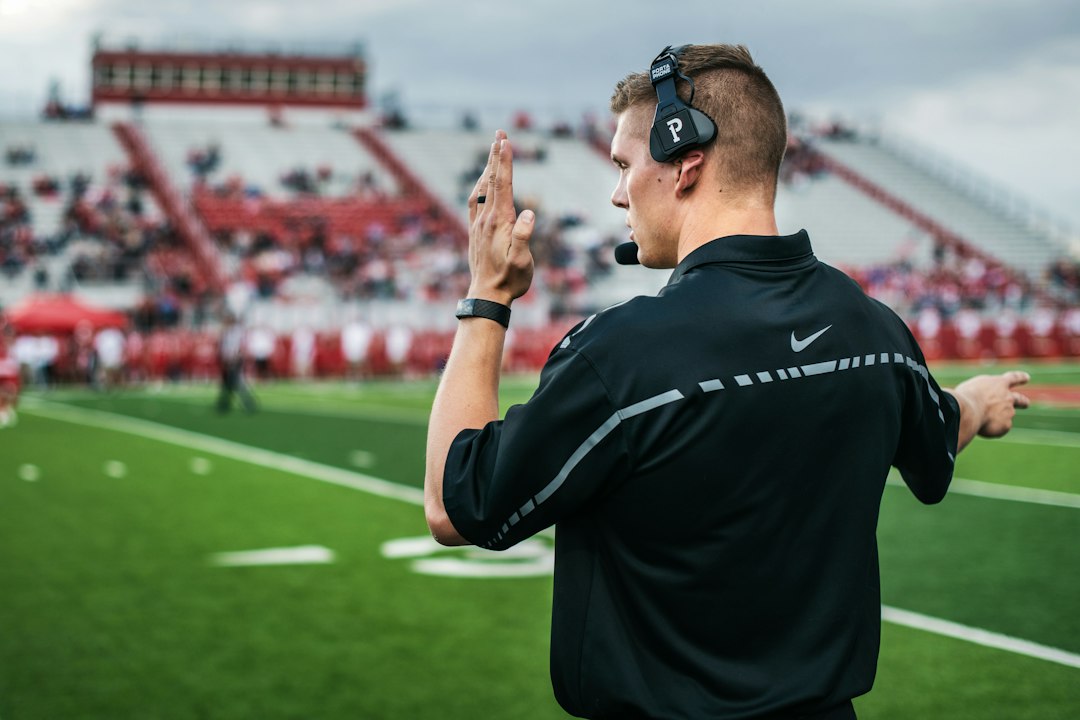




There's a voice you still hear sometimes.
Not during the big moments — not on your wedding day or your first day at a new job. It shows up in the small ones. When you're tempted to cut a corner. When something unfair happens and you're deciding how to respond. When you're running out of steam at the exact wrong time and there's nobody watching.
It says something short. Something specific. And it sounds exactly like your high school coach.
The best advice from high school coaches doesn't always arrive wrapped in inspiration. Sometimes it comes delivered in a parking lot after a loss. Sometimes it's thrown over a shoulder on the way to the water cooler. Sometimes it doesn't even make sense until twelve years later, standing in a conference room, watching a colleague do the thing your coach told you never to do.
This article is a collection of those moments. Real advice, specific stories, and the long, often surprising arc of how coach wisdom for life actually plays out when the uniform comes off for good.
The Advice That Wasn't About Sports at All
Coach Dale Whitmore used to say one thing to his JV soccer players in Bowling Green, Kentucky, before every match. Not about formation. Not about the other team. He'd look down the row of fourteen-year-olds and say: "Don't apologize for taking up space."
It took contributor Marcus T. — who ran varsity left mid and now manages a 40-person engineering team — until his late twenties to understand what Whitmore meant. "I used to shrink in meetings," Marcus told us. "I'd offer a half-idea and immediately qualify it. I'd move out of the way before anyone asked me to. And then one day I heard that voice and I thought — he was not talking about the pitch."
The best coach wisdom lands like that. Sideways. In language that seems to be about one thing and turns out to be about everything.


A women's basketball coach in rural Iowa, according to multiple contributors who played under her in the mid-2000s, had a single rule about making a mistake during practice: you got one second to be upset. One visible second of reaction — head drop, hand to forehead, whatever you needed. Then it was gone. "She'd literally count," said one contributor. "One. Done. Play."
Three contributors, unprompted, told us they use that rule in their adult lives now. One is an ER physician. One runs a small business that survived a supply-chain collapse in 2021. One is a father of four.
One second. Done. Play.
The Stories We Collected — and What They Have in Common
Over the past several weeks, our team reached out to contributors ranging from former athletes to coaches themselves, asking one question: What is the one piece of advice from your high school coach that you still carry?
We weren't looking for the greatest coach quotes from high school in the motivational-poster sense. We specifically asked for the unusual ones. The specific ones. The ones that didn't show up anywhere else.
Here is what we heard.
"Win the Walk to the Car"
Defensive lineman. Northeast Ohio. Late 1990s.
His coach — a man built like a refrigerator who'd played two years of college ball before a knee injury ended his career — had a saying that made no sense on its surface: Win the walk to the car.
The concept: how you carry yourself in the ninety seconds after a game, in the parking lot, before you get in the vehicle, tells everyone who you actually are. Not the game. Not the speech. The walk.
"He was obsessed with not performing your emotions for an audience," said the contributor, now a civil litigation attorney. "He hated it when guys would slump or mope where everyone could see them. He said it was disrespectful — not to the other team, to yourself. You were showing people a performance of losing instead of just losing."
The inverse was equally true. Don't spike the ball. Don't scream at the sky. Win it and walk to the car like it was what you expected.
He uses it now before closing arguments. "Win the walk to the car" means: the performance is for no one. The result speaks.
"You Don't Have to Like It. You Have to Do It."
A distance runner. Northern California. Early 2010s.
Her coach was a former collegiate track athlete who had, in her words, "zero patience for the idea that enjoyment was required for excellence." She ran 5 a.m. hill repeats in December. She hated every one of them. She said so, loudly, one morning when the temperature had dropped below forty and her coach met her at the starting cone with a stopwatch.
His response: "You don't have to like it. You have to do it. Those are different things."
She is now a physical therapist who works primarily with adolescent athletes recovering from ACL injuries. "My patients want the exercises to feel good, or at least to feel purposeful," she told us. "Sometimes they don't. Sometimes they're boring and they hurt in a low-grade way and they don't produce visible results for weeks. I tell them what Coach Orias told me. You don't have to like it."
She paused. "It's the most useful thing anyone has ever said to me."
"The Second Effort Is the Only One That Counts"
Maya R., 34, played club volleyball in suburban Atlanta before making varsity her junior year. Her coach had a rule during conditioning drills: she never watched the first effort. She'd be looking at her clipboard, checking her phone, talking to the assistant coach. It wasn't until the whistle blew for the second rep that she turned around and watched.
"We figured it out eventually," Maya told us. "The first rep, you're just moving your body. The second rep, that's the one you decide to run. That's the one that tells you who you are."
Maya coaches youth volleyball now on weekends. She uses the same drill structure — and she's never explained why she looks away for the first rep.
She says she doesn't need to. "They figure it out."
What the Research Says About Early Mentors — and Why Coaches Are Different
There's a reason these stories follow a pattern. A 2019 study published in the Journal of Applied Sport Psychology found that athletes who reported having a highly influential coach in adolescence demonstrated significantly higher scores in self-regulation, emotional resilience, and goal-setting behavior in adulthood — independent of whether they continued in athletics. The researchers noted that the coach relationship is structurally different from parent or teacher mentorship because it combines physical stakes, public performance, and voluntary participation. You can't fake caring about the outcome the way you sometimes can in a classroom.
Coaches also operate at a specific developmental window. Adolescence is when identity is still malleable — when a well-timed sentence from an authority figure can install itself into the operating system rather than just the memory.
The motivational advice from my old coach that our contributors remembered wasn't inspirational in the conventional sense. It was practical. It was specific. And it was delivered at exactly the moment when the nervous system was most open to receiving it.
The Advice That Stung — and Why That Was the Point
Not all of it was gentle.
One contributor, a former defensive back who now coaches high school football himself, told us about a conversation his coach had with him after he'd played a genuinely bad game and expected sympathy.
"He sat down next to me in the locker room and he said, 'You played scared today.' I said something about how the other team was good. He said, 'That's not what I said. I said you played scared. You can play scared against a good team or a bad team. That's your problem, not theirs.'"
He sat with that for a week. He came back differently the following Friday.
"He didn't say it to be mean," the contributor told us. "He said it because it was true and because he thought I could handle the truth. That's the thing about a great coach — they tell you what you are, not what you're doing."
The Quiet Ones You Almost Missed
Some of the best advice was delivered so quietly it barely registered.
A swimmer from Michigan remembered her coach walking past her during warm-ups one Tuesday, not stopping, not making eye contact, just saying: "You swim like you're asking permission."
She didn't respond. He'd already moved on. But that night she thought about it for three hours.
"I did everything like I was asking permission," she told us. "In the pool, yes. But also in my life. In relationships. At work. I always had this sense that I needed someone to confirm I was allowed to be where I was."
She's forty-one now. "I still catch myself asking permission," she said. "But now at least I catch it."
A wide receiver in Texas remembered his coach pulling him aside after a particularly good practice — not a game, just a practice — and saying only: "Now do that when it costs you something."
He became a high school coach himself. He says that sentence is the only thing he's ever said to a player that he actually means.
Why These Lessons Outlast the Sport
Here is the structure of what makes coach wisdom for life actually stick, based on everything our contributors shared:
- It was specific, not general. Not "work hard." Not "believe in yourself." Win the walk to the car. One second. Done. Play. The more specific the instruction, the longer it lives.
- It was delivered at a moment of real consequence. Not in a team meeting. After a loss. During a cold morning drill. In a parking lot. The nervous system remembers what it learned when something was at stake.
- It required the athlete to interpret it. The best advice was never fully explained. It was handed over like a tool and left for the athlete to figure out how to use it. That process of figuring it out is what lodges it permanently.
- It transferred. Every story we collected had a moment where the contributor said: "and then, years later, I realized he wasn't talking about the game."
That's the common thread. The sport was always the classroom. The lesson was always about everything else.
Your Jersey Is Still Out There Waiting
If any of this hit the way we hoped it would — if you found yourself thinking about a practice, a conversation, a voice you haven't heard in twenty years — there's something worth holding onto.
The years you played were real. The jersey you wore was yours.
Design yours in minutes and see your name and number exactly the way you remember it.
Frequently Asked Questions
What makes advice from a high school coach so memorable compared to other mentors?
Coaches operate at a unique intersection: they supervise voluntary physical performance under real stakes, in real time, with public consequences. That combination — stakes, physicality, and visibility — creates a neurological context where information is encoded differently than in a classroom or office. The advice lands in the body, not just the mind, which is why so many contributors describe hearing their coach's voice in physical moments of adult life.
Is there a type of advice from coaches that tends to have the most lasting impact?
Based on the stories our contributors shared, the advice that stuck longest was always specific rather than general, delivered at a moment of genuine consequence, and not fully explained. When a coach handed a player a sentence and walked away — when the athlete had to work out what it meant — that interpretive act seems to be what made the lesson permanent. Generic encouragement faded quickly. Specific, slightly cryptic observations lasted decades.
How do I pass on this kind of wisdom if I'm now a coach or mentor myself?
The contributors who went on to coach told us the same thing in different words: don't over-explain. Deliver the specific observation at the specific moment. Trust the person across from you to be capable of carrying it. The temptation is to make sure they understood. The better instinct is to say the true thing and let it work on its own timeline. The athletes who heard "win the walk to the car" at fourteen were still working out what it meant at thirty-four. That's not a failure of communication. That's how the best lessons work.
What if I never had a coach like this?
Then you're the first one. Some of the contributors who shared the most powerful stories grew up without consistent mentorship and went looking for coach wisdom deliberately — in books, in older colleagues, in the kind of frank feedback most people spend their lives avoiding. The structure of what makes this advice work doesn't require a gymnasium. It requires someone who tells you something true about yourself, specifically, without softening it. If you're in a position to do that for someone else, that is exactly the place to start.
See also: what high school sports actually teach you that classrooms never could | why high school sports still matter so much to adults | how athletic identity shapes who you become after the sport ends | the grief that comes with the end of your playing days