

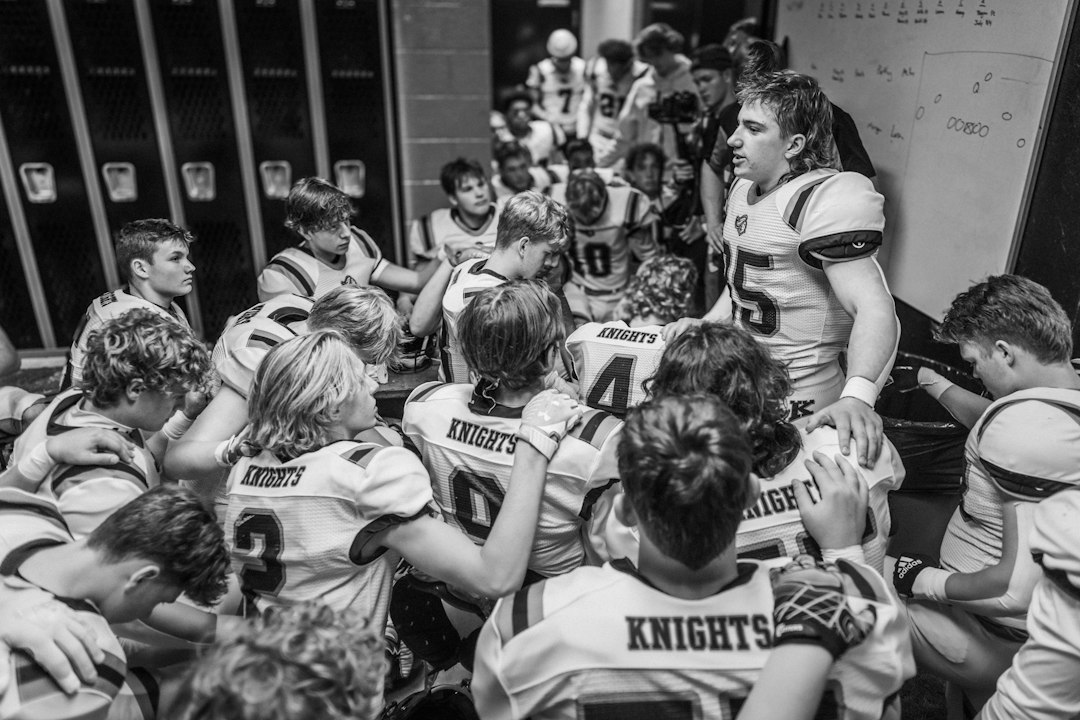




You remember the weight of it.
Not the game, not the score — the specific, draped heaviness of a mesh football jersey pulled over your shoulder pads on a Friday night in October. The way the number sat across your chest in thick tackle twill, raised just enough that you could feel it with your fingertips. The way the sleeve stripes caught the stadium lights in that particular way they don't anymore.
That jersey is gone. Retired to a gym bag, faded in a closet, lost in a move. And if you've started searching for vintage football jerseys to find something close to what you wore, you've already hit the wall: every result is an eBay listing for a cracked NFL throwback or a museum-quality photograph of a 1974 Steelers uniform. Nobody is writing about your jersey — the one from a mid-sized high school in a mid-sized town, with a stripe configuration that existed nowhere else on earth.
This guide changes that.
What follows covers the specific mesh weight, sleeve stripe patterns, block number fonts, and tackle twill construction that defined the last era of American football uniforms before sublimation printing changed the industry permanently. Whether you want to wear yours again, commission something in the style of your original for a reunion, or build a team uniform that actually looks like football looked before it looked like a video game character — start here.
What Made the 1980s Football Uniform Actually Different
Before you can build an accurate tribute to what you wore, you need to understand the construction standard you're working from. The 1980s high school football uniform wasn't a style preference — it was a manufacturing reality, shaped by fabric technology and production traditions that have almost entirely vanished from mass-market production.
The Mesh: Weight and Weave
The defining material of the old school football uniform was double-knit polyester mesh — heavier, stiffer, and more dimensionally structured than any moisture-wicking knit that dominates modern athletic production. When former players describe the feel of an 80s jersey as "substantial," that's the specific word for this fabric.


Standard weights ran between 5.5 and 7 ounces per square yard. Modern performance fabrics sit between 3.5 and 4.5 ounces. That gap is immediate and tactile — pick one up and you feel it in your hands before you've put it on. The older mesh had a visible hexagonal or diamond hole pattern, open enough to allow real airflow without sacrificing the structural rigidity that kept the jersey's shape under a set of shoulder pads. It didn't cling. It hung.
When you're commissioning a custom football jersey built in this style, the single most important material instruction you can give a builder is: heavy double-knit polyester mesh, minimum 5.5 oz per square yard. Some manufacturers still stock this fabric specifically for throwback and tribute orders. If a builder can't confirm that specification, find one who can.
Tackle Twill vs. Sublimation: The Line That Separates Eras
This is the dividing line between everything the 1980s uniform was and everything that came after.
Tackle twill is a woven polyester fabric — cut into letter and number shapes and sewn directly onto the jersey surface. It sits raised and dimensional. Run your hand across an original 80s jersey number and you feel the edge of the twill, the stitching at its border, the physical presence of the character on the fabric.
Sublimation printing — cost-effective for team uniforms by the late 1990s, fully dominant by the mid-2000s — dyes the pattern into the fabric fibers at the molecular level. The result is perfectly flat, photo-quality, unlimited in color options, and completely without dimensional presence. Modern Nike football uniforms, Under Armour football jerseys, and virtually every set of NCAA football jerseys produced today use sublimation for graphics and numbers.
Neither construction is objectively better. But they are categorically different aesthetics. A sublimated version of an 80s design will look immediately, undeniably wrong to anyone who wore the original. If you want the look of that era, you want tackle twill numbers on heavy mesh. That's not negotiable.
Color Blocking and Uniform Structure
The 1980s high school football uniform followed a construction logic that modern design has largely left behind:
- Jersey body in team color A
- Sleeve panels in team color B, often white — with the reverse configuration on the away uniform
- Shoulder yoke sometimes in a contrasting block
- Collar and hem in ribbed elastic, matching team color A
This created a visually structured garment readable from 50 yards — which mattered in an era before high-definition scoreboards and before anyone watched football on a screen larger than a television set. The uniform had to communicate identity at distance.
The Stripe Patterns That Defined the Era
This is where most tribute builds fall apart, and where the gap in existing guides is widest. Generic discussions of vintage football jerseys treat stripes as decoration. They weren't. In the 1980s, stripe placement was a structural grammar that communicated program identity as clearly as the colors did.
Sleeve Stripe Configurations
The dominant sleeve stripe configurations in 1980s high school and college football broke into four patterns:
- Single wide stripe — one stripe, 2–3 inches wide, running around the circumference of the sleeve at mid-bicep. Clean, readable, common in programs with straightforward fabrication budgets.
- Double stripe — two parallel stripes in team color A and white, with a defined gap between them. Associated with programs modeling their look after Big Ten aesthetics.
- Triple stripe — three stripes, the center wider than the flanking pair. Common in programs influenced by SEC and Southwest Conference visual language. Texas Tech football jerseys from this era ran variations of this configuration on both home and away sets.
- Shoulder-to-cuff stripe — a continuous stripe running from the shoulder seam down the full sleeve length. Less common at the high school level due to fabrication complexity, but used by programs wanting a distinctive athletic silhouette.
If you're building a jersey in the style of your original and can't pin down the exact configuration, your best resources are:
- Your state's high school athletics association archive — many digitized yearbooks from the 1980s are now searchable online
- Local newspaper photo archives, where Friday night sports photography often captured uniform detail clearly
- Former teammates — someone has a photograph
Pant Stripes and the Full Uniform Read
The jersey didn't exist in isolation. The 1980s uniform read as a complete system, and the pant stripe was part of that visual logic. The standard was a single or double stripe running vertically down the outer thigh of the football pants, mirroring the sleeve stripe configuration on the jersey above.
Auburn football jerseys from the 1980s — a well-documented example — used a consistent navy-and-orange stripe logic that carried from sleeve to thigh, creating a visual continuity that made the full uniform instantly identifiable at any distance. High school programs across the Southeast consciously mirrored this approach. When you specify your stripe for a custom build, specifying both the jersey sleeve and the pant thigh creates the full period-accurate read.
Block Numbers, Fonts, and the Typography of the Era
The numbers on a 1980s high school football jersey weren't chosen for aesthetic preference. They came from a catalog. Uniform manufacturers of the era offered a small, standardized set of tackle twill number fonts, and most programs used one of three:
Standard Block — the most common font family by a wide margin. Thick, unmodified block numerals with uniform stroke width and minimal serifs. Close your eyes and picture a football number — this is probably what you see.
Modified Block with Shadow — a secondary twill layer in a contrasting color, offset by roughly a quarter inch behind the primary numeral to create a drop-shadow effect. Common in programs with the budget for two-layer tackle twill work. When people describe the look of vintage NFL football jerseys applied to high school aesthetics, the shadow block number is usually what they're picturing.
Outlined Block — the primary numeral in one color, bordered by a thin outline in a contrasting color sewn as a second twill layer. Cleaner than the shadow version. Widely used in Midwest programs.
For any custom build: if you have a single photograph of your original jersey, the number font is usually identifiable from that image alone. Send the photograph to your uniform builder and ask them to match the twill font family. Any manufacturer doing serious custom work will have all three in their system and can match from a visual reference.
The Jersey Numbers Themselves: What They Meant
This comes up consistently in discussions about recreating 1980s high school football jerseys — and it's worth addressing directly, because the question connects to something real about the era and about what your number actually said about you on the field.
Football jersey numbers aren't random, and in the 1980s, they never were. The NFL's positional numbering rules were well established by that decade, and most high school programs followed the same logic — formally by rule, or informally by tradition:
- 1–19: Quarterbacks, kickers, punters
- 20–49: Running backs and defensive backs
- 50–59: Centers and linebackers
- 60–79: Offensive and defensive linemen
- 80–89: Wide receivers and tight ends
- 90–99: Defensive linemen and linebackers
That means your number told anyone watching exactly what you did. A 44 played in the backfield. A 72 played in the trenches. An 88 caught passes. The NFL's official playing rules codified these numbering requirements to help officials identify eligible receivers and enforce formation rules — and high school programs adopted the same framework for the same practical reasons.
When you wore your number, you were wearing your position identity. That's why getting it right matters when you're building something in the style of what you wore. It isn't just a number. It's a statement of what you were on that field.
A Recreation Story: From Memory to Mesh
Marcus T., 54, grew up in central Ohio and played outside linebacker for his high school team in 1986 and 1987. He wore number 55 — dark scarlet body, white sleeves, double stripe in silver and white at mid-sleeve, standard block twill numeral in white outlined in silver.
He commissioned a custom build for his 35-year class reunion and brought the original team photograph to a uniform builder who specialized in throwback orders. The builder matched the double-knit mesh weight, used two-layer outlined tackle twill for the number, and reproduced the double sleeve stripe configuration precisely from the photograph.
The finished jersey weighed noticeably more than any modern athletic shirt Marcus owned. "The first time I put it on," he said, "I could feel exactly where I was standing. It wasn't nostalgia. It was more specific than that."
That specificity — the weight, the twill edge under your fingers, the stripe width — is the whole point.
How to Commission a Modern Custom Build in the 1980s Style
The process is straightforward once you know what to specify. The difference between a generic custom jersey and an accurate period tribute is entirely in the precision of your instructions.
The Four Non-Negotiable Specifications
- Fabric weight and type — heavy double-knit polyester mesh, minimum 5.5 oz per square yard. If a builder cannot confirm this specification before you order, find one who can.
- Number and letter construction — tackle twill, sewn on. Not sublimated, not screen-printed. If the builder offers only sublimation, the finished jersey will not look like the era you're working from.
- Stripe placement and width — be specific to the inch. "Double sleeve stripe, 1.5 inches wide each, 0.5-inch gap between, positioned 4 inches from the shoulder seam" gives a builder something to work from. A photograph gives them even more.
- Color matching — if you have any original garment, any photograph, or any record of your program's official colors, provide it. Pantone matching is the most reliable standard. If you're working from memory alone, find the closest Pantone reference online and specify the number.
What to Bring to the Design Conversation
- Any photograph of the original uniform — even a low-resolution yearbook scan carries enough visual information for an experienced builder
- The school's colors, with any Pantone or hex reference you can locate
- Your number
- Your name, if the original jersey included a nameplate on the back
- The font style from the three options above: standard block, shadow block, or outlined block
Modern custom jersey platforms — including tools in the style of the Nike football uniform builder used by many programs — handle most of these specifications through their configuration interfaces. Our team recommends specifying stripe dimensions in writing, not just selecting from a preset menu, because preset options rarely match the exact width combinations that defined 1980s high school aesthetics.
The most common error in custom orders like this: under-specifying the stripe. People write "stripes on the sleeve" and receive something that is technically correct and visually wrong. Measure, describe precisely, provide the photograph.
A Note on International Vintage Jerseys and Why They're Different
If your search for vintage football jerseys has surfaced results for a vintage England football jersey or a vintage German football jersey, you've hit a terminology overlap worth clarifying. In international search contexts, "football jersey" almost always refers to association football — soccer. The aesthetics, construction standards, and custom build processes for vintage soccer kits are categorically different from American football uniforms.
The vintage England football jersey tradition, for example, is built around cotton-polyester blends, v-neck collars, and embroidered crests — a completely different construction history from American tackle twill on mesh. If that's what you're after, the process described in this guide doesn't apply. This guide is specifically for American football uniform reconstruction in the style of the 1980s era.
Your jersey is still out there waiting.
Design yours in minutes and see your name and number exactly the way you remember it.
Frequently Asked Questions
What do jersey numbers mean in football?
Football jersey numbers indicate a player's position group, and the system has been consistent since the NFL formalized numbering requirements. Numbers 1–19 belong to quarterbacks and kickers. Numbers 20–49 are running backs and defensive backs. Numbers 50–59 are centers and linebackers. Numbers 60–79 are offensive and defensive linemen. Numbers 80–89 are wide receivers and tight ends. Numbers 90–99 are defensive linemen and linebackers. High school programs in the 1980s followed this same positional numbering framework, which means your number from that era carried a specific identity — it told anyone watching exactly what you did on the field.
Can any custom jersey builder recreate the 1980s mesh look, or do I need a specialty manufacturer?
Most general custom jersey platforms default to modern sublimated fabrics, which will not produce the 1980s aesthetic accurately. You need a builder who explicitly offers heavy double-knit polyester mesh and sewn tackle twill numbers — not sublimated graphics. Ask those two questions directly before placing an order. Some specialty uniform manufacturers maintain vintage fabric stock specifically for throwback and tribute orders. If a builder cannot confirm those two construction methods, they are not the right fit for a period-accurate build.
How accurate can a custom build be if I don't have the original jersey?
Remarkably accurate, if you have a photograph. Even a low-resolution yearbook scan or a cropped team photo contains enough visual information for an experienced uniform builder to identify mesh type, number font, and stripe configuration. Color is the hardest element to match from a photograph due to printing variation — if you can contact your former school's athletics department, most programs retain their official Pantone color references in their branding documentation. With a photo and confirmed colors, a custom build in the style of your original can be visually indistinguishable from the genuine article to anyone who wasn't on that specific team.
What is the difference between a throwback jersey and a custom tribute build?
A throwback jersey reproduces a known, documented uniform design — an NFL franchise's historical look or a college program's archived set. A custom tribute build reconstructs a specific original that may exist nowhere in documented form — your high school's 1986 road uniform, for instance, with a stripe configuration unique to your program. Tribute builds require more specification work upfront because there is no reference document to pull from. That's exactly what this guide is designed to support: giving you the specific language and criteria to describe what you remember precisely enough that a skilled builder can bring it back.
See also: personalized sports gifts that actually make a former athlete feel seen | custom softball jerseys built for alumni games | jersey size chart to get the numbers right | what it actually felt like to play under the Friday night lights | displaying old athletic gear in a custom sports shadow box