

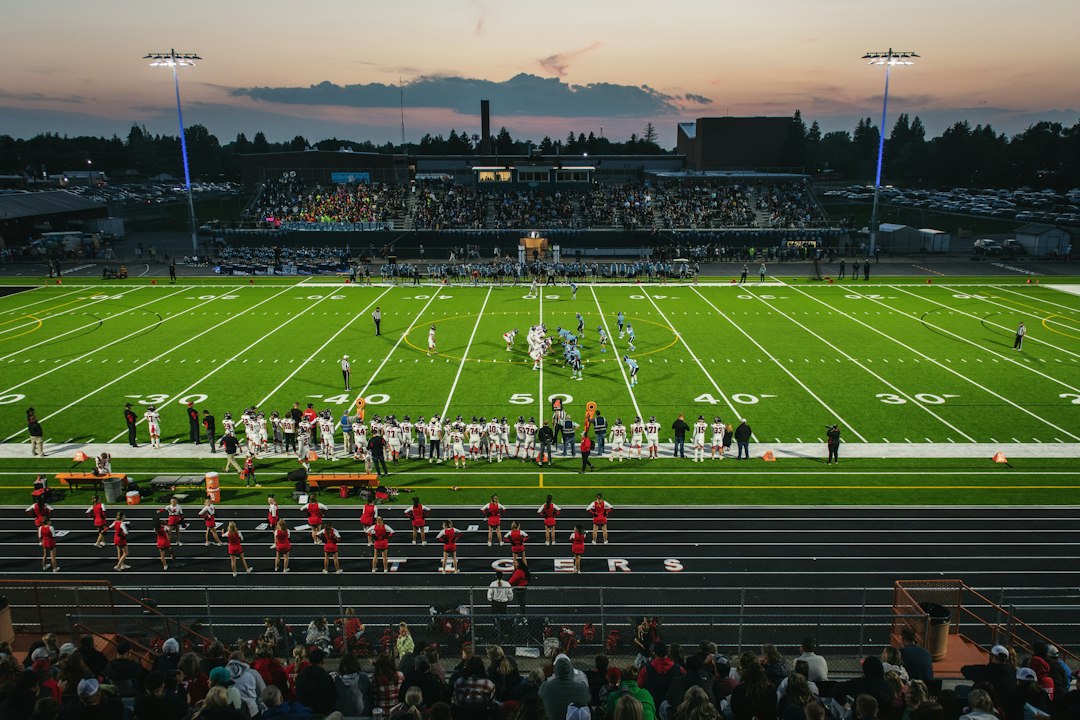




The Texas High School Football Playoffs capture what every former player feels watching the bracket fill in — something that starts in the chest and doesn't have a clean name, the specific weight of recognizing a moment you once lived from the outside looking in.
The 2024 UIL Texas high school football playoffs are deep in the area round now, with November 19–21 matchups across all 12 classifications set after the bi-district weekend of November 12–14. Schools from the Panhandle to the Rio Grande Valley, from the East Texas piney woods to the Hill Country, are down to the round where the bracket stops being abstract. Where the dream either survives another week or ends on a Friday night under the lights.
For the players on those fields right now, it is the most present they will ever feel inside a game jersey.
For the rest of us — the ones who played those games a decade ago, or three decades ago — watching the bracket advance does something to the chest that is genuinely hard to explain to someone who never suited up for a playoff week.
This piece is for us.
When the Bracket Was Proof of Something Real
Here is what nobody tells you before you live it: the playoff bracket is not a schedule. It is an argument your team has been making since August, and the bracket is the moment that argument gets accepted.
Proof that the two-a-days in hundred-degree heat were worth it. Proof that the Friday nights you played through sideways rain, or through a 38-point deficit that somehow became a one-score game in the fourth quarter, added up to something measurable. The bracket is documentary evidence that your team's name belongs in a conversation most programs never get invited into.
In Texas, that conversation is enormous. The UIL's 12 football classifications — from the 6A Division I schools with enrollment in the thousands, competing in stadiums that seat more people than some small cities, all the way down to 1A six-man football played in towns where the entire community genuinely fits in the bleachers — mean the bracket holds nearly every kind of Friday night football there is. Scoreboard screens the size of billboards. Caliche fields with hand-lettered wooden signs. All of it counts. All of it is Texas high school football.


Every former player who ever made the playoffs remembers their specific bracket position the way some people remember their wedding anniversary. The round. The opponent. The town they had to drive to. Whether they were the favorite or the team nobody expected to be there. What the weather felt like.
Pause there for a second, because it matters why that memory stays so sharp: it was the moment the season became finite. Before the bracket, the season was still theoretical — there was always another week, another chance to get sharper, another Friday to prove something. The bracket told you exactly how many Fridays were left. That specificity is what made it sacred.
The Area Round Is Where the Bracket Gets Honest
The area round is where Texas high school football reveals its particular character, and it does not do so gently.
By the time a team reaches this round, they have already beaten somebody. They already know what it feels like to advance — to board the bus home as the team that is still playing. The area round is the first elimination stage where the loser goes home knowing their season is finished. No second-chance game. No consolation bracket. No "we get another shot next week." Lose the area round in Texas, and the season ends. For every senior on the losing sideline, so does their high school career.
That is not a small thing to absorb in a stadium parking lot on a Friday night.
Every former player who made it past this round remembers the specific lightness of surviving — the particular quiet of the bus ride home after winning, when everyone is exhausted and relieved and not ready to talk about it yet. And every former player who lost in the area round carries that memory too, with a sharpness that years do not fully dull.
Marcus T., 34, played defensive end for a mid-sized 4A school in Central Texas. He still talks about the area-round game his junior year — his team won on a last-second field goal and the whole sideline poured onto the field like they had just won state. "That was the loudest I've ever heard anything," he said. "And we hadn't won anything yet. We'd just survived. That's what the area round does to you."
What the current bracket is producing in players across Texas right now — that exact sensation — is something those of us who played are uniquely positioned to understand.
The Sounds That Never Left
There are sounds from Friday night playoff football that do not go away, no matter how long ago you played.
The specific crack of pads on the first play of a postseason game — sharper, somehow, than any regular-season hit. The way crowd noise shifts when the stakes are real, less constant and more volcanic, erupting in bursts rather than humming along. The chain gang moving the first-down marker. The PA announcer's voice bouncing off aluminum bleachers three counties from home. The band playing the fight song when you're outnumbered in the visitor stands and it sounds more brave than celebratory.
The whistle at the end of the game that tells you everything.
Remember when you could feel that whistle before you heard it? When the final two minutes of a close playoff game had actual physical weight — not nerves exactly, but something deeper in the body that already understood what was coming? That sensation does not transfer to watching from the bleachers. It lives only in the people who wore the jersey and stood on the field.
Texas high school football in November belongs to those people.
The area-round matchups spread across all 12 UIL classifications represent hundreds of players living inside that feeling right now, in real time, this week. They do not yet know whether their season ends Friday or continues into the following week. They are in the bracket. They are still alive in it.
For those of us watching, that is the most honest version of sports spectatorship there is — not professional stakes, not scholarship pressure, but the high school moment. The one where players compete for something that cannot be bought, transferred, or repeated. Just the season. Just the team. Just the Friday night.
What Twelve Classifications Mean to Someone Who Played in One
People who didn't grow up around Texas high school football sometimes look at the UIL's 12-division structure and see administrative complexity. Former players see something entirely different.
They see which bracket their school would have lived in. They see the size of the towns they traveled to for road games, and the size of the programs they spent years measuring themselves against. They see whether their path to a state championship ran through enormous 6A programs in the DFW Metroplex and Houston suburbs, or through a classification where the Friday night crowd was small enough that you recognized faces in the opposing stands.
Both paths are real. Both produce the same October and November memories.
The area-round bracket across all 12 classifications means twelve parallel stories are unfolding across Texas this week:
- Twelve sets of coaches drawing plays on whiteboards before sunrise
- Twelve towns where the diner conversation has shifted entirely to Friday's game
- Twelve buses pulling out of school parking lots toward something that matters
- Twelve groups of seniors who don't yet know if this is their last week
In our experience following high school sports across the state, nothing captures the texture of a playoff road-game bus ride quite the way Texas football does. The playlist somebody puts on the speakers. The way conversation gets quieter the closer you get to the other team's town. The first time you spot the lights of their stadium from the highway, and somebody says — out loud or just inside their head — here we go.
Former players watching these brackets are not watching a sport. They are watching a specific chapter of their own story play out again, with new faces, in the same November light.
The Walk-Off Nobody Films
Here is what the highlight packages never capture:
Somewhere in this area round, a group of seniors is about to play their last high school football game and not know it yet.
Some of them will figure it out in the final minutes when the score gets away. Those minutes will feel unlike anything else they have experienced in a uniform — not quite grief, not quite acceptance, but something in between that most eighteen-year-olds do not have words for yet. Some will not know until the final whistle, and then it arrives all at once, standing on a field that is suddenly just a field.
This is not a tragedy. It is the shape of the thing. Every player who ever put on a high school jersey eventually played their last game in it. For most players, that last game was a playoff game — the area round, the regional, the quarterfinals, somewhere along the bracket. Very few careers end at state.
What that means is that the bracket, for most players, is ultimately a record of when their chapter ended. Not bitterly. Truthfully. The bracket marks the moment.
Former players hold onto their jerseys because of exactly this. Not as a souvenir of a championship. As physical evidence that the season happened. That the Friday nights were real. That the bracket had their name in it. It is the most honest artifact from one of the most honest experiences a person carries.
A jersey worn on a Friday night in November is a tribute to something that cannot be undone or taken back. The games are permanent. The bracket is permanent. The only thing that fades is the physical reminder — and that part is fixable.
Your Jersey Is Still Out There Waiting
Design yours in minutes and see your name and number exactly the way you remember them — the colors, the font, the number you wore when you were still on the field.
Frequently Asked Questions
How does the Texas UIL playoff bracket work across all twelve classifications?
The UIL organizes Texas high school football into 12 classifications based on school enrollment, from 6A Division I — the largest schools, anchored in major metro areas — down to 1A Division II, which includes six-man football played in some of the state's smallest communities. Each classification runs its own independent bracket, beginning with bi-district play and advancing through area, regional, quarterfinal, semifinal, and state championship rounds. Teams compete exclusively within their classification. The area round currently underway for November 19–21 is the second round of the postseason, matching bi-district winners to determine who advances to the regional stage.
When and where is the Texas high school football state championship played?
UIL state championship games for all 12 football classifications are held in December at AT&T Stadium in Arlington, Texas. The bracket from the area round progresses through regional, quarterfinal, and semifinal rounds before the final two teams in each classification meet for the title. For current bracket results, scores, and updated matchup information across all 12 divisions, the UIL's official athletics page is the authoritative source.
Why does watching the high school playoff bracket feel so different for people who used to play?
The high school playoff experience is emotionally distinct because it is finite and uncompensated — players compete for the season, the team, and the community, with no professional future guaranteed and no second chances within the same career. For most players, the playoffs represent the highest-stakes version of a game they loved, and the specific sensory memories from that period tend to be encoded with unusual clarity because of the emotional weight surrounding them. That is why former players can describe their playoff bracket position decades later with a precision they cannot apply to a regular-season game from the same year.
What is a meaningful way to hold onto a high school football career after the playing days are over?
The most common thing former players point to is reconnecting with something tangible from that time — finding old game film, reaching out to former teammates, or having a jersey made in the style of the one they actually wore. A custom jersey bearing the original name, number, and team colors gives former players something physical that honors a chapter of life that passed faster than expected. It is not about championships or statistics. It is about the Friday nights, the locker room, the bracket — and the proof, held in your hands, that all of it was real.
See also: why high school sports still matter to adults long after the final whistle | the grief that comes when your playing days end at 18 | why your senior season memories are burned into your brain so clearly | Texas is one of the most football-obsessed states in the country for a reason