

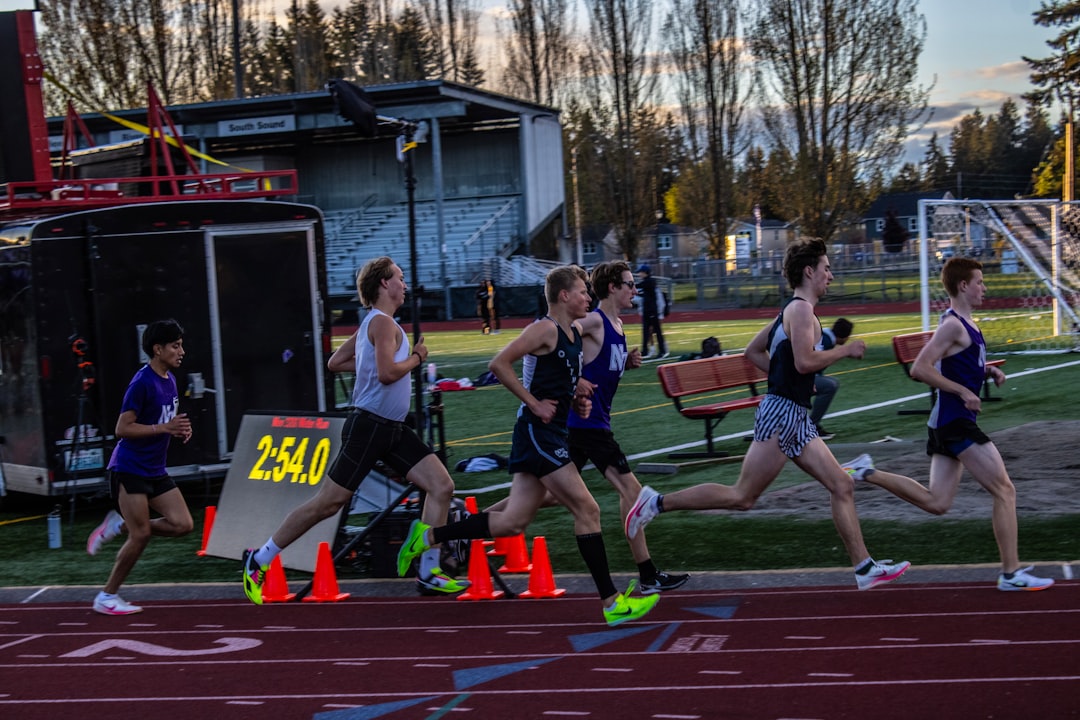




There's a specific smell that comes back before the memory does: cut grass, wet turf, and the particular combination of sunscreen and exhaustion that only exists in August two-a-days. You didn't know it at the time. Nobody handed you a plaque. Nobody told you what was actually happening inside your chest, your legs, your competitive refusal to quit. But the perseverance learned from sports during those years is still running your life right now. It shows up every time a deadline tightens, every time a project collapses in the third quarter, every time you choose to finish what someone else would have abandoned.
You earned something on those practice fields. This article names exactly what it was.
The Practice Nobody Talks About
Here's what the highlight reels miss: the game was never where it happened.
It happened on a Tuesday in October when nobody was watching. When the stands were empty and the sky was the color of old concrete and your coach blew the whistle for one more set of sprints after you'd already run twelve. It happened when the ground was so wet your cleats packed with mud and the drill felt pointless because the season was already half over and your lungs were two sizes too small for what was being asked of them.
That Tuesday. That's where the endurance from athletics actually lives.
Most conversations about sports and success stay comfortable: they talk about teamwork, discipline, sacrifice, all of it technically true and completely insufficient. What they don't say is that the specific physical experience of refusing to stop when your body is loudly and specifically asking you to stop. That experience rewires something. It writes a new line into the code.
Sports psychologists at the American Psychological Association have documented the connection between structured athletic participation and long-term grit development in adolescents. But the data only confirms what any former athlete already knows in their legs. You learned something about yourself under duress that you could not have learned in a classroom. You learned that the feeling of wanting to stop is not the same thing as needing to stop. That gap, the precise distance between the feeling and the fact, is where your adult work ethic lives.


The slogans your coaches painted on locker room walls (the ones that seemed corny at seventeen) were trying to put words to that gap. "Pain is temporary. Pride is forever." Clunky, sure. But they were pointing at something real.
What Two-A-Days Actually Teach You
August practice was its own specific kind of institution.
You reported at 6am before the world had fully decided to be awake. The second session started after the heat peaked and your body had already spent a full practice's worth of energy trying to stay upright. By 4pm you were operating on something closer to stubbornness, or momentum, or the simple social contract of not being the one who sat down first. It wasn't quite energy anymore.
Here's what was actually being taught during those sessions, in specific terms:
Your discomfort threshold is adjustable. Every athlete who has been through a serious preseason understands this viscerally. The first week, everything is catastrophic. By week three, things that would have felt catastrophic in week one feel manageable. Your nervous system recalibrates to a new baseline. The adult application: you can handle more than you think, and you know this because you've already proven it to yourself under documented conditions.
The group contract matters. You didn't run the extra sprint for the coach. You ran it because the teammate next to you was still running and the alternative was being the person who didn't. Resilience from high school sports is almost never individual in origin. It grows from the specific social pressure of not letting people down who are suffering alongside you. That's a sophisticated adult professional skill: staying in hard situations because the team depends on your presence.
Suffering with a deadline is different from suffering without one. Practice ends. Season ends. The suffering is bounded. You learned to tolerate significant discomfort because you understood, in your body, that it would conclude. The adult version: every hard project, every brutal quarter, every difficult season at work has an end. You know how to wait it out in motion.
The slogan on the wall isn't ridiculous. It's a compression algorithm. "One more rep" is a cognitive tool, a way of making an overwhelming whole into a manageable piece. High-functioning adults use this constantly. "Just finish the slide." "Just get through this call." "One more thing before I quit for the day." You learned that technique from a coach who probably didn't realize they were teaching cognitive behavioral strategy. They were just trying to get you to do one more sprint.
The Rainy Days Were the Whole Point
There's a specific kind of practice that lives permanently in the memory of every serious high school athlete: the one that happened in genuinely terrible conditions.
Rain. Cold. One of those days where the administration probably should have called it off and didn't. Where the field got increasingly apocalyptic as practice progressed and everybody's practice gear was indistinguishable from everyone else's because it was all the same shade of mud.
Those practices produced something that good-weather practices couldn't. They created a shared reference point, a specific moment the team could point to later and say: we did that together, and it was genuinely bad, and we didn't quit. The memory functions as proof. Not abstract proof. Specific, sensory, documented proof that you can operate in conditions that are far from optimal and still produce.
This is why grit from being an athlete doesn't fade when the cleats go into storage. It's not a mindset you adopted. It's a memory you carry. When things get hard in adult life (and they do, specifically and repeatedly), you have an internal file that says: I have been this uncomfortable before. I finished anyway. Here is the specific evidence.
Marcus T., 34, and the Jersey He Still Thinks About
Marcus T., 34, played middle distance track in Ohio (the 800, mostly), which is the specific distance that exists to punish people who are neither sprinters nor distance runners. He describes his junior year coach as the kind of person who treated miserable weather as a training opportunity rather than a reason to move practice inside.
"We did a full workout in a thunderstorm once. Not lightning, just this sideways cold rain in April. Coach stood there in a rain jacket looking completely unbothered and we ran every interval." Marcus said he didn't realize until his late twenties, when he was managing a team through a product launch that was deteriorating in real time, that he'd been in that room before. "I kept thinking: we've done this in worse conditions. We're going to finish."
He recently ordered a custom track jersey with his number (the same one he wore for conference his senior year) because, he said, he wanted his kids to understand that the person standing in front of them had earned something they couldn't see. The jersey was the most efficient way he knew to make that visible. Design your own: custom track jerseys.
How the Locker Room Slogans Were Right (Even When They Were Corny)
Revisiting the slogans is a strange exercise for most former athletes. They felt like wallpaper at the time, words you walked past too many times to read anymore. But they were encoding something.
"Hard work beats talent when talent doesn't work hard." A crude formulation, maybe. But the premise is specific and verifiable: sustained effort is a competitive advantage over raw ability, over time. You watched this happen in real time. The kid with the most natural talent in your sophomore class who coasted through workouts. The kid who didn't have the natural tools but showed up every single day and outran everyone by senior year. The slogan was just describing a real phenomenon you were living through.
"Earn the right to win." You had to deserve the outcome through the specific process of preparation. There's an adult professional version of this that's worth naming directly: the people who do the work before the meeting, the ones who have already thought through the failure modes, the ones who stay when the project goes sideways — they have earned the right to lead the recovery. You understand this framework in your bones because you learned it in a gym.
"Leave everything on the field." Which sounds like an exhortation to exhaust yourself, but is actually an instruction about the relationship between effort and regret. You cannot control outcomes. You can control the quality of your effort. The outcome of that game — the one you lost in the final seconds, or won on a day you barely had it — doesn't change the value of what you put in. You carry both.
The Specific Skill That Transferred
The most durable transfer from high school sports is something more specific than discipline in the abstract: the ability to perform under conditions that haven't improved.
Discipline is a routine. It works when conditions cooperate. What athletes develop is something harder to name — a tolerance for operating under degraded conditions without degrading performance proportionally. You learned to run the play in the rain. You learned to compete when you were tired. You learned to show up on a Tuesday when nothing about Tuesday was motivating.
That specific capability — performing without the ideal conditions that motivation-based discipline requires — is what separates athletes from people who merely have good habits. Good habits require maintenance. The endurance from athletics you carry is structural. It doesn't need ideal conditions because it was forged in their absence.
The application in adult professional life is consistent and observable:
- You don't wait to feel ready. You begin because beginning is the work.
- You don't require enthusiasm to maintain quality. You maintained quality on days when you actively disliked what you were doing.
- You operate on the principle that the discomfort is temporary and the standard is not.
- You know specifically, from evidence, that you can finish hard things. This is not self-help conviction. It is personal data.
That teammate mindset grows up into a leadership mindset at work — a direct line one former volleyball player turned CFO has followed from the court to the boardroom.
Your jersey is still out there waiting.
Design yours in minutes and see your name and number exactly the way you remember it.
Not sure where to start? Look through the gallery of jerseys other former athletes have made.
Frequently Asked Questions
Does the perseverance learned from sports actually transfer to adult life, or is that just nostalgia talking?
It transfers specifically, not universally. What transfers is the concrete, embodied memory that you have operated under significant physical and psychological pressure and continued functioning. This functions as evidence your brain can access when adult pressure appears — not inspiration, but proof. The transfer is strongest in situations involving sustained effort under suboptimal conditions, which covers most high-stakes professional environments.
What if I wasn't a star athlete? Does the resilience still apply?
The resilience from high school sports has almost nothing to do with athletic outcome and everything to do with athletic process. The athlete who played junior varsity and showed up to every practice in the rain built identical grit structures to the starter who received the scholarship. The character asset being forged is in the showing up and continuing, not in the scoreboard result. Some of the most durable professional performers came from the bench — and the player who got cut on tryout day built the same grit by showing up anyway.
How do I explain to someone who didn't play sports what this kind of grit actually feels like?
The most accurate description: it's the knowledge, verified by personal experience, that you can be deeply uncomfortable and still choose your next action. Most people manage discomfort by adjusting the environment until the discomfort reduces. Athletes learn to adjust their response to discomfort while the environment stays the same. That's not a personality trait — it's a practiced skill with a specific developmental history. You know where yours came from.
Why do former athletes so often go back to their jerseys, their numbers, their team gear?
Because the jersey is the most efficient artifact that exists for locating a specific version of yourself. The number is a precise address — it points to a particular season, a particular team, a particular version of who you were becoming under pressure. When former athletes wear that number again, they're not pretending the years haven't passed. They're confirming that what was built during those years is still structural. The jersey is proof of character made visible. It's also the anchor for an identity that follows you into adulthood — the athletic identity that never really left.
See also: what high school sports actually teach you that classrooms never could | why high school sports still matter so much to adults | the athletic identity you carried long after your last practice | the bus ride home after a tough loss