

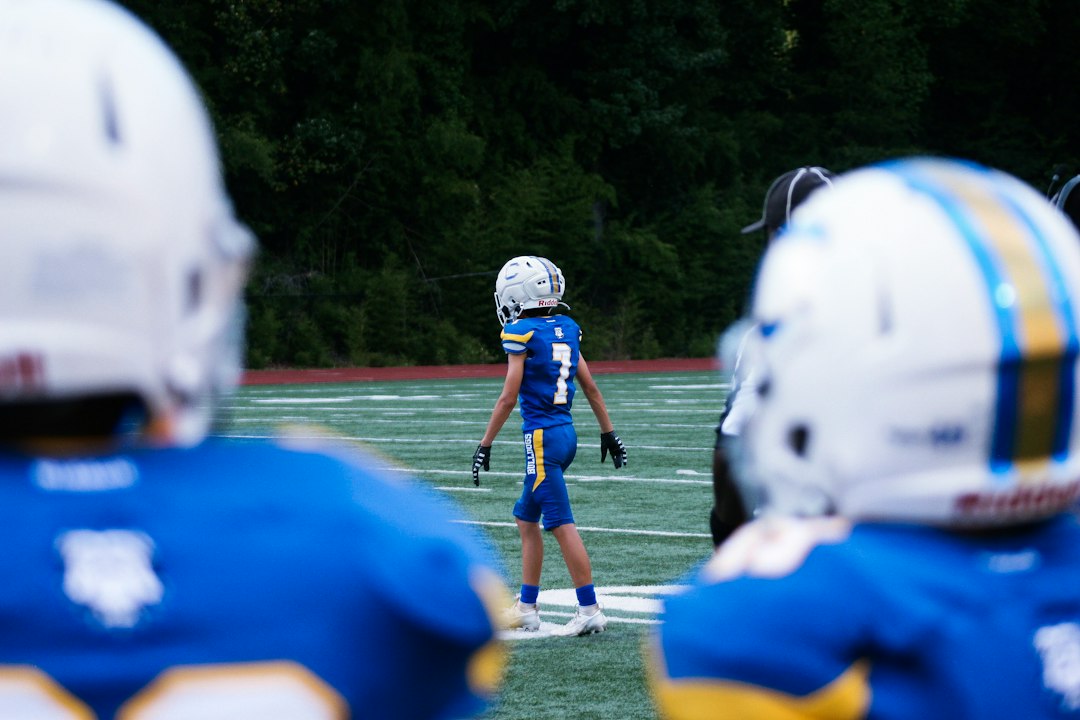




There's a specific moment that arrives every January without asking permission.
The playoff coverage comes on. The camera sweeps a frozen field — breath hanging in the air above the players, the crowd already humming at a frequency that means something is at stake here. And before you've made a conscious decision about how you feel, something shifts in your chest.
Not excitement, exactly. Not just fandom.
This is NFL playoffs nostalgia — the particular, almost physical pull that belongs specifically to people who have worn the pads. You know what that cold air smells like inside a helmet. You know the specific gravity of a game that actually matters. You know what it feels like when your whole body understands the moment before your brain has finished processing it. That knowledge doesn't leave you when you stop playing. It goes somewhere deeper, and playoff season is what calls it back up.
Watching from a couch hits differently when you've lived even one version of this — high school, college, semi-pro, a serious rec league team that played for something real. The game reaches through the screen and finds the part of you that remembers.
This piece is for the people the cameras never find. The ones who went quiet for a second during a timeout and realized the silence was telling them something.
When the Playoffs Become a Mirror
Former players describe playoff season in a register that lifelong fans don't use. It's not about being superior — it's about a genuinely different experience of the same broadcast.
When you played, the playoffs weren't a television event. They were a sensory reality. The cold lived in your lungs. The noise was something your sternum registered before your ears processed it. The stakes weren't abstract — they were written into your body in the specific way your hands went slightly numb before the first snap, the way a night-game field looks different under the lights than any screen ever renders it.


Your nervous system stored all of that. And when playoff football returns every year, that nervous system receives a signal it recognizes.
Research on involuntary autobiographical memory — what psychologists call memories retrieved without conscious intention — shows that sensory cues like crowd noise, cold environments, and physical arousal trigger episodic memories with unusual vividness and emotional charge. The roar coming through your television speakers isn't just audio. It's a retrieval cue. Your brain is running exactly the process it was built to run.
The thing that separates former athletes from fans in this moment isn't skill level or how far they went in the game. It's embodied memory — memory that lives in the muscles and the nervous system, not just the mind. A fan knows what playoff football looks like. A former player knows what it feels like from inside a helmet. Every January, that felt knowledge wakes up and wants somewhere to go.
NFL Playoffs Nostalgia: What You're Actually Feeling
The word most former players reach for is nostalgia, and it's accurate — but it's not the whole picture.
The original roots of that word translate roughly to "the ache of returning home." Homesickness. That's closer to the actual experience than the softer, more decorative use of the word we've settled into. What playoff season produces in former players isn't gentle sentimentality. It's a specific, compound feeling with identifiable layers:
Pride — You were part of something that required everything you had. Watching high-stakes football reminds you that what you did was real, demanding, and worth something. That pride has no expiration date.
Longing — Not necessarily for the game itself, but for the particular state of being the game required: the total focus, the physical demand, the belonging to a group of people who were all fighting toward the same thing at the same time.
Gratitude — This one tends to ambush people. Watching a playoff game as a former player will sometimes produce an unexpected wave of thankfulness for the years you had it — even if it ended too soon, even if it didn't end the way you wanted.
Identity — The deepest layer. For players who competed seriously through high school or college, football wasn't simply something they did. It was a central piece of how they understood themselves. Playoff season briefly and vividly reactivates that identity. You feel, for a few hours, like the person who wore the number.
Marcus W., 34, played defensive end through two seasons of college ball before an ACL tear closed that chapter earlier than he'd planned. His description of playoff season has stayed consistent for years: "I don't watch as a fan. I watch as someone who's been in those exact conversations in a locker room before a game that matters. I know what that quarterback is thinking right now. I know what the defensive line is saying to each other. I can't switch that off." He's right that he can't switch it off. It's not a switch. It's a part of his architecture.
The Locker Room the Camera Never Shows
Ask former players what they miss most. Almost none of them lead with the wins. Very few mention stats or highlights.
They say the locker room.
The specific, unreproducible atmosphere of it — that combination of athletic tape and cut grass and sweat and the industrial cleaner that never quite neutralized the other three things. The sound before a big game: someone's music too loud in the corner, the guys who go completely silent and the guys who get louder and louder, the specific compressed energy of a group of people about to do something hard together.
Playoff broadcasts put the best players in the world back inside that space, and even through a television screen, something in a former player recognizes it. Not because they're watching the NFL. Because they're remembering their version of it. Their locker room. Their visiting-team field on a cold Friday night. The specific face of the teammate who always found the right thing to say before the defense ran out.
That's the layer of NFL playoffs nostalgia that's hardest to explain to someone who didn't play. It's not about professional football. It's about your football, surfacing through someone else's broadcast.
In our experience, this response is essentially universal across sports and levels. A woman who played serious college softball has the same embodied memory response watching a high-stakes game that a former linebacker does watching the playoffs. The sport differs. The underlying mechanism is identical. The game becomes a window, and what you're looking through is your own history.
The Number You Still Know by Heart
Here's something that holds across nearly every former player: they still know their number.
Not approximately. Specifically. The exact digits. The font they were printed in. The way they sat on the chest of the jersey. The first time the equipment manager handed it over and you understood — before anyone said anything — that this number was yours now. That it meant something about where you belonged.
Jersey numbers carry weight in athlete memory that goes beyond simple identification. The number was on your back every time you competed. It's what your teammates sometimes called you in shorthand. It appeared in the box score, if there was one. It's what your parents pointed to from the stands when they found you in a crowd of players. It was the visible, external marker of your membership in something that mattered to you.
Watching playoff coverage, you'll sometimes catch a close-up of a jersey number on the screen and notice a small, quick flicker of recognition before you've consciously processed why. That's your brain cross-referencing what it sees with what it remembers. Your number. Your membership. Your chapter of the game.
That number hasn't gone anywhere. Playoff season just knows where to find it.
How Former Players Actually Watch the Playoffs
The viewing experience of a former player is distinct enough that it deserves its own honest description. If you've played, you'll recognize all of this from the inside:
You track the line, not the ball. Casual fans follow the receiver downfield. Former players — particularly linemen and linebackers — are locked onto what happens in the first three seconds after the snap, in the trenches, before anyone else's attention has arrived there.
You narrate decisions out loud. To the room, to whoever will listen, sometimes to no one in particular. "He knew the safety was coming from the left side — he held that ball two seconds too long." This isn't performance. It's translation. You're converting what you're seeing into the language your body still speaks fluently.
You feel the contact. Not in a spectator's cringe. In a former player's proprioceptive flash — a somatic echo where your body supplies the memory of impact before your conscious mind has finished watching the play. Former players describe this consistently: a big hit on a playoff broadcast and something happening in their own shoulders or chest that isn't pain but is unmistakably physical. The body remembers contact. It briefly supplies that memory when it witnesses impact.
You hear what the broadcast doesn't carry. The huddle. The specific compressed tone of a defensive call in a loud stadium. What a timeout sounds like from the inside of the team, not the outside of the television. You know that sound. You've been inside it. And every playoff broadcast, some part of your attention is reaching for it through the speakers.
What to Do With the Feeling
NFL playoffs nostalgia doesn't require a fix. It isn't a problem to be solved. It's evidence that something happened to you that was real, demanding, and worth something — and that it shaped the person you became. That's not an ache that needs treating. It's an ache that deserves acknowledging.
But it does want somewhere to land. Feelings with that kind of weight don't dissolve on their own. They want direction.
Here are four things former players do with it that actually honor what it is:
- Get specific, not general. Not "I really miss playing" — that's true but it's not the memory. The memory is: "I remember the semifinal game my junior year. Third and goal from the two. I remember exactly what I was thinking in that huddle." The specifics are where the real thing lives. Go there.
- Find the teammate. Playoff season has a remarkable track record of making people pick up phones they haven't touched in years. There's a structural reason for that. The shared memory wants to be shared again. Send the text. Start with "are you watching this?" The conversation rarely stays only about football.
- Tell it to someone who didn't play. Not to explain yourself. To discover what happens when you try to put the experience into words for someone who doesn't have the reference points. Former players often find that this translation process clarifies things about what the game meant to them that they hadn't fully articulated before.
- Put the number back on. The feeling is real. The memory is worth honoring. There's something genuinely grounding about having a jersey in your hands again — not a tribute to someone else's playing days, but yours. Your name. Your number. The colors of the team you actually ran out onto a field with. That jersey that lives in a memory doesn't have to stay only there.
Your jersey is still out there waiting.
Design yours in minutes and see your name and number exactly the way you remember it.
Frequently Asked Questions
Why does watching the NFL playoffs feel so emotional for former players specifically?
Former athletes encode their playing experience as embodied memory — physical sensations, ambient sounds, and environmental conditions are stored alongside the events themselves, not separately from them. When playoff broadcasts deliver sensory cues that match those stored conditions (crowd noise at a certain intensity, cold-weather stadiums, the specific visual rhythm of high-stakes football), the nervous system retrieves those memories involuntarily and with unusual emotional charge. The response isn't vague sentimentality. It's a specific neurological process: sensory input triggering episodic memory retrieval. The more immersive and emotionally significant the original playing experience was, the stronger and more specific the retrieval tends to be.
Does it matter what level you played at — high school, college, semi-pro — for this kind of nostalgia to be real?
Not at all. The embodied memory response isn't calibrated to the size of the stadium or the level of competition. It's calibrated to depth of investment and the quality of the shared experience. Someone who played high school football seriously — who cared about the team, ran real practices, competed in games that felt like they mattered — will experience the same quality of nostalgic response watching the playoffs that a former college player will. The feeling belongs to anyone who was genuinely inside the experience, regardless of where that experience took place.
Is it normal to feel something almost physical when watching big hits during playoff games?
Yes, and former athletes report this consistently across sports and positions. When physical contact — absorbing it and delivering it — was a regular part of your competitive experience, your body stores procedural and motor memories of that contact. Watching similar impact on a broadcast can activate those stored physical memories and produce a mild somatic echo: not pain, but something recognizably physical. It's closer to recognition than sensation. Your body's memory of impact briefly surfaces when it witnesses impact. This is a well-documented feature of how motor memories are stored and retrieved, not an anomaly.
How do you explain NFL playoffs nostalgia to someone who has never played a sport seriously?
The most useful framing is the difference between watching something and knowing it from the inside. A fan watches the game. A former player watches the game while simultaneously hearing the sounds that aren't on the broadcast — the huddle cadence, the tone of a defensive call, what a team timeout sounds like from inside the sideline. Former players aren't simply watching the NFL. They're watching their own history reflected through it. A useful analogy for non-players: imagine watching a detailed film about a profession you spent years working in versus one you've only seen from the outside. The insider experience adds an entire layer of meaning, recognition, and emotion that changes what you're actually seeing.
See also: the psychology of why athletic nostalgia hits so hard | why your senior season memories are so much sharper than everything else | the difference between watching the game and having actually played it | what it meant to play under the lights on a big game night | the grief that comes when high-stakes games are suddenly behind you forever