

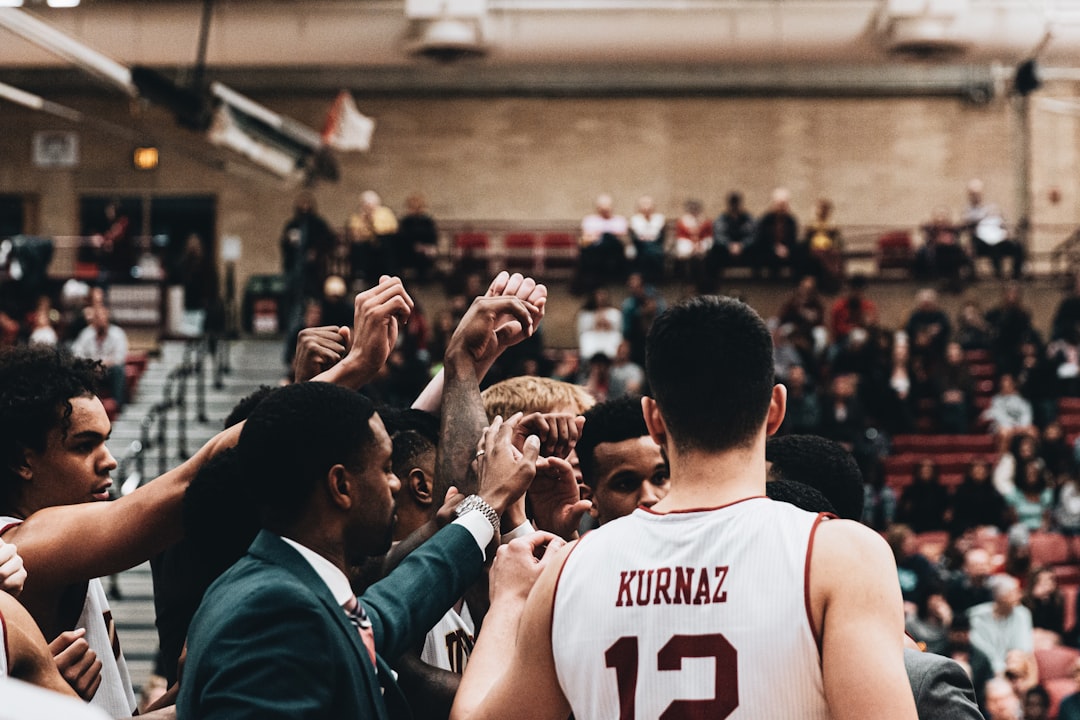




The scoreboard was hand-operated. Someone's younger sibling worked the numbers behind the glass. The bleachers creaked when the student section shifted its weight. The gym smelled like rubber and old wood and whatever industrial cleaner the custodial staff had used since before any of you were born. Your name was on a hand-painted banner above the locker room door.
That was high school sports in the 1990s — and if you were there, you already know exactly what that smelled like.
This is not an argument that things were better then. It's something more precise than that. The 1990s high school athlete occupied a genuinely singular cultural position — past the era of complete analog obscurity, not yet inside the era of total digital visibility — and the specific texture of that experience has never been fully documented. The 90s sports culture at the high school level was its own distinct thing: shaped by the absence of the internet, by the last gasp of multi-sport normalcy, by a recruiting process conducted entirely through paper and personal relationships.
This is that documentation.
The Multi-Sport Athlete Was the Default, Not the Exception
Before club seasons consumed the off-calendar months, before specialization became the received wisdom of travel coaches and private trainers, the working assumption in 1990s high school athletics was straightforward: you played multiple sports, and the seasons organized your year.
Fall was football or cross country or field hockey or volleyball. Winter was basketball or wrestling or swimming. Spring was baseball or softball or track or lacrosse. You moved from one to the next without a formal transition protocol, and the physical demands of each discipline functioned as cross-training for the others — even if nobody had started using that term yet in a high school context.
The participation numbers from that decade confirm the pattern at scale. The National Federation of State High School Associations recorded 6.5 million high school athletes in the 1998-99 school year — an all-time high that surpassed every previous record, including the Baby Boom peak, and a figure that would not be approached again for over a decade. Football led boys' participation by a wide margin, followed by basketball, track and field, baseball, and wrestling. For girls, basketball held the top spot, with track and field, volleyball, softball, and soccer rounding out the top five. The growth trends within those rankings tell their own story. Soccer participation grew 65 percent between 1990 and 1998, making it the fastest-growing major high school sport of the decade. Female participation overall increased 40 percent over the same period, with girls reaching 40.1 percent of all high school athletes by the 1998-99 school year — a figure that reflected both Title IX's maturing impact and a cultural shift in how communities viewed and supported girls' athletics. The multi-sport athlete is disappearing, and what that loss means becomes clearer when you understand what it produced. The 1990s multi-sport athlete was not a nostalgic archetype. The data confirms it was simply the dominant model during the decade — and it was a model that produced the largest, most diverse athletic population American high schools had ever fielded.


The scale of what has changed since is significant. A 2019 study in the Journal of Athletic Training found that early single-sport specialization correlates with elevated injury risk and burnout — yet by the time that research was published, specialization had already become the dominant model in youth athletics. In the 1990s, that model barely registered at the high school level. You played what was in season. That was the whole system, and most athletes developed well inside it.
The practical consequence: your athletic identity was not fixed to a single sport before you were old enough to drive. The football lineman who placed at the state track meet. The point guard who pitched on the baseball team. The wrestler who threw shot put. These weren't exceptional profiles — they were typical ones. The conversation about specialization that now begins in middle school, sometimes earlier, simply hadn't arrived yet. The athletic development that came from moving between disciplines was an accidental byproduct of a system that hadn't yet been optimized into narrowness.
Our team has spoken with enough former 90s athletes to recognize the pattern: the multi-sport background is consistently what they're most grateful for. Not any single achievement, but the breadth — the fact that they were genuinely capable across multiple disciplines before anyone asked them to choose one permanently.
Recruiting Was a Physical, Paper-Based, Relationship-Driven Process
Here is something that athletes who came up after 2005 find genuinely difficult to reconstruct: in the 1990s, if a college program was interested in you, they wrote you a letter.
An actual letter. Mailed to your house. Your name on the envelope — handwritten or on a typed label — the school's return address in the upper left corner. You pulled it from the mailbox. You held the paper. You read it at the kitchen table.
The entire infrastructure that now operates through recruiting apps, digital film submissions, direct messages, and real-time scholarship offer announcements on social media did not exist. What existed was postal mail, phone calls that your parents might answer first, and campus visits where you brought a VHS tape of your highlight reel because the coaching staff had no other way to evaluate you if they hadn't watched you compete in person.
That VHS tape deserves a moment. Your highlight reel was whatever a parent or an assistant coach had managed to capture from the bleachers on a camcorder that required a full-sized cassette. The image shook. The zoom was imprecise. Night games under stadium lights came out grainy. You rewound it on the living room TV, watched it through your fingers, and decided it was good enough. Then you made physical copies — at real-time recording speed — and mailed them to schools with a cover letter.
A few recruiting websites appeared in the late 1990s, and some coaches were beginning to communicate via email by the end of the decade. But for the majority of those years, and for virtually every athlete below the Division I scholarship conversation, the 1990s high school athlete experience of recruiting was entirely human-mediated. You got noticed because a coach saw you play, or because your coach picked up the phone and called someone they knew.
Kira M., 46, ran the 400 meters at a mid-sized high school in Ohio and received her first college inquiry as a handwritten note from an assistant track coach she'd never met. "He said he'd seen me run at the state qualifier and wanted to know if I was considering Division II programs," she recalls. "There was no email, no form to fill out, no recruiting profile. Just a letter. I read it probably a dozen times." The physical reality of that moment — paper in hand, the specific weight of it — is something no push notification has replicated since.
Sports Science Was Just Reaching the Locker Room
The 1990s were the decade when sports drinks arrived in earnest at the high school level. Gatorade had existed since 1965, but its penetration into high school athletic programs accelerated through the 90s — driven partly by the Jordan-era marketing apparatus and partly by a growing, if still rudimentary, awareness among coaches that hydration and fueling affected performance in measurable ways.
"Drink water" became "drink Gatorade" became, by the late 1990s, the first tentative locker room conversations about protein timing and carbohydrate loading. Those conversations were usually initiated by the coach who had read something in a magazine, or by the one kid on the team whose older brother was in college and had mailed home a photocopied page from a training manual.
Strength programming was in a similar transitional state. Many high school weight rooms were still operating on equipment installed in the 1970s — free weights, a few benches, a universal machine bolted to one wall — with programming that amounted to bench on Monday, squat on Wednesday, power clean on Friday. The concepts of periodization, movement-pattern specificity, and sport-targeted strength development existed in university athletic departments and some elite high school programs. They had not yet filtered into the average gym.
What the 90s athlete had instead was volume across disciplines and the adaptive demands of competing in multiple sports across a full calendar year. The science was arriving in real time. Most athletes were its early, uninformed beneficiaries.
Injury prevention culture was similarly early-stage. ACL tears were understood as misfortune rather than the biomechanically preventable events the research now identifies them as. Concussion protocol at the high school level was, at best, uneven. Playing through pain remained a dominant cultural norm in many programs — and the athletic trainer, where one existed at all, was a figure whose authority was largely confined to acute injury response.
Nothing Was Recorded, and That Changed Everything About Pressure
This is the single sharpest distinction between the 1990s high school athlete experience and every generation of athletes that followed: almost nothing was captured on video.
Your practice was not recorded. Your game existed on film only if a parent happened to bring a camcorder to the stands. Your performance lived in the memory of everyone present, in the game recap in Tuesday's local paper, and in your own body's knowledge of what had happened. Then the week moved on and the specific details softened.
What that absence created was a particular kind of freedom. A complete failure — in front of a packed gymnasium, on the biggest night of the season — receded into the general texture of the year by the following week. It was not retrievable. Nobody was going to send you a clip. The athlete who dropped the routine, missed the late free throw, false-started in the finals: that moment belonged only to the people who were there, and memory is a generous editor.
The pressure that athletes now describe — the constant awareness that practice reps can be filmed, that a difficult game could produce a circulating clip, that a digital athletic identity is being assembled in real time before graduation — did not exist inside 90s sports culture at the high school level. The distance between that analog pressure and how social media has reshaped the high school athlete experience is hard to overstate. Real pressure existed. The expectations of coaches, teammates, parents, and home crowds were concrete and heavy. But it was pressure that existed in the moment and then dissipated. It was not archived.
The inverse was equally true. The great moments were just as ephemeral. The game-winner that nobody caught on video. The personal record that lived on the timer's clipboard and in the stands. The senior night that exists only in the memory of everyone who filled those bleachers. The tournament-winning pin your parents didn't make it to. These moments belonged to the people present, and they have been carried privately for thirty years — uncontested by footage, exactly as vivid and exactly as meaningful as they felt when they happened.
This is part of what makes nostalgia for 90s high school athletics so persistent among the people who lived it. The memories are not subject to review. Nobody can pull up the tape.
The Letter Jacket Was the Only Profile You Had
Before athletes had digital profiles archiving their careers in real time, they had letter jackets.
The letter jacket was the physical record of an athletic identity — each varsity letter representing a completed season, a certified level of competition. The pins and patches accumulated over four years created a legible document that anyone who knew the visual grammar could read at a glance: all-conference recognition, tournament finishes, captaincy.
And in a 1990s high school hallway, everyone knew that grammar.
Wearing a letter jacket was a specific social statement that had remained relatively stable since the postwar era. It communicated belonging to something with a history. It communicated a standard met. The jacket was also, in a way that digital profiles structurally cannot be, uneditable. You couldn't surface your best season and suppress the hard one. You couldn't curate the record. The whole thing was sewn into wool and worn on your back.
The impulse to mark an athletic identity physically — to make it tangible, to hold it outside of memory — doesn't disappear when the season ends. It just needs a different form.
The Coach Was the Entire Infrastructure
In a decade without recruiting platforms, without highlight aggregators, without algorithmic prospect surfacing, your athletic future beyond high school depended almost entirely on whether the right person saw you compete at the right moment. That person was almost always your coach.
The high school coach in the 1990s occupied a role that was simultaneously more influential and more isolated than what coaches navigate today. They were the primary conduit between their athletes and any opportunity at the next level. A direct phone call from a high school coach to a college program carried a weight that a submitted digital profile cannot replicate. Their personal credibility was the credential.
This created coaches who were, in many programs, genuinely and personally invested in their athletes' trajectories after graduation — because the mechanism for that trajectory ran directly through them. It also created systems that were deeply dependent on the individual relationships any given coach had cultivated over a career, and deeply inequitable for athletes whose coaches lacked those relationships or didn't prioritize making those calls.
The former 90s athlete who made it to the next level almost always credits a specific conversation a specific coach had on their behalf. That direct human advocacy was the infrastructure. There was no platform sitting beneath it.
Your jersey is still out there waiting.
Design yours in minutes and see your name and number the way you remember it.
Frequently Asked Questions
What made the 1990s different from earlier decades for high school athletes?
The 1990s occupied a specific transition point in American athletic culture. Unlike the 1970s and early 1980s, sports science and nutrition awareness were beginning to reach high school programs — sports drinks were standard, strength training was expanding, and early conversations about periodization were happening in well-resourced programs. Unlike the 2000s and beyond, there was no internet infrastructure for recruiting, no social media, and no consumer-grade digital video. The decade was the last period when high school athletics operated on a fully analog social and informational foundation while the earliest traces of the modern sports science approach were just beginning to arrive.
Did high school athletes in the 1990s specialize in one sport the way they do now?
Not as a norm. Multi-sport participation was the default assumption at the high school level throughout the 1990s. The club and travel sports infrastructure that now begins pulling athletes toward single-sport tracks in middle school was in its earliest stages — present in some sports and some markets, but nowhere near the dominant model. Most high school athletes in the 90s played whatever sport was in season and moved through two or three sports across the academic year without it being considered unusual.
How did college recruiting actually work before the internet?
Through physical mail, phone calls, campus visits, and the direct personal relationships coaches had built with programs at the next level. Athletes who wanted to be recruited assembled physical letters and VHS highlight tapes and mailed them to schools. College coaches who had seen a prospect play sent letters to the athlete's home address. The process was relationship-dependent and geography-constrained in ways that even early recruiting websites — which appeared only at the very end of the decade — barely began to address. For most of the 1990s, if a college coach hadn't personally seen you compete or received a direct referral from someone they trusted, you simply weren't in their consideration.
Was the mental and social pressure different for athletes in the 90s?
Structurally, yes — and the primary reason is the absence of video. Because performances at the high school level were almost never recorded, failures and successes alike were equally temporary. The specific anxiety that contemporary athletes describe around digital footage, clip circulation, and the construction of an online athletic identity simply did not exist. Pressure was real — from coaches, teammates, parents, and competitive stakes — but it was analog pressure, experienced in the moment and released afterward. The hard game faded. The great moment was equally unarchived, equally private, and equally permanent in the memory of everyone who was there.
See also: why high school sports still matter so deeply to adults | the science behind why those senior season memories stay so vivid | what playing under the Friday night lights actually felt like | the athletic identity that formed during those years and what happened when it ended