

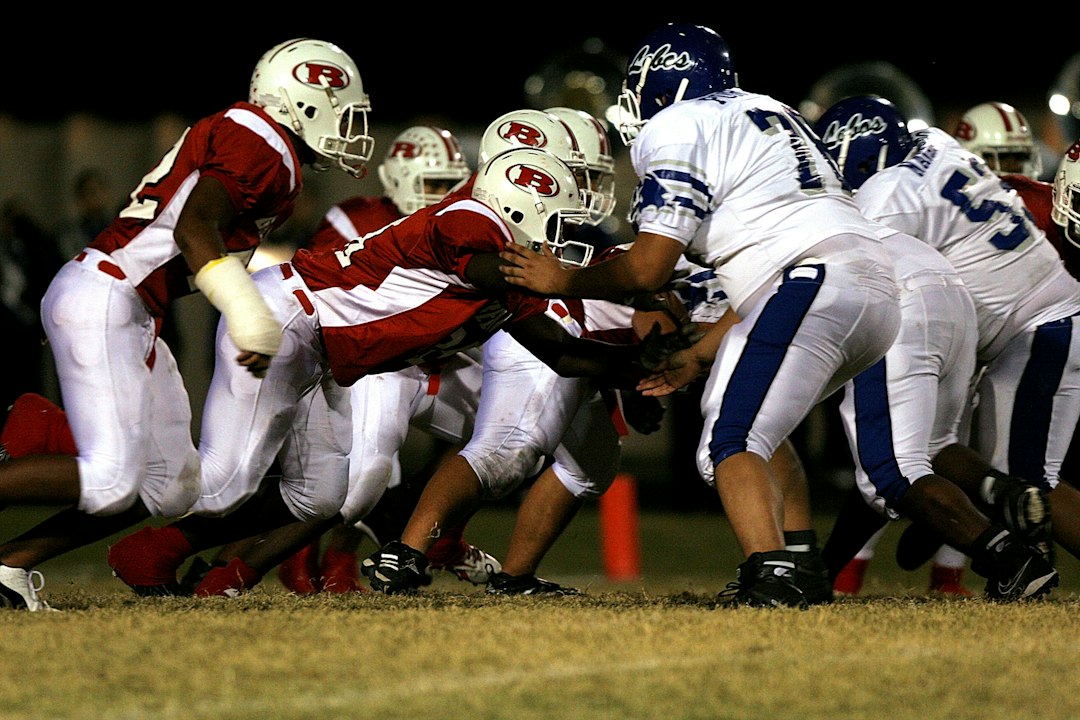




There's a specific moment every former high school football player carries somewhere in their body — not in their memory exactly, but in their muscle and bone.
It's the moment they got back up.
Maybe it was a hit they didn't see coming. Maybe it was the fourth round of conditioning drills on a Tuesday in August when the air itself felt like wet concrete. Maybe it was the fourth quarter of a game they were losing by two scores and the guy across from them was bigger, faster, and hadn't slowed down once.
They got back up anyway.
That's mental toughness from high school football — and it didn't stay on the field. It followed you into every difficult conversation, every failed business quarter, every personal loss where you didn't know how you'd get through it. You got through it the same way you got through two-a-days: one rep at a time, without knowing how many reps were left.
This article maps exactly how that happened. Not in vague "sports builds character" terms — but specifically. The experiences you had, the mental patterns they burned in, and the adult resilience traits they produced.
Two-a-Days Built Your Tolerance for Discomfort Before You Knew You Needed It
There is nothing in the civilian adult world quite like two-a-days in August.
Two sessions a day. Pads on. Full heat. No guarantee of water when you needed it. A second practice starting while the first session's exhaustion was still sitting in your legs like wet sand.
The specific thing two-a-days did — the thing that transfers — was teach you that your first signal of "done" is not accurate information.
You felt done after the first period. You weren't. You felt done again at the water break. You weren't. You felt done when the whistle finally blew, but the film session was still ahead. Your body's early-warning system was miscalibrated by comfort, and two-a-days recalibrated it.


In adult life, this maps directly to what psychologists call distress tolerance — the ability to stay functional under conditions your nervous system is loudly insisting are unbearable. The parent of a sick child who runs on four hours of sleep for three weeks. The founder who pushes through a funding collapse and keeps making calls. The person who sits with grief and doesn't collapse because they have some body-level knowledge that "this is hard" and "this is unendurable" are not the same statement.
Two-a-days taught you the difference between those two statements before you were seventeen years old.
In our experience talking with former players about football taught me resilience — the one moment they point to isn't the championship game. It's an ordinary Tuesday in August that no one photographed.
Contact Taught You That Fear Doesn't Have to Stop You
The first time you lined up for contact — real, full-speed, pads-on contact — your body did something involuntary. Your heart rate jumped. Your peripheral vision narrowed. Everything got loud and then suddenly quiet.
That is fear. Specifically, it is the threat-response cascade: cortisol, adrenaline, a sympathetic nervous system doing exactly what evolution designed it to do when something large is moving toward you at speed.
Here is what football taught you that most people never learn: you did it anyway.
Not once. Hundreds of times. You lined up, felt the fear response, and moved into contact — and on the other side of that contact, you were still intact. The play was over. The whistle blew. You went back to the huddle.
This is one of the most transferable life lessons from high school football, and it's the one that's hardest to teach in any other environment. The neurological term for what you were doing is extinction learning — repeated exposure to a feared stimulus that doesn't produce the catastrophic outcome your nervous system predicted. Over hundreds of repetitions, the threat response de-escalates. Fear doesn't disappear, but it shrinks to a manageable size.
Adults who played football do this in boardrooms, in difficult conversations, in moments of confrontation that other people avoid at enormous personal cost. They've already been trained at the neurological level to move toward the thing that scares them. They just do it in different pads now.
Being Coached Hard Taught You the Difference Between Criticism and Attack
There is a specific kind of communication that only happens in competitive sports — and almost nowhere else in a young person's life.
A coach gets in your face. Volume is involved. The assessment of your performance is direct, unhedged, and delivered at speed. It is not gentle. It often happens in front of your teammates.
And then — this is the part that matters — it's over. The next play happens. The coach has moved on. The critique was not personal. It was functional.
Most adults, by the time they reach a professional environment, have been so thoroughly conditioned to treat criticism as a social threat that they cannot receive direct feedback without some degree of defensive response. The feedback feels like an attack on their identity, not a note on their performance.
Football players who were coached hard — really coached, with real stakes and real accountability — learned to separate those two things.
The specific cognitive skill is called depersonalization of feedback: the ability to hear "that was wrong, here's the correction" as information rather than condemnation. It's why former athletes often make disproportionately coachable employees and remarkably resilient leaders. They've been trained — at volume, repeatedly, under competitive pressure — to receive correction and apply it without emotional shutdown.
Marcus J., 41, played offensive line for three seasons at a Division 2 program after his high school career in Texas. He manages a regional sales team of 22 people now. "The thing I tell new managers," he said, "is that feedback delivered with conviction looks aggressive to people who've never been coached. To me it just looks like someone who actually cares if you improve."
The Locker Room Taught You How to Function Inside a Culture You Didn't Choose
You didn't select your teammates. They were assigned to you by geography, age, and whoever came out for tryouts that year.
You had to make it work with all of them.
This is a profoundly underappreciated life lesson from football. You learned — at 15, 16, 17 years old — how to function effectively inside a group you didn't choose, toward a goal you all shared, without the luxury of only working with people you liked or agreed with.
The football mindset in business is often described in terms of competitiveness or work ethic. Those traits are real, but the deeper one is this: the capacity to maintain team function under interpersonal friction. Former players know how to check personal conflict at the door during competitive situations because the alternative — letting it affect performance — has a visible, immediate cost. On a football field, that cost shows up on the scoreboard.
In an office, it shows up slower. But former players often see it coming because they've learned to track team cohesion the same way they used to track coverage schemes.
Losing on Friday Night Taught You What Real Recovery Looks Like
Winning felt good. But losing is where the actual development happened.
A Friday night loss has a specific texture. The ride home. The silence that's louder than any noise. The weight of the week of preparation that produced this outcome. The knowledge that the same team, on the same field, scored more points than you did.
And then Monday comes. Pads go on. Practice starts.
This is the specific recovery mechanism that football installed in a way that classroom education almost never can: the enforced return to work after a clear, public failure. There was no option to process indefinitely. The schedule didn't negotiate with your feelings. You came back, you reviewed the film, and you prepared for the next opponent.
In adult terms, this is what psychologists call bouncing forward — not just returning to baseline after a setback, but extracting the corrective information from the failure and carrying it into the next attempt. Former players do this almost automatically because they've done it dozens of times before they were old enough to drive.
The football mindset in business shows up here as the capacity to close a bad quarter, run the film review (the retrospective, the post-mortem, whatever you call it at your company), and walk into the next quarter with a corrective plan rather than an identity crisis.
The Fourth Quarter Built Your Relationship With Fatigue at Peak Stakes
There is a specific condition in the fourth quarter of a close game that has no civilian equivalent.
You are physically exhausted. Your decision-making is compromised by fatigue. The stakes are at their maximum — this is the moment that determines the outcome of everything that came before it. And the opponent is also exhausted, also compromised, also at peak stakes.
What you do in that moment — whether you find something, whether you execute, whether you hold your assignment — is determined almost entirely by what you've already built in practice. There's nothing left to manufacture. You're running on stored capacity.
This is the clearest example of how football prepared many players for life. Not the moments when you were rested and prepared and performing at normal conditions. The moments where every resource had already been spent and the result was still undecided.
Adults who played football have been in that condition before. Not as a metaphor. Literally. They know what they're capable of at the bottom of their reserves because they have tested it in a context where the test was real. That knowledge is not cognitive. It lives in the body.
When the crisis hits — the midnight hospital call, the company in freefall, the relationship falling apart — former players often reach for that stored knowledge without quite knowing where it comes from.
It came from the fourth quarter.
Your Jersey Is Still Out There Waiting
The mental toughness you built in high school didn't belong to the program. It belongs to you — and so does everything that came with it.
Design yours in minutes and see your name and number exactly the way you remember it.
Frequently Asked Questions
Does the mental toughness from high school football actually transfer to adult life, or is that mostly nostalgia?
The transfer is real, but it's specific. Traits like distress tolerance, feedback reception, and recovery from failure transfer because they were trained through repetition under real stakes — not simulated. The nostalgia is about the experience; the resilience is about the neurological patterns that repetition built. Research in sport psychology consistently identifies competitive team sports as one of the few environments where adolescents encounter real adversity with real consequences and real enforced recovery — the combination that produces durable mental habits.
What if I didn't play much? Can someone who rode the bench still get these benefits?
In our experience, playing time matters less than people assume. The daily practice environment — two-a-days, contact drills, being coached hard, functioning in the locker room culture, suiting up for games regardless of snap count — contains most of the formative experiences this article describes. Players who rode the bench often report learning the mental discipline of preparation without guaranteed reward, which is itself one of the more transferable skills the game produces.
How do I apply a football mindset in business when the culture doesn't reward that kind of directness?
The specific skill isn't directness — it's the underlying separation of feedback from identity, and the capacity to function under pressure without emotional shutdown. Those traits apply in any professional culture. The directness that football normalized can be calibrated to context; the mental toughness underneath it doesn't require translation. The adjustment is tactical, not fundamental.
Is it too late to reconnect with what football gave me if it's been decades?
The reconnection doesn't require playing again. It often starts with naming the specific experiences — two-a-days, contact, fourth-quarter moments — and recognizing them explicitly in your current adult patterns. Former players who do this often report a recalibration of confidence: the recognition that they have already done harder things than what's in front of them right now. That's not nostalgia. That's an accurate accounting of their own history.
See also: what high school sports truly teach you that classrooms never could | athletic identity you carried long after the final whistle | why high school sports still matter so deeply to adults | the grief that follows when your playing days are over