

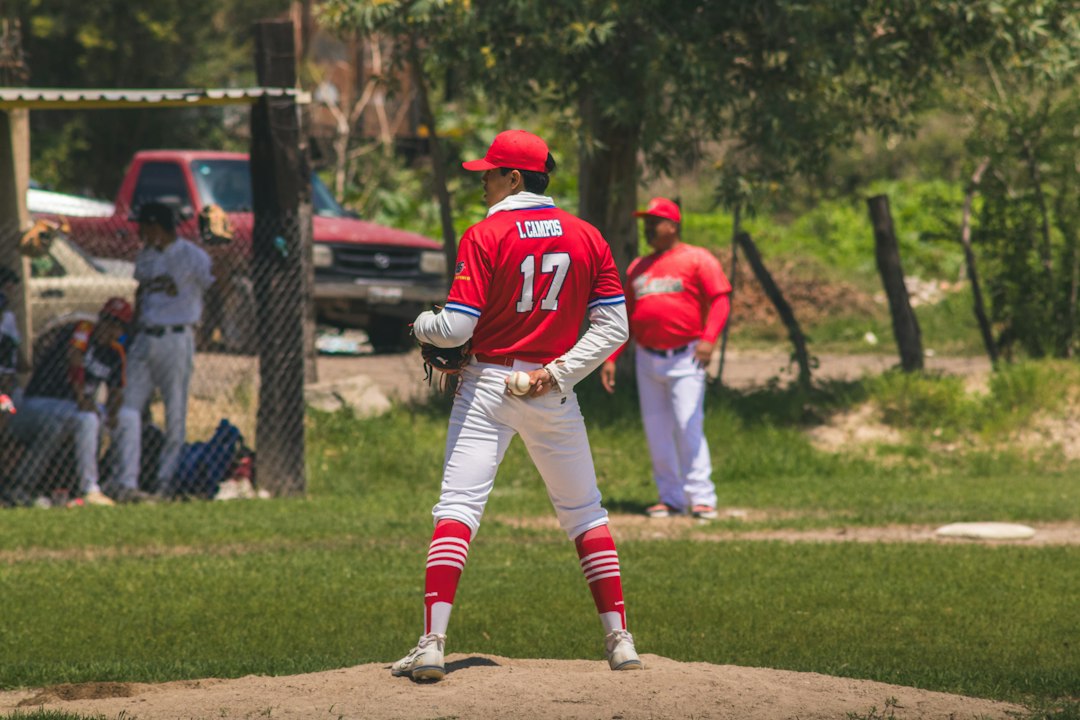




You still remember exactly how the jersey felt. The weight of the fabric across the shoulders. The number sitting square on your back. The specific tightness across the chest when you wound up for a throw.
Now you're ordering a men's baseball jersey — for a reunion game, a rec league comeback, an anniversary season, or simply because you want one hanging in your office — and you've already run into the problem. Every size chart on every product page assumes you're a teenager. These charts are built for a body that's lighter, narrower at the chest, and hasn't spent twenty years accumulating actual adult muscle, or the more negotiable kind.
This is not a standard size guide. It's the one written for the former player: the guy whose shoulders have changed, whose chest measurement is nothing like it was at 17, and who has zero interest in a jersey that looks borrowed from someone else's closet. We'll cover the exact measurements that matter, explain how the traditional oversized baseball jersey cut actually distributes fabric, and tell you what to avoid so your custom baseball jersey looks like it was made for you — because it will be.
The Real Reason Standard Size Charts Don't Work for Adult Men
Every men's baseball jersey size chart is calibrated to a single body type: the high school or college player. That's not carelessness — it's where the volume is. Manufacturers and licensors build sizing assumptions around the demographic that buys jerseys most frequently, and that demographic skews young, narrow-shouldered, and proportioned like someone who is still filling out.
The result is a size chart that places "Large" at a chest circumference of roughly 40–42 inches and treats that as the standard for a full-grown adult man. If your chest now measures 44 inches, 46 inches, or more, the chart is guessing rather than fitting.


There's a second problem specific to former players. Baseball jerseys are intentionally cut with extra room through the torso — that's the tradition, and it's part of the aesthetic. The issue is that the same extra volume that produced a clean, athletic silhouette on an 18-year-old reads entirely differently on a 38-year-old with broader shoulders and a fuller chest. The fabric that looked right in 1998 looks like a tent in 2025.
The fix is not sizing down. Sizing down sacrifices shoulder width, and nothing undermines a baseball jersey faster than a seam sitting two inches behind your actual shoulder line. The fix is knowing which measurements control the fit and understanding exactly where a baseball jersey's traditional cut puts its extra fabric — so you can order with precision rather than optimism.
The Four Measurements That Actually Matter
Before you open a size chart on any jersey page — whether you're looking at a custom baseball jersey for your reunion weekend or browsing a New York Mets baseball jersey ahead of a trip to Citi Field — take these four measurements. You need a soft tape measure and either a friend or a full-length mirror.
1. Chest Circumference — The Number Everyone Gets Wrong
Measure around the fullest part of your chest with the tape parallel to the floor. The mistake most men make is holding the tape too loose, or pulling it slightly tight without noticing. Neither gives you a usable number.
The right tension: the tape lies flat against your body without compressing the skin. You should be able to slide two fingers underneath it, but just barely. Write down that number. It is the single most important starting point for any jersey size chart.
2. Shoulder Width — The Number Most Guides Skip
This is the measurement that separates a jersey that fits from a jersey that looks borrowed. Stand naturally — no squared-up posture — and have someone measure from the edge of one shoulder to the edge of the other, straight across the back. The endpoint on each side is the bony prominence at the top of the arm, not the widest point of whatever shirt you're wearing.
For most men who played through high school or college, shoulder width has changed less than chest circumference over the years — but it still determines whether the sleeve seam sits on your shoulder or migrates down your arm. A sleeve seam that falls off the shoulder point is the single most reliable visual signal that a jersey is too large for your frame.
3. Shirt Length — Torso Preference
Baseball jerseys traditionally run long, designed to stay tucked through nine innings of hard movement. Most men wearing a baseball jersey for a casual game or as a fan piece will not be tucking in. Measure from the top of your shoulder to where you want the jersey to fall — for most men, that's roughly 2–3 inches below the waistband of a pair of shorts. If you're ordering a full-button front jersey, length matters more: an over-long hem on an untucked shirt is visually awkward in a way a pullover is not.
4. Sleeve Length — Optional but Worth Having
Some custom order forms include sleeve length as a separate input. Baseball jerseys historically use a three-quarter sleeve so an undershirt can show, or a full sleeve for cooler conditions. If the option exists, measure from your shoulder seam point to your preferred sleeve endpoint. Many adult men find that the standard three-quarter sleeve sits higher on their arm than it did at 17, simply because their arms carry more mass. Having that measurement costs you thirty seconds and can save an awkward reorder.
How the Traditional Baseball Jersey Cut Actually Works — and Where It Fails
Here's what product pages never explain: a traditional baseball jersey is not oversized in the way a streetwear drop-shoulder shirt is oversized. The extra volume in a baseball jersey is intentionally concentrated in specific places — through the torso below the chest, through the lower sleeve, and across the back panel — while the shoulder seam and chest are meant to track reasonably close to actual body dimensions.
That distinction matters enormously when you're ordering as an adult man.
The design logic goes back to function. A pitcher needs to extend their arm fully overhead. An outfielder needs to dive. A catcher needs to crouch and throw hard from their knees. All of that movement demands freedom through the back panel and the underarm gusset. The shoulder is supposed to fit correctly. The back is where the fabric gives.
Where this fails for adult men is the chest-to-shoulder ratio. At 17, those two measurements are proportionally close to what the chart expects. At 38, your chest may have grown considerably more than your shoulders, or your shoulders may have broadened while your chest stayed similar. When those two measurements diverge from the chart's assumptions, you end up with a jersey that fits in one place and looks wrong in the other.
According to the American College of Sports Medicine's position on adult athletic apparel fit, shoulder seam placement is the primary structural indicator of correct garment fit in performance-cut tops — and that principle applies directly to the baseball jersey's traditional construction.
The practical rule: Always fit to the larger of your chest and shoulder measurements. Then check the other measurement against the chart's tolerance. If the size that fits your chest puts the shoulder seam off-line by more than half an inch, the custom option — where you can enter both measurements separately — is worth the difference in cost.
A Story from Someone Who Got This Wrong First
Tony R., 44, played catcher through high school and two years of junior college. He ordered an XL Yankees baseball jersey as a gift to himself for his 40th birthday, based entirely on the chest measurement listed on the product page. It arrived technically correct in the chest. The shoulder seams landed nearly three inches down his arm. The back panel billowed. His daughter told him he looked like he was wearing his dad's jersey.
He reordered through a custom option, submitted his actual shoulder width — 18.5 inches — and chest measurement of 46 inches separately, and specified a 29-inch shirt length. The result was the jersey he remembered wearing: the fabric sitting correctly across the shoulders, the number on the back looking like it belonged there. He still wears it to his son's games.
Tony's first order wasn't a failure of taste. It was a failure of information. The standard chart had no mechanism for his combination of measurements, and no one had written down how to handle it.
Navigating Team-Style Jerseys vs. Custom Orders
If you're shopping for a jersey in the style of a specific team — an LA Dodgers baseball jersey for the fan who wants that classic blue and white, an SF Giants baseball jersey for someone who grew up watching Pac Bell, a Chicago Cubs baseball jersey that marks a specific season — you're working with fixed size runs and no input options. The measurements on those charts are non-negotiable.
For those purchases, the guidance is straightforward:
- Fit to shoulder width first. You can live with extra torso fabric. You cannot un-shrink a shoulder seam that's already on your arm.
- Go up one size from your chest measurement if your shoulders are broad. Most men find this produces the better overall silhouette.
For custom baseball jersey orders — where you're putting your own name, your old number, and your team's colors on the back — the equation is different. You have inputs. Use them.
Custom jersey platforms generally offer:
- Chest measurement input
- Shoulder width input (sometimes listed as yoke width)
- Length input
- Fit type selector: athletic fit vs. traditional baseball cut
Choose traditional baseball cut, not athletic fit, unless you are currently playing competitive ball and need the garment to perform. Athletic fit jerseys are cut closer through the torso to reduce wind resistance and stay tucked under a belt. For a former player wearing a jersey as a fan piece or for a casual game, the traditional cut produces the silhouette that looks right — the one that matches your memory.
A practical note on team-style sizing: a Pittsburgh Pirates baseball jersey in a standard XL runs differently than a White Sox baseball jersey in the same marked size. Manufacturers who hold different team licenses produce to slightly different spec sheets. When ordering across brands, treat the chest and shoulder measurements on that specific product page as the governing number — not the size label on the tag. The same caution applies to an Arizona Diamondbacks baseball jersey ordered from a different supplier than your previous purchase: measure the chart, not your memory of the last size that worked.
Custom platforms can build jerseys in team-inspired colors and design styles without being officially licensed. The jersey will be in the spirit of your team — a tribute to the look, not an officially certified garment — but it will fit correctly because you controlled the measurements. If official authentication matters to you for a gift or a display piece, source the licensed version and size to shoulder width as described. If fit matters more than certification, the custom route gives you precision that licensed team jerseys cannot offer.
The Three Mistakes That Make a Jersey Look Like a Costume
Mistake 1: Ordering to chest measurement without checking the shoulder. This is the most common error, and the most visible one. The shoulder seam is what viewers register first. Everything else is secondary.
Mistake 2: Choosing athletic fit to compensate for extra fabric. Athletic fit jerseys are designed for a specific body type at a specific activity level. If you're not currently playing competitive ball, an athletic fit jersey may pull across the chest and strain at the shoulder when you raise your arm. It trades one problem — too much fabric — for another: restricted movement and visible stress at the seams. The traditional cut, ordered to your actual measurements, is the right choice almost every time.
Mistake 3: Skipping the name and number. This isn't about fit — it's about what makes the jersey yours. A custom baseball jersey with your name and your old number on the back is not vanity. It's the specific thing that makes it a jersey instead of a shirt. An Atlanta Braves baseball jersey with someone else's name on it is a fan item. One with your name and your number is yours. The price difference on most custom platforms is minimal. The difference in how it feels to wear it is not.
Your jersey is still out there waiting.
Design yours in minutes and see your name and number exactly the way you remember it.
Frequently Asked Questions
What size should I order if my chest and shoulder measurements put me between two sizes on the chart?
Order to the larger measurement, then verify the other. If your chest measurement points to XL but your shoulder measurement sits comfortably within the L range, order XL and understand the shoulder seam will land close to correct. Never size down to fit the shoulder — a jersey that pulls across the chest with every arm movement is unwearable after the first inning. If the gap between your two measurements spans more than one full size, look for a custom option where you can input both measurements directly.
Do men's baseball jerseys shrink after washing, and should I size up to account for it?
Traditional baseball jersey fabric — polyester mesh or a poly-cotton blend — shrinks minimally. In our experience, a properly cared-for polyester jersey holds its measurements across dozens of washes. If you're ordering a cotton-blend jersey, size up by half a size to account for first-wash shrinkage. For pure polyester construction, order to your actual measurements. Sizing up preemptively on a jersey you're ordering to fit will simply shift you from too large to slightly less too large.
I want a jersey in the style of a specific team — something in the spirit of a NY Mets baseball jersey — but the standard sizes don't match my measurements. Is a custom option a good solution?
Yes, with one clarification. Custom jersey platforms can build jerseys in team-inspired colorways, fonts, and design styles as a tribute to the look you have in mind, without carrying official licensing. The jersey won't include official MLB authentication marks, but it will reflect the team's aesthetic in the way that matters for a rec game or a fan piece — and it will fit correctly because you controlled the measurements. If official authentication is important to you for a collectible or a display item, source the licensed version and apply the shoulder-width sizing method described above.
How do I know if the shoulder seam is in the right position once the jersey arrives?
Stand naturally in front of a mirror and raise both arms to shoulder height, parallel to the floor. The sleeve seam should stay at or very near the tip of your shoulder — the acromion, the bony point where your shoulder and arm meet. If the seam slides down your arm when you raise it, the jersey is too wide at the shoulder. If the seam pulls upward and you feel resistance at the underarm, the jersey is too narrow. The ideal fit lets the seam sit still at your shoulder point through a full throwing motion.
See also: jersey size chart for numeric sizes like 44, 48, and 52 | personalized sports gifts that actually make a former athlete feel seen | adult recreational leagues where you might actually wear it | custom softball jerseys ordered for alumni games