

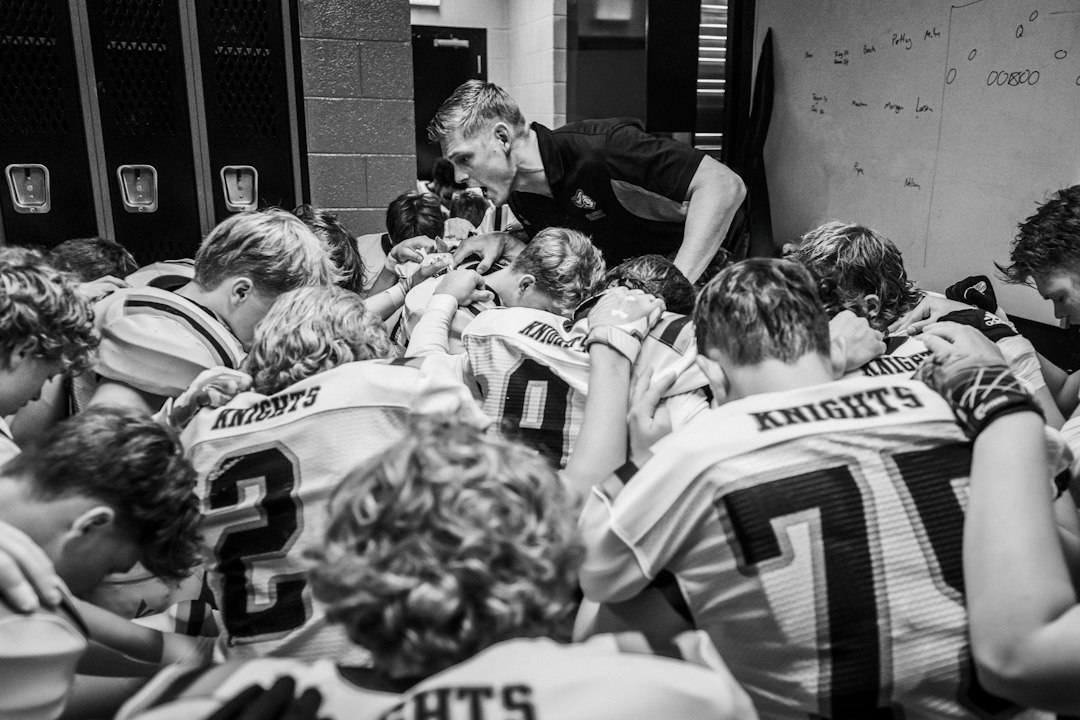




You have one photo.
Maybe it's a yearbook page — black and white, shot under gymnasium fluorescents, reproduced at roughly 300 pixels wide. Maybe it's a newspaper clipping your mom kept in a manila envelope for thirty years. Maybe it's a Polaroid carrying that 1990s fade that turns every royal blue into something vaguely teal.
That photo is enough.
This guide exists because every other custom throwback jerseys tutorial assumes you already know your full jersey specification: the font name, the color codes, the tackle twill measurements. Those guides are useful if you're working from an official NFL archive to build something inspired by Pittsburgh Steelers throwback jerseys. They are nearly useless if you're trying to recreate the jersey you actually wore — the one that only survives in that one grainy photo.
By the end of this, you'll know exactly what information you can pull from degraded source material, what you'll need to reconstruct from memory and research, and how to hand all of it to a custom jersey builder in a way that produces something you'll genuinely recognize when it arrives.
Step One: Audit Every Source You Have
Before you do anything creative, do something analytical. Lay out everything you can find and catalogue what each source tells you — and just as importantly, what it doesn't.
Most people underestimate their source material. A grainy photo that looks useless at thumbnail size often contains recoverable information once you zoom in, boost contrast, or convert to grayscale to strip away color noise.
What to gather before you start:
- Your primary photo (yearbook page, newspaper clipping, Polaroid, or digital scan)
- Secondary photos — team shots, action photos, sideline images from the same season
- Your own memory, written down before you study the photos (the reason this order matters is coming)
- Any physical artifacts: a game-day program, a booster club schedule card, or the jersey itself if it survived
The reason you commit memory to paper before studying the photos is methodological, not sentimental. Memory and vision contaminate each other. Once you stare at a pixelated number font for twenty minutes, your brain starts interpolating — filling gaps with what it wants to see rather than what's actually there. Your first uncontaminated recall is often more reliable than anything you reconstruct after close analysis.
What a Degraded Photo Can Still Reveal
Here is what most people overlook: even a heavily degraded image tends to preserve structure far better than it preserves fine detail.


Structure means: Was the number on the chest or lower on the stomach? Was the name arched above the number or set flat across the back shoulder? Was there a colored border around the number — single outline or double? Was the font blocky and collegiate, or did it carry the thin italic style common to basketball jerseys in the late 1980s?
Detail means: What was the exact typeface name? What were the exact Pantone values? What was the precise width of each tackle twill letter?
Structure is usually recoverable from a bad photo. Fine detail almost always requires supplemental research — which is what the next two steps address.
Step Two: Extract Every Clue From Your Source Material
This is the core technical work of yearbook photo jersey recreation, and it is more achievable than it first appears.
1. Digitize everything at the highest resolution you can manage. Scan physical photos at 600 DPI minimum. Newspaper clippings benefit from 1200 DPI. The additional data gives editing tools something real to work with when you enhance the image.
2. Run basic corrections before analyzing anything. Open the scan in any free editor — even Google Photos' built-in tools are sufficient. Increase contrast, reduce shadows, apply a light sharpen. For color photos, try converting to grayscale: this frequently makes number outlines and lettering edges easier to read because color noise is no longer obscuring edge definition.
3. Zoom to 200% or 400% and write down observations, not conclusions. Work region by region across the jersey. Record what you see, not what you decide. "The left edge of the number appears to have a lighter-colored border approximately 3–4 pixels wide at this scan resolution" is an observation. "The number has a white outline" is a conclusion — and it may be wrong if the border is silver, cream, or gold.
4. Cross-reference against era reference material. Your jersey came from one of a small number of manufacturers active during your playing years, using one of a limited set of typefaces that were standard in athletic apparel production at the time. If you played high school football in the early 1990s, the font was almost certainly one of three or four block letter styles that Rawlings, Wilson, and Russell Athletic used during that period. If you played basketball in the mid-2000s, the letter proportions and spacing align with conventions that were industry-standard at that time.
Search "[sport] jersey typography [decade]" and "[state] high school athletic association uniform specifications [year range]." You'll surface archived manufacturer catalogs and supplier records that narrow your font candidates from "could be anything" to "one of these three."
In our experience, that research step alone cuts font guesswork by more than half.
Step Three: Reconstruct What the Photo Cannot Show
There will be details your source material simply cannot provide. The goal is to reconstruct them accurately rather than guess blindly.
Colors are usually the hardest detail to recover from aged photos and the most important to get right. The approach that reliably works:
- Start with your school's official colors. Most schools have maintained consistent color identities for decades. Your current athletic department almost certainly has a brand or style guide listing official Pantone or hex values.
- Cross-reference against team photos from the same era in your school's library, local newspaper archives, or athletic hall of fame records.
- If neither exists, search "[school name] [sport] [decade] jersey" on eBay and Etsy. Vintage athletic apparel from the high school level trades on those platforms more than most people realize, and listings frequently include photographs that render color far more accurately than yearbook reproductions.
Fonts narrow down quickly once you know the era and likely manufacturer. The jersey collector community — the same people who document the differences between a Philadelphia Eagles throwback jersey from one season and the next — has catalogued most typefaces used by major manufacturers across the past four decades. That knowledge lives in searchable collector forums and is freely accessible.
Structural details like number placement, nameplate sizing, and shoulder stripe width often appear clearly in team photos of other players wearing the same uniform, photographed from different angles. If you have access to a full squad photo from that season, other players' jerseys frequently fill in the structural gaps your individual photo cannot show.
One Athlete's Approach to a Difficult Source
Mariana V., 34, spent six months trying to recreate her high school soccer jersey from a single yearbook photo. The image was black and white, shot from the side, and showed less than half of her number. What it preserved clearly was the arch of the lettering across the back and the stripe pattern on the sleeves.
Using the yearbook's team photo — which she'd initially dismissed as too small to be useful — she identified two other players whose jerseys showed the front number in full. She matched the font against a reference catalog for the manufacturer active in her district during that period, then confirmed the color by contacting her school's current athletic director, who had an archived uniform specification going back to the early 2000s.
The custom retro jersey she ordered brought back details she had genuinely forgotten until she saw them rebuilt. The photo you have is a starting point. The information you need is almost always out there — just rarely all in one place.
Step Four: Build a Brief That Gets You the Right Custom Throwback Jersey
This is what you hand to the builder. How clearly you construct it determines what comes back.
A weak brief says: "I want a jersey like my high school one, number 22, blue and gold."
A strong brief for custom throwback jerseys covers seven specific elements:
- Team name and era: "[School Name] Varsity [Sport], [Year or year range]"
- Colors with specificity: "Royal blue body, gold numbers. The gold is closer to old gold — Pantone 116 — not bright yellow. The blue is medium royal, similar to Pantone 287."
- Number: "22, chest placement, large collegiate block font, double outline — gold inner, white outer"
- Name: "VARGAS across the back, same font family as the number, slight arch"
- Structural details: "Two sleeve stripes, approximately one inch wide each, gold and white, positioned at the sleeve midpoint"
- Reference images: Attach your source photo and any comparison images you found — even if they're not close matches. Annotate them: "My number looked like this one but with a double outline instead of single."
- Acknowledged uncertainty: "I'm not certain whether the font is Classic Block or Collegiate. Here are two examples; mine was closer to the left one."
That final point matters more than most people expect. A skilled builder can work effectively with acknowledged uncertainty — showing you digital proofs of two font options before committing to production. What they cannot work around is confident misinformation. Present the wrong font with certainty and you'll receive the wrong jersey.
What Recreates Well — and What Will Be a Close Tribute
This is the section most guides skip, and skipping it leads to avoidable disappointment.
What you can reliably recreate:
- Overall jersey structure, cut, and silhouette — modern equivalents exist for every historical style
- Color, once you've completed the reference research
- Number and name lettering, once you've identified the font family
- Placement and proportions of all design elements
What will be a close tribute rather than a duplication:
- The specific weight and hand-feel of the original fabric — manufacturing standards have shifted significantly since the 1980s and 1990s
- The worn-in quality of a jersey that was actually played in — some builders offer distressed finishes, but these are approximations of aging, not the genuine article
- Proprietary team or league marks that were licensed — any official insignia on your original jersey is controlled intellectual property and will not appear on a custom build
The distinction worth settling before you start: most former athletes aren't trying to produce an archival artifact. They're trying to wear their number and name again in their team's colors. That goal is entirely within reach. The National Federation of State High School Associations maintains uniform code archives by sport and era — a useful starting point for verifying structural specifications before you build your brief.
A Note on Pro-Team Styles and Your Own Jersey
Licensed throwback jerseys built in the style of professional teams — designs inspired by Seattle Seahawks throwback jerseys, tributes to the Philadelphia 76ers throwback jersey aesthetic, or pieces in the style of a Manchester United retro jersey — benefit from official archives, licensed cooperation, and fully documented specifications. Mitchell & Ness throwback jerseys, for instance, have built a well-earned reputation on that documented infrastructure.
Your high school jersey has none of that institutional support. What it has instead is something no licensed throwback program can offer: your name on the back, your number on the chest, and the colors of your team. The Spurs throwback shirt behind glass in a retail case is a piece of sports history. The jersey you wore on the floor, the field, or the ice is your history. Custom throwback jerseys exist to capture the version that official licensing never will — and that version belongs only to you.
The process takes more effort than ordering a premade NFL throwback jersey from a catalog. The result is incomparably more personal — and for most former athletes, that is precisely the point.
Your jersey is still out there waiting.
Design yours in minutes and see your name and number exactly the way you remember them.
Frequently Asked Questions
How do I figure out what font was used on my high school jersey?
Narrow the era and likely manufacturer first. Most high school athletic jerseys from the 1980s through the 2000s were produced by a small group of major suppliers — Rawlings, Russell Athletic, Wilson, Champro — each using a limited set of standard block letter typefaces. Search "[sport] jersey font [decade]" or look for archived manufacturer catalogs in jersey collector forums. Once you have two or three candidate fonts, place them side by side against your source photo. A custom jersey builder can usually identify the closest match from that shortlist, or produce digital proofs of each option before production begins.
How do I handle a how-to custom jersey brief when I only have a black-and-white photo?
A black-and-white source removes color data but typically preserves structural information clearly: number outline style, font shape, stripe placement, lettering arch. Recover your colors separately — through your school's current athletic records, local newspaper archives that may hold color photos from the same season, or vintage jersey listings on resale platforms. Cross-reference at least two independent sources before committing to a specific color specification in your brief.
Can I recreate a jersey from a sport that doesn't have much online documentation?
Less-documented sports — swimming, wrestling, track, lacrosse — have thinner collector infrastructure than football or basketball, so online reference databases will be harder to find. In that case, lean on physical sources: contact your school's current athletic department, reach out to your former coach, check local historical societies or public libraries with sports archives, and look at official alumni or booster club channels. Former teammates are also an underused resource — someone on your squad may still have their original jersey or access to better source photos than you do.
What if the image quality is too poor to extract any reliable detail?
When the image is genuinely too degraded for direct analysis, your strategy shifts from extraction to era-driven reconstruction. Document what you can confirm with confidence — overall jersey style, approximate number size relative to the body, presence or absence of a name bar — and treat everything else as informed estimation based on the era and team. The goal becomes "faithful to the period and team identity" rather than a detail-for-detail match, which is still a meaningful and recognizable result. Most athletes who go through this process report that the finished custom retro jersey triggers genuine recognition even when the original source material was severely limited.
How do I describe my jersey to a builder when I'm uncertain about several details?
Be explicit about your uncertainty rather than guessing and presenting the guess as fact. Structure your brief in two clear sections: what you're confident about, and what you're deciding between. Attach annotated reference images showing what matches your jersey and what doesn't. Then ask the builder to produce digital proofs for any element you've flagged as uncertain — specifically requesting two or three font or color variations — before you approve the final design. That proof stage is where the details your source material couldn't confirm get resolved before anything goes into production.
See also: why personalized sports gifts hit differently than generic ones | old high school photos aren't the only thing worth tracking down — your game film might still exist too | what to do with your old varsity letter jacket | the psychology of why high school sports still matter to adults