



If you've been on social media or sports forums this week, you already know: friday night lights is having a moment. The searches are spiking, the threads are running long, and former players everywhere are doing that thing where they go quiet for a second before they start typing.
Because for the people who lived it, friday night lights was never a trend. It remains a place they still return to.
Set the TV show aside, though it understood something real. The subject here is the genuine article: the lived experience of walking out of a locker room tunnel on a September night with your name on your back and the whole town watching. For anyone who played high school football, that experience doesn't belong to the past tense. It lives in the present tense of memory. Immediate. Sensory. Yours.
And right now, with searches surging and nostalgia running thick, it feels like the right moment to talk about what friday night lights actually meant: not as a cultural symbol, but as something you wore, something you felt, something that happened inside your body on a specific field in a specific town.
The Moment You Remember First
It isn't the touchdown.
It isn't the big play or the final score. Ask any former high school football player what they remember first about friday night lights, and almost none of them lead with the scoreboard.
They lead with the lights themselves.
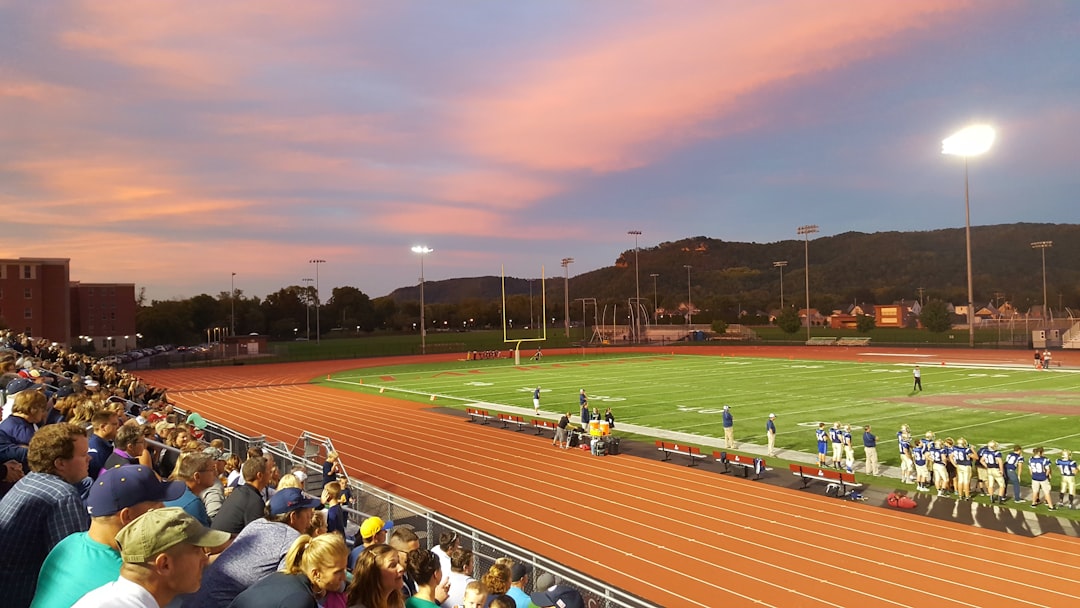
There is something that happens when you walk through that tunnel (or out of that locker room, or across that parking lot), and the field opens up in front of you for the first time on a Friday night. The lights are already on. They are always already on. That yellow-white wash over the green turf, the way it makes the whole field look almost constructed, like something built specifically for this moment. And then the sound arrives. Not one sound: the full frequency range of a crowd that has been waiting since Wednesday.

Your cleats hit the track. The grass comes next. And something in your body that has been coiled all week (all season, maybe) finally releases.
That's the moment. That's what people are searching for when they type friday night lights into a search bar at 10pm on a Tuesday in October. Not information. The feeling. The way the nervous system gets there before the brain does.
In my experience as a former player, and in conversations with former players at every level of the game, the high school stadium is the one that stays sharpest. College has bigger crowds. Adult recreational leagues have more relaxed energy. But the high school stadium, on a Friday night, with the people from your actual hometown watching you play, carries an emotional weight that nothing else quite matches. You were young enough that it felt like everything. Because at the time, it genuinely was.
What Made Friday Night Football Different From Every Other Game
High school football exists inside a particular social ecosystem that generates an intensity you simply cannot manufacture at any other level of the sport.
Nobody in that crowd drove in from another city. That's your English teacher. The parent of the kid you've known since kindergarten. Your grandmother in the bleachers wearing a scarf in your school colors. The cheerleader you've been in class with for three years. The coach's wife watching from the corner of the end zone. The local paper's photographer who will print your name in a caption on Sunday morning.
Every face belongs to someone specific. And they are all watching you.
That specificity, the way everyone in those stands is somebody you know by name, creates a kind of accountability that organized professional sport never replicates. It isn't anonymous. There is no crowd to hide in when you're playing inside a small town's football stadium on a Friday night. The accountability runs in every direction, and somehow that total visibility produces the most genuine version of team cohesion most players will ever experience.
You weren't playing for a franchise. You weren't playing for a scholarship offer, at least not primarily. You were playing for each other, for the name on the front of the jersey, for the specific people whose faces you could pick out of the bleachers from the sideline.
The elements that made it irreplaceable:
- The pregame locker room: that particular silence before the coach spoke, the way thirty teenagers who had been loud all week went completely still at once
- The band in the stands cycling through the same songs every game, which somehow never stopped working on you
- The smell of the turf after the groundskeeper watered it that afternoon
- The way the visiting team's uniforms looked wrong under your lights, in your stadium, in front of your people
That last one is something former players rarely name directly but recognize the moment it's said. There was something proprietary about your stadium. The angle of the lights. The distance from the bleachers to the hash marks. The way crowd noise bounced off whatever was behind the end zone. It belonged to your team in a way that felt almost physical.
The Jersey Was Never Just a Jersey
Here's what gets underexamined in the friday night lights conversation: the jersey.
Not as a uniform. As an identity object.
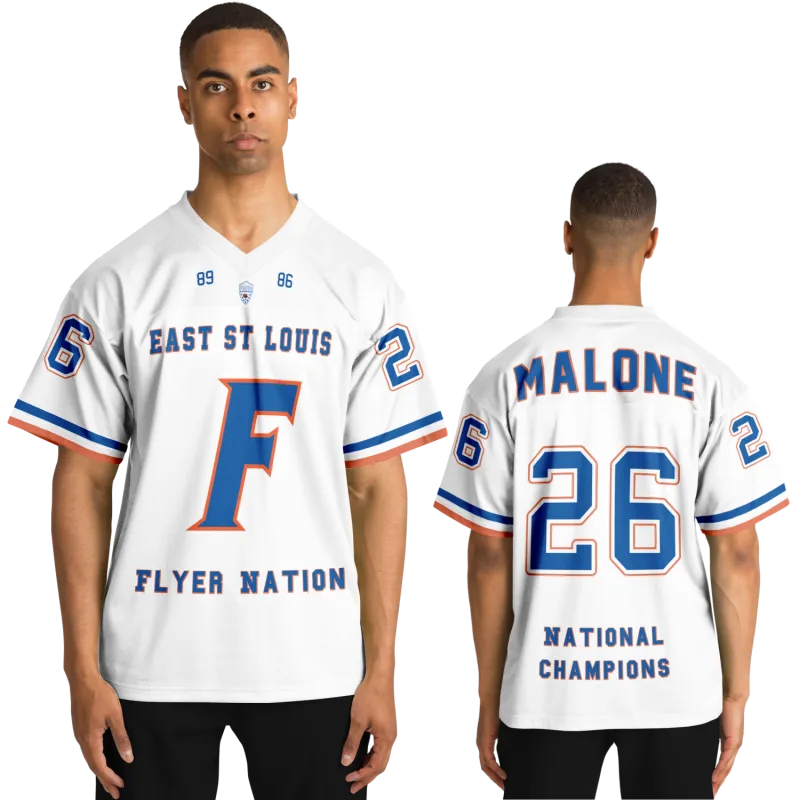
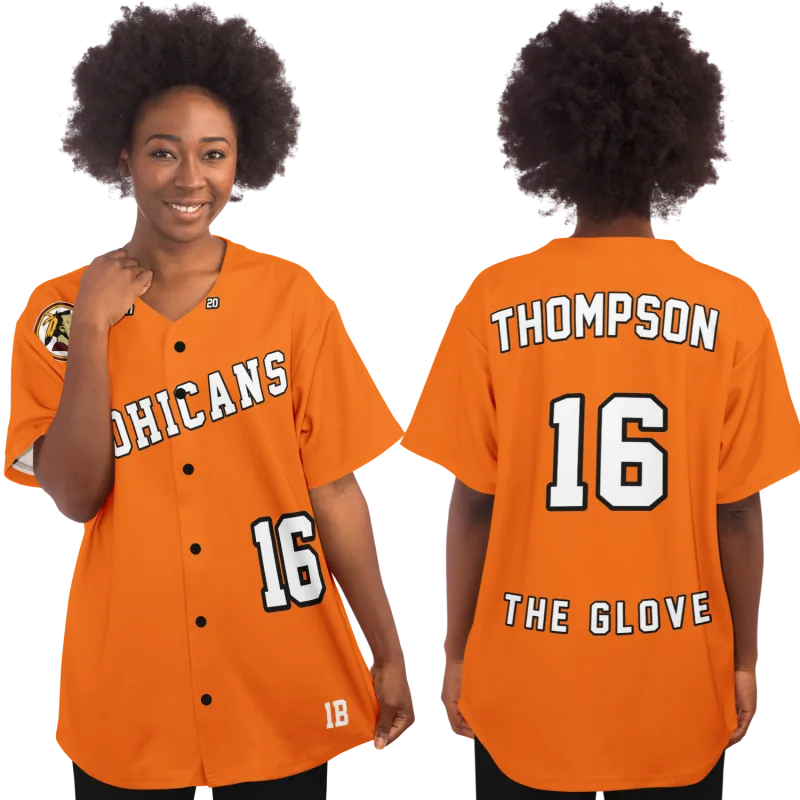
When you pulled on a high school football jersey before a game, you were putting on something that carried weight beyond fabric and numbering. Your number. Your school name. Your town. The same colors your older brother wore, or your father described wearing, or the upperclassman you idolized in eighth grade whose number you specifically requested when you made the roster.
Maria C., 34, played wide receiver for her high school in central Texas and still has her number 11 jersey in a box in her closet. She hasn't worn it in sixteen years, but every September when football season starts, she takes it out. "It still smells like the field," she says. "I don't know if that's real or if I'm imagining it. But every time I open that box, I'm back on that field in about two seconds."
That's what a jersey holds. Not fabric. Not nostalgia in the abstract. A sensory, nearly instantaneous route back to the experience itself.
The number you wore wasn't arbitrary. You either chose it deliberately (because of what it represented, because of who wore it before you) or you were assigned it and then spent a season making it yours. By the time the last game came, that number was you in a way that's difficult to describe to someone who hasn't worn one. When people in the stands called your number, you didn't process it as a number. You heard your name.
Why Friday Night Lights Keeps Coming Back Every Fall
The show aired. The movie ran. The book predated both. And still, every September, friday night lights climbs the search charts again.
This has nothing to do with an algorithm quirk or content recycling. Something more particular is going on here.
Certain experiences mark a person in a way that ordinary experience doesn't: they lodge in the body and the memory with a durability that everyday moments can't match. Developmental psychologists sometimes describe these as identity-defining periods: stretches of time so concentrated in emotional intensity and social significance that they become reference points for everything that follows.
High school football, for the people who played it, is almost always one of those periods.
Research published in the journal Memory has documented that emotionally intense adolescent experiences are recalled with greater frequency, vividness, and consistency than most adult experiences — a phenomenon tied to the way high-arousal, high-stakes moments are encoded during identity formation. The brain doesn't just archive those memories. It preserves them with more sensory detail, more access points, more routes back in.
Which is why the smell of cut grass on a cool evening can return a 42-year-old to the sideline of a game played twenty-three years ago in a matter of seconds. The nervous system kept the key.
Friday night lights keeps trending because the people who lived it are still living with it. Every fall, the air changes, and the memory shifts with it. The search spike is not an algorithm effect. The season drives it, along with the physical sensation of October arriving and the brain doing what it was built to do. That pull never really goes away, which is why the NFL's return each fall stirs the same ache in former players.
What Former Players Actually Miss (It's Rarely What You'd Expect)
Ask a former high school football player what they genuinely miss, and the answers cluster around something that tends to surprise people who didn't play.
Winning rarely makes the top of the list. The before does.
The two answers that come up most consistently:
- The pregame tunnel walk — that ninety-second corridor between the locker room and the field, when everything was still possible and nothing had been decided yet
- The Friday afternoon of game day — the specific way school felt different that day, the way the clock seemed to move wrong, the quality of anticipation that built from the moment you woke up
The game itself lives clearly in memory, but not necessarily with more vividness than the frame around it. The bus ride over. The pregame meal. The film session where the coach drew up assignments on a whiteboard and the room went so quiet you could hear the marker on the board. The way your teammates looked at each other in the locker room during the final minutes before the walk out. And the bond with your old coach, the man who drew those assignments on the whiteboard, tends to outlast almost everything else from those years.
What players miss is the preparation — the ritual, the shared experience of getting ready for something together. Because that kind of collective preparation for a shared high-stakes moment is genuinely uncommon in adult life. Most of what adult life requires gets prepared for individually, executed individually, evaluated individually.
The team experience of friday night football is something many former players spend years trying to approximate in other forms. Recreational leagues. Adult flag football. Pickup basketball that gets competitive faster than anyone planned. The sport itself is rarely what draws them back. They are chasing the feeling of being prepared together, for something that matters, in front of people who showed up specifically to watch.
The Homecoming Game: Friday Night Lights at Full Intensity
If regular friday night games were the weekly emotional infrastructure of high school football, homecoming was the annual peak.
Everything that made friday nights feel significant was amplified at homecoming. The crowd was larger — alumni returned, families drove further distances, the bleachers filled up an hour before kickoff. The ceremony added layers: the court, the announcements over the PA, the halftime show the band had been building toward for six weeks. The opponent was frequently a rival. The stakes felt absolute in the particular, beautiful way that only adolescent stakes can — completely total and somehow free from real consequence at the same time.
Homecoming games produced the performances players recall most completely. Not because the competition was necessarily sharper, but because the sensory environment was more concentrated. More people watching. More noise coming from more directions. The specific gravity of the moment registered differently in the body — and the brain filed it accordingly, with more detail and more staying power than an ordinary Friday.
For former players, homecoming is frequently the friday night that returns most fully. The number on the back of the jersey. The coach's expression in the tunnel before kickoff. The score at the half. The smell of the concession stand drifting across the field during warmups. The face in the stands you looked for after the final whistle.
That memory doesn't age the way other memories do. It sits inside you, preserved almost perfectly, waiting for the right Friday night in October to come fully back online.
Your Jersey Is Still Out There Waiting
Your jersey is still out there waiting.
Design yours in minutes and see your name and number the way you remember them.
Frequently Asked Questions
Why does "friday night lights" trend every fall?
The annual search spike for friday night lights aligns closely with the start of high school football season across the United States, which runs roughly from late August through November depending on the state. Former players, fans, parents of current players, and people who grew up in communities where friday night football anchored fall social life all return to the topic when the season begins. No single event drives it. The season itself does, along with the sensory cues that accompany it: cooler air, shorter days, the particular sound of a crowd on a Friday night drifting across a parking lot.
Is "Friday Night Lights" only a Texas thing?
The cultural association with Texas runs deep — H.G. Bissinger's book, the film, and the television series all centered on Texas high school football — but friday night lights as a lived experience belongs to communities across the country. Ohio, Pennsylvania, Florida, Georgia, California, and dozens of other states have their own versions of it: packed small-town stadiums, Friday nights that pulled the whole community out of their houses, players who still know their number and can hear their coach's voice thirty years later. Texas gave the experience its mythology. The experience itself was — and remains — something much wider than any one state.
Why do former players say high school football felt more intense than college or adult leagues?
Several things combine to produce that specific intensity. The crowd is made up of people the player personally knows — family members, teachers, neighbors — which creates a form of accountability that is more personal and more immediate than anonymous fandom. The stakes feel absolute because the player is young enough that this is the highest level of organized competition they've yet experienced. The team shares a specific community context rather than being assembled from recruited athletes across different cities. And all of it is happening during adolescence, when identity is still forming and belonging carries an urgency it never quite has again. The combination produces something that's difficult to replicate at any other level of the game.
What's the most effective way to hold onto the memory of playing high school football?
The most durable preservation tends to come through objects that carry sensory memory — and the jersey is the primary one. Former players consistently report that the jersey produces more immediate emotional recall than photographs, trophies, or programs. The weight of it, the number, the name of the school: each element functions as a direct access point to the experience. Many former players who no longer have their original jersey describe recreating it — their school name, their number, their name on the back — as one of the most direct routes back to how it felt. The brain's sensory memory responds to the visual and tactile cues themselves, not only to their origin. It is also why many people land on a jersey as a gift for the former football player in their life, whether they are buying it for someone else or finally for themselves.
See also: what playing under the lights actually felt like | why high school sports still matter to adults | why your senior season memories are so vivid | how football obsession runs deep across entire states