

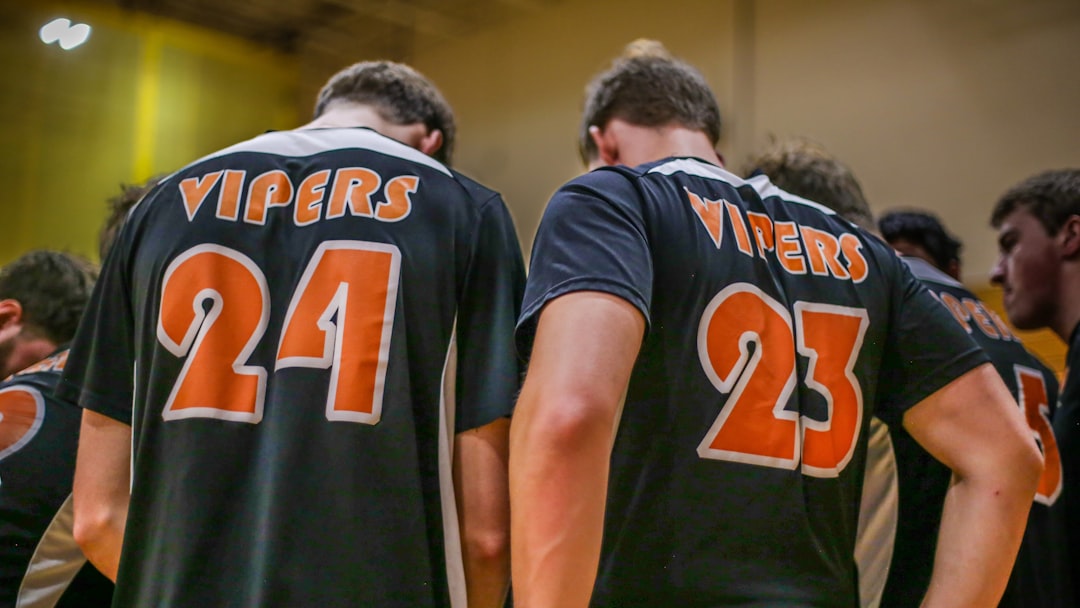




There is a specific moment before the list goes up.
You already know the one. You're standing in a hallway (or hovering near a gym door, or refreshing a school website on your phone with a grip that's leaving marks on the case) and the whole season is balanced on one sheet of paper you haven't read yet. Everything you practiced. Every early morning. Every made shot, every dropped one. It's all still in the air.
Earning your high school jersey tryout is one of those experiences that sounds simple from the outside and enormous from the inside. You tried out. You either made it or you didn't. That's the sentence version. But the actual version, the one that stays with you for decades, is nothing like that summary. It is a full narrative with a beginning that stretches back months, a middle that lasts about four days and feels like four years, and an ending that, whether the news was good or not, genuinely changes who you are.
This is that story. Not as an instruction manual. Not as a motivational poster. As the true account of what it actually feels like, from the first day you lace up in the gym to the afternoon someone puts a folded jersey in your hands and you stop breathing for just a second.
The Week Before Tryouts: When the Waiting Has a Specific Weight
It starts before you walk through the gym door.
There's a week (sometimes two) where tryouts are coming and the whole school knows it and everyone who's trying out exists in this peculiar suspended state. You're going to class. You're eating dinner. You're nodding when your parents ask how you're feeling. But underneath all of it is this constant low hum: it's almost time.
You start noticing things you wouldn't normally notice. Whether your sneakers still have grip. Whether the other kids who are trying out look more confident than you, or less, or whether that confident one is just performing it. You replay the unofficial summer pickup games in your mind like game tape, cataloguing every moment you looked good and strategically forgetting every one you didn't.


The high school team tryout experience begins, in other words, with a kind of controlled terror that most teenagers have never felt before in anything that actually mattered to them. School assignments have deadlines that move. Friend drama resolves itself. But this, this has a fixed date and a fixed outcome, and neither is negotiable.
In my experience as a former player, the athletes who describe their tryout week most vividly are the ones who understood, even then, that it meant something. Not just as a pathway to playing time, but as a test of a specific kind of courage: the courage to want something in public. To show up and be evaluated and have the answer be official and visible to everyone you go to school with.
That takes something. Whatever happens next, it takes something.
The Tryout Floor: What the Coaches Are Actually Watching
The First Drill Matters More Than You Think
You walk in and the gym smells exactly the way gyms smell: floor polish and old rubber and something slightly electric about the lighting. The coaches are already there. They have clipboards. They have seen every version of this day before, and they have their own system for reading it, and you don't have access to that system.
Whatever sport it is, the first day of practice always has the same texture — the newness, the sizing-up, the sense that everyone, players and coaches alike, is watching everyone.
What most athletes misunderstand about the high school team tryout experience is that coaches are rarely watching what you think they're watching. They've watched enough tryouts to filter through the performance anxiety quickly. What surfaces for them — what actually lands on the clipboard — is the gap between effort and talent, the moments when a player gets a result they didn't expect and how they respond to it, and the question of coachability: not whether you already know how to do something, but whether you adjust when you're shown how.
The athlete who makes an error and immediately recalibrates — shifts their feet, changes their read, tries the adjustment without being asked twice — is often more valuable in a high school program than the naturally gifted one who's been doing it their way since third grade and can't hear a correction.
None of this means you shouldn't prepare. Preparation is what gives you the base to actually be coachable. You can't adjust what you haven't practiced. But it does mean that the tryout is a fuller test than a skills audition. It's a character sample — and years later, you may find yourself wondering what your coach saw in you that you didn't see in yourself, the thing that showed up in the moments you weren't performing but simply responding.
What the Roster Board Reads When It Reads You
Every coach runs tryouts slightly differently, but almost all of them are watching for the same four things:
- Athletic readiness — can you do the fundamental skills required? Not perfectly. Adequately, consistently, with visible competency.
- Team instinct — do you play for the moment when your team scores, or for the moment when you score? They can tell.
- Response to pressure — you're going to make mistakes. Everyone does. What you do in the thirty seconds after the mistake tells them more than the mistake did.
- Presence — are you here? Fully here? Not performing focus but actually in it?
That fourth one is harder to describe and impossible to fake for four days in a row. The coaches know when someone is genuinely locked in versus managing an impression. Real presence is specific and consistent. Impression management frays at the edges by day three.
The Roster Board: The Specific Geography of That Hallway
It goes up and then everyone knows and no one is the same after.
The roster board has been a rite of passage in American high school athletics for so long that it's practically mythological. And yet every athlete who has stood in front of one experiences it as entirely personal, entirely new, entirely theirs. You walk up. You scan. Your eyes do that specific thing where they're looking for your name and the world has narrowed to the width of a printed list.
And then one of two things happens.
When Your Name Is There
You see it.
Your name. Your name on their list. The one that means you are now part of this — this team that has been here before you and will be here after you, this community of athletes who know each other's tendencies and have a shorthand built from shared practice and shared losses and shared moments when something worked and everyone knew it.
Making the team is the door; walking through it is another story — your first year on the team is its own kind of education, separate from the one that got you here.
The making the team memory tends to have a very specific texture. Most athletes describe a strange combination of relief and disbelief, followed almost immediately by something that isn't quite joy yet: something more like the moment before joy, when you can feel it arriving but haven't fully let it in yet because you still aren't sure you heard what you just heard.
Then someone sees it too. Another kid who made it. And you make eye contact and something passes between you and suddenly it's real.
This is the beginning of the jersey. You don't have it yet. But it's yours now. That feeling of being named, of being chosen, doesn't end here — it returns every time your name appears on a list that matters, and nobody forgets the starting lineup announcement that still lives somewhere in your chest.
When Your Name Isn't There
This part is harder to write about, and it matters more.
Getting cut from high school team is one of those experiences that tends to get processed too quickly in retrospect, especially by adults who want to reassure. "It made you tougher." "You learned something." "Everything happens for a reason." All of those may be true, and none of them are what a fourteen-year-old needs in the hallway when they've just scanned a list and not found their name.
What they need first is permission to feel what they feel without having to justify it.
The tryout meant something to you. You prepared. You showed up across multiple days and tried, genuinely, in front of people who were evaluating you. The fact that the result went one way rather than another does not undo what it required of you to be there. And there is something in that (something that belongs to you regardless of the roster) that is worth naming.
And if you were standing beside someone when it happened to them — the year cuts day landed on a friend instead of you — you carry a version of it too, the strange guilt of having made it while they didn't.
The athletes who got cut and came back the next year describe something specific: they couldn't have been who they became without the cut. Not because rejection is automatically educational, but because they chose to let it be. That's a different thing. The cut didn't make them. They decided what the cut meant, and some of them decided it meant not yet instead of not ever.
That distinction is everything.
Equipment Day: The Specific Weight of Something Earned
For the athletes whose names were on the list, there is still one more milestone.
Equipment day. Jersey day. The afternoon someone calls your name and hands you a folded piece of fabric and it has a number on it and that number, from this moment forward, is yours.
Mara T., 17, played varsity volleyball her junior and senior years at a mid-sized high school in the Pacific Northwest. She still has both jerseys — number 12 — hanging in her childhood bedroom. When she talks about the first time wearing team jersey, she doesn't start with the first game. She starts with the equipment room: the specific smell of it, the way the fabric was stiffer than she expected, how she turned it over and looked at the back and traced the number with her thumb before she put it on.
This is what the first time wearing team jersey actually is: not performance, not display. A private moment that happens to occur in a room full of people. You hold something that now carries your name and your number and the name of your school across the chest, and for a few seconds it's just you and this object and the understanding of what it means.
What it means is: you are someone who earned this.
Not bought it. Not inherited it. Not been given it. You put your name into consideration, endured the evaluation, absorbed the wait, and came out the other side on the list. The jersey is the physical record of that.
What You Carry After — Whether You Wore One or Not
There is a thing that happens to athletes in their thirties and forties when someone asks if they played sports in high school. There is a small, involuntary shift in the face before the answer comes. Depending on the answer, it carries different freight — but it always carries something.
The athletes who made their teams carry the specific sensory memory of those seasons. The locker room before the first game. The specific person whose voice they can still hear calling out a defensive switch. The way the gym felt on a winter evening with the bleachers full. And there are specific moments that cut through everything else — the moment the crowd got loud and you were the reason, a memory every former athlete carries whose edges stay sharp while other details fade. These are not nostalgia. They are identity markers. They are part of the architecture of who these people became.
But the athletes who were cut carry something too — and this is the part that gets acknowledged least. They carry the memory of having tried. Of having wanted something enough to show up and be measured. Of having stood at a roster board and gotten an answer they didn't want and then, eventually, having decided who they were going to be about it.
That's not a consolation prize. That's its own kind of formation.
The high school jersey isn't just a piece of team apparel. It's a record of a specific kind of courage at a specific point in a person's life. And the athlete who earned it — whether they wore it for two years or two games, whether they were a starter or a benchwarmer, whether they can still fit into it or not — knows exactly what it cost.
Your jersey is still out there waiting.
Design yours in minutes and see your name and number exactly the way you remember it — or browse the gallery first and see how other former athletes have brought their own back.
Start Designing My Jersey · See the Gallery
Frequently Asked Questions
What do coaches actually look for during high school tryouts?
Most coaches at the high school level are looking for a combination of fundamental skill, coachability, and competitive instinct — roughly in that order of weight. Raw athleticism helps, but the athlete who adjusts quickly to correction, plays with full effort regardless of the score, and understands how to function within a team structure tends to rank higher than the talented individualist. Coaches who run multi-day tryouts are specifically watching how each athlete's performance changes day over day: consistency under fatigue is one of the most reliable indicators of how a player will perform in a season.
How long does it typically take to get over being cut from a high school team?
There's no standardized timeline, and anyone who offers one is projecting rather than observing. What the research on athletic identity suggests — including work from the American Psychological Association on youth sports and self-concept — is that the athletes who process cuts most successfully are the ones who are helped to see their athletic identity as broader than any single roster decision. The athletes who struggle longest are those whose entire self-concept was staked on making a particular team. This is why coaches, parents, and counselors who work with young athletes consistently recommend building identity across multiple contexts simultaneously.
Is it normal to feel grief after getting cut, even for a sport you weren't sure you wanted?
Completely normal, and the ambivalence doesn't cancel the grief — it can actually intensify it. When you wanted something enough to try out for it, some part of you had already imagined the version of your life where you made it. Getting cut doesn't just end the athletic possibility; it ends that imagined version of the upcoming year. Grieving something you had pictured, even tentatively, is a legitimate emotional process. The athletes who give themselves permission to feel that loss and then actively decide what comes next tend to navigate it better than those who either deny the feeling or stay stuck in it.
What's the best way to prepare for a high school team tryout?
Preparation for high school tryouts has two components that most athletes address unequally. The first is physical skill preparation — working specifically on the fundamental skills most relevant to the position you want, ideally in a setting that mimics tryout conditions (observed, evaluated, under mild pressure). The second is mental preparation, which most athletes underinvest in. This means practicing your response to mistakes in advance: literally practicing the reset. What will you do in your body and mind in the thirty seconds after a missed shot, a dropped pass, a blown coverage? Athletes who have rehearsed this response — not just conceptually but physically — perform more consistently under the specific stress of being evaluated.
Why do athletes keep their high school jerseys for so long?
Because the jersey is a physical object that holds a non-physical truth. It's the record of a specific window of time when something was asked of you and you answered. Sports equipment in general accumulates meaning that transcends function — shoes worn through a championship season, a batting helmet with the painted number worn down — but jerseys carry particular weight because they carry the name. Your name and your number, belonging to you, on something your school gave you in exchange for what you gave the team. That's not easily discarded, even when the fabric has faded and the person wearing it is twenty years older and lives three states away.
See also: why high school sports still matter so deeply to adults | the athletic identity you were beginning to build | what high school sports teach you that nothing else could | why those first-season memories are still so vivid decades later