

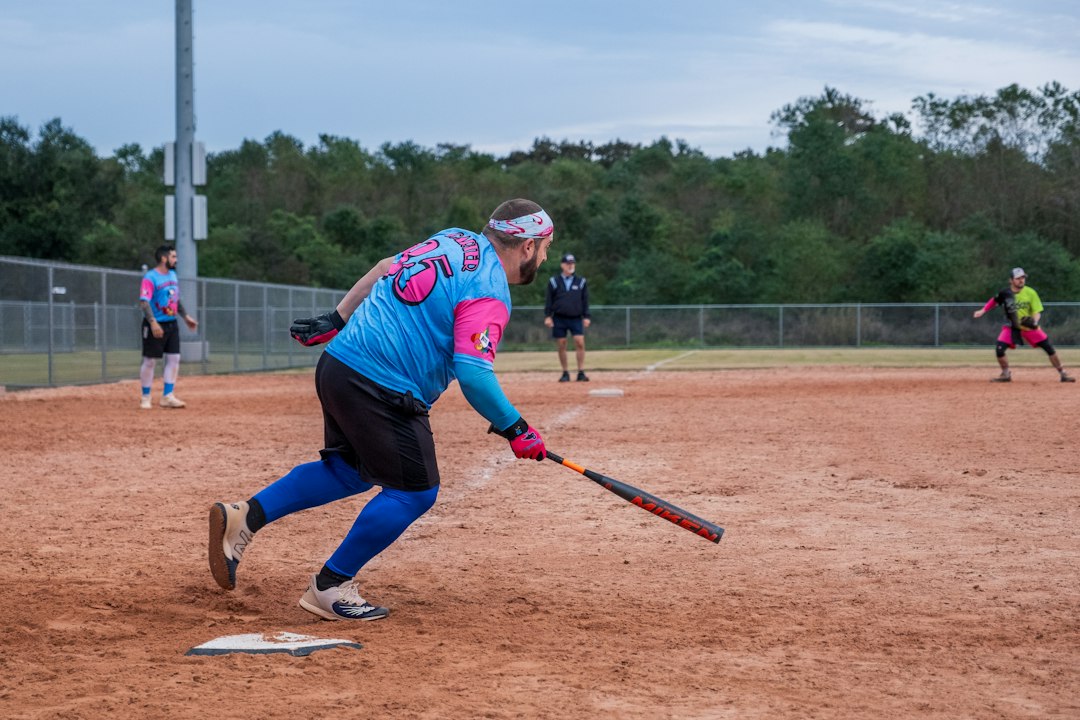




Custom slowpitch softball jerseys are not a consolation prize for people who didn't go further in the game — they are the continuation of something that refused to end when the final high school season did. That distinction matters, and it's the entire reason this article exists.
You already know the feeling. Standing in a parking lot on a Sunday morning, coffee in one hand and cleats in the other, more awake than you've been all week. The game hasn't started. You haven't touched a bat yet. But something is already switched on that the rest of your week never quite reaches — the same thing that fired when you pulled on a high school jersey before a game that actually counted.
This article is for the player who understands that distinction — and who wants to order a jersey that honors both eras.
The High School Uniform Was Never Just a Shirt
Ask anyone who played organized sports through high school what their jersey number was. They'll tell you without pausing.
That number is stored in a different part of the brain than your locker combination or your first car's license plate. It sat on the back of something you wore when you were performing at your best, in front of people who mattered to you, doing something you loved enough to train for. That is not a shirt. That is a psychological anchor.
The jersey carried the team's identity outward and your individual identity inward. When you pulled it on, you weren't just getting dressed — you were stepping into a role. The number meant your position in something larger than yourself. The colors meant your town, your school, the specific group of people who had agreed to compete together.
Here is the part that almost nobody talks about: that mechanism does not expire.
The same neurological response that made the high school jersey feel significant fires when an adult recreational player pulls on a custom slowpitch jersey with the right number, the right colors, and their name across the back. The stakes are different. The uniform's psychological function is identical.


This is precisely why the contractor catalog pages that treat adult recreational softball jerseys as pure commodity — a jersey is a jersey, pick a color, add a number — miss the entire point of what someone is actually ordering. They are not ordering polyester. They are ordering continuity.
What Slowpitch Softball Actually Preserved
Slowpitch softball thrives in adult recreational leagues across North America for one reason: it kept organized team sport alive for the people that competitive baseball left behind.
The transition out of high school or college athletics is abrupt and largely unacknowledged. One season, you are a player on a team. The next, you are a former player who goes to work on Monday. There is no formal ceremony. The uniform goes in a drawer. The team disperses.
Slowpitch softball — specifically the Sunday-morning-or-Tuesday-evening recreational league format — created an infrastructure for people who weren't ready for that drawer. According to USA Softball, millions of adults participate in organized recreational softball leagues annually, making it one of the largest organized adult recreational sports in the country. The arc for most of them is remarkably consistent: a former competitive player gets pulled into a recreational slowpitch league by a friend or coworker, shows up expecting a nostalgia exercise, and discovers that the competitive instinct is fully intact. The game is slower. The body is different. The feeling is the same.
The adult recreational slowpitch uniform is where that continuity becomes visible. It is the jersey equivalent of saying: this is still real. We are still a team. This still counts for something.
Melissa C., 41, played fastpitch through her junior year of college before a knee injury ended her competitive career. She joined a Thursday night slowpitch league in suburban Ontario nine years ago and has played every season since. "I ordered a custom jersey the second year," she says. "I put my old number on it — 14 — and my name on the back the same way it was in college. It sounds small, but it wasn't. I felt like myself again the first time I wore it."
That is not a niche feeling. That is the entire point of the slowpitch softball jersey for former players — and it is the reason this decision deserves more than thirty seconds on a catalog page.
How to Order Custom Slowpitch Softball Jerseys That Honor Both Eras
The slowpitch jersey market has matured significantly. The major manufacturers who built their reputations in competitive softball have extended their offerings into recreational adult formats, and the customization options available today are substantially better than they were even five years ago.
Here is what experienced recreational softball players — and former competitive players who have been through this process — pay close attention to when placing an order.
Fabric and Fit: The Difference Between a Jersey and a Costume
The most common ordering mistake is treating the fabric specification as a secondary decision after the design. It is not.
Competitive-grade polyester moisture-wicking fabric — the kind used in legitimate softball jerseys — behaves differently from the fashion-weight fabric that appears in budget catalog jerseys. It moves differently at the plate, holds its shape through a full season, and reads differently on the field. For a former competitive player, the difference is immediately apparent the moment you put it on.
Manufacturers like Champro have built their market share in recreational and competitive softball by getting the fabric right at accessible price points. Champro softball jerseys, and the broader range of Champro softball uniforms, are a consistent reference point in adult recreational leagues specifically because the construction holds up through a full spring-to-fall season of weekly games without the institutional price tag of full custom performance wear.
For Canadian leagues ordering domestically, custom softball jerseys in Canada are increasingly available through licensed Canadian distributors, giving teams access to comparable construction without cross-border shipping complexity. The softball jerseys Canada market has expanded considerably as the recreational league infrastructure has grown.
Rawlings softball jerseys sit at a similar level of construction consistency — sublimated numbers that will not crack or peel through two seasons of weekly wear, which matters when you are asking a jersey to do what your high school jersey did: last long enough to become part of the story.
Design: The Psychology Lives in the Details
This is where former players and pure recreational participants diverge most sharply.
A former competitive player ordering a custom softball jersey for adults does not want generic. They want the specific design decisions that make a jersey feel earned rather than selected from a dropdown menu. That means:
- Number placement and size matching the competitive standard, not the costume standard. The right size for the jersey's proportions, centered correctly, readable from the outfield.
- Name on the back in a font and size that reflects how it appeared on competitive uniforms — not oversized novelty lettering, not undersized decoration.
- Color blocking and piping that reflects the team's identity consistently, not whatever was available as a default template.
- Logo placement that follows the visual logic of a real team uniform rather than a printed souvenir.
Brands like Nike offer the Nike softball uniform builder tool, which lets teams work through design decisions with enough customization options to get the specific look right. Nike softball uniforms and Nike softball jerseys carry the competitive pedigree that matters to former players who want that visual continuity — the same silhouette, the same performance feel, the same design vocabulary as the uniforms they wore when the game counted most.
Adidas softball uniforms and Under Armour softball uniforms occupy similar territory: performance-grade construction with design systems that allow enough customization to give a recreational team a jersey that reads as legitimate rather than approximate.
The design decision that most former players get right instinctively and most pure recreational players underestimate: the jersey should look like it belongs on a field, not like it was ordered for an office party. The difference is in the proportions, the fabric, and the number placement — and all three are worth specifying explicitly when placing a custom order. Think of it as a tribute to the uniform you once earned, built with the same visual standards.
The Number Decision
This one is personal, and the answer is usually obvious before the question is finished.
For former competitive players, the number is typically the same one they wore through their competitive years. This is not superstition — it is continuity. The number is part of the identity thread that the jersey is designed to carry forward. If you played in 22 through high school and college, you wear 22 on the slowpitch jersey. The connection is the point.
For players coming to organized softball for the first time in adulthood — building a league identity from scratch rather than extending an existing one — the number is a new decision. In our experience, the players who put genuine thought into this choice early end up with the strongest attachment to the jersey and, by extension, to the team. Pick a number that means something, or one you intend to make mean something. Arbitrary numbers tend to produce arbitrary jerseys.
The Slowpitch Softball League Jersey as Team Infrastructure
One dimension of the custom slowpitch softball jersey that gets underweighted in most guides: what a matching set of jerseys does for team cohesion in an adult recreational context.
High school teams had institutional infrastructure for identity — the school provided the uniforms, the colors were established, the identity was given. Adult recreational teams build their identity from scratch, voluntarily, with no institutional support. A team that shows up to a Sunday game in matching custom jerseys with consistent design has made a statement about how seriously they take each other, independent of how seriously they take the game's outcome.
This distinction matters more than it sounds. Adult recreational leagues carry a retention problem: players drift away when the social infrastructure weakens. A team that invested in a real uniform — one that feels like it means something — has a materially stronger rate of returning players season over season. The jersey is the visible commitment. It makes leaving harder because it makes belonging more tangible.
The practical implication: when your league is ordering custom jerseys, the design conversation is worth more time than the budget conversation. A team that spends an extra hour getting the design right and pays $15 more per jersey ends up with something that players wear with genuine pride. That pride is what keeps the team intact in year three and year four, when novelty alone is no longer sufficient.
For leagues ordering in quantity — 12 to 20 jerseys for a full roster — the per-unit economics of manufacturers like Champro make full customization accessible. A complete set of sublimated custom jerseys with individual names and numbers, in team colors, with consistent design, is not the institutional expense it once was. The barrier to ordering a jersey that actually feels legitimate is lower than most recreational leagues assume.
Your jersey is still out there waiting.
Design yours in minutes and see your name and number exactly the way you remember it.
Frequently Asked Questions
What is a custom jersey, and how is it different from a standard team jersey?
A custom jersey is a team jersey produced with individually specified design elements — including team name, player name, player number, colors, and logos — rather than a generic off-the-shelf option. In the context of custom slowpitch softball jerseys, the distinction matters because a custom jersey is built to your team's exact specifications, while a standard jersey is a pre-made garment selected from existing inventory. Custom jerseys produced through sublimation printing have the design baked into the fabric rather than applied on top, which means numbers and names do not crack, peel, or fade through a full season of weekly play. For adult recreational teams that want their uniform to carry the visual weight of a legitimate game jersey, custom is the appropriate choice.
How far in advance should a slowpitch softball league order custom jerseys?
The reliable minimum lead time for a sublimated custom order — full team, individual names and numbers — is three to four weeks from artwork approval to delivery. For leagues ordering before the spring season, placing the order in late February or early March gives adequate buffer. Summer leagues ordering for a June start should aim to have artwork finalized by early May. Rush options exist through most manufacturers but come with premium pricing and reduced customization flexibility. Our team recommends ordering before the roster is fully finalized rather than waiting — it is straightforward to add a jersey for a late addition, and far harder to get the team dressed in time if the order lands two weeks before opening day.
Can a single player order a custom softball jersey, or is it only available for full teams?
Single-player custom jersey orders are available through most manufacturers, though the per-unit pricing is significantly higher than team-quantity pricing. For a former player who wants a jersey in the style of their old team's uniform — their number, their name, their colors, the same general design vocabulary — a single-unit custom order is entirely the right path. The design process is identical to a team order: you specify the fabric, the color blocking, the number, the name, and any logo or graphic elements. For Canadian players, domestic custom softball jersey options through Canadian distributors avoid cross-border shipping timelines and import considerations. If the goal is a jersey that carries personal significance rather than a team identity, the single-unit custom order is completely viable — it simply costs more per jersey than ordering for a full roster.
Does the brand of slowpitch softball jersey matter for a recreational league?
For competitive leagues with sponsorship or institutional affiliation, brand may carry specific weight. For adult recreational slowpitch leagues, the brand decision matters primarily at the level of construction quality and customization flexibility rather than name recognition on the back of the collar. Champro, Rawlings, and similar manufacturers built specifically for softball produce construction-quality jerseys at recreational price points. Nike and Under Armour offer performance-grade fabric with design systems that allow significant customization, at higher per-unit cost. Adidas sits in similar territory. The honest framework: identify your budget, your design requirements, and your lead time — then match those parameters to a manufacturer. The jersey that looks legitimate and lasts through a full season is more important than the brand label inside the collar.
See also: custom softball jerseys for alumni games | adult recreational leagues for former high school athletes | the athletic identity that never quite goes away | personalized gear hits differently than anything off the rack