

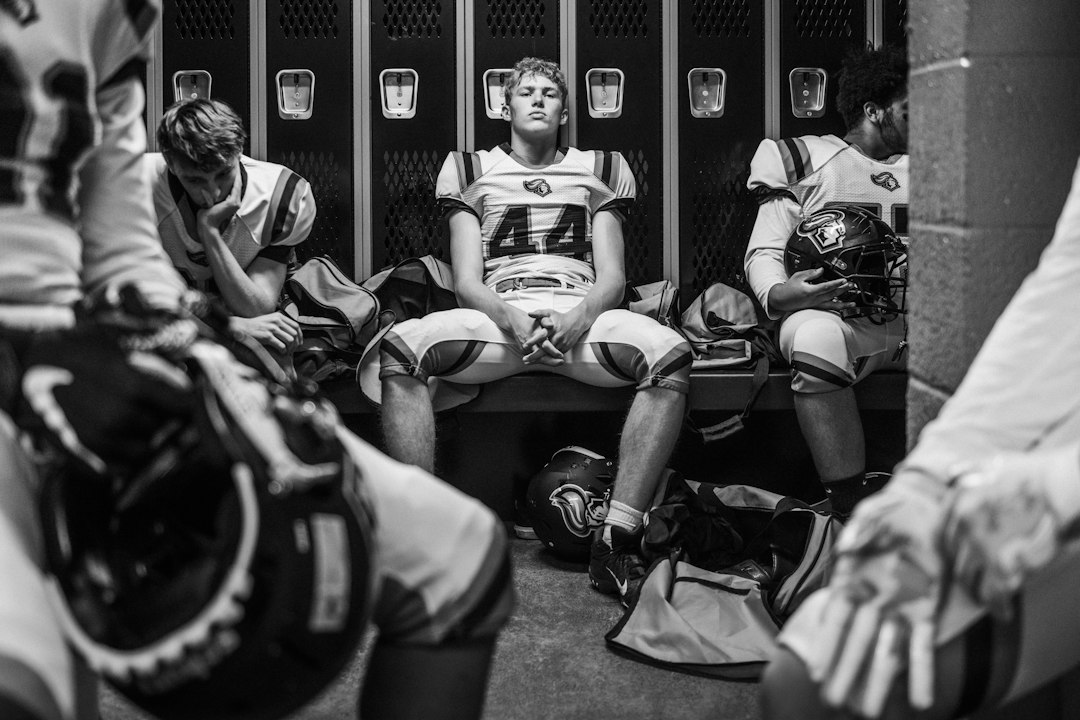




You remember the weight of it. Not sentimental weight — actual weight. The way the shoulder pads sat under the fabric, the specific pull of the collar when you turned your head hard on a snap. You remember the number. Where it sat on your chest. Whether the sleeve had two stripes or three, and whether those stripes were thick or thin based on the year your program last updated its uniform contract.
You are not looking for a fan jersey. You are looking for a jersey football custom order that gets it right — specifically right, down to the details that only make sense if you actually lined up on that field.
This guide is not for gift-buyers. It's not for spirit wear. It's for the former player who wants to reconstruct something real — a faithful tribute to the uniform you actually wore — and who has already been frustrated by templates built for people who never wore the pads.
The Problem With Every Custom Jersey Builder You've Already Tried
Most customized jersey football tools are designed around one use case: a fan who wants their name on the back of their favorite team's colors. That's a legitimate product. It's just not your product.
When you sit down with a standard builder, you immediately hit walls that wouldn't exist if the tool understood your actual question. The number placement defaults to center-chest because that's what fan-market jerseys use. But your program put the number on the upper left in the early 2000s because that's what your supplier did. The sleeve stripe pattern in the template looks close but not quite right — two stripes when yours had three, or the wrong spacing between them. The font is a rounded block when your uniform used a condensed gothic that every player from your era would recognize instantly.
These are not small details to you. These details are the difference between a jersey that feels like yours and a jersey that looks like a costume.


In our experience, former players describing what they want almost always start with the number, then immediately qualify it: "Number 54 — but on the left shoulder, not the chest, because that's how ours were." That qualifier is the whole ballgame. It tells you this person is not buying a jersey. They are recovering a memory, and they need someone who understands the precision that recovery requires.
What Former Players Actually Need to Decide (And In What Order)
Before you open any design tool, do this work on paper or in your head. The order matters because each decision constrains the next.
1. Era First, Everything Else Second
Your jersey had a year. Not just a school or a team — a specific year or range of years when your program's uniform looked the way it looked. Uniforms change on supplier cycles, on coaching changes, on budget decisions. The program that went from plain white numerals to outlined block numerals in 1997 was a different visual experience for the players who suited up before and after that change.
Ask yourself: what year did I play? What did the jersey look like that specific season? If you played across multiple seasons where the uniform changed, pick the one that feels most like yours — the one from the year that mattered most.
That era answers several downstream questions automatically:
- Number font style: Condensed, block, gothic, outlined, or drop-shadow? Programs tend to stick with a supplier's standard font package for years at a time.
- Stripe configuration: Single sleeve stripe, double, triple, none? The era tells you.
- Collar cut: Round neck, V-neck, or the wider athletic cut that became common post-2010?
- Overall silhouette: The baggier cut of 1990s uniforms versus the compression-influenced trim fit that arrived mid-2000s is immediately visible and immediately felt.
2. Number Placement Is Not Interchangeable
This is the detail that most casual jersey guides skip entirely, and it is the one former players notice most immediately.
Chest placement (center of the torso, large numeral) is the standard on fan-market and spirit-wear jerseys. It's what most templates default to.
Shoulder placement (upper left quadrant, smaller numeral) was standard in certain eras of certain programs, particularly across the 1980s and 1990s. Some programs ran both — a large chest number with a smaller shoulder identifier. Some used only the back number and a minimal front marker.
If your number lived on your shoulder, a center-chest template will never look right to you. This is non-negotiable for the former player. Identify your placement before you open any builder and look specifically for a tool that gives you genuine placement control — not just number entry.
3. The Name — And Whether It Belongs
Not all football jerseys carried a name on the back. High school programs varied widely on this. Some ran name tapes only for home games. Some ran numbers-only for away games. Some programs never used names on the back at all.
If your jersey didn't have a name on the back, adding one now is a deliberate choice — not a recreation of what you wore. That's a perfectly valid choice, but be honest with yourself about what you're making: a personalized tribute that honors your playing days, or a design that matches the specific uniform you remember. Both are worth making. They're just different products.
If your jersey did carry a name, the nameplate font almost always matched the number font. A condensed number with condensed lettering. A block number with block text. Mixing font styles across number and name is common on fan jerseys and reads as immediately off to anyone who played.
The Details That Separate a Tribute From a Template
A faithful tribute to your uniform is achievable through a custom order. An exact licensed reproduction of a program's uniform is not what custom builders produce — and that's fine, because what you actually want is something truer than a commercial product. You want the feeling of the specific jersey from the specific year you played, built around your name and your number. That's a different goal, and it's one a good custom builder can meet.
Here's where design choices produce the most meaningful difference:
Color matching: Your school colors looked a specific way under stadium lights and a different way on a Tuesday afternoon. The printed colors on a custom jersey may shift in tone. Request a physical proof or ask for Pantone-matched color options if the builder supports them. Burgundy that reads too red, or navy that reads too dark, will catch your eye every time.
Fabric weight: Modern performance fabrics are lighter and more breathable than what most programs used in the 1980s and 1990s. If you want the heavier feel you remember, look for builders who offer a heavier mesh or a twill option. If wearability today matters more than tactile fidelity, lighter fabric is a reasonable trade — just make it a conscious one.
Tackle twill vs. sublimated printing: Tackle twill — the raised, stitched numerals — is what most game jerseys used through the 2000s. It costs more on a custom order but produces the tactile dimension that flat printing cannot. If you remember your number having a raised edge you could feel with your fingers, tackle twill is what gets you there. Sublimated printing is clean and sharp for complex designs but sits flat against the fabric. Both are legitimate choices. Neither is wrong. They produce different sensory results.
One Former Player's Process
Marcus T., 41, played linebacker at a mid-size program in Texas from 1999 to 2002. He came to iPlayedFor after ordering two jerseys from general custom builders and being disappointed both times — the first had the right colors but the wrong stripe count, the second had the right stripes but defaulted to a font his program never used.
What finally worked: he pulled up three photos from his senior season before touching any design tool. From those photos, he confirmed that his program used a two-stripe sleeve design, a condensed block numeral on the upper chest rather than center-mass, and a nameplate font that was slightly narrower than standard block. He built his design spec from the photos first, then found a builder whose tool had enough placement and font flexibility to match what he'd documented. The third jersey was the right one.
The photos-first approach is what our team recommends to every former player who reaches out about this process. Your memory is the starting point. The photos are the specification.
A Note on the Broader Custom Jersey Landscape
If you've been searching for jersey customization options, you've likely encountered results spanning multiple sports — Mexico national team jersey customization, New York Yankees jersey personalization, San Antonio Spurs jersey orders, New York Mets jersey design tools. These appear because the custom jersey market is broad and search results cluster across sports categories.
What those searches reveal is actually useful context: buyers of a Mexico soccer team jersey tribute want the specific crest placement and collar style of a particular era. A fan ordering something in the style of a New York Yankees jersey wants the correct script weight and pinstripe proportion. The specificity of what makes a jersey feel right is not unique to football — it is universal to anyone who cares about a particular uniform from a particular moment.
Your situation differs from those in one important way: professional and national team designs involve licensed intellectual property. Your high school or semi-pro jersey did not. That means you have more design freedom and more design responsibility simultaneously. No one hands you the spec sheet. You build it from memory, photographs, and a builder with enough flexibility to meet you there. According to USA Football's guidelines on youth and amateur program uniforms, uniform standards at the high school level have historically varied significantly by state association and supplier — which is precisely why your program's specific choices in a given year were genuinely unique to that program.
How to Evaluate a Custom Jersey Builder as a Former Player
Not every builder is equipped for this use case. Here is how to filter quickly before investing time in a design session.
Four questions to ask before committing:
- Can I control number placement independently — shoulder position versus chest position, with size control separate from placement?
- How many numeral font options are available, and can I preview them at actual scale before finalizing?
- Can I request a physical or digital proof before the order goes to production?
- Is tackle twill available as a construction option, or is this builder sublimation-only?
If a builder cannot answer these questions — or if the design tool doesn't surface these controls — it is built for fan orders. Move on.
What a builder equipped for former players will give you control over:
- Number placement (position on the body, size, not just the numeral entered)
- Font selection with full-scale preview
- Sleeve stripe configuration (count, individual stripe width, color per stripe)
- Construction method (twill, sublimated, heat transfer)
- Collar style and cut silhouette
That list of controls is your checklist. A builder who offers all five is worth your time. A builder who offers two is not built for what you're making.
Frequently Asked Questions
Can I design my own custom jersey, or do I have to use a pre-built template?
You can design your own — but the degree of control depends entirely on the builder. Most platforms use a base template as a starting point and let you customize within it. The better builders give you enough parameter control that the template becomes a starting canvas rather than a constraint: you're specifying placement, font, stripe configuration, and color rather than adjusting a locked design. For former players, the right question to ask is not "how many templates do you have?" but "how much placement and font control does your tool give me?" Templates are the starting point. The control layer is what determines whether the result looks like your jersey.
How do I figure out how to custom jersey-match what my program actually used?
Photographs are the most reliable source — game photos, yearbook photos, team photos where the front of the jersey is visible. If you don't have personal photos, reach out to former teammates or your program's alumni office. Many programs retain archive photography going back decades. Failing that, recall what the number looked like when you looked down at yourself: if you could see it clearly at a glance, it was center-chest or upper-chest. If it was partially obscured by equipment and only fully visible straight-on, it was likely a smaller upper-left or shoulder position. One detail worth remembering: the specific weight and texture of the numeral — raised and stitched, or flat-printed — is often one of the clearest memories former players carry. That tells you whether your program used twill construction or a printed application.
How long does a personalized football jersey order typically take?
Production and shipping timelines vary by builder and by construction method. Sublimated jerseys generally run two to three weeks from proof approval to delivery. Tackle twill construction adds time because the stitching process is separate from the base fabric production — budget three to five weeks for a high-quality twill order. Rush options exist at some builders for an additional cost. If you're ordering for a specific occasion, work backward from that date and add one week of buffer. The variable most people underestimate is proof approval turnaround — have your design spec documented before you start so you can review and approve the proof quickly rather than spending days going back and forth on details you could have resolved before the session began.
Your jersey is still out there waiting.
Design yours in minutes and see your name and number exactly the way you remember it.
See also: personalized sports gifts that actually make a former athlete feel seen | the psychology behind why high school sports memories hit differently as an adult | athletic identity that doesn't disappear just because the season ended | before you order, make sure you get the right fit with this jersey size chart