

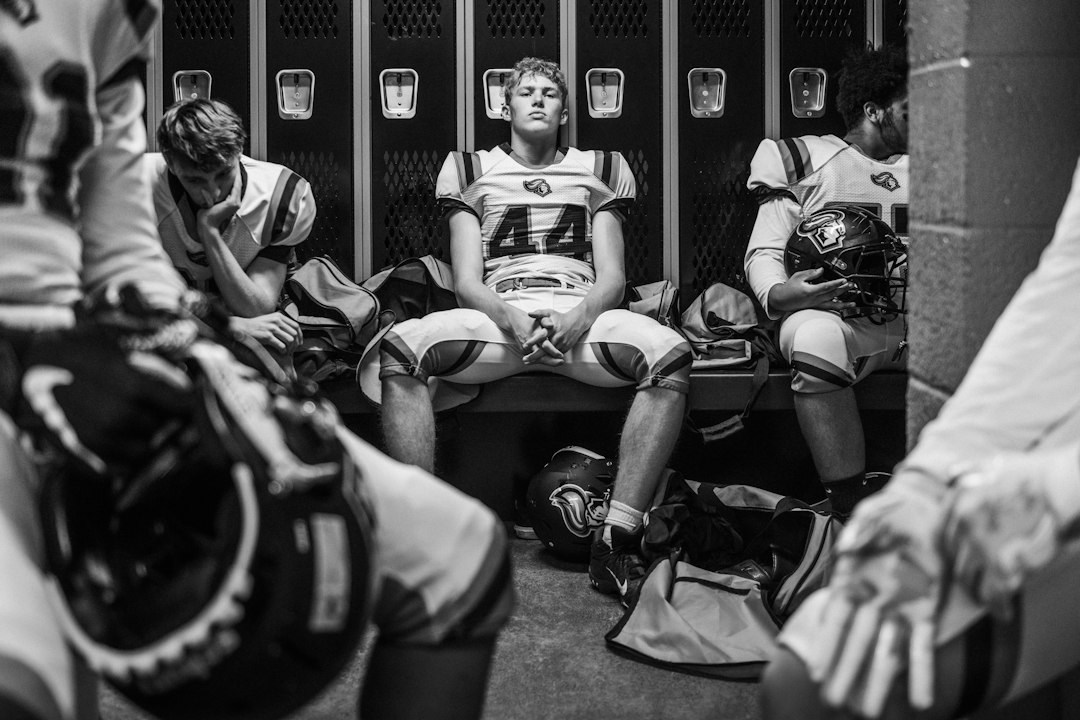




There's a specific moment most former athletes can pinpoint — not the last game, not the final whistle, but the morning after. The world kept moving. Practice didn't start at six. Nobody called a play. And something inside you that had always known exactly where it stood went quiet in a way that felt permanent.
Being an ex-athlete is one of the most universal experiences in sport — and one of the least talked about with any honesty. This piece doesn't offer a five-step recovery plan. It offers something most articles won't: the specific truth of what that identity shift actually feels like, why it hits the way it does, and how former athletes — across every sport, every level, every era — eventually find their footing again.
When the Game Ends, Part of Your Map Disappears
For most people, identity is built gradually — through career, family, relationships, interests layered over decades. For athletes, it happens differently. From the moment you're old enough to wear a uniform with your name on the back, the sport begins to do enormous identity work on your behalf.
It tells you when to wake up. It tells you what to eat, how to move, who your people are. It gives you a role in every room you enter: you're the point guard, the outside hitter, the middle-distance runner. The sport is not something you do — it is something you are. And you are it, with a completeness that most non-athletes spend their whole lives searching for in other places.
This is not an accident. Research from the Journal of Sport and Exercise Psychology has examined athletic identity — the degree to which an individual identifies with the athlete role — and found that athletes who report the strongest athletic identity also experience the most significant psychological disruption when that identity is removed. High identification is an asset during competition. It becomes a vulnerability the moment the competition stops.


The word for this in sport psychology is foreclosure — not in the financial sense, but in the developmental one. When a person's identity is built almost entirely around a single role, and that role ends, the internal architecture doesn't simply rearrange itself. It has to be rebuilt from scratch. And rebuilding something from scratch, as any athlete knows, is not a weekend project.
What makes it harder is that nobody around you has a framework for what you're experiencing. Your family sees someone who retired from a sport. Your employer sees a competitive, disciplined former athlete — an asset. Your friends see someone who should be relieved the pressure is over. None of them see the specific interior experience of waking up without a practice schedule for the first time in fifteen years and genuinely not knowing who you are at six in the morning.
Every Former Athlete Remembers the First Week
If you played, you know the particular dissonance of that first week without structure.
Not the first day — the first day can feel like a vacation. The soreness is there but the pressure isn't, and that's almost pleasant. It's around day four or five that it starts. The restlessness. The low-level irritability that doesn't attach itself to any specific grievance. The sensation of being in the wrong gear with nowhere to shift.
For high school athletes, it arrives the September after senior year — that first week of a school year where there are no two-a-days, no roster announcements, no weight room check-ins. For college athletes, it's often the spring semester of senior year, when the last season ends months before graduation and there's a strange dead zone of still being at school but no longer being what school was for. For professional athletes, it comes with the specific brutality of contractual finality — a team stops calling, and the structure of an entire adult life evaporates overnight.
The circumstances vary. The interior experience is remarkably consistent.
In our experience talking to former athletes across dozens of sports, the sensation almost everyone describes first is not grief — it's disorientation. The grief comes later. What comes first is the feeling of moving through a space that used to have walls and suddenly doesn't. You were defined by a set of edges. Now the edges are gone, and you don't know where you end.
The Invisible Second Career of Being an Ex-Athlete
Here is what nobody tells you about life on the other side: being an ex-athlete is not a phase you pass through on the way to becoming something else. It is a permanent part of what you are. The identity doesn't expire — it transforms.
This matters because a lot of the conventional wisdom around athletic transition treats it as a problem to be solved. Move on. Find the next chapter. Translate your skills. That framing implies that the athlete identity should be left behind — that maturity means outgrowing the jersey. This is both factually wrong and unnecessarily painful.
The athlete you were did not disappear. They became the foundation everything else is built on.
Karla M., 34, played Division I soccer for four years before a knee injury ended her playing career in her junior season. She spent two years after graduation actively avoiding anything that reminded her of the sport — no pickup games, no coaching offers, no watching matches. "I thought distance would help," she said. "What actually helped was the day I realized I wasn't done being an athlete. I'd just changed arenas." She now coaches club soccer on weekends and describes it as the first time since her injury that she felt fully herself.
Karla's story is common in its arc — not the specific details, but the underlying logic. The former athlete who tries to perform a clean break from their sport often finds the break costs more than the sport did. Because the sport wasn't just the sport. It was the structure for how that person processes challenge, relates to community, finds meaning in effort, and orients themselves in the world.
Those things don't stop being true when the final whistle blows.
What the Game Actually Gave You (That You Still Have)
It's worth naming specifically what competitive sport installs in a person — not as a recruiting pitch, but as an inventory. Because the former athlete who understands exactly what they carry has a much cleaner path to figuring out where to put it.
What sport builds that transfers completely:
- Tolerance for discomfort with a purpose. Athletes learn early that suffering is not the same as failing. Pain in service of a goal is productive. This distinction — which most people never develop — is an extraordinary life asset that never expires.
- The ability to function in systems. You know how to be part of something larger than yourself. You understand role clarity, deference to process, and what it means to subordinate individual preference to collective outcome. This transfers to every professional environment, every family, every team structure you will ever enter.
- Comfort with coaching. Athletes are uniquely prepared to receive feedback without defensiveness — not because they're emotionally inert, but because they were trained young to understand that criticism is an investment in their performance, not an attack on their worth. This is rarer than it sounds.
- A specific relationship with time. Seasons end. Careers end. Athletes internalize the finitude of competitive windows earlier and more viscerally than almost anyone else. This can produce anxiety — but it can also produce a clarity about urgency and intention that becomes a genuine advantage.
The list doesn't end there. But those four things alone represent a psychological architecture that most people spend decades trying to build — and athletes receive it as a byproduct of participation.
The transition grief is real. The loss is real. And simultaneously, what was given is permanent and substantial.
The Specific Grief That Doesn't Have a Name
There is one dimension of being an ex-athlete that deserves its own section, because it's the one most former athletes report feeling most alone in: the grief for the version of yourself that existed inside the sport.
That version was not better or worse than who you are now. But they were specific. They had a physical capability, a competitive acuity, a way of inhabiting their body that was trained over years into something precise and powerful. And that specific version of yourself cannot be fully recovered, regardless of how much you train or compete recreationally.
If you played, you know the specific feeling of watching yourself on old footage — not with vanity, but with the particular recognition that you are watching someone who could do something you can no longer do at that level. The footwork, the reaction time, the specific physical intelligence developed through ten thousand repetitions. It belonged to that window of your life, and that window is closed.
Letting yourself grieve that — without explaining it away, without minimizing it as "just a game," without rushing toward silver linings — is not weakness. It's accuracy. Something real was lost. Naming the loss precisely is not the same as being defined by it.
The former athletes who carry that grief most lightly are not the ones who resolved it fastest. They're the ones who acknowledged it most honestly.
Finding Your Arena Again
The question former athletes eventually face is not who am I without my sport — it's where does this identity belong now?
The answer looks different for everyone. Some find it in coaching — not as a consolation prize, but as a genuinely different version of the same competitive investment, redirected toward someone else's development. Some find it in team-structured professional environments where the dynamics of sport translate directly. Some find it in endurance challenges — marathons, triathlons, obstacle races — that give the athlete identity a present-tense outlet without requiring a return to the specific sport that ended.
Some find it in something simpler and quieter: the act of claiming the identity explicitly rather than abandoning it. Saying I played not as an apology for the past but as a statement about who they still are.
That's not nostalgia. It's honesty.
The jersey you wore doesn't become meaningless the moment you hang it up. The name on the back doesn't stop being yours. The number you wore through two seasons, or four years, or an entire decade of your life — it carries something that generic athletic wear never will. It carries the specific evidence that you were there, that you competed, that it mattered.
Being an ex-athlete means carrying that forward — not as a burden, but as the foundation everything else is built on.
Your jersey is still out there waiting.
Design yours in minutes and see your name and number exactly the way you remember it.
Frequently Asked Questions
Is it normal to feel depressed or lost after retiring from sport?
Yes — and it's more common than most people realize. Research on athletic transition consistently shows that former athletes with strong athletic identities are at elevated risk for depression, anxiety, and identity disruption following the end of their competitive careers. This is not weakness, and it is not a sign that sport was a negative force in your life. It's a sign that sport did exactly what it was supposed to do — it built a central identity — and that transition requires real psychological adjustment. If the feeling persists or becomes severe, speaking with a therapist who has experience in sport psychology is a genuinely useful step, not an overreaction.
How long does the identity transition after sport take?
There is no universal timeline. Some former athletes find their footing within months; others report that the full transition takes several years. The length is not a measure of how much you loved the sport or how well you're adjusting — it reflects the depth of integration between your self-concept and your athletic identity. Athletes who competed at higher levels, for longer periods, or who had their careers ended by injury (rather than natural retirement) tend to report longer and more complex transitions. What matters is direction, not speed.
Does the athlete identity ever fully go away?
In our experience, it doesn't — and trying to make it go away often causes more disruption than accepting it as permanent. What changes is not the identity itself but its relationship to the present tense. The former athlete who tries to leave their sport identity behind often describes a persistent sense of something missing. The former athlete who finds ways to carry it forward — through coaching, competition in new arenas, community, or simply claiming the identity explicitly — tends to describe a coherence that the first group doesn't. The goal is not to stop being an athlete. It's to figure out what being an athlete means now.
Is it okay to still feel proud of what you accomplished in sport, years later?
Not only is it okay — it's accurate. What you built through years of training, competition, and commitment was real. The discipline, the resilience, the specific physical intelligence, the experience of competing at whatever level you reached — none of that becomes less true because time passed. Pride in what you accomplished is not living in the past. It's acknowledging something that actually happened and that actually shaped who you are. The former athlete who dismisses their playing days as irrelevant doesn't become more grounded — they just carry the same identity with less access to what it built.
See also: athletic identity after high school | grief that comes with the end of your athletic career | what high school sports actually taught you