

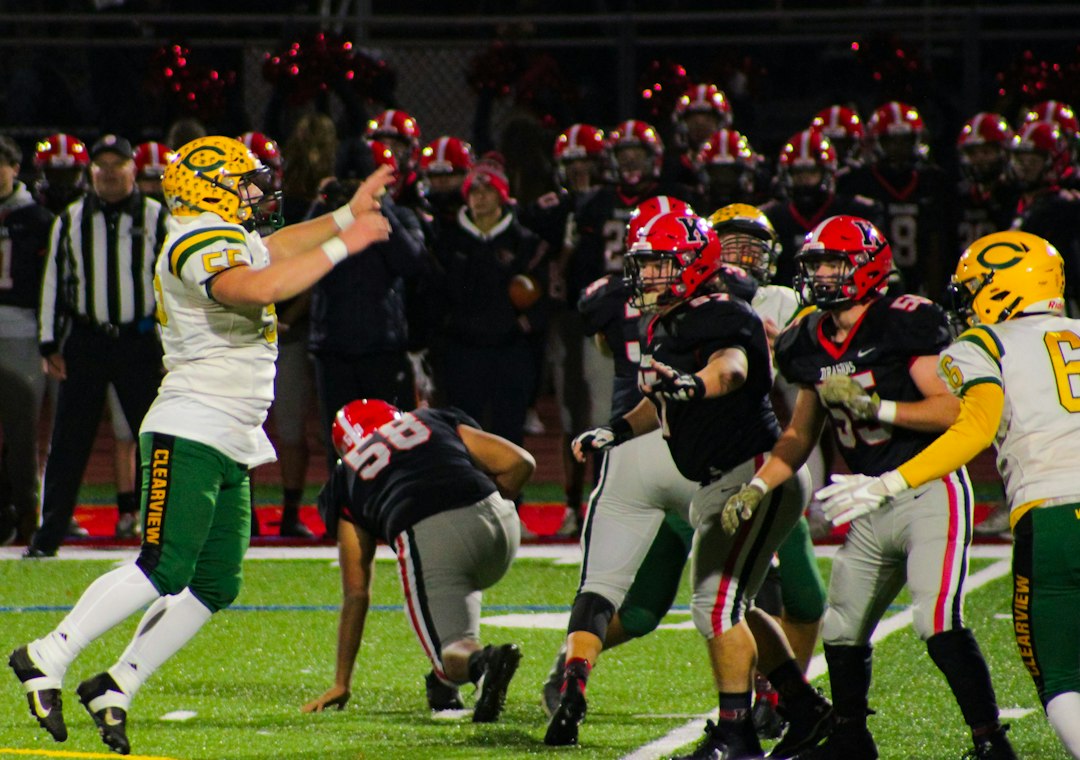




There's a specific kind of quiet that settles over a locker room the night before a championship game.
Not silence exactly — someone's always taping their wrists, someone's always bouncing a knee, someone's always listening to something through one earbud that the rest of you can barely hear. But underneath all of that, there's a hush that every player who has ever been in that room knows by feel. You don't describe it to people who weren't there. You don't even try.
If you were a high school senior during championship week — if you were the one who had played through four years of early mornings and late film sessions to arrive at that exact room, in that exact moment — then you already know what this piece is about before you've read another sentence.
And if you're the kind of national championship former player who still catches yourself thinking about that week at odd, unannounced moments, decades later? This one's for you.
The Week That Operated Outside of Normal Time
Championship week does something to the calendar. The seven days leading up to a state or national title game don't feel like ordinary days. They feel elongated — like someone stretched Monday into Tuesday and left extra room in every hour for things you couldn't name yet.
In our experience covering athlete memory and the stories that stick longest, championship week comes up more than any other single window of time. Not the game itself — the week. The bus ride to the neutral-site field. The walkthrough in a gymnasium that wasn't yours. The way the hotel's carpeted hallways smelled different from home and somehow made everything feel more serious.
That week had its own logic. School still technically happened, but nobody was really there. Teachers looked the other way when the seniors on the team fell asleep in third period. The hallways had a different electricity — people who had never come to a single game all year were suddenly wearing the school colors, suddenly invested, suddenly part of something they were watching from the outside of but that you were standing in the center of.


You were a high school senior. You were eighteen or seventeen or still somehow sixteen. And the whole school — the whole town, in some cases — had turned its attention toward the field where you played.
That is an experience that marks a person. Not just for a season. For a life.
What Seniors Carry That No One Else Does
There's a particular weight to being a senior during championship week that underclassmen can't quite access, no matter how talented they are or how much they contribute.
The underclassman knows they will come back. They know there is another season, another chance, another year in that uniform. The senior knows — in the particular, embodied way that the body knows things before the mind fully processes them — that this is the last time.
The last time wearing that number. The last time pulling on that specific jersey in that specific locker room with those specific people. The last time the bus ride is heading somewhere that matters this much, with this group, under these lights.
That knowledge does something to the experience of championship week that is hard to explain but impossible to miss if you felt it yourself. It makes the ordinary extraordinary. It makes the routine — the film session, the walk-through, the pre-game meal — feel sacred.
A lot of former players describe a heightened sensory awareness during their final championship week. The way the grass looked under the stadium lights during warmups. The exact temperature of the air. The sound of pads hitting pads during the final practice. These details are stored with unusual fidelity because the body knew, on some level, to pay attention. This was worth remembering.
Mia T., 34, a former high school point guard from outside Cleveland, describes it this way: her school had won its regional title the year before, but she was a junior then. Senior year, returning to that same gym for the district finals, she said it felt like she was watching herself from slightly outside her own body — aware of every detail in a way she hadn't been twelve months earlier, because now she understood it would not come again. She still keeps a photo from that night on her desk. Not from the win. From the warmup layup line. The team mid-motion. The crowd behind them just beginning to fill.
That's the one she kept.
The National Championship Former Player and the Weight of Representation
When a team reaches a championship game — whether that's a state title, a national championship at the small-school level, or any equivalent peak — something shifts in the relationship between the players and the community around them.
You stop being just a team. You become a symbol of the place.
For the seniors, that symbolic weight is especially pronounced. You have lived in this town. You have played in this program. You have come up through the system that everyone around you is now watching from the stands or following on their phones. And in that championship week, you carry not just your own ambition but the accumulated hope and pride of every person who invested in the program before you, every parent who drove to 6 AM practices, every younger player who watched you and dreamed of one day being where you now stood.
That's not a small thing to carry at seventeen or eighteen.
And yet — here's what most retrospective accounts of championship week miss — it doesn't feel like a burden in the moment. It feels like fuel. The weight of it becomes the thing that gets you out of bed on that final Tuesday morning when your body is sore and your mind is nervous. The weight is what makes the warmup feel different from every warmup you've done before.
National championship former players often describe a kind of clarity that arrives during that week. The noise — social, academic, everything outside the game — falls away. What's left is the work, the teammates, and the specific, concrete goal. Many describe it as the most focused they have ever felt in their lives. Not stressed. Focused. There's a difference, and championship week teaches it.
The Locker Room After: Win or Lose
Here is the truth that championship games produce in both directions: the locker room after is one of the most honest places a person can be in their entire life.
If you won — if the confetti fell on your side, if the trophy came to your sideline, if your team was the one celebrating at midfield — then the locker room after is a kind of controlled chaos. Pure, unfiltered joy. The specific sound of a room full of people who have held something inside for months and are finally releasing it all at once. Coaches you had seen as invulnerable showing emotion you didn't know they contained. Teammates who had barely spoken all week now unable to stop talking, laughing, holding the moment in both hands.
If you lost — and many seniors have stood in that other locker room, the quiet one, the one where the fluorescent lights seem a shade too bright — then the experience is entirely different and, in a strange way, just as formative. The specific grief of a final game lost is a loss unlike others. It is the closing of a door. It is the last time in that uniform, in that role, in that chapter. And the people in that room with you, in that specific grief, become permanently significant in a way that is difficult to explain to anyone who wasn't there.
Both rooms matter. Both rooms shape who a person becomes.
The former player who stood in the winning locker room carries a particular kind of confidence forward — the lived knowledge that the hardest thing they'd ever attempted had worked. The former player who stood in the losing locker room carries something equally valuable: the knowledge that they had given everything and that the giving itself was not diminished by the outcome.
In our experience talking to athletes across all levels and sports, the ones who describe championship week as transformative rarely qualify it by whether they won or lost. The transformation happened in the week itself. The game was the punctuation, not the sentence.
What the Jersey Actually Meant
You wore a jersey that week that meant something different than it had during any regular-season Friday night.
The name on the back — your name, your number — had been earned through a specific, concrete, years-long process. You had been in that uniform for four years. You had run in it, been hit in it, gotten back up in it. You had worn it in games that nobody but your parents came to watch and in games that the entire region knew about.
By championship week, that jersey was not a uniform. It was documentation.
It documented every practice you had attended, every conditioning run you had finished, every film session, every off-season workout, every time you had shown up when showing up was the hardest thing. The number on your back had accumulated all of that. When you pulled it on for the final time — in that locker room, with those teammates, before that game — you were not just putting on fabric and thread.
You were putting on everything the last four years had been.
That is not a small thing. That jersey connected you backward in time to every version of yourself that had made the choice to keep going, and it connected you forward in time to whatever kind of person this experience was shaping you to become.
There's a reason so many former players describe an almost instinctive reaction when they see a photo of themselves in that jersey: the response is immediate and specific. Not general nostalgia. The specific weight of that particular thing. That specific number. Those specific colors.
The Person You Were That Week Still Exists
Here is what takes the longest to understand after championship week is over and the years have put distance between you and the field:
The person you were during that week — focused, purposeful, connected to something larger than yourself, belonging completely to a specific time and place and team — did not disappear when the season ended.
That version of you became part of who you are.
The focus that championship week demanded became a tool you carried into everything that came after. The capacity for belonging — for being one member of a group working toward a single thing — that is not a skill unique to athletics. It translates. It has been translating, in your life, in ways you may or may not have named.
Former players who talk about their championship weeks rarely frame them as the best days of their lives in a way that implies everything since has been lesser. The best of them frame it differently: that week taught them something specific about what they were capable of, and they have been living out the proof ever since.
That's the real gift of championship week. Not the trophy. Not the banner. The specific, embodied knowledge of what happens when a person gives everything they have toward something that genuinely matters, with people they genuinely care about, under conditions that genuinely test them.
You know what that feels like. You have always known. And that knowledge doesn't expire.
Your jersey is still out there waiting.
Design yours in minutes and see your name and number exactly the way you remember it.
Frequently Asked Questions
What does "championship week" mean to a national championship former player differently than to other athletes?
For a national championship former player — especially one who was a senior — championship week carries a finality that regular-season play does not. It is the convergence of everything the program has worked toward, compressed into a single week, amplified by the knowledge that this is the last time this specific group of people will do this together. That combination of peak stakes and irreversibility is what makes the week so memorable and so formative, often more than the game itself.
Why do former high school athletes remember championship week more vividly than the actual game?
The game unfolds quickly and in a state of intense focus — many players describe the game itself as a blur, the fastest two to three hours they can remember. The week before, by contrast, is slower, more conscious, more deliberately experienced. The body and mind seem to register that something rare and important is happening, which creates the heightened sensory encoding that produces vivid, lasting memories. The bus ride, the locker room, the walkthrough — these slower moments are stored with unusual detail.
Does the memory of championship week fade over time?
The emotional core of championship week — the sense of belonging, purpose, and shared effort — tends to remain remarkably stable over decades. What shifts is context: the older a former player gets, the more clearly they can articulate what that week gave them beyond the immediate experience. Many describe their understanding of championship week deepening over time rather than fading, as the skills and qualities it built become more identifiable in their adult lives.
Is it normal for former players to feel emotional when they see photos or highlights from their championship week?
Completely normal, and well-documented in athlete experience research. The emotional response to championship-related memories is connected to what psychologists call "self-defining memories" — experiences that were high in intensity, emotionally significant, and tied to core identity formation. Championship week checks every criterion. The emotional response when encountering those images is not sentimentality. It is the recognition of a genuinely formative experience.
How can a former player honor what championship week meant to them?
The most direct way is to reconnect with the tangible artifacts of that experience: the photos, the game programs, the conversations with former teammates. Many former players also find meaning in representing the experience visually — having a custom jersey made with the name and number they wore that week is one of the most common ways players described reconnecting with that version of themselves. It is not about living in the past. It is about acknowledging that the past built something worth acknowledging.
See also: why high school sports still matter to adults long after the final whistle | the grief nobody talks about when your athletic career ends at 18 | why your senior season memories stay sharper than almost anything else | senior night and the last home game ceremony that still gets you emotional