

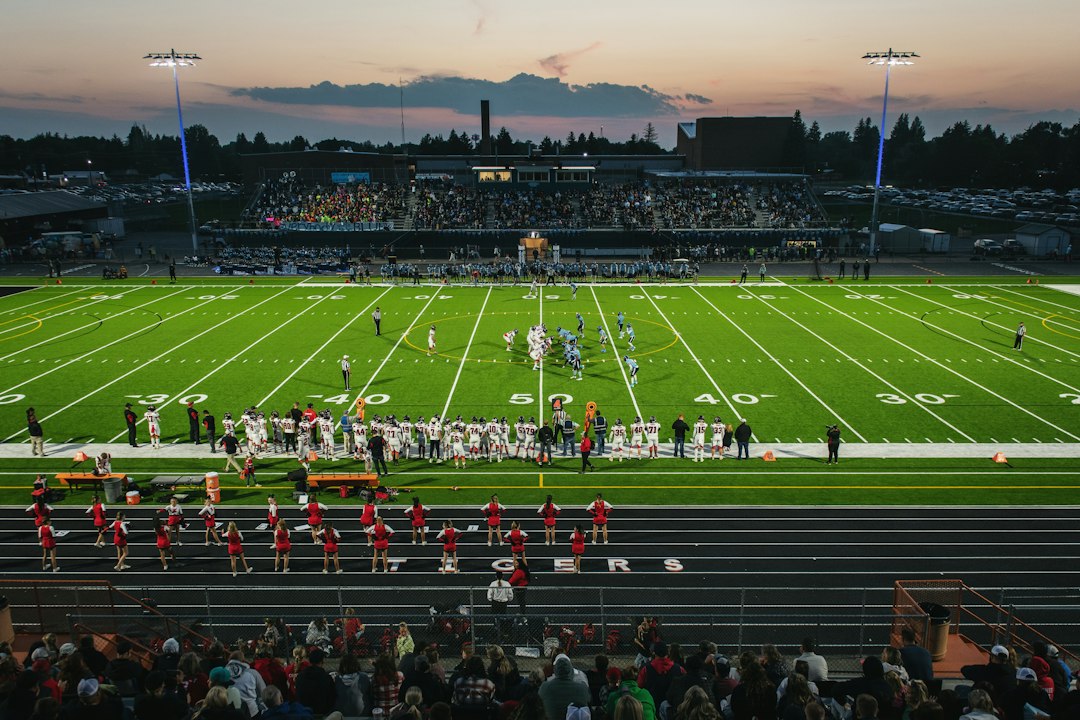




What Muskego's playoff run means to everyone who ever played Friday night football is something no box score will ever capture — but every former player who reads these rankings feels it immediately, somewhere in the chest, before they've even finished scanning the standings.
Muskego is still at the top. Four consecutive weeks at number one in the Wisconsin Top 25. A 63-0 first-round statement over Milwaukee Hamilton-Audubon. Eleven teams in the top 25 still undefeated heading into the second round. According to SI High School Sports, the Warriors' grip on the top spot is firm — and the bracket is about to start answering the questions the regular season left open.
If you ever pulled on shoulder pads in November, you already know exactly what those kids are carrying into this week.
Muskego Is Rolling — And the Rest of Wisconsin Is Watching
The margin tells the story before anything else does. Sixty-three to nothing is not a football score — it's a declaration. It says: we are not here to survive the first round. We are here to remind everyone watching what we're capable of.
Four consecutive weeks at the top of a statewide poll means something different in a playoff week than it does during the regular season. During the regular season, the number-one ranking is a reward for what you've done. In the playoffs, it becomes a target. Every program left in the bracket knows where Muskego sits. Every coordinator who pulls up film this week starts with the Warriors.
And Muskego knows that too.
That dynamic — being the team everyone is preparing for — is one of the stranger psychological experiences in team sports. The pressure isn't external. It's internal. It's the weight of expectation that the team has built for itself, week by week, by continuing to win and continuing to do it decisively.


For anyone who ever played on a ranked team, that feeling is specific and familiar. You want to be at the top. And then you get there, and you realize the top has its own particular kind of pressure that nobody warned you about.
What Playoff Week Actually Smells Like
The media covers scores. The rankings cover records. Neither one covers what Tuesday practice feels like in a playoff week.
It's quieter than a regular-season Tuesday. Not because the coaches have called for quiet — nobody has to. It's quiet because the players feel it. Something is at stake in a way that is different from every other week of the season, and seventeen-year-olds who don't yet have language for that feeling carry it in their posture instead.
The coaches are different too. Even the ones who are loose all season long get a little tighter around the eyes in playoff weeks. The assistant who normally cracks jokes during stretching goes silent. You notice it. Everyone notices. Nobody mentions it.
The bus ride to an away playoff game has a texture that is completely unlike any regular-season bus ride. Guys who normally have headphones in and are mouthing lyrics are just sitting there, watching the highway and the darkening fields and the sky, running through assignments in their heads, or maybe not thinking about football at all — just sitting with the weight of what's coming.
Every former player knows that bus ride. You were somewhere between focused and terrified, and the two feelings were so close together you couldn't always tell which one was which.
Muskego's players are on that bus right now. So are the players from ten other undefeated programs across Wisconsin. So is every kid still alive in the WIAA bracket, ranked or not, because the bracket does not care about the poll.
The Eleven Undefeated Programs and What They're Protecting
There is a specific kind of pressure that comes with carrying a perfect record into a playoff run that is different from ordinary winning pressure.
When you've lost before, you're playing to get something back. When you've never lost, you're playing to protect something that has never been broken. Those are not the same psychological state. Protecting feels more fragile than chasing, even when the scoreboard mechanics are identical.
Eleven programs in Wisconsin's top 25 have not lost a game this season. Eleven locker rooms full of kids who have built something together — through August two-a-days, October rain, and every close game that could have gone the other way — and have not yet had to experience what it feels like when it falls apart.
Some of them will experience that feeling this weekend. That's what the second round does.
Marcus T., 34, played linebacker for a central Wisconsin program that finished the regular season 10-0 and lost in the second round of the playoffs. He still talks about that week — not the loss itself, but the ten weeks before it — as one of the most clarifying experiences of his life. "It wasn't about the loss," he said. "It was about understanding what we'd built. Ten weeks where nobody could break it. I've had jobs and whole years that didn't teach me as much about what commitment actually looks like as that season did."
That's the thing about a perfect record in November. The streak ends eventually — for almost everyone, it ends before a state title. But the thing you built to get there doesn't end with it.
The Classic 8 Co-Championship and the Business of Shared Titles
Muskego enters the playoffs as a Classic 8 Conference co-champion, a detail that gets a footnote in most rankings coverage but deserves more than that.
Co-championship is a complicated emotional territory for any team that has lived inside it. There is genuine pride — the record is real, the work was real, nobody handed it to you. But there is also the unresolved feeling that comes from knowing another program is holding the same trophy, calling themselves the same thing, having had a season that the standings couldn't separate from yours.
The playoffs exist, in part, to resolve exactly that ambiguity. The conference schedule can produce ties. The bracket cannot.
Muskego's 63-0 opener suggests the Warriors are not interested in leaving anything ambiguous. That margin is not accidental. It's a team playing the way it has practiced — fully, decisively, without pulling back — and finding out that its preparation is more than sufficient for the moment it's in.
Former players understand this kind of performance intuitively. You've been in games where the other team was supposed to challenge you and instead you came out of the first quarter with a lead that made the rest of the night feel almost dreamlike. Those games don't make you overconfident. They make you believe. And belief carried correctly is different from confidence — you can manufacture confidence, but belief has to be built over months.
Muskego has been building it since August.
What November Football in Wisconsin Actually Demands
Let's be honest about the conditions, because they matter.
Wisconsin in late October and November is not a neutral backdrop for football. The turf can be frozen or muddy depending on the week. The wind in the upper Midwest finds every gap in your uniform. Your breath is visible during warmups. Your fingers take the first ten minutes of practice to start working correctly, and by the time they do, you've already run through enough reps that the cold doesn't matter the way it did when you first walked out.
And yet — ask any former player who played meaningful games in the cold — and most of them will tell you they'd take November football over September football every time.
The cold removes the casual. Nobody who is casual about football is still playing it in Wisconsin in November. The teams that are left in the bracket are teams that wanted it enough to keep building when the weather stopped cooperating, when the crowds thinned out for Thursday practices, when the work stopped being exciting and started just being work.
By November, the field has sorted for the right things.
Every former player who ever taped up in a cold locker room and walked out into a night that hit them like a wall knows what the WIAA playoff field is made of right now. These are not players who showed up because it seemed fun. These are players who showed up every day of a season that has been getting harder and colder and more consequential, and kept showing up.
That means something. In our experience covering this sport and talking to people who played it, the players who make it to November in a northern-climate program carry a specific kind of toughness that doesn't always show up in rankings or scoring margins — but shows up immediately when the conditions get difficult.
The Number on Your Back
Here is what no ranking ever captures, and what no broadcast camera ever quite catches.
Your number.
Not your school's ranking. Not your conference standing. The number on the back of your jersey — the one that was yours for those years, that the student section saw when you came out of the tunnel, that your family found in the crowd when the teams lined up for the opening kick.
Numbers in high school football carry a weight that is completely out of proportion to what they literally are, which is just ink on fabric and thread on mesh. But they become something else entirely when you're wearing them in a game that matters. They become the shorthand for everything you were during those seasons — the work you put in before anyone was watching, the teammates who knew your tendencies better than you knew your own, the Friday nights you will be able to describe in specific sensory detail when you are decades removed from them.
Muskego's players have numbers on their backs this weekend. So do the players from every undefeated program in the top 25. So does every kid still alive in the WIAA bracket.
And the strange thing about numbers is that they don't fully belong to you until after you've stopped wearing them. When you're inside the season, you're too close to see it clearly. It's only later — sometimes years later, sometimes a conversation with an old teammate later — that you understand what it meant to have your name above that number, on that field, with those people, in that cold.
The kids playing this weekend don't know that yet. They will.
Your Jersey Is Still Out There Waiting
The players on those Wisconsin fields this weekend still have theirs. For the rest of us, the jersey lives in memory — the specific weight of it across the shoulders, the number a little worn at the edges by November, the way the fabric smelled after a cold game when everything was spent.
Design yours in minutes and see your name and number exactly the way you remember it — a tribute to the seasons that shaped you, built for the person you became because of them.
Frequently Asked Questions
What is the WIAA and how does Wisconsin structure its high school football playoffs?
The WIAA — Wisconsin Interscholastic Athletic Association — governs high school sports across the state, including football. The playoff structure divides schools into divisions based on enrollment, so programs compete against comparable-sized schools rather than facing mismatched opponents. Each division runs its own bracket through multiple rounds, ultimately crowning a state champion per division in late November. The result is a playoff system that rewards the best teams at each enrollment level rather than defaulting to a single open bracket where large schools dominate small ones.
How is the Wisconsin high school football Top 25 ranking determined?
The Wisconsin Top 25 is a statewide poll that evaluates programs across all divisions based on overall performance, strength of schedule, scoring margins, and quality of wins assessed by voters who cover high school football across the state. It is not division-specific — a dominant smaller-school program can rank ahead of a larger-school program if the overall body of work supports it. Rankings update weekly throughout the regular season and into the playoffs, giving a real-time picture of which programs are performing at the highest level statewide.
What does it mean for Muskego to be a Classic 8 Conference co-champion?
The Classic 8 is one of the prominent high school football conferences in southeastern Wisconsin. A co-championship happens when two programs finish the conference schedule with identical records, sharing the title rather than one team claiming it outright. For Muskego, the co-championship reflects how competitive the Classic 8 was this season — the standings couldn't separate the top programs on record alone. The WIAA playoffs serve as the natural resolution: the bracket produces a definitive outcome that conference schedules sometimes cannot.
Can former players get a custom jersey in the style of what they wore in high school?
Yes. Custom jersey services let you choose your sport, your number, your name, and colors inspired by your school's palette — creating something in the style of what you wore without requiring any team licensing. The result is personal rather than generic: your name, your number, a tribute to the seasons you actually played. For many former players, that turns out to be more meaningful than any off-the-shelf option, because the jersey was never really about the school crest — it was about the number that was yours.
What makes the WIAA second round the real test of a playoff run?
The first round of the WIAA playoffs is structured to reward higher seeds with more manageable opening matchups. The second round is where that changes. By the second round, every program still in the bracket has proven it belongs — which means every matchup carries genuine uncertainty, and margin of victory is no longer predictable from seed differential alone. For players and coaches, the second round is where the real evaluation begins. It's also where undefeated records most often meet their first serious test, because the opponents who reach the second round have earned their way there.
See also: why high school sports still matter to adults | what it actually felt like to play under the lights | the grief that hits when your final season ends