

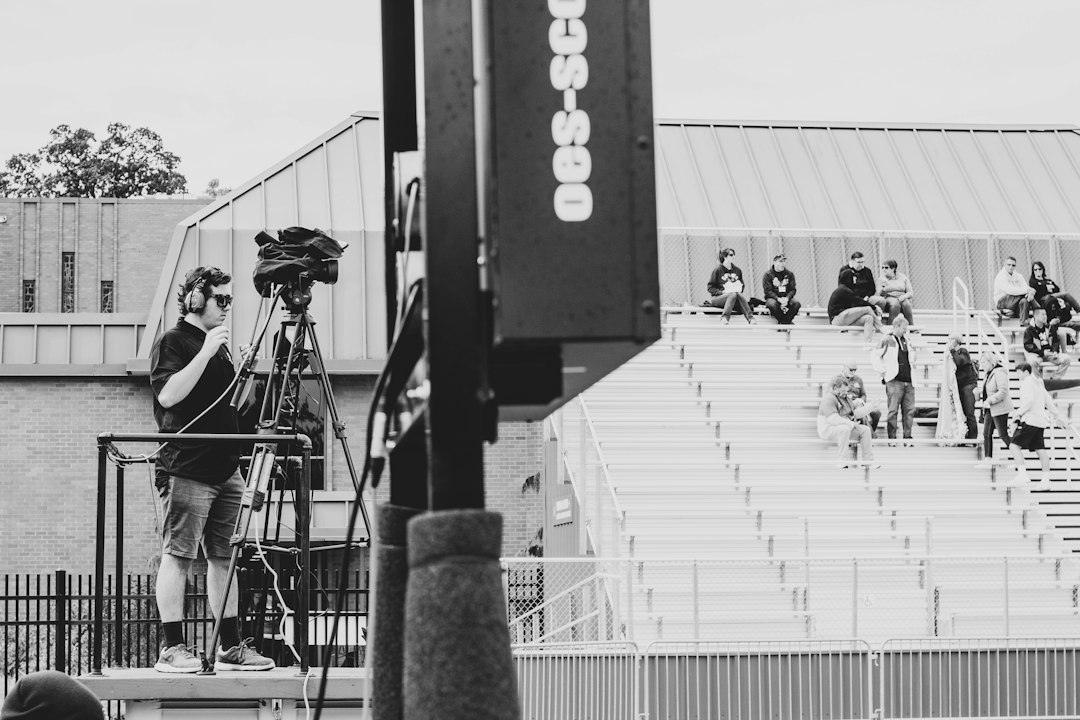




The sensory memories of high school football don't fade the way other memories do — they stay encoded in the body long after the final whistle, sharp enough that a single smell or sound can drop you back onto that field as if the years between then and now collapsed to nothing.
You know the moment. Third down, late fourth quarter. Your crowd — your town, the people who drove twenty minutes down a county road on a Friday night — rises together. Not a cheer yet. A held breath that somehow registers as physical pressure before it registers as sound. You feel it move through the turf, up through your cleats, before your ears have made sense of it. Your body knows what's coming before your mind catches up.
That moment is still in you. The specific weight of a helmet settling onto your head. The precise give of grass under a three-point stance. The exact pitch of a stadium going electric on a play that matters. These aren't stored the way you store a locker combination or a date from history class — filed somewhere retrievable but distant. They're written into the nervous system itself. This article is about those memories: what they are, why they endure, and why a single smell or sound can carry you back to a Friday night decades ago as if you never left.
The Sensory Memories of High School Football Start With Sound
Ask former players what they remember most about their years in the game, and the answers don't scatter the way you might expect. They cluster.
Not around scores. Not around specific plays, not even around the biggest wins.
Around sound.
The sound of a football crowd occupies a different register than crowd noise in any other sports setting, and the high school version has a character that larger, better-acousted venues never quite produce. It starts with proximity — the bleachers are close, the metal amplifies, the sound bounces off concrete and corrugated metal roofing in ways that surround a player rather than washing over them from a distance. Add to that the fact that these aren't strangers in the stands. You recognize individual voices. You know which side of the field your parents are sitting on without looking. You can pick your position coach's wife out of the general roar when she yells your number.


But the specific sound that former players recall with the most precision — the one they describe twenty, thirty, forty years later with a specificity that surprises even them — is the third-down crowd.
The offense breaks the huddle on third and eight. Or the defense sets its feet at the goal line with two minutes left. And the crowd, which has been a steady ambient pressure all night, suddenly changes texture. It sharpens. Focuses. Not louder in volume so much as more concentrated in intent — the way a room goes still right before something significant happens, except here it does the opposite: it rises, and in rising it narrows.
In our experience talking with former players across different decades and different levels of the game, this specific quality of sound is the single most commonly recalled detail from their playing days. Not the most spectacular play they were part of. Not the biggest game on the schedule. That particular frequency of crowd noise on a critical down. It did something measurable — it elevated heart rate, compressed attention, narrowed the perceptual field to the ball and the immediate assignment. And because the body was at peak arousal when that sound arrived, the memory was encoded at extraordinary depth.
This is what researchers call state-dependent memory — the finding that memories formed during high physiological arousal are retained with far greater vividness than memories formed at rest. Your nervous system was running at maximum capacity when the stadium rose on third down. Everything present in that moment — the sound, the smell, the feel of the field underfoot — got written into memory at a resolution that ordinary moments never reach.
Which is why you can close your eyes right now and hear it exactly.
The Smell of High School Football Exists Nowhere Else
Grass. Cold air. Sweat and rubber. The specific chemical sharpness of a freshly painted yard line mixing with the hot chocolate someone is drinking three rows up in the home bleachers.
The smell of high school football is its own compound — a combination that exists only on autumn Friday nights, in that specific cool that hasn't yet turned serious but is already reminding you that it will. You cannot seek it out deliberately. You can only encounter it when the conditions align, and when they do, there is no mistaking it or where it takes you.
The olfactory system has a direct anatomical pathway to the hippocampus — the brain's primary memory-forming structure — and to the amygdala, which assigns emotional weight to experience. This is not metaphor. Smell is the only sense that bypasses the thalamic relay station and connects immediately to memory and emotion. Every other sense takes a processing detour. Smell goes straight in.
This is why the smell of high school football functions as a time machine in a way that photographs never quite manage. A photograph shows you the image of a place. The smell of cut grass on a cool October evening puts you back inside the experience — in your body, inside that night, inhabiting it rather than observing it from outside.
Marcus D., 38, played defensive end at a small school in central Texas where the practice field had a clay-heavy soil that dried to a specific red dust every October. He keeps a small bag of dry playground sand on his desk — not the same thing, he readily admits, not even close — because the smell of dry earth is the nearest available approximation to the air of those evenings. "People think it's strange," he says. "But anyone who played knows immediately what I'm talking about. That smell is the whole thing. That smell is the game."
The precise composition of this olfactory memory varies by geography, surface type, and stadium construction. Natural grass fields carry a different signature than artificial turf, which has its own distinct mixture — rubber crumb, polyurethane, and a heated-plastic undercurrent on warm nights — that players who've played both surfaces describe as immediately and completely distinct. Neither is more evocative than the other. Both are exact. Players who transitioned between surface types during their high school careers frequently report that each calls up an entirely separate set of memories, almost like two different chapters lived inside the same sport.
The Feel of Football Turf and Grass Beneath Your Feet
The feel of football turf and grass is among the least-discussed sensory dimensions of the game. It may be the most physically intimate.
You are in contact with the surface on every play — not just when you go down, but with every stance, every cut, every first step off the line. Natural grass fields develop a specific character across the arc of a season that players who practiced on them six days a week understood in their bodies without ever consciously analyzing it:
- Early September: firmer underfoot, the grass still thick from summer, a surface that rewarded sharp lateral cuts
- October into November: the worn patches in front of the line developing a hardpan that changed your footing in ways you compensated for automatically, without thinking
Artificial turf — particularly the original-generation carpet-over-asphalt variety installed in many high school stadiums through the 1990s and early 2000s — left its own distinct marks. Turf burns on forearms and knees with a texture and duration specific to that surface. The way it radiated heat during September afternoon practices. The sound cleats made on it: harder, more percussive, carrying differently through cold air than grass ever did.
What the field gave you, play after play, was proprioceptive feedback — the body's ongoing sense of its own position in space and what the ground beneath it is doing. Players who competed on multiple surface types built a layered archive of somatic memory: the body's record of how to stand, accelerate, cut, fall, and recover on each specific surface under each specific condition.
That archive doesn't clear when you stop playing. When you walk across a natural grass field today — a park, a backyard, any open ground with that particular give underfoot — part of your nervous system registers it. Compares it. Knows where it has felt something close to this before.
The Sounds Nobody in the Stands Ever Heard
Everyone who watched from the bleachers remembers the crowd. Only the players remember the sounds that lived underneath the crowd sound — exclusive to being on the field rather than in the stands.
The sound of shoulder pads meeting shoulder pads is nothing like what television conveys. Broadcast audio processes contact noise until it becomes something cinematic and compressed. The actual sound of two lines colliding on a cold Friday night is sharper, drier, and harder than any broadcast captures — partly the equipment, partly the cold air tightening the acoustic environment around everything. Players who experienced the game in warm and cold climates both describe the collision sound differently by season, and they're right. Temperature changes the acoustic signature of contact in ways that are subtle but real.
There are four other sounds former players identify with particular consistency:
- The crowd on the far side of a tunnel, audible before you can see the field, growing in volume and pressure as you walk toward the opening until the noise surrounds you all at once
- Cleats on a concrete locker room floor — that specific staccato that only existed in the minutes immediately before you went out
- Turf tape being torn from the roll: sharp, slightly hollow, a ripping sound whose physical motion your hands can still approximate if you think about it right now
- Your own breath inside your helmet on a cold night, and the way the helmet changed the entire acoustic world — muffling everything at distance, amplifying everything close, so that the center's grunt and the quarterback's cadence lived in an enclosed echo that belonged only to the people inside it
These are the sounds that never appear in highlight footage. They are the sounds that players carry and fans never access. For many former players, they are the most precise and most powerful of all the sensory memories of playing sports — because they are not shared with anyone who was not on that field. They belong exclusively to the people who were there.
What These Memories Are Actually Retrieving
Here is what is worth sitting with: the sensory memories of high school football are not nostalgia in the ordinary sense of that word.
Nostalgia is a diffuse, general warmth — a soft longing toward a past that feels better in memory than it may have been in reality. What former football players describe is more specific and more physiological than that. It is the retrieval of a particular state. The body's memory of what it felt like to be maximally alert, maximally present, and maximally capable — simultaneously, with something on the line.
On Friday nights under those lights, you were not distracted. Not divided. Not thinking about anything other than what was immediately in front of you. The crowd, the smell, the feel of the field, the crack of pads — all of it conspired to produce a state of total present-moment awareness that most adult life systematically works against. The game demanded your complete attention, and your complete attention answered the demand.
When a smell or a sound retrieves that memory, what you're experiencing is not just the memory of a place or an event. You're experiencing the memory of that state. Of being that focused. Of the world narrowing to exactly the task in front of you and nothing beyond it.
That's what stops a former player mid-sentence when they drive past a lit field on a Friday night in October. That's what cut grass does on a cool afternoon. That's what the sound of a football crowd on a big play calls back from wherever it's been living.
It retrieves the version of you that was entirely, completely there — and knew it in your bones.
Your jersey is still out there waiting.
Design yours in minutes and see your name and number exactly the way you remember it.
Frequently Asked Questions
Why do sensory memories of high school football feel more vivid than other memories from the same years?
High school football creates the conditions that neuroscientists associate with deep memory encoding: high physiological arousal combined with strong personal meaning. When the nervous system is operating at peak capacity — during a critical play, in front of a loud crowd, in physical contact with other players — the brain encodes surrounding sensory details at much higher resolution than it does during low-arousal moments. The smell of the field, the sound of the crowd, the feel of turf and grass underfoot — all register as part of an emotionally significant event and are stored alongside it at unusual depth. A single sensory trigger decades later can retrieve the entire experience with a completeness that surprises even the person experiencing it, while memories from the same era that carried less physiological weight have faded considerably.
Is the smell of high school football universal, or is it personal to each player?
Both, in different ways. The category is consistent — cut grass, cold air, rubber, sweat, the particular compound of a game night — but the precise signature is specific to each player's experience. It depends on your field's surface type, your region's climate, your stadium's construction, and the particular combination of equipment and field products your program used. Two players from different states will both recognize the smell of football as a category, but each carries a version of it tied precisely to their own field and their own Friday nights. The olfactory memory is simultaneously universal in type and completely individual in its exact detail.
Do players who saw limited game time carry the same sensory memories as starters?
Yes — and this matters. These memories are not organized around playing time or statistical contribution. A player who dressed for games and rarely saw the field reports the same vividness around crowd sound, field smell, and equipment feel as a player who started every game across three seasons. The body was present in the environment — on the sideline, in the locker room, in the tunnel, in the pregame warmup. The nervous system encoded the experience regardless of the role the player filled within it. The sensory memories of playing sports at this level belong to everyone who was in that uniform, on that sideline, under those lights. The body doesn't sort by playing time.
See also: why high school sports still matter so deeply to adults | the science of why those game-day memories stay so vivid | still dreaming about those Friday nights under the lights | why you still dream about high school games